
Sweetening the Future of Medicine: How Sugar-Based Bioprinting is Revolutionizing Tissue Engineering and Cancer Research
The burgeoning field of bioprinting continues its remarkable trajectory of innovation, with engineers at the University of Illinois recently unveiling a groundbreaking sugar-based biomaterial that promises to profoundly impact medical engineering and cancer research. This pioneering development steers away from conventional bio-inks or hydrogels, instead introducing a novel approach centered on a soluble and biodegradable material, coupled with a sophisticated new printing method. This allows for the creation of exceptionally intricate and precise three-dimensional structures, paving the way for more dynamic and realistic biological models.
Bioprinting stands at the forefront of personalized medicine, offering the potential to create patient-specific tissues, organs, and cellular constructs perfectly adapted to individual needs. This promise is fueled by continuous advancements in biomaterials and printing technologies. While existing biomaterials come in various forms, the American engineering team embarked on a unique path by utilizing an isomalt-based material. Isomalt, a sugar alcohol commonly found in sugar substitutes and cough drops, was chosen for its distinct advantages. Crucially, it is both water-soluble and biodegradable, properties that are paramount for creating temporary, supportive tissue scaffolds essential for advanced cell culture and regenerative medicine applications. Unlike permanent support structures, a soluble and biodegradable scaffold can be introduced to foster cell growth and tissue development, and then safely dissolve away, leaving behind only the engineered tissue.
Professor Rohit Bhargava (left) and Matthew Gelber who developed the 3D printer (Photo credits: L. Brian Stauffer)
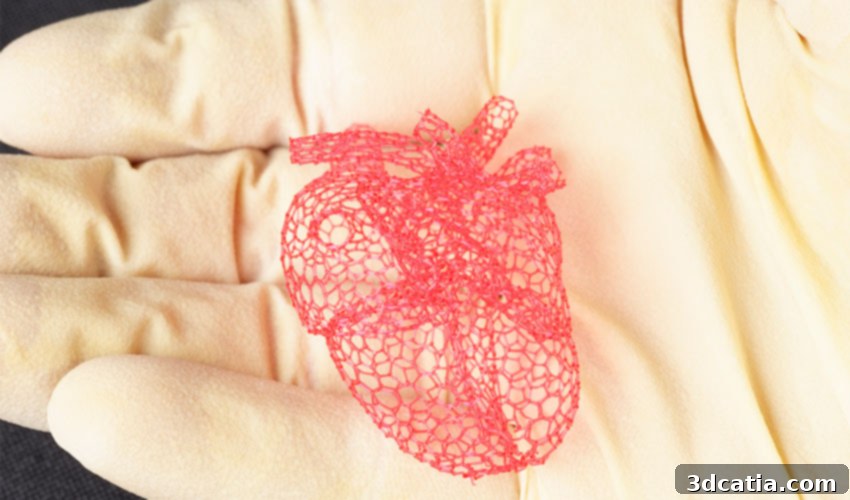
Accompanying this innovative biomaterial is an equally advanced, free-form 3D printer meticulously designed by the same team to print complex, three-dimensional architectures. This printer operates fundamentally differently from traditional additive manufacturing systems. Instead of depositing material layer-by-layer in a planar fashion, this specialized 3D printer extrudes fine ribbons and tubes of molten isomalt. These delicate structures then harden almost instantly upon contact with the air, much like the precise output of a high-performance 3D pen. This unique mechanism enables the creation of truly intricate, self-supporting structures in a free-form manner, allowing for unprecedented design freedom in scaffold creation. Rohit Bhargava, a distinguished professor of bioengineering and the director of the Cancer Center in Illinois, explains the profound implications of this method: “This is a great way to create shapes around which we can pattern soft materials or grow cells and tissue, then the scaffold dissolves away.”
The potential applications of this technology are vast and transformative, particularly in the realm of biological research and medical advancement. Professor Bhargava further elaborates, “For example, one possible application is to grow tissue or study tumors in the lab. Cell cultures are usually done on flat dishes. That gives us some characteristics of the cells, but it’s not a very dynamic way to look at how a system actually functions in the body. In the body, there are well-defined shapes, and shape and function are very closely related.” This highlights a critical limitation of traditional 2D cell cultures, which often fail to replicate the complex cellular environments found within living organisms. By providing a three-dimensional scaffold that mimics the natural extracellular matrix, researchers can cultivate cells and even model diseases like cancer in a more physiologically relevant setting. This allows for a deeper understanding of cellular interactions, drug responses, and disease progression, accelerating the development of new therapies and diagnostic tools. The ability to create dynamic, intricate 3D environments is a monumental leap forward from static petri dish cultures, offering a window into the nuanced interplay of shape and biological function.
A 3D printed rabbit printed using their developed technique
While 3D printing with sugar is not an entirely new concept within the additive manufacturing landscape, previous attempts have faced significant material science and engineering hurdles. The University of Illinois team, however, has successfully navigated and overcome many of these persistent challenges. Two of the most formidable obstacles inherent in sugar-based 3D printing are combustion and crystallization. Sugar, when heated, can easily burn or caramelize, altering its chemical structure and rendering it unsuitable for precise bioprinting applications. Furthermore, controlling the crystallization process – ensuring the sugar forms a stable, amorphous glass rather than brittle crystals – is crucial for maintaining structural integrity. To circumvent these issues, the engineers meticulously maintained a precise temperature and sufficient pressure throughout the printing process. This careful control prevented premature degradation and ensured the isomalt remained in an ideal state for extrusion. Beyond material stability, the team also had to identify the optimum nozzle diameter and the precise printing speed. These parameters were critical to guarantee that the material could be extruded evenly, maintaining a consistent flow, and subsequently harden into a stable, well-defined form upon exiting the nozzle. The synergy of these carefully calibrated factors is what distinguishes this new method, allowing for the reliable production of complex, functional structures.
The isomalt structures produced by this advanced bioprinting technique offer a multitude of significant advantages for the rapidly evolving field of bioengineering. One of the most compelling benefits, distinguishing it from conventional layer-by-layer 3D printing, is the unprecedented ability for users to accurately control the mechanical properties of each distinct part of the intricate structure. This level of granular control is immensely important because the stiffness, porosity, and overall mechanical cues of a scaffold directly influence cell behavior, differentiation, and tissue development. By precisely tailoring these properties, researchers can create environments that more closely mimic specific biological niches, optimizing conditions for various cell types or tissue regeneration. Currently, this innovative 3D printing technique is being strategically employed to produce sophisticated tissue supports for a wide array of microfluidic devices and advanced cell cultures. These applications are critical for everything from drug screening and toxicology studies to fundamental research into disease mechanisms and the development of regenerative therapies. The biodegradability of isomalt ensures that once the cells have formed their own extracellular matrix and matured into functional tissue, the temporary sugar scaffold simply dissolves away, leaving behind only the engineered biological construct.
Looking ahead, this pioneering work from the University of Illinois holds immense promise for advancing personalized medicine, regenerative therapies, and fundamental biological research. By providing a robust, repeatable, and versatile method for creating intricate 3D environments from a common, biocompatible material like sugar, the engineers have opened new avenues for studying complex biological processes in a manner that closely resembles the human body. This breakthrough could accelerate drug discovery by enabling more accurate in vitro testing, improve the understanding of diseases like cancer by modeling tumor microenvironments with unprecedented fidelity, and ultimately contribute to the development of new strategies for repairing or replacing damaged tissues and organs. The journey from flat petri dishes to dynamic, dissolvable 3D biological scaffolds represents a significant stride towards a future where medical solutions are tailored, precise, and profoundly effective.
Find more information on the University’s website or in the video below:
What do you think about this bio-based sugar material and its implications for the future of medicine? We invite you to share your thoughts in a comment below or engage with us on our Facebook and Twitter pages! For the very latest news, innovations, and insights in the world of 3D printing, don’t forget to sign up for our free weekly Newsletter, delivered straight to your inbox!