
The State of 3D Printing 2019: Unveiling Industrial Adoption and Future Trends in Additive Manufacturing
Sculpteo, a leading provider of 3D printing services, has recently unveiled the fifth comprehensive edition of its highly anticipated study, ‘The State of 3D Printing 2019’. This pivotal report offers an in-depth, global perspective on the evolving landscape of the additive manufacturing industry. This year’s survey saw an unprecedented level of participation, with over 1,300 respondents contributing their insights, marking it as the largest survey conducted in the study’s five-year history. Participants hailed from diverse backgrounds, countries, and industrial sectors, ensuring a truly global and comprehensive overview of the industry’s current status and future trajectory. A standout finding from the report underscores the increasing integration of 3D printing technologies within companies, solidifying its role as a legitimate and increasingly vital means of production.
The transformation in how companies perceive and utilize 3D printing is strikingly evident in the data. Back in 2015, a mere 17% of survey participants reported using the technology for final production applications. Fast forward to 2019, and this statistic has soared to an impressive 51%. This dramatic shift clearly indicates that 3D printing is no longer relegated solely to its traditional role as a prototyping technology. Instead, it is now widely recognized and adopted for manufacturing end-use parts and components, signaling a significant maturation of the industry. Furthermore, the report highlights the tangible benefits experienced by companies embracing additive manufacturing, with a remarkable 80% of participants acknowledging that 3D printing has substantially improved their speed of innovation, enabling quicker product development cycles and faster market entry.
The ‘State of 3D Printing 2019’ study meticulously analyzed responses from its 1,300 participants, revealing an interesting geographical distribution. The majority of respondents were located in Europe, accounting for 64% of the total, followed by Asia with 20.2%, and the United States contributing 16.6%. This broad geographical representation ensures that the findings reflect global trends rather than being skewed by regional specificities. The study also encompassed insights from eight key industrial sectors, including but not limited to aeronautics, the agri-food industry, health, education, and advanced technologies. This multi-sectoral approach provides a holistic view of how additive manufacturing is being adopted across different industries. An encouraging trend highlighted in the 2019 study, aligning with previous observations, is the continuous increase in the proportion of women actively involved in the 3D printing market. This positive development was also identified in 3Dnatives’ dedicated study on the 3D printing job market, suggesting a growing diversity within the industry.
Looking ahead, the report identifies several promising trends poised to shape the future of 3D printing. These include advancements in mass production capabilities, significant improvements in printing speed, enhanced affordability of both machines and materials, sophisticated software solutions, the crucial role of education and training, the emergence of generative design for optimized parts, breakthroughs in bioprinting for medical applications, and a growing focus on sustainability in manufacturing processes. These trends collectively point towards a future where 3D printing becomes even more integrated, efficient, and impactful across various facets of industry and research.
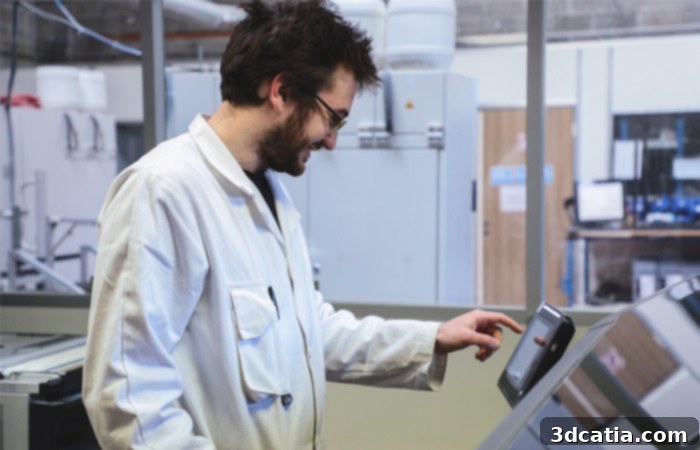
One of Sculpteo’s 3D printing factories | Photo credits: Sculpteo
Evolving Applications: How Additive Manufacturing is Being Utilized Across Industries
How is additive manufacturing being used?
Consistent with findings from previous surveys, such as the one we covered in March from Essentium, the broader industry has shown a measured pace in fully adopting 3D printing for large-scale mass production. The primary limiting factor continues to be scalability, though significant progress is being made. While 3D printing was almost exclusively synonymous with rapid prototyping just a few short years ago, its current focus has unmistakably shifted towards final part production. Sculpteo’s report confirms that while 3D printing remains highly valued for product development – particularly for creating limited series runs and customized parts – and indeed for rapid prototyping, the reliance on prototyping is trending downwards as final production capabilities mature. This evolution is entirely understandable and expected, given the rapid advancements in both additive manufacturing technologies and the diverse range of compatible materials that have emerged in recent years. New materials offer enhanced properties, while improved machine capabilities allow for greater precision, speed, and reliability, thereby expanding the potential applications beyond mere concept validation.
Clément Moreau, CEO and co-founder of Sculpteo, articulated the profound impact of these changes, stating, “Our fifth study shows that 3D printing and digital manufacturing continue to radically change the industrial manufacturing landscape. While the technological advantages of companies lead to increased spending, the figures speak for themselves: 51% say they use additive manufacturing at an industrial level. It seems that industrials have already noted that these new technologies offer a major asset to improve their entire production process and strengthen their commercial strategies.” Moreau’s comments underscore the growing confidence among industrial players in additive manufacturing as a strategic tool for enhancing operational efficiency, fostering innovation, and gaining a competitive edge. The shift to industrial-level application reflects a clear understanding that 3D printing is not just a technology for niche applications but a transformative force capable of redefining entire production workflows and business models.
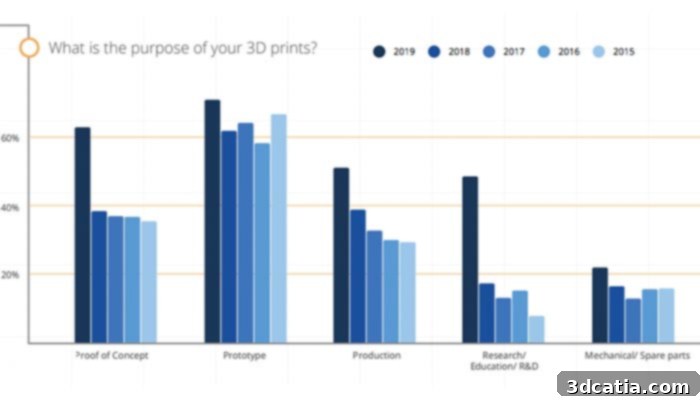
Source: ‘The State of 3D Printing 2019’ from Sculpteo
When examining the dynamics of in-house production versus external service adoption, the study presents an interesting dichotomy. Apart from Fused Deposition Modeling (FDM), which is often favored for in-house use due to its relative simplicity and lower entry cost, most other advanced 3D printing technologies are predominantly accessed through external service providers. This includes sophisticated processes like Selective Laser Sintering (SLS), PolyJet, and HP Jet Fusion. This trend is particularly pronounced in the realm of metals. Metal additive manufacturing has experienced significant growth in recent years, driven by its ability to create complex, high-performance parts. According to the study, a substantial 50% of metal 3D printing projects are fulfilled by external services. This preference for external services often stems from the high capital investment required for these advanced machines, the need for specialized expertise to operate them, and the complex post-processing often involved. By leveraging external providers, companies can access cutting-edge technology without incurring the prohibitive costs and operational complexities of owning and maintaining the equipment themselves. Another intriguing statistic from the report reveals that over 70% of users choose to leave their 3D printed parts unfinished, opting out of any post-processing methods whatsoever. This could indicate that for many applications, the functional requirements do not necessitate extensive surface finishing or that the initial print quality is deemed sufficient for their intended use, potentially saving time and cost.
Surging Investments and Critical Challenges in the 3D Printing Market
Companies are investing in 3D printing technologies
A significant highlight of the study published by Sculpteo is the dramatic surge in investments within the 3D printing sector, with spending doubling in 2019. This demonstrates a burgeoning confidence in the technology’s potential. A notable 25.6% of participants in the study reported investing over $100,000 in 3D printing solutions, a stark contrast to only 12% in the preceding year. The vast majority of these investors indicated their intention to continue increasing their expenditure in this dynamic market. Their conviction is rooted in the tangible benefits offered by the technology, such as its unparalleled ability to produce highly complex geometries that are often impossible to achieve with traditional manufacturing methods. These substantial investments are a clear reflection of the growing maturity of 3D printing as a reliable and effective manufacturing methodology. Companies are no longer experimenting with 3D printing; they are strategically integrating it into their core operations. In terms of primary applications driving these investments, the acceleration of product development emerged as the top focus for businesses, according to the surveyed participants. This emphasis underscores the role of 3D printing in streamlining innovation cycles, reducing time-to-market, and staying competitive in fast-paced industries.
Despite the widespread enthusiasm and increasing investment, the report also identifies critical challenges that need to be addressed for the continued growth and broader democratization of 3D printing. Most professionals surveyed underscored the paramount importance of education and training as two key pillars for further developing and expanding the adoption of additive manufacturing. For a notable 14% of respondents, the sheer lack of adequate training and skilled personnel presents a significant obstacle to effectively integrating 3D technology into their professional environments. This highlights a clear skills gap that must be bridged through targeted educational programs and vocational training initiatives. However, the single largest barrier identified by participants remains budgetary constraints. Nearly 60% of respondents cited a lack of sufficient budget as a primary impediment to expanding their current use of 3D printing. This financial hurdle often limits access to advanced equipment, high-performance materials, and comprehensive training, thereby slowing the pace of adoption, especially for smaller and medium-sized enterprises. Overcoming these challenges will require concerted efforts from industry stakeholders, educational institutions, and policymakers to ensure that the benefits of 3D printing are accessible to a wider audience and its full potential can be realized.
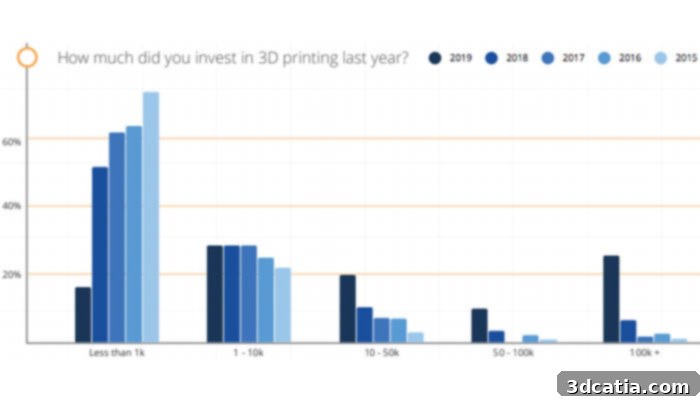
Source: The State of 3D Printing 2019 from Sculpteo
The ‘State of 3D Printing 2019’ report from Sculpteo paints a vivid picture of an industry undergoing a profound transformation. From its origins as a prototyping tool, 3D printing has decisively moved into the realm of industrial production, driven by increasing investment, technological advancements, and a growing recognition of its strategic value. While challenges related to budget and education persist, the overall trajectory of additive manufacturing is one of robust growth and expanding application. The report serves as an invaluable resource for anyone seeking to understand the current pulse of the 3D printing market and anticipate its future directions.
You can download the full report HERE.
What do you think of the findings of The State of 3D Printing 2019 and how the market seems to be progressing? Let us know in a comment below or on our Facebook and Twitter page! Don’t forget to sign up for our free weekly Newsletter, with all the latest news in 3D printing delivered straight to your inbox!