
Meltio’s Vision: Revolutionizing Aerospace and Space Exploration with Advanced Metal 3D Printing
Almost a year ago, a significant new player emerged in the dynamic field of metal additive manufacturing. Meltio, an innovative company strategically located between Las Vegas and Spain, has successfully enhanced the offerings within the metal AM market. This sector has experienced remarkable expansion, demonstrating nearly 80% growth according to the influential Wohlers’ 2018 report, underscoring the increasing demand and technological advancements in the industry. To gain deeper insights into Meltio’s ambitious projects and their impact, particularly within the demanding aerospace sector, we had the privilege of speaking with Brian Mathews, the company’s Chief Technology and Innovation Officer. Our discussion focused on the critical role of metal additive manufacturing in aerospace and explored the profound implications of introducing a metal 3D printer into the unique environment of space. We delved into how such a capability could fundamentally transform current missions aboard the International Space Station (ISS) and beyond, paving the way for unprecedented on-demand manufacturing in orbit.
As the company celebrates the one-year anniversary of its groundbreaking 3E Metal Deposition technology, Meltio is set to participate in the prestigious virtual event, ADDITIV digital World. This event offers a prime platform for industry leaders to converge and discuss future trends. Meltio will contribute to an aerospace-focused panel, sharing insights alongside two other giants in the industry: NASA, the pioneering space agency, and Virgin Orbit, a leader in satellite launch services. This participation highlights Meltio’s growing influence and its commitment to shaping the future of manufacturing in highly critical and advanced sectors.
3DN: Can you introduce yourself and tell us about your first experience with 3D printing?
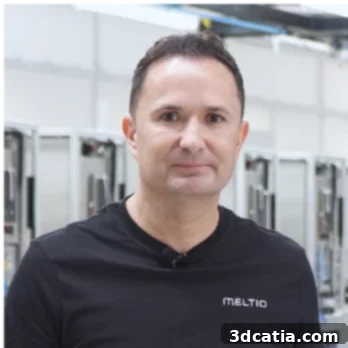
Brian Matthews, Chief Technology and Innovation Officer at Meltio
I hold a postgraduate degree in nuclear physics, which provided me with a strong foundation in complex systems and rigorous analysis. My career spans over 23 years, dedicated primarily to the design and analysis of advanced nuclear energy systems. This experience also extended to advanced manufacturing techniques across a broad spectrum of industries and applications, exposing me to diverse engineering challenges. My journey into entrepreneurship began in 2012 when I founded a nuclear consulting company. Driven by the potential I saw in advanced manufacturing, I subsequently established a vertically integrated metal additive manufacturing company in 2015. Recognizing an even greater opportunity for global impact, I co-founded Meltio in 2019. Since then, I have proudly served as the Chief Technology and Innovation Officer for Meltio, overseeing the critical areas of Research & Development, special projects, and technology incubation activities that drive our innovation. My work has resulted in several patents, particularly in the realm of multi-laser AM, and I have led numerous pioneering projects as Principal Investigator, specifically those focused on the application of additive manufacturing in micro-gravity environments, pushing the boundaries of what’s possible in space manufacturing.
3DN: How did you develop Meltio’s technology?
After two decades deeply immersed in the intricate design and rigorous analysis of advanced nuclear energy systems, a crucial realization dawned upon me. I recognized that without the advent of advanced, rapid, and cost-effective manufacturing methods, many highly complex engineering projects would remain conceptual or face insurmountable obstacles. The inherent manufacturing complexity and exorbitant cost considerations associated with traditional methods were significant barriers to innovation and realization. This pivotal insight set the stage for a rapid acceleration of my interest in advanced additive manufacturing. Following a comprehensive, year-long review of the state of manufacturing technology conducted throughout 2014 and 2015, it became abundantly clear that there was both a significant need and a unique opportunity to develop truly advanced and scalable metal additive manufacturing technology. I initially focused the application of metal AM on nuclear energy systems, understanding that this demanding sector would require the highest standards of precision, material integrity, and reliability. My reasoning was strategic: if the technological tools developed could meet the stringent requirements of the nuclear industry, they would likely be rapidly applicable to a multitude of other industries. These industries often have fewer regulatory constraints and manufacturing challenges compared to nuclear, thereby allowing for broader adoption and faster market penetration of our innovative solutions.
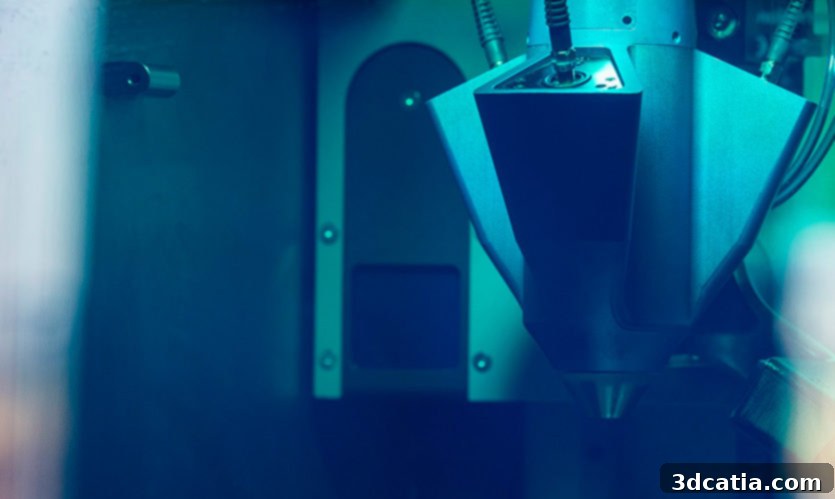
The key to Meltio’s technology lies in its multi-laser head, enabling advanced metal deposition | Photo Credits: Meltio
3DN: Why did you decide to tackle the aerospace industry?
Our decision to delve into the aerospace industry was a natural progression, stemming from the striking similarities it shares with the nuclear sector, where my foundational experience lies. Both industries are characterized by highly stringent regulatory environments, necessitating adherence to rigorous codes and standards, and demanding uncompromising quality. Furthermore, they exhibit analogous requirements concerning specialized materials, intricate geometries, and precise part dimensions. This alignment made the aerospace industry an ideal and logical application fit for Meltio’s advanced metal additive manufacturing technology. The expertise we developed in meeting the exacting demands of nuclear applications translated seamlessly into addressing the unique challenges of aerospace manufacturing.
Currently, Meltio is actively engaged in several pioneering aerospace projects. One notable initiative, supported by an SBIR (Small Business Innovation Research) grant, involved the successful development and demonstration of a laser-wire AM capability. This innovative technology is designed to enable the reliable joining of metal structures and the precise repair of metal surfaces directly in space, offering critical maintenance and construction capabilities for future missions. Additionally, Meltio has recently embarked on a groundbreaking project aimed at demonstrating its novel metal additive manufacturing capability within a microgravity environment. This ambitious undertaking seeks to validate the technology’s effectiveness for both space-based and Earth-based applications, promising revolutionary advancements in how components are manufactured and maintained in extreme conditions, ultimately enhancing the sustainability and versatility of space exploration.
3DN: What is the importance of adopting metal AM in a field like aerospace?
The aerospace industry stands as one of the most demanding sectors globally, with exacting requirements for materials, material properties, and build capabilities. These often include the need for parts composed of multiple materials and featuring incredibly complex geometries that traditional manufacturing struggles to produce efficiently or even at all. Recognizing these unique challenges, Meltio’s additive manufacturing technology was meticulously developed with these critical considerations at its core. The availability of scalable, multi-material AM technology offers profound advantages for aerospace manufacturers. Firstly, it can dramatically reduce the lead time for producing highly complex parts, accelerating development cycles and deployment. Secondly, it enables significant improvements in aerospace component design and performance. Engineers can now design lighter parts, incorporating intricate internal lattice structures and optimized topologies that were previously impossible, leading to enhanced fuel efficiency and operational capabilities. Furthermore, the ability to utilize higher-performing materials, often tailored specifically for extreme aerospace environments, contributes to greater durability and resilience. Finally, by streamlining the manufacturing process, reducing material waste, and simplifying complex assemblies, metal AM can substantially reduce overall production costs, making advanced aerospace technologies more accessible and sustainable.
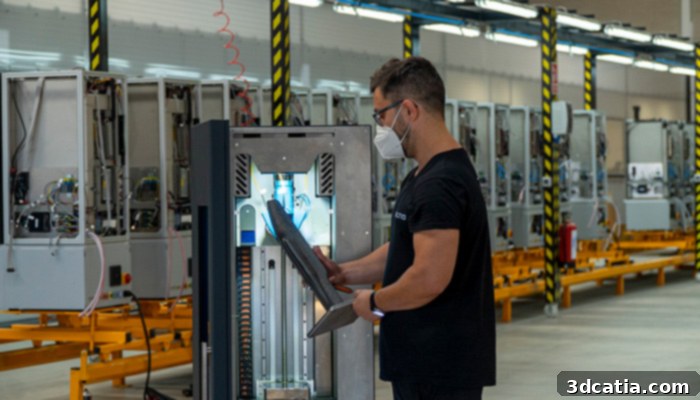
Metal 3D printing in the aerospace sector enables improved design and performance of components and parts through complex geometries and lighter structures | Credits: Meltio
3DN: What are Meltio’s future plans in the space industry?
Additive manufacturing in microgravity environments holds immense promise, representing a paradigm shift for future space applications. In space, where every kilogram launched incurs significant cost and risk, minimizing material usage in the creation of parts and tools directly correlates with reducing these crucial factors. Beyond this logistical advantage, the microgravity environment itself, by largely removing gravity-driven physical processes such as convection and sedimentation, presents a unique opportunity. This allows for the potential to produce metal alloy parts, components, and tools with truly superior material properties that are simply unobtainable through conventional terrestrial manufacturing methods. Imagine materials with enhanced strength-to-weight ratios or improved fatigue resistance, critical for long-duration space missions.
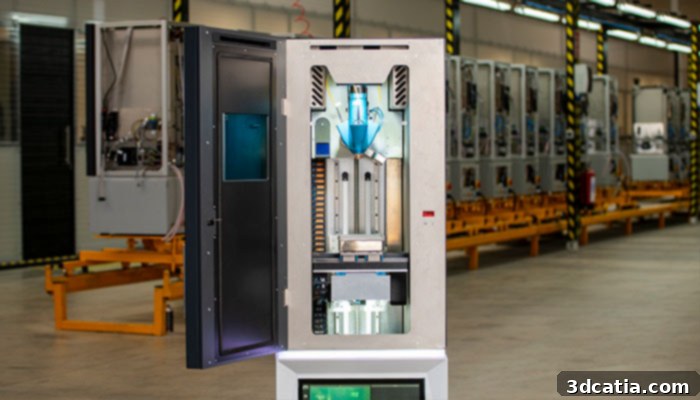
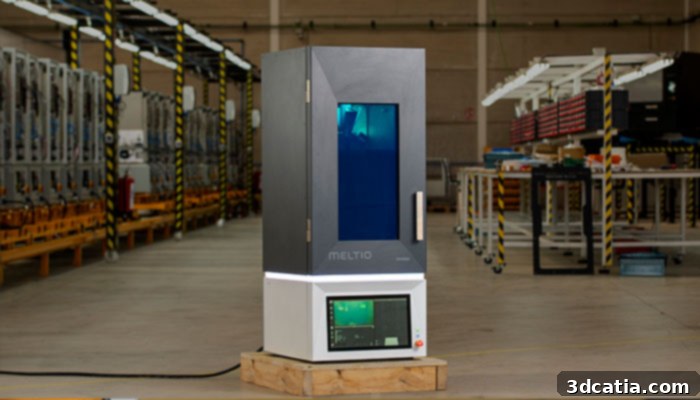
Meltio’s cutting-edge solution for microgravity research and practical application is the Meltio 0GM Printer. This revolutionary system is a custom Express Rack mounted Direct Metal Deposition (DMD) printer specifically engineered for space applications. Its primary objective is to enable rapid, on-demand printing of critical metal parts within the notoriously resource-constrained environment of the International Space Station (ISS). This capability will transform the ISS from a logistics-dependent outpost to a more self-sufficient orbital laboratory and workshop, capable of manufacturing spare parts, tools, and even custom components as needed, without waiting for costly resupply missions. Direct Metal Deposition (DMD), often referred to as Direct Energy Deposition (DED), is renowned as one of the most versatile additive manufacturing technologies available. The process fundamentally involves depositing metal wire onto a substrate, which is then instantly melted and fused using a concentrated energy source, typically a high-power laser. This method offers excellent control over material properties, allows for repairs of existing components, and is highly adaptable to various metal alloys, making it ideal for the diverse and challenging requirements of space manufacturing.
In addition to developing and deploying orbital AM solutions, Meltio is also actively supporting comprehensive application studies for several key customers within the broader aerospace sector. These clients are keenly interested in leveraging the rapid production capabilities, high-quality output, and significant cost-benefit advantages offered by Meltio’s unique multi-metal additive manufacturing technology for their terrestrial and near-space projects. This dual focus on both orbital and Earth-based applications underscores Meltio’s commitment to advancing additive manufacturing across the entire aerospace ecosystem.
The Meltio 0GM printer will allow on-demand metal 3D printing on the International Space Station, enhancing mission flexibility and sustainability | Photo Credits: Meltio
3DN: Do you have any last words for our readers?
Indeed, there are several interesting and innovative additive manufacturing solutions emerging in the market, and recent trends firmly suggest that metal AM will continue to grow in importance, becoming an increasingly indispensable process for the aerospace industry and many others. However, Meltio distinguishes itself significantly. Our approach is founded on the development of tightly integrated technologies, achieved through the adoption of a fully vertically integrated manufacturing model. This means that all major components of our advanced systems are not only designed but also built entirely in-house. This comprehensive control over our production chain provides us with unparalleled design freedom, allowing for the deep and precise integration of sub-systems. The result is not merely incremental improvement, but rather “step-change” advancements in capabilities, overall performance, and cost-efficiency that set our technology apart from competitors.
Furthermore, Meltio holds a unique position as the only commercially available solution capable of manufacturing parts using multiple materials, accommodating both wire and powder feedstock. Critically, this can be done either independently or simultaneously, and without requiring any hardware changes or complex reconfigurations. This unparalleled versatility in feedstock utilization provides unprecedented capabilities for engineers and designers. It opens up new avenues for optimizing material properties, creating gradient materials, and developing complex, multi-functional aerospace components that can exhibit superior performance characteristics compared to those produced by single-material or less flexible AM systems. This novel technology empowers our customers to push the boundaries of design and engineering, leading to improved strength, reduced weight, enhanced thermal management, and overall higher performance for critical aerospace applications.
You can find more detailed information about Meltio and our groundbreaking projects in metal additive manufacturing by visiting our official website HERE.
What are your thoughts on Meltio’s innovative technology and ambitious projects, especially within the context of aerospace and space exploration? We encourage you to let us know in a comment below or join the conversation on our Facebook and Twitter pages! And to stay fully informed about the latest advancements, research breakthroughs, and inspiring entrepreneurs in the world of 3D printing, remember to sign up for our free weekly Newsletter, delivered straight to your inbox.