
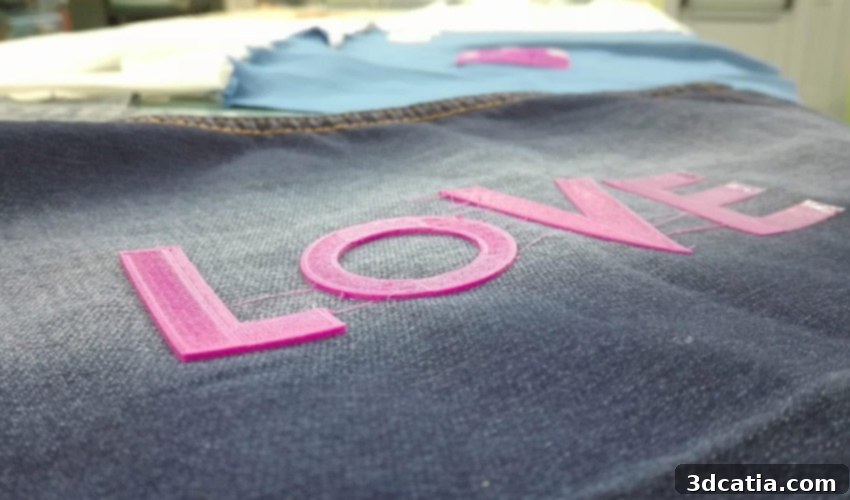
Eurecat Unveils Blackbelt: Revolutionizing Textile Customization with Continuous 3D Printing
The Catalan technology centre, Eurecat, has recently presented a groundbreaking innovation set to transform the textile industry: an advanced application of continuous 3D printing specifically designed for fabric personalization. By ingeniously adapting the Blackbelt machine, Eurecat has achieved the unprecedented ability to 3D print intricate patterns and designs directly onto fabrics, seemingly without end. This pioneering 3D printer operates on the principle of a conveyor belt, a significant departure from conventional fixed-tray systems, enabling truly uninterrupted printing. This development is poised to profoundly impact the textile manufacturing landscape, offering unparalleled customization possibilities even on exceptionally long fabrics, while simultaneously facilitating a much higher degree of process automation.
Additive manufacturing, commonly known as 3D printing, continues to permeate and redefine numerous sectors, spanning from heavy industrial applications to highly specialized consumer markets. Its influence on traditional manufacturing methods is undeniable and ever-expanding. While the direct 3D printing of entire textiles is still an emerging field, the broader fashion industry is rapidly embracing and evolving with the advancements in 3D technologies. These innovations are opening doors to producing highly personalized products, a crucial differentiator for today’s consumers who increasingly seek uniqueness and individuality. Furthermore, 3D printing enables the creation of more complex geometries and, in cases like footwear, can lead to designs that are not only aesthetically striking but also significantly more comfortable and ergonomically optimized. Eurecat’s latest endeavor specifically targets the textile sector, presenting an elegant and efficient method to personalize virtually any fabric with remarkable ease and precision.
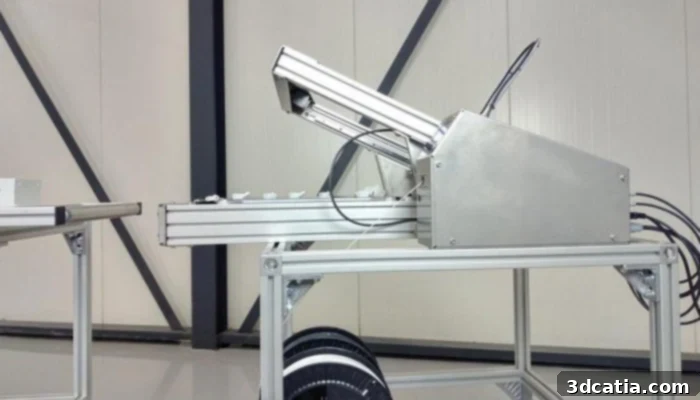
The Blackbelt 3D printer is based on the use of a conveyor belt, enabling continuous, infinite-length printing.
The Blackbelt Advantage: Infinite Length and Uninterrupted Production
The core innovation behind Eurecat’s textile personalization system lies in the adaptation of the Blackbelt 3D printer. Unlike conventional 3D printers that operate on a fixed build plate, limiting the size of individual prints, the Blackbelt incorporates a continuous conveyor belt. This fundamental design difference allows for an uninterrupted printing process, theoretically enabling patterns to be printed for an “infinite length.” This capability is a game-changer for the textile industry, where materials are often produced and processed in long rolls. The ability to print continuously eliminates the need for manual intervention between print jobs or the re-alignment of fabric rolls, leading to a significant boost in efficiency and throughput. This addresses a major bottleneck in traditional textile decoration and also opens up new possibilities for mass customization at an industrial scale.
While Eurecat maintains a certain level of discretion regarding the proprietary intricacies of the process, given that it is currently patent pending, the company has confidently asserted its ability to customize any type of fabric. This includes variations in color, texture, and, crucially, length. The technical prowess required to achieve this is considerable, particularly regarding the adhesion of extruded plastic materials to diverse fabric substrates. How do the successive layers of molten material securely bond with the textile fibers without compromising the fabric’s integrity or flexibility? This critical challenge, often a hurdle in integrating additive manufacturing with flexible materials, appears to have been successfully addressed by the Spanish company, even as specific technical details remain under wraps. Xavier Plantà, Director of Industrial Technologies at Eurecat, highlights the significance of this breakthrough, stating, “This innovative application means that the Blackbelt 3D textile printer is the first in the world to be capable of printing in “infinite length” formats. In turn, this enables 3D printing to move into the world of mass-produced textiles; or in other words, the world of continuous manufacturing.” This statement underscores the paradigm shift Eurecat envisions, bridging the gap between bespoke 3D printing and high-volume textile production.
Unlocking Unprecedented Textile Personalization
The implications of this continuous 3D printing technology for textile personalization are vast and exciting. Designers and manufacturers will no longer be limited by the constraints of traditional printing methods, which often involve screens, dyes, or sublimation processes that can be time-consuming, costly for short runs, and less adaptable to complex three-dimensional forms. With the Blackbelt, it becomes possible to create intricate patterns, textured surfaces, and even subtle reliefs directly onto fabrics. Imagine garments with tactile elements, home furnishings with unique sculptural details, or functional textiles featuring integrated raised components. This level of design freedom was previously challenging, if not impossible, to achieve with conventional techniques. The ability to directly apply these designs in a continuous flow means that entire rolls of fabric can be processed, ready for subsequent cutting and assembly into finished products. This not only enhances aesthetic possibilities but also streamlines the entire production chain.
The potential extends beyond purely decorative aspects. This technology could enable the integration of functional elements directly into textiles, such as conductive traces for smart fabrics, protective layers for industrial applications, or structural reinforcements for sportswear. The adaptability to any color or texture of fabric suggests a versatility that can cater to a wide array of fashion trends and technical specifications. Furthermore, by automating the personalization process, brands can significantly reduce lead times for custom orders, allowing them to respond more swiftly to market demands and consumer preferences. This shift towards more agile and responsive manufacturing aligns perfectly with the current trends of fast fashion and the growing demand for personalized goods, allowing for localized, on-demand production that minimizes waste and maximizes relevance.
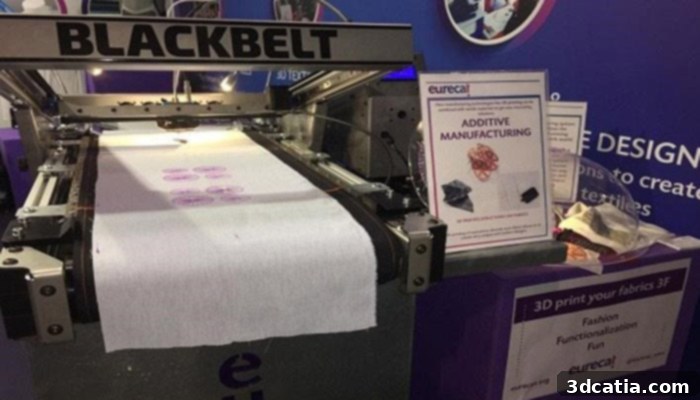
Photo Credits: Eurecat, showcasing their continuous 3D printing on textiles.
Transforming the Textile Manufacturing Landscape
The introduction of the Blackbelt’s continuous 3D printing capability is set to significantly accelerate the marketing and production cycles of various garments and textile products. By enabling highly aesthetic and personalized designs directly on the fabric rolls, manufacturers can achieve greater differentiation in a competitive market. The precision and repeatability inherent in 3D printing technology also mean that quality control can be more consistently maintained across large volumes, leading to fewer defects and a higher standard of finished products. This method offers a compelling alternative to current multi-stage processes that often involve separate design, patterning, printing, and cutting steps, thereby consolidating and simplifying the entire workflow. The automation potential inherent in continuous printing promises not only speed but also a reduction in labor costs associated with manual handling and setup, further enhancing manufacturing efficiency.
Virginia Garcia, Director of Eurecat’s Functional Fabrics Department, elaborates on the practical advantages, stating, “This innovative development makes it possible to create three-dimensional designs and reliefs and print them onto rolls of fabric that will subsequently be used to make garments. It is a pioneering development that contributes to the optimisation of the entire production process.” Her comments emphasize the holistic impact of this technology, not just on the design possibilities but on the overarching efficiency of textile production. The ability to apply three-dimensional textures and reliefs directly at the fabric level introduces an entirely new dimension to textile design, enabling tactile experiences and visual depths previously unattainable through conventional flat printing methods. This positions Eurecat at the forefront of combining advanced manufacturing with traditional industries, driving innovation where it’s most needed.
Beyond Aesthetics: Efficiency and Sustainability
Beyond the immediate aesthetic and customization benefits, Eurecat’s Blackbelt technology holds substantial promise for improving the sustainability and efficiency of the textile industry. Traditional textile printing often involves significant water usage, chemical dyes, and considerable material waste due to overproduction or faulty batches. By shifting towards an on-demand, additive manufacturing approach, brands can produce exactly what is needed, when it is needed, drastically minimizing excess inventory and textile waste. The precise deposition of material in 3D printing also allows for optimized material usage, reducing overall consumption. Furthermore, the potential to use a wider range of printable materials, including bio-based or recycled polymers, could open avenues for more environmentally friendly textile products. This agility allows for rapid prototyping and iteration, accelerating design cycles and reducing the resources spent on developing new products, making the entire textile value chain more responsive and environmentally conscious.
Future Implications and Market Potential
While information regarding the official commercial launch of such a machine remains undisclosed, the implications of Eurecat’s Blackbelt are far-reaching. This technology could empower smaller design studios and fashion brands to compete with larger players by offering highly customized, limited-edition collections without massive upfront investments in traditional printing infrastructure. It could also lead to entirely new product categories, where textiles are not just surfaces but integral components of smart, functional, and highly personalized items. The convergence of additive manufacturing and textile production is an area ripe for innovation, and Eurecat’s contribution is a significant step forward. As the demand for bespoke products continues to grow, and as manufacturing processes seek greater efficiency and sustainability, solutions like the Blackbelt will become increasingly vital. This innovation reinforces the idea that the future of fashion and textiles is intricately linked with advanced digital fabrication technologies.
We eagerly await further details on the official launch and broader availability of this transformative technology. In the meantime, those interested in delving deeper into Eurecat’s announcement can consult their official press release HERE for more information. This development truly showcases the boundless potential of 3D printing to redefine long-established industries and foster a new era of customization and efficiency.
What are your thoughts on this groundbreaking new technology from Eurecat? Do you envision its widespread potential in various segments of the textile and fashion industries? If you have additional insights or perspectives that we might have overlooked, we encourage you to share them in the comment section below. You can also join the conversation and connect with us on our Facebook and Twitter pages! Don’t forget to sign up for our free weekly Newsletter to receive all the latest news and updates in the world of 3D printing directly in your inbox!