
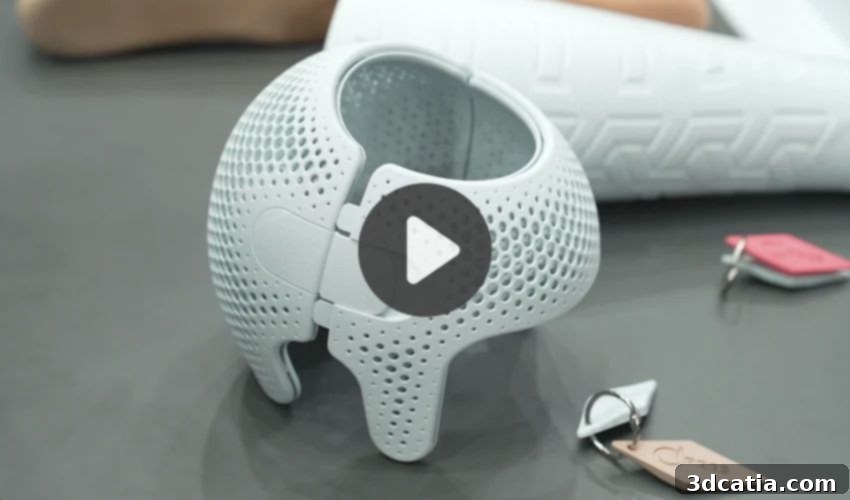
HP’s Groundbreaking Additive Manufacturing Solutions at Formnext 2022: Introducing Metal Jet S100 and Jet Fusion 5420W
At Formnext 2022, the world’s leading exhibition for additive manufacturing and industrial 3D printing, HP, a global pioneer known for its extensive contributions to computing and printing, once again captivated the industry with significant advancements. For several years now, HP has been a transformative force in the additive manufacturing sector, primarily through its innovative HP Multi Jet Fusion (MJF) technology. This proprietary technology has been instrumental in shifting the paradigm of 3D printing from mere prototyping and custom part creation to enabling true mass production, thereby elevating manufacturing capabilities to unprecedented levels.
The Power and Evolution of HP Multi Jet Fusion Technology
HP’s journey into additive manufacturing began with a clear vision: to revolutionize how the world designs and produces. The introduction of Multi Jet Fusion technology marked a pivotal moment. Unlike traditional 3D printing methods, MJF employs an innovative process that involves the selective application of fusing and detailing agents across a bed of powdered material, followed by a pass of thermal energy. This precise, layer-by-layer fusion process allows for the rapid production of functional parts with exceptional mechanical properties and intricate geometries.
The core strength of MJF lies in its unparalleled speed, cost-efficiency, and versatility. By fusing entire layers simultaneously, MJF systems can produce parts significantly faster than many other polymer additive manufacturing technologies. This speed, combined with optimized material consumption and a high packing density within the build chamber, translates into a lower cost per part, making high-volume production economically viable. Furthermore, MJF technology excels in producing parts with isotropic mechanical properties, meaning they exhibit consistent strength in all directions, a crucial factor for functional end-use components. The technology supports a growing array of materials, including PA 11, PA 12, PA 12 Glass Beads, Polypropylene (PP), and flexible materials like Thermoplastic Polyurethane (TPU), opening doors to diverse applications across various industries, from automotive and aerospace to medical and consumer goods. This robust material ecosystem and technological prowess have firmly established HP’s Multi Jet Fusion as a go-to solution for companies seeking to scale their 3D printing operations from custom prototypes to robust, ready-for-market products.
Formnext 2022: A Showcase of HP’s Latest Innovations
Formnext serves as the premier international platform for showcasing the latest trends, technologies, and solutions in additive manufacturing. It’s where the future of production is often unveiled, and HP’s presence at the 2022 event was no exception, marking a significant milestone in their commitment to driving industrial transformation through 3D printing. At Formnext 2022, HP made two landmark announcements that underscored its relentless pursuit of innovation and its dedication to expanding the capabilities of additive manufacturing.
Unveiling the HP Metal Jet S100 Solution for European Markets
One of the most anticipated reveals at Formnext 2022 was the European debut of HP’s Metal Jet S100 solution. As its name suggests, this revolutionary system is designed to enable the efficient and scalable production of high-quality metal parts, leveraging HP’s advanced binder jetting technology. The Metal Jet S100 represents a significant leap forward in metal additive manufacturing, offering a viable alternative to traditional metal fabrication methods and even other established metal 3D printing techniques like selective laser melting (SLM) or direct metal laser sintering (DMLS).
The HP Metal Jet S100 operates on a binder jetting principle, where a liquid binding agent is selectively jetted onto a bed of metal powder, layer by layer, to form a green part. This part is then sintered in a furnace to achieve its final density and mechanical properties. This process boasts several key advantages: it eliminates the need for expensive and complex laser systems, allows for significantly faster build speeds due to its ability to print across the entire powder bed simultaneously, and enables the creation of highly intricate geometries without the extensive support structures often required by laser-based systems. This translates into lower production costs, increased design freedom, and higher throughput, making metal additive manufacturing more accessible and economically attractive for a broader range of industrial applications.
The S100 solution is engineered for industrial-grade production, featuring a modular architecture that supports streamlined workflows from design to finished part. It emphasizes automation and reliability, critical for integrating into existing manufacturing lines. Initial material offerings focus on widely used metals such as stainless steel (e.g., 316L and 17-4 PH), which are crucial for demanding applications in automotive, industrial, and medical sectors. The automotive industry stands to benefit immensely from the Metal Jet S100, enabling the production of lighter, more complex components that enhance fuel efficiency and performance. In the medical field, it facilitates the creation of custom implants and surgical instruments with unprecedented precision. For industrial applications, it offers rapid production of tooling, jigs, and functional end-use parts. The Metal Jet S100 is not just a printer; it’s a comprehensive solution designed to accelerate the industrialization of metal 3D printing, enabling businesses to innovate faster and produce more efficiently.
Introducing the HP 3D Jet Fusion 5420W: Precision in White
In parallel with its metal printing breakthrough, HP also utilized Formnext 2022 to launch the HP 3D Jet Fusion 5420W. This machine represents a significant advancement in polymer 3D printing, specifically tailored to produce high-quality white parts with remarkable consistency and aesthetic appeal. While producing parts in various colors is possible with 3D printing, achieving a truly pristine, consistent white can be challenging. The 5420W addresses this demand head-on, leveraging HP’s established Multi Jet Fusion technology with specialized enhancements for white production.
The HP 3D Jet Fusion 5420W is engineered to deliver bright, consistent white parts with superior surface finish and precise detail, fulfilling a critical need in several industries. For consumer goods manufacturers, the ability to produce aesthetically pleasing white prototypes and end-use parts is invaluable for items like appliance casings, electronics, and fashion accessories. In the medical sector, the 5420W can create medical devices, anatomical models, and functional components that require a sterile, clean white appearance. Architectural firms can produce detailed building models, and designers can realize their visions in a crisp, neutral white, ideal for showcasing forms and textures without color distractions.
What sets the 5420W apart is its meticulous control over material jetting and fusing processes, optimized specifically for white polyamide (PA 12) material. This ensures uniform color saturation, excellent mechanical properties, and a smooth, unblemished surface that often eliminates the need for post-processing steps like painting or dyeing, saving time and cost. The introduction of the 5420W expands the versatility of the Jet Fusion portfolio, offering businesses an end-to-end solution for producing high-quality white parts at scale, from functional prototypes to final production. It underscores HP’s commitment to providing targeted solutions that meet specific industry demands, further solidifying Multi Jet Fusion’s position as a leading technology in industrial polymer 3D printing.
HP’s Vision for Industrializing Additive Manufacturing
The introductions of the Metal Jet S100 and the Jet Fusion 5420W are not isolated product launches; they are integral components of HP’s broader strategic vision for additive manufacturing. HP’s goal is to industrialize 3D printing, making it a cornerstone of digital manufacturing workflows worldwide. This involves not only developing cutting-edge hardware but also fostering an entire ecosystem that includes software, materials, services, and a robust network of partners. By offering solutions for both polymer and metal parts, HP is addressing a vast spectrum of manufacturing needs, from rapid prototyping and tooling to mass customization and end-part production across diverse industries.
Driving this vision are key leaders like Ramón Pastor, Global Head and General Manager of 3D Metals, and Ayelén Fernández, Product Manager for 3D Printing and Digital Manufacturing at HP 3D Printing. Their insights, often shared at industry events such as Formnext, highlight HP’s commitment to innovation, sustainability, and customer-centric development. HP is actively working towards making additive manufacturing a more sustainable practice, by enabling the use of recycled materials, optimizing energy efficiency in their machines, and promoting circular economy principles throughout the product lifecycle. These efforts align with the growing global demand for more environmentally responsible manufacturing processes.
HP’s strategic emphasis is on developing end-to-end solutions that simplify and accelerate the adoption of 3D printing for industrial applications. This includes robust post-processing solutions, advanced software for build preparation and fleet management, and a continuous expansion of compatible materials. The modularity and scalability of HP’s systems are designed to allow businesses to grow their additive manufacturing capabilities as their needs evolve, ensuring long-term value and flexibility.
The Impact on the Future of Manufacturing
These latest innovations from HP have a profound impact on the future of manufacturing. They accelerate the ongoing shift from traditional subtractive and formative manufacturing to a more agile, digital, and additive approach. By making metal 3D printing more accessible and polymer 3D printing more versatile, HP is empowering designers and engineers to push the boundaries of product innovation. It allows for the creation of complex parts previously impossible or economically unfeasible to produce, enables greater customization, and facilitates shorter lead times for product development and market introduction.
Moreover, HP’s focus on production-ready solutions supports the decentralization and localization of manufacturing, creating more resilient and responsive supply chains. Companies can produce parts closer to the point of need, reducing shipping costs and environmental impact, and adapting quickly to market demands. The ability to produce functional prototypes and end-use parts with speed and precision is critical for industries striving for continuous innovation and competitive advantage in a rapidly evolving global economy.
In summary, HP’s announcements at Formnext 2022 – the introduction of the Metal Jet S100 to European users and the launch of the 3D Jet Fusion 5420W – represent significant milestones. They not only expand HP’s impressive portfolio of 3D printing solutions but also reinforce the company’s position at the forefront of the additive manufacturing revolution, driving the industry towards a future of digital, sustainable, and highly efficient production.
What are your thoughts on these groundbreaking new HP products showcased at Formnext 2022? We encourage you to share your insights in a comment below or join the conversation on ourLinkedIn,Facebook, andTwitter pages! Don’t miss out on the latest 3D printing news – sign up for our free weeklyNewsletter here to get updates straight to your inbox! You can also find all our compelling videos on our dedicatedYouTube channel.