

Revolutionizing Vaccine Delivery: The Future of 3D Printed Thermostable Microneedle Patches
The global healthcare landscape is on the cusp of a transformative change, thanks to pioneering advancements in additive manufacturing. Researchers at the prestigious Massachusetts Institute of Technology (MIT) have engineered a breakthrough that promises to redefine how vaccines are stored, transported, and administered worldwide. They have developed a highly portable 3D printer capable of producing ready-to-use vaccine patches. What makes these patches truly revolutionary is their inherent thermostability, allowing them to remain viable and effective for months when stored at room temperature. This innovation directly addresses one of the most significant logistical hurdles in global vaccination efforts, paving the way for unprecedented accessibility. Ultimately, the team aims for this compact machine to produce hundreds of these critical vaccine doses daily, decentralized and on-demand.
While the concept of 3D printing vaccines, particularly those integrated into microneedle patch structures, isn’t entirely new, the groundbreaking aspect of MIT’s research lies firmly in the realm of thermostability. This ability to store vaccines at ambient temperatures is not merely an improvement but a fundamental shift that tackles a persistent and critical problem in vaccine distribution and preservation. A substantial proportion of conventional vaccines, including the vital RNA-based formulations that played a crucial role during recent pandemics, necessitate stringent cold chain storage. This requirement for continuous refrigeration or freezing dramatically complicates their transportation and storage, especially in regions that are geographically challenging to access. Think of remote rural communities, vast desert expanses, or precarious war-torn zones—places where maintaining an unbroken cold chain is often impractical, prohibitively expensive, or simply impossible. The MIT invention offers a robust solution to these longstanding challenges, making vital immunization accessible to even the most underserved populations.
Initially, the ambitious objective of this project was to provide a rapid response mechanism for infectious disease outbreaks, particularly those akin to Ebola epidemics. The vision was to deploy these portable printers directly into affected regions, enabling swift and localized vaccination campaigns to contain disease spread. However, the emergence of the unprecedented Covid-19 pandemic brought to light a global crisis regarding vaccine accessibility and, crucially, vaccine stability. Recognizing this urgent need, the research team adeptly reoriented their focus. They pivoted to produce messenger RNA (mRNA) vaccines specifically designed to combat the novel coronavirus disease. Messenger ribonucleic acid (mRNA) is an indispensable molecule found within virtually all living cells of the human body. Its fundamental role is to carry genetic instructions from DNA to the protein-making machinery of the cell. In the context of the innovative Covid-19 vaccines, the synthetic mRNA delivered by the patch instructs the body’s cells to produce the S (Spike) protein. This distinctive protein is also prominently featured on the outer envelope of the SARS-CoV-2 virus responsible for Covid-19. By exposing the immune system to this harmless spike protein, the body learns to recognize and mount a robust protective immune response, preparing it to effectively neutralize the actual virus upon future infection.
The efficacy and potential of this technology have been rigorously demonstrated. For instance, in a compelling study published in the esteemed journal *Nature Biotechnology*, the dedicated MIT researchers presented compelling evidence that their innovative printer is fully capable of manufacturing highly heat-stable mRNA vaccines specifically targeting Covid-19. These experimental vaccines, when administered to mice in dosages equivalent to those typically delivered via traditional injections, successfully triggered a comparable and robust immune response. This finding is critical, as it validates both the delivery mechanism and the stability of the vaccine formulation, suggesting a promising pathway toward human applications. The ability to elicit a strong immune response after storage at ambient temperatures highlights the transformative potential of this approach for global public health initiatives.
How Are These Advanced 3D Printed Vaccines Made?
The manufacturing process for these cutting-edge vaccine patches is as ingenious as it is precise. Each individual patch, remarkably compact and approximately the size of a human thumbnail, is intricately composed of hundreds of minuscule microneedles. These microneedles are not merely structural; they are meticulously filled with the active vaccine formulation. To fabricate these intricate structures, the portable 3D printer employs a sophisticated robotic arm. This arm precisely injects a specialized liquid “ink” into pre-designed microneedle molds. To ensure the complete and uniform filling of each microneedle—a crucial step for consistent dosing—a vacuum chamber is strategically positioned beneath each mold. This vacuum mechanism actively draws the ink downwards, guaranteeing that it permeates all the way to the very tips of the microneedles, leaving no air pockets and ensuring optimal vaccine payload in every single needle.
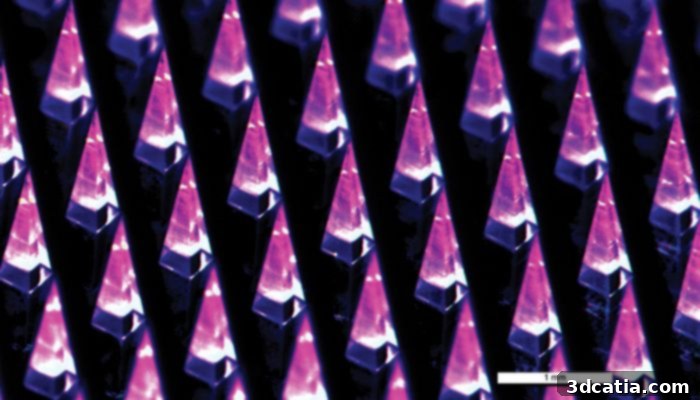
The printer creates patches containing hundreds of vaccine-filled microneedles (photo credit: MIT)
One of the most compelling advantages of this innovative delivery system is its remarkable ease of administration. Unlike traditional injectable vaccines that typically require trained healthcare professionals, administering these 3D printed vaccine patches is exceptionally straightforward. The process involves simply applying the patch directly to the skin. Upon contact, the tiny tips of the microneedles gently penetrate the outermost layer of the skin, where they then gradually dissolve. This controlled dissolution ensures that the vaccine’s active components are slowly and effectively diffused into the body over time, providing a sustained release. This user-friendly approach not only simplifies vaccination campaigns but also holds immense potential for increasing vaccine coverage, particularly in settings where medical personnel are scarce or when self-administration could be a viable option. It transforms vaccination from a clinical procedure into a simple application, making it accessible to a much wider population.
The specialized “ink” developed for printing these vaccine microneedles is a sophisticated blend engineered for both efficacy and long-term stability. At its core, this ink comprises the mRNA vaccine molecules, which are meticulously encapsulated within protective lipid nanoparticles. These nanoparticles play a crucial role, shielding the delicate mRNA from degradation and facilitating its entry into cells. Crucially, the ink also incorporates specific polymers, which are key to maintaining the vaccine molecules’ stability over extended periods. After extensive research and experimentation, the scientists identified the optimal formula for achieving superior stability: a precise blend consisting of half polyvinylpyrrolidone (PVP) and half polyvinyl alcohol (PVA). Both PVP and PVA are widely recognized and regularly utilized polymers in the biomedical field, particularly in the fabrication of various microneedle systems due to their biocompatibility and favorable physical properties. This carefully curated ink composition is the secret behind the patches’ groundbreaking ability to withstand ambient temperatures for months without losing potency.
To rigorously evaluate the long-term stability of these innovative vaccines, the MIT researchers devised a clever experimental approach. They formulated an ink containing RNA that encodes for luciferase, a well-known luminescent protein. This allowed them to visually and quantitatively track the integrity of the RNA over time. Patches containing this luciferase-encoding ink were then stored under various conditions: some at a controlled 4°C (refrigerator temperature), others at 25°C (room temperature) for up to an impressive 6 months, and a subset was even subjected to an accelerated stability test at 37°C (body temperature) for 1 month before being administered to mice. The results were unequivocally successful and highly encouraging. When applied to the mice, the patches that had been stored at elevated temperatures for extended periods retained their luminescence exceptionally well. This directly contrasted with traditional vaccines, which are typically administered by intramuscular injection and were observed to rapidly lose their efficacy when stored for long durations at room temperature. More critically, the vaccine patches that had been stored at room temperature for up to 3 months generated an immune response in the mice that was indistinguishable from those stored under optimal cold conditions, confirming their remarkable thermostability and sustained immunogenicity. This scientific validation underscores the immense potential of this technology to overcome the pervasive challenges of cold chain logistics.
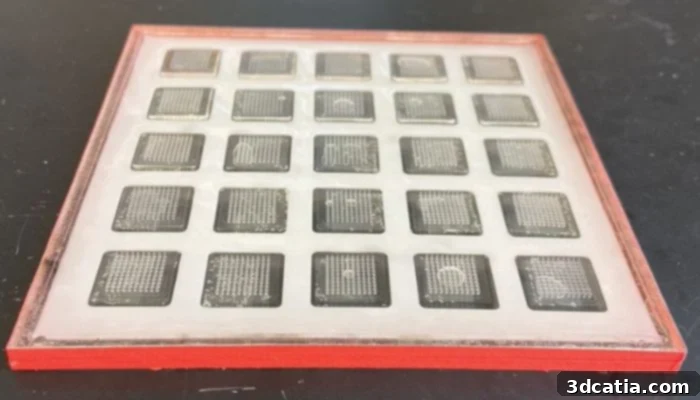
Example of a microneedle mold (photo credits: MIT)
While the initial results are incredibly promising, the researchers are continually refining the technology to maximize its global impact. Currently, the advanced printer developed by the MIT team has a production capacity of approximately 100 vaccine patches over a 48-hour period. However, this is just the beginning. Driven by a commitment to expand accessibility, the researchers are actively working to significantly enhance the efficiency and speed of the machine. Their ambitious goal is to increase this output to 100 patches per day, representing a substantial improvement that would enable more widespread deployment and impact on public health. Achieving this higher production rate will be crucial for scaling up the technology and making these vital thermostable vaccines readily available where they are needed most.
A Process Adaptable to Any Type of Vaccine, Expanding Horizons
The true power and long-term vision of this innovative 3D printing platform extend far beyond mRNA vaccines alone. The dedicated researchers involved in this seminal study are already making plans to broaden the scope of their work, aiming to produce an array of other types of vaccines by skillfully adapting the foundational process currently employed for mRNA formulations. This adaptability is a key feature, meaning the technology can potentially be leveraged for vaccines made from inert proteins or even attenuated viruses—traditional vaccine types that also suffer from cold chain constraints. As articulated by Ana Jaklenec, a distinguished researcher at MIT’s Koch Institute for Cancer Research and one of the senior authors of the study, the versatility lies in the “ink” itself. “The composition of the ink has been a key element in stabilizing mRNA vaccines, but the ink can contain different types of vaccines or even drugs. So this microneedle system allows for great flexibility and modularity of delivery,” she explains. This profound flexibility implies that the 3D printing platform could serve as a universal delivery system, capable of packaging and delivering a wide range of therapeutic agents in a thermostable, easy-to-administer format. This vision opens up immense possibilities not just for vaccines, but for other medications that could benefit from simplified logistics and administration, promising a future of more accessible and equitable healthcare. For those eager to delve deeper into the specifics of this groundbreaking research, comprehensive details are available in the official MIT press release and the full study, which can be accessed HERE.
The development of 3D printed thermostable vaccine patches by MIT represents a monumental leap forward in addressing global health inequities and logistical challenges in medicine. By eliminating the stringent requirements of the cold chain, this technology promises to democratize vaccine access, ensuring that life-saving immunizations can reach every corner of the world, from bustling urban centers to the most remote and underserved communities. The ease of administration further simplifies the vaccination process, reducing reliance on specialized medical infrastructure and personnel. As researchers continue to enhance production capabilities and explore its adaptability for various vaccine types and other therapeutic agents, these tiny patches hold the potential to reshape public health strategies for generations to come, fostering a healthier and more resilient global population. The future of medicine is indeed being printed, one patch at a time.
What are your thoughts on these innovative 3D printed thermostable vaccine patches and their potential impact on global health? We invite you to share your perspectives in a comment below or engage with us on our LinkedIn, Facebook, and Twitter pages! Don’t forget to sign up for our free weekly Newsletter here to receive the latest 3D printing news directly in your inbox! You can also find all our compelling videos on our YouTube channel, showcasing more innovations in additive manufacturing.
Photo credits: Ryan Allen from Second Bay Studios