

The Transformative Power of 3D Printing in Industry 4.0: Shaping the Future of Smart Manufacturing
As we navigate the complexities of the modern industrial landscape, it becomes increasingly clear that 3D printing, also known as additive manufacturing, stands as a cornerstone technology within the framework of Industry 4.0. To fully appreciate its significance, we must first establish a comprehensive understanding of what Industry 4.0 truly represents. Often referred to as the Fourth Industrial Revolution, Industry 4.0 embodies the profound automation and digitization of industrial processes and all associated business operations. Throughout history, industrial revolutions have been characterized by the distinct emergence of groundbreaking technologies that fundamentally reshape production methods, often with astounding speed. These technological shifts invariably incite significant economic and social transformations, profoundly influencing human evolution and societal structures. Humanity has experienced three such pivotal industrial and technological revolutions in the 19th and 20th centuries, each propelling progress across all economic and social dimensions.
Since approximately 2014, industries, economies, and societies worldwide have been experiencing an unprecedented wave of change, unequivocally defined by the Fourth Industrial Revolution. This monumental shift has been largely facilitated by the exponential growth of digital technologies and Information and Communication Technologies (ICT) over the past decade, giving rise to the concept we now know as Industry 4.0. At its core, Industry 4.0 orchestrates the seamless integration of physical, digital, and even biological systems into a sophisticated, intelligent production network. Within this network, diverse components and entities interact and collaborate autonomously, driving efficiency and innovation. It is underpinned by a suite of innovative and disruptive technologies that collectively enable the creation of flexible, intelligent, and autonomous solutions. This paradigm shift necessitates the comprehensive digital transformation of industries and enterprises through the strategic integration of these cutting-edge technologies. Key among these are 3D printing (additive manufacturing), the Internet of Things (IoT), cyber-physical systems (CPS), advanced cybersecurity measures, pervasive cloud computing, distributed ledger technologies like blockchain, sophisticated artificial intelligence (AI), machine learning (ML), deep learning, and the analysis of big data. This convergence of technologies paves the way for the emergence of the industry of the future, commonly envisioned as the Smart Factory.
3D Printing: A Pillar of Industry 4.0 Transformation
3D printing, or additive manufacturing, has rapidly ascended to become one of the most leading and transformative emerging technologies driving the evolution of Industry 4.0. Its strategic implementation, particularly when synergized with other advanced technologies, is catalyzing a profound shift within the industrial sector towards an intelligent production paradigm. In this evolved environment, machines—characterized by their autonomy, automation, and intelligence—along with complex systems and expansive networks, possess the inherent capability to seamlessly exchange information and dynamically respond to sophisticated production management systems. This interconnectedness allows for unparalleled agility and responsiveness. Fundamentally, as a technology capable of translating a digital 3D design into a tangible product with minimal human intervention, 3D printing occupies an absolutely central role in this revolution. The inherent advantages are numerous and compelling: the reliance on expensive traditional tooling and fixtures is significantly diminished or entirely eliminated, leading to substantial cost and time savings. Furthermore, the processes associated with post-processing are often simplified, material waste is dramatically reduced due to the additive nature of the process, and human intervention is minimized, contributing to greater safety and consistency. These attributes are not merely operational improvements; they are defining characteristics that underscore the vision of the industry of the future.
The integration of 3D printing empowers factories to achieve an unprecedented level of flexibility and adaptability, allowing them to precisely tailor their operations to the evolving and often unpredictable demands of an increasingly dynamic market. This agility extends to manufacturing highly personalized and customized objects without the prohibitive costs traditionally associated with designing and producing bespoke molds or specialized manufacturing tools. For industries ranging from medical devices to consumer goods, this capability unlocks immense potential for innovation and niche market creation. Beyond its operational and customization benefits, 3D printing also emerges as a formidable ally for environmental sustainability. This aspect is critically important given our current global climate challenges and the imperative to adopt manufacturing processes that minimize resource consumption and waste generation. Additive manufacturing’s ability to create complex geometries with minimal material, optimize part designs for lightweighting, and facilitate localized production significantly reduces carbon footprints associated with transportation and traditional manufacturing waste streams. It enables the creation of lighter, more fuel-efficient parts for aerospace and automotive, and promotes a circular economy through on-demand production, reducing inventory and obsolescence.
A testament to its rapid advancement, 3D printing has achieved a remarkable level of maturity in a comparatively short timeframe, as evidenced by its position on the widely recognized Gartner Hype Cycle. This influential curve graphically illustrates the maturity, adoption rate, and commercial applicability of specific technologies over time. It typically progresses through stages: Innovation Trigger, Peak of Inflated Expectations, Trough of Disillusionment, Slope of Enlightenment, and finally, the Plateau of Productivity. The fact that various applications of 3D printing are now firmly established within the ‘Slope of Enlightenment’ or even the ‘Plateau of Productivity’ signifies their proven viability and widespread acceptance. Prominent applications that have reached this highest peak of maturity and commercial application include the 3D printing of medical implants, where precise customization and biocompatibility are paramount, point-of-sale 3D printing for immediate product customization, and its increasingly critical role in modern supply chains for rapid prototyping, tooling, and on-demand production of spare parts. Furthermore, 3D printing is making significant inroads in classrooms within the education sector, fostering hands-on learning and innovation, and bioprinting is accelerating research in the expansive field of medicine, pushing the boundaries of regenerative therapies and drug discovery. Its robust position across diverse sectors underscores its fundamental shift from a niche technology to a mainstream manufacturing solution.
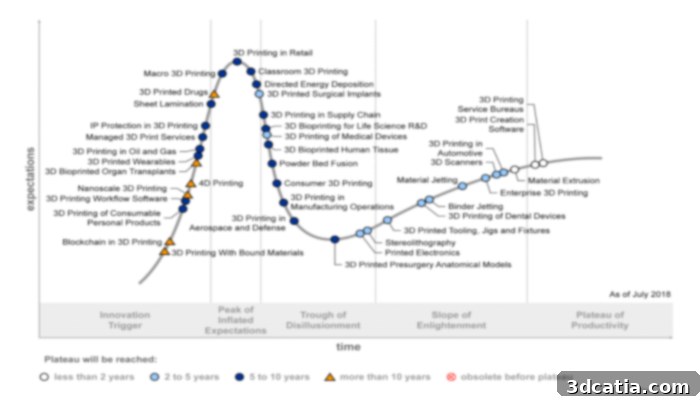
Stages on the Gartner curve.
Future Prospects for Additive Manufacturing in the Smart Factory Era
The future of additive manufacturing is not just promising; it is brimming with revolutionary potential. The continuous expansion in the array of available techniques and compatible materials, coupled with a surging volume of scientific research and the proliferation of specialized companies, has dramatically broadened the spectrum of the technology’s application possibilities. From metals and ceramics to advanced polymers and composites, the material palette for 3D printing is continuously diversifying, enabling its use in increasingly demanding sectors. Consequently, 3D printing has firmly established itself as the preferred manufacturing technology across numerous industries, with an unwavering prospect of sustained and significant growth. This trajectory has only been accelerated by recent global events. The unprecedented situation experienced worldwide due to the COVID-19 pandemic, for instance, acted as a powerful catalyst, driving greater progress and consolidation of 3D printing. The urgent need for personalized protective equipment, medical device components, and rapidly produced parts highlighted additive manufacturing’s unparalleled ability to provide agile, on-demand, and localized production capabilities, thereby demonstrating its critical role in supply chain resilience and rapid response.
The symbiotic relationship between 3D printing and Industry 4.0 is being vigorously fostered through numerous strategic initiatives across the globe. Prominent innovation hubs such as Silicon Valley, London, and New York are leading the charge, serving as fertile ground for Industry 4.0-related startups and technological advancements. Among these global efforts, DFactory BCN in Barcelona, Spain, stands out as an ambitious initiative aiming to become the largest Industry 4.0 hub in southern Europe. Its multifaceted objective extends beyond job creation, targeting the generation of between 1,500 and 5,000 indirect employment opportunities by fostering a vibrant ecosystem for advanced manufacturing, robotics, and artificial intelligence. Complementing this, the facilities of the 3D Factory Incubator, recognized as Europe’s premier high-tech incubator dedicated solely to 3D printing, currently hosts over 50 pioneering companies specializing in various facets of additive manufacturing, from material development to advanced printer technologies. Another exemplary initiative is Project DIAMOnD in Michigan, USA, which is actively working to transition the region’s robust manufacturing sector into the age of Industry 4.0 by integrating advanced digital technologies. These global investments in research, infrastructure, and entrepreneurial support are critical. The demonstrable maturity of 3D printing technology, the expansive and continually growing range of possibilities it offers, and the resolute support and impetus provided by governmental and institutional bodies worldwide are collectively poised to solidify additive manufacturing’s position as a truly leading and indispensable technology across multiple sectors in the very near future. This will not only redefine production but also foster sustainable practices and unprecedented levels of customization.
What are your thoughts on the pivotal role of 3D printing in the ongoing evolution of Industry 4.0? We invite you to share your perspectives in a comment below or join the conversation on our Facebook, Twitter, and LinkedIn pages! For the latest updates and breaking news in the world of 3D printing, be sure to sign up for our free weekly Newsletter here, delivered straight to your inbox!