
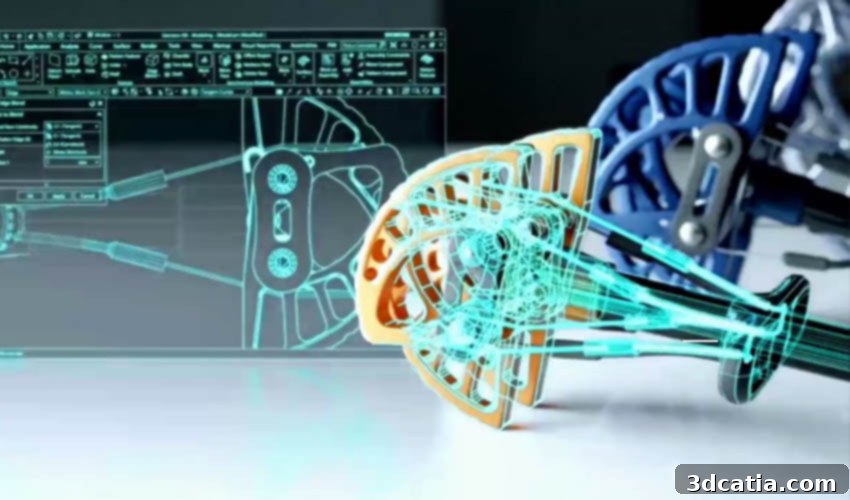
The Future of Innovation: How Generative Design Transforms Manufacturing with AI
Generative design represents a revolutionary, iterative design process that leverages computational power to automatically generate a multitude of design outputs. These outputs are precisely tailored to meet a set of predefined constraints and performance requirements. This cutting-edge methodology finds applications across diverse fields, from intricate art installations and complex architectural structures to sophisticated product engineering. It can produce everything from unique soundscapes and compelling images to highly optimized CAD models, fundamentally reshaping how we approach creation.
One of the most compelling advantages of generative design lies in its unparalleled speed for exploring vast design possibilities. Unlike traditional design methods that rely on human intuition and manual iteration, this technique can evaluate hundreds, if not thousands of potential solutions within a remarkably short timeframe. This rapid exploration capacity allows engineers and designers to uncover innovative designs that might otherwise be overlooked, pushing the boundaries of what’s conventionally achievable.
Within the critical realm of manufacturing, generative design has emerged as an indispensable tool for part optimization. The process typically begins within specialized software platforms capable of generating CAD-ready options. These platforms operate based on meticulously defined real-world constraints and stringent performance requirements. By inputting these critical parameters, engineers can achieve significant advancements such as impressive light weighting, substantial performance improvements, efficient part consolidation, and enhanced sustainability. Consequently, generative design is not merely improving the design process; it’s fundamentally transforming it, empowering engineers to solve complex challenges and conceive design solutions that would be incredibly difficult, if not impossible, to envision through traditional, manual approaches.
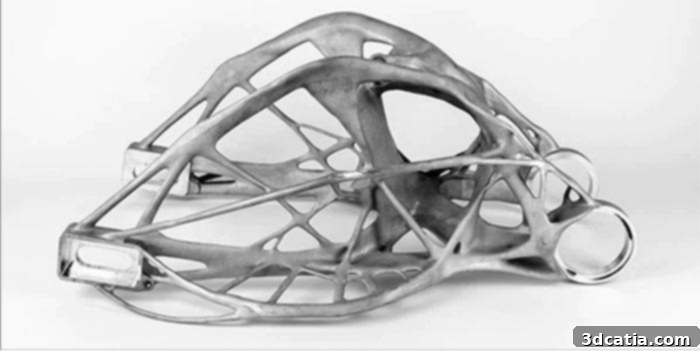
Engineers can achieve light weighting, performance improvements, part consolidation, or sustainability through generative design workflows. | Photo Credits: Autodesk
The market today offers a growing array of generative design solutions, each tailored to address the specific needs of various industrial sectors. Peter Rogers, APAC Additive Manufacturing Product Specialist at Autodesk, offers a more detailed explanation of how generative design functions specifically for manufacturing applications: “It does not require a starting geometry, which is a major departure from conventional design. Users simply input the critical areas that the part must retain (known as preserved regions) and define zones where no material should exist (these are the keep-out zones). Following this, they specify the performance requirements, which include constrained areas, the forces and pressures the part will endure, and other operational conditions. From there, you can input a diverse range of materials that are accessible for manufacturing and delineate specific manufacturing criteria—such as minimum wall thickness and support angle parameters for additive manufacturing, or drill bit sizes for CNC machining. By providing some basic guidance in terms of design objectives, the tool then leverages Autodesk’s advanced design algorithms in conjunction with sophisticated simulation technology. This powerful combination enables it to create thoroughly validated, cost-estimated, and readily manufacturable geometry solutions tailored precisely to the defined design problem.” This comprehensive approach ensures that the generated designs are not only innovative but also practical and economically viable.
Generative Design: Unlocking Unprecedented Benefits and Expanding Design Horizons
To effectively explore an expansive spectrum of design possibilities that adhere to complex constraints and performance requirements, generative design software harnesses the formidable power of artificial intelligence (AI) and machine learning (ML). This technological foundation allows the software to mimic nature’s evolutionary approach to design, systematically evaluating countless permutations and combinations. The outcome is a comprehensive suite of potential solutions, often far exceeding human imagination. However, it’s crucial to distinguish generative design from other optimization techniques, such as topology optimization, with which it is sometimes conflated.
Tod W. Parrella, NX Product Management for Siemens Digital Industries Software, clearly articulates this distinction: “Topology optimization primarily focuses on refining a product’s form to satisfy specific system requirements, such as achieving desired strength, minimizing weight, optimizing cooling efficiency, or improving fluid flow. In contrast, generative engineering operates at a higher level and on a broader scale. It actively explores the entire design space of options and possibilities, rigorously evaluating multi-disciplinary requirements with the unique ability to solve against multiple, often conflicting, objectives.” This key difference means that instead of merely optimizing a single design outcome, as is typical with topology optimization, generative design empowers engineers to compare, contrast, and meticulously consider a multitude of diverse design outcomes, leading to more innovative and robust solutions.
The strategic implementation of generative design can yield immense opportunities and competitive advantages for companies across various sectors. For instance, Siemens, a global technology powerhouse, leverages these advanced design methods to serve eight core industries, consistently improving product performance and efficiency. As previously noted, the requirements considered by generative design are multifaceted, encompassing not only weight, structural integrity, and assembly complexity but also critical factors like manufacturing costs. Parrella further elaborates on some of the tangible benefits observed in real-life applications:
- “Product light weighting directly translates to increased performance and greater fuel efficiency, delivering significant advantages to the automotive, aerospace, and energy industries.”
- “The creation of porous structure medical implants greatly improves bone growth adhesion, leading to better patient outcomes and accelerating recovery.”
- “Reduced assembly complexity brings substantial manufacturing savings through decreased tooling requirements and lower assembly costs, streamlining production lines.”
- “Mass optimization markedly improves the performance and operational efficiency of heavy equipment, reducing operational costs and increasing longevity.”
- “And finally, increased mass airflow provides improved cooling performance, which is vital for high-performance applications in the aerospace and consumer electronics industries.”
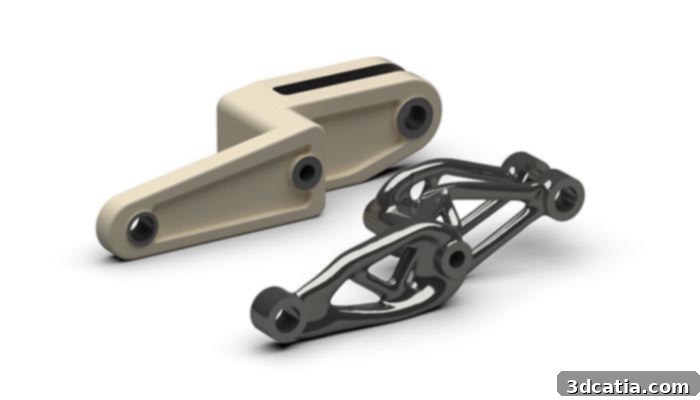
Generative engineering methods can achieve light weighting whilst keeping the strength of parts as shown above, showcasing superior material efficiency.
Generative Design and 3D Printing: A Powerful, Yet Nuanced, Match?
Generative design is widely recognized as an integral component within the suite of Design for Additive Manufacturing (DfAM) techniques. Given that additive manufacturing (3D printing) inherently enables unprecedented levels of design freedom, it intuitively appears to be the ideal manufacturing method for producing the complex geometries and intricate internal structures often generated by generative design software. These designs frequently demand a highly flexible manufacturing approach that traditional methods struggle to replicate.
However, it’s crucial to understand that additive manufacturing is not always the definitive or sole technology to pair with generative engineering. Peter Rogers provides important context: “A significant number of parts are currently being manufactured with 3D printing that could, in fact, be produced more effectively and economically using conventional manufacturing methods. Conversely, with the correct design strategy enabled by generative tools, many traditionally manufactured parts could see substantial improvements in performance and a significant reduction in waste by transitioning to additive manufacturing. The core principle here is not to indiscriminately push all designs towards additive manufacturing. Rather, it’s about ensuring that the right design is channeled into the most appropriate manufacturing technology to achieve the most desirable outcome—whether that’s superior performance, cost efficiency, material reduction, or a combination thereof.” This pragmatic view emphasizes a balanced approach to modern manufacturing.
Nevertheless, the extraordinary design freedom afforded by additive manufacturing technologies remains highly beneficial for fully leveraging the opportunities presented by generative design. This synergy allows for the exploration and realization of optimal solutions across various engineering challenges. For example, it becomes possible to find innovative solutions for structural, thermal, and fluid flow optimization. Furthermore, generative design can be applied to engineering-based part orientation optimization, aiming to minimize surface area, reduce support material volume, prevent overheating during printing, or significantly decrease overall printing time. Ultimately, as Parrella explains, “manufacturing suitability depends on a multitude of variables such as the specific materials employed, target manufacturing volumes, and desired production costs.” He adds that the primary factors that often advocate for the adoption of additive manufacturing are: “the unparalleled opportunities to significantly reduce product assembly complexity through strategic part consolidation, greater capabilities to bring personalized and tailored products swiftly to market, and substantially enhanced manufacturing flexibility, allowing for rapid adaptation to changing demands.”
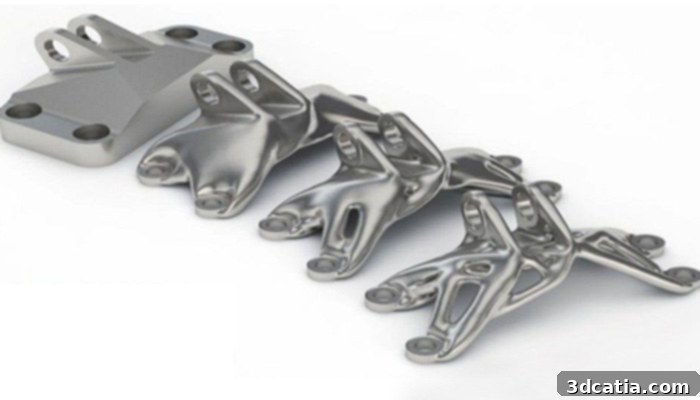
Generative design streamlines product development across sectors. | Photo Credits: Siemens
The ongoing evolution of generative engineering is directly correlated with advancements in computing power and sophisticated algorithmic development, particularly within the field of artificial intelligence. Simultaneously, 3D printing technologies have matured considerably, transitioning from prototyping tools to viable methods for scaled production. Reflecting on these parallel developments, Peter Rogers comments: “In the additive manufacturing space, we frequently observe that light weighting alone is often insufficient to fully justify the investment and complexities of additive processes. To better substantiate the use of additive, we need to simultaneously increase both the performance and the inherent functionality of the parts. This next leap will be realized with the integration of dynamic simulation-based generative design, which will optimize factors such as flow rates, enhance thermal efficiency, reduce unwanted vibration, and more. Once these advanced simulation capabilities are seamlessly integrated into the generative design process, we will truly witness additive manufacturing reaching its ‘hay day’ – a period of unprecedented utility and widespread adoption.”
Is generative design truly the definitive key to significantly increasing both the performance and functionality of 3D printed parts, unlocking their full potential? We invite you to share your thoughts and insights in a comment below! For more comprehensive information and resources, you can explore Autodesk’s dedicated generative design website and Siemens’ detailed pages on generative engineering solutions.