

Boom Supersonic XB-1 Soars with VELO3D 3D Printing: Revolutionizing Supersonic Aerospace Manufacturing
The future of supersonic travel is taking shape, thanks to groundbreaking advancements in additive manufacturing. US-based aerospace manufacturer, Boom Supersonic, has unveiled its innovative XB-1 aircraft model, a demonstrator designed to pave the way for a new era of commercial supersonic flight. A remarkable aspect of this cutting-edge aircraft is its integration of 21 titanium 3D printed components, meticulously produced by the leading metal additive manufacturing solution provider, VELO3D. This partnership signifies a major leap forward, showcasing the immense potential of metal 3D printing in developing high-performance, next-generation aerospace vehicles.
VELO3D’s involvement in the XB-1 project underscores its position at the forefront of industrial metal additive manufacturing. Earlier this year, VELO3D successfully raised an additional $28 million to further expand its product portfolio, bringing its total funding to an impressive $138 million. This significant investment reflects confidence in the company’s proprietary technology, particularly its Sapphire 3D printer. The Sapphire system is renowned for its capability to produce incredibly detailed and complex metal 3D printed parts with unprecedented geometric freedom and consistent quality – critical attributes that made VELO3D an ideal partner for Boom Supersonic, as all 21 components were manufactured using this advanced AM system.
The Dawn of a New Supersonic Era: Boom Supersonic’s Ambitious Vision
Boom Supersonic is not just building aircraft; they are rekindling the dream of routine supersonic passenger travel. The company’s ambitious goal is to develop aircraft capable of flying dozens of passengers at speeds approaching 1,500 miles per hour (Mach 2.2), drastically shortening typical air travel times. Imagine flying from New York to London in just three and a half hours, or from San Francisco to Tokyo in six hours. This vision necessitates an aircraft design that pushes the boundaries of engineering, demanding exceptional aerodynamic performance, structural integrity, and material efficiency. The XB-1, often referred to as “Baby Boom,” is the crucial first step, serving as a technology demonstrator to validate key innovations for Boom’s future commercial airliner, Overture.
Achieving such speeds economically and safely requires a fundamental rethinking of aircraft design and manufacturing. In this context, Boom Supersonic strategically turned to advanced manufacturing technologies like 3D printing to tackle challenges that conventional manufacturing methods simply cannot address. The ability to create complex geometries, reduce weight without compromising strength, and rapidly iterate designs became paramount. Additive manufacturing offers a unique solution set that aligns perfectly with the demanding requirements of supersonic flight.
Why 3D Printing is Critical for Supersonic Aircraft Design
The integration of additive manufacturing technologies in aeronautics is experiencing exponential growth, as more and more companies invest in these advanced manufacturing methods. While historically, only a few elements of a vehicle might be fabricated or repaired with 3D printing – as exemplified by Honeywell additively manufacturing a critical engine component for a Dassault Falcon 20G maritime aircraft – the scale of integration on the XB-1 is noteworthy. Having as many as 21 flight-critical parts created with 3D printing signals a significant shift in the industry’s confidence in AM for end-use aerospace applications. But what specific advantages compelled Boom Supersonic to opt for AM for such a substantial number of plane parts?
Unlocking Complex Geometries and Superior Aerodynamics
Supersonic flight demands unparalleled aerodynamic efficiency. Even minute imperfections or suboptimal designs can drastically impact performance and fuel consumption. 3D printing empowers engineers to design parts with intricate internal structures and complex external contours that are impossible or prohibitively expensive to produce with traditional subtractive manufacturing. This design freedom allows for optimized airflow, reduced drag, and enhanced overall aerodynamic performance, which are critical for achieving and maintaining supersonic speeds efficiently. For components exposed to the intense forces and temperatures of supersonic flight, the ability to fine-tune every curve and channel is invaluable.
The Imperative of Lightweighting for Supersonic Performance
Weight is the enemy of supersonic flight. Every kilogram saved translates directly into increased speed, extended range, and improved fuel efficiency. 3D printing excels at producing lightweight structures through lattice designs, topology optimization, and part consolidation. Instead of assembling multiple components, a single, complex 3D printed part can perform the functions of several, eliminating fasteners, reducing assembly time, and significantly cutting down on overall weight. This is particularly vital for an aircraft like the XB-1, where every gram contributes to the ability to break the sound barrier and sustain high velocities with reduced operational costs.
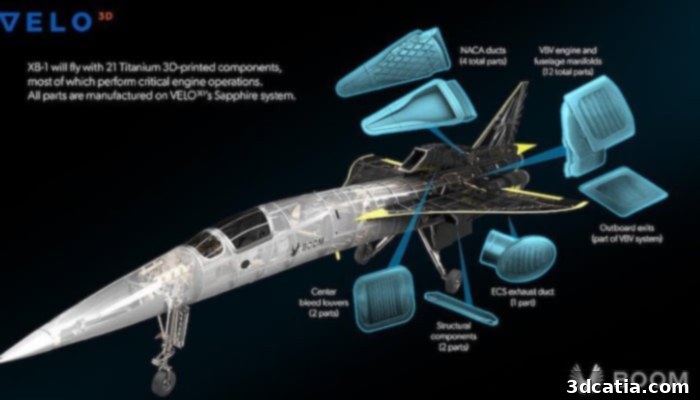
Image credits: VELO3D
Material Innovation: High-Performance Alloys for Extreme Conditions
Supersonic aircraft operate in extremely challenging environments, facing intense heat, pressure, and structural loads. The choice of material is therefore critical. Titanium, known for its high strength-to-weight ratio, excellent corrosion resistance, and ability to withstand high temperatures, is an ideal material for many aerospace applications, especially for supersonic flight. VELO3D’s Sapphire system is specifically engineered to process such demanding alloys with precision and consistency. This capability ensures that the 3D printed components not only meet the required geometric specifications but also possess the superior durability and high-temperature resistance necessary for mission-critical applications in the toughest operating conditions. The robust mechanical properties of VELO3D’s printed titanium parts provide the reliability and safety margins required for an experimental supersonic jet.
VELO3D’s Sapphire System: Enabling Aerospace Innovation
The partnership between Boom Supersonic and VELO3D is a testament to the latter’s advanced capabilities. Benny Buller, the Founder and CEO of VELO3D, articulately summarized the unique challenges and solutions: “Aviation hardware is especially difficult to manufacture with 3D metal printing, due to challenging aerodynamic designs that must be balanced with superior durability and high-temperature requirements. VELO3D’s technology allows the production of lightweight, complex designs for mission-critical applications in the toughest operating conditions. Our partnership with Boom is truly an advancement for the metal AM industry, and XB-1 supersonic aircraft is a game-changer for the aviation industry.” This statement encapsulates the core value proposition of VELO3D’s technology: enabling designs that were previously considered impossible to manufacture, with the stringent quality and performance demanded by aerospace.
The Sapphire system differentiates itself with its unique “support-free” printing capabilities for angles down to zero degrees, particularly for internal geometries. This means that complex internal channels, intricate lattice structures, and delicate overhangs can be printed without the need for extensive support structures that are difficult to remove in conventional powder bed fusion processes. For aerospace components, this translates to cleaner parts, reduced post-processing, and the ability to design parts with optimal internal fluid flow paths, which is crucial for cooling systems and engine performance. The high fidelity and repeatability of the Sapphire system ensure that each of the 21 titanium components meets the exacting standards for flight safety and performance.
Key 3D Printed Components on the XB-1
After a rigorous series of qualification trials on the VELO3D Sapphire System, Boom Supersonic has confidently equipped its XB-1 aircraft with these critical 3D printed components. These parts are integrated into various vital systems, including the engine hardware, environmental control system, and several structural elements throughout the vehicle. The strategic placement of these AM parts highlights their essential roles in the aircraft’s operation.
For instance, some of the highly engineered 3D printed elements include twelve Variable Bypass Valve (VBV) engine and fuselage manifolds. These manifolds play a crucial role in the engine’s operation by helping to route air released by the engine compressor to the aircraft’s outer mould line. Precise control over airflow is paramount for efficient engine performance and thermal management, especially during varying flight regimes, including supersonic acceleration and cruise. The complex internal channels required for these manifolds are perfectly suited for VELO3D’s technology, ensuring optimal flow characteristics and minimal pressure drop.
Additionally, four NACA ducts, also 3D printed, are integral to the XB-1’s cooling system. These ducts are designed to efficiently capture exterior air and channel it into the aircraft to cool vital engine bays. The smooth, optimized internal geometry achievable with additive manufacturing allows for superior airflow and heat exchange, preventing overheating of critical engine components. The ability to produce these ducts with complex curves and tight tolerances ensures maximum cooling efficiency while minimizing drag, contributing to the overall performance of the supersonic jet. The integration of such intricate and critical components through 3D printing demonstrates a profound trust in the technology’s reliability and performance for the demands of supersonic flight.
XB-1: Paving the Way for Overture
It is important to emphasize that the XB-1 is not merely an experimental jet; it is, in fact, the world’s first independently developed supersonic jet, setting a new benchmark in aerospace innovation. Its primary mission is to demonstrate critical technologies and validate design principles for Overture, Boom Supersonic’s ambitious future commercial airliner. These technologies include advanced carbon-fiber composite construction, which provides exceptional strength and stiffness while being lightweight, and computer-optimized high-efficiency aerodynamics, crucial for efficient supersonic travel. The insights gained from the XB-1’s development and flight testing will directly inform the design and certification of Overture, accelerating its path to commercial service.
The XB-1 project has already undergone an extensive and rigorous testing regimen, showcasing Boom Supersonic’s commitment to safety and performance. This includes successfully passing multiple wind tunnel trials, dozens of structural tests, hundreds of simulation iterations, and tens of thousands of work hours dedicated to its development. Such meticulous validation processes are essential for any aircraft, especially one pushing the boundaries of speed and manufacturing technology, ensuring that all components, including the 3D printed ones, meet the highest standards of aerospace reliability.
The Future Landscape of Additive Manufacturing in Aerospace
The collaboration between Boom Supersonic and VELO3D on the XB-1 is more than just a successful application of 3D printing; it represents a significant milestone for the entire additive manufacturing industry and its role in aerospace. This project serves as a powerful validation that metal AM is no longer limited to prototyping or non-critical parts, but is a viable, reliable, and even superior manufacturing method for highly stressed, flight-critical components operating in extreme environments. This shift has profound implications for the aerospace supply chain, potentially leading to shorter lead times, greater design flexibility, reduced material waste, and the ability to produce parts closer to the point of need.
As the industry moves towards more complex and customized aircraft, the agility and innovation offered by 3D printing will become increasingly indispensable. The success of the XB-1’s 3D printed components paves the way for broader adoption of similar technologies across various aircraft programs, both commercial and military. It inspires confidence in engineers and designers to leverage the full potential of AM for performance optimization, weight savings, and system integration. This partnership truly embodies a new era where digital manufacturing tools are integral to shaping the future of aviation, making faster, more efficient, and more sustainable air travel a reality.
Conclusion: A Leap Forward for Aviation
In conclusion, the rollout of Boom Supersonic’s XB-1, featuring 21 titanium 3D printed components from VELO3D, marks a monumental achievement in aerospace engineering. It is a testament to the synergistic power of visionary aircraft design and cutting-edge additive manufacturing technology. By embracing 3D printing, Boom Supersonic has been able to unlock unparalleled design freedom, achieve critical weight reductions, and integrate complex geometries essential for supersonic flight. VELO3D’s Sapphire system has proven its capability to deliver the precision, quality, and material properties required for such demanding applications.
This collaborative effort not only accelerates the development of Overture, Boom’s future commercial airliner, but also sets a new benchmark for the aerospace industry as a whole. It demonstrates that additive manufacturing is poised to revolutionize how aircraft are designed, produced, and maintained, ultimately leading to faster, more efficient, and more innovative air travel experiences for passengers worldwide. The XB-1 is indeed a game-changer, signalling that the return of supersonic passenger flight is closer than ever, powered by the incredible possibilities of advanced 3D printing.
What do you think about VELO3D printing parts for the XB-1 Supersonic jet and the implications for future supersonic travel? Let us know in a comment down below or on our Facebook and Twitter pages! Don’t forget to sign up for our free weekly Newsletter, with all the latest news in 3D printing delivered straight to your inbox!