
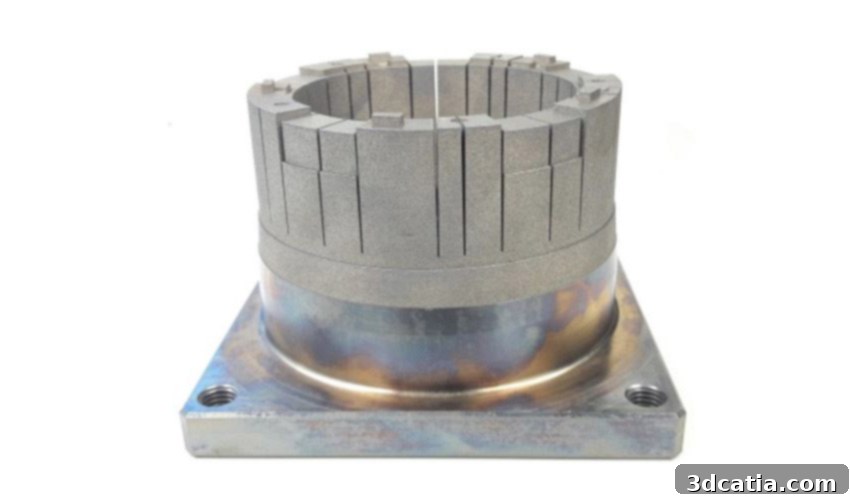
Hybrid Manufacturing: Unleashing Precision and Efficiency by Blending Additive and Subtractive Technologies
In the dynamic landscape of modern manufacturing, the choice of production method is critical, heavily influenced by the desired part geometry, production volume, and material specifications. While additive manufacturing, commonly known as 3D printing, has revolutionized rapid prototyping and increasingly found applications in end-use parts, its adoption is often complemented by traditional subtractive manufacturing processes. Current additive technologies, while offering unparalleled design freedom for intricate components, sometimes face limitations in terms of build volume, speed for large batches, and surface finish requirements. Consequently, additive manufacturing excels in creating parts with highly complex geometries, producing small series, facilitating rapid prototyping, and fabricating specialized tooling. However, a transformative trend is emerging: an increasing number of manufacturers are exploring and implementing a synergistic approach that combines these two powerful production paradigms. This innovative methodology, termed “hybrid manufacturing,” promises a multitude of advantages, often proving to be a more economically viable and technically superior solution for complex industrial challenges.
The integration of additive and subtractive manufacturing processes, while offering significant benefits, also introduces a unique set of challenges. Typically, the workflow involves 3D printing a part, followed by extensive post-processing and machining to achieve the desired final geometry, tight tolerances, or a superior surface finish. This sequence is particularly common for highly complex components featuring intricate internal geometries, such as conformal cooling channels within molds or internal fluidic pathways that are impossible to create using conventional machining methods alone. These intricate features often necessitate several post-processing steps including, but not limited to, support structure removal, specialized heat treatments to relieve residual stresses and improve material properties, precision milling for critical surfaces, or even meticulous manual polishing to meet stringent aesthetic and functional requirements. These essential finishing operations are frequently time-consuming, labor-intensive, and inherently expensive, making their minimization a key objective in optimizing manufacturing efficiency and cost-effectiveness.
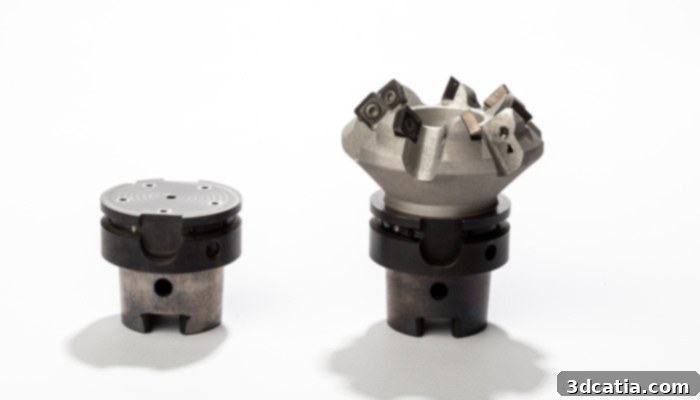
Hybrid cutting tool showcases the successful integration of additive and subtractive manufacturing for enhanced performance. Image courtesy of GF Machining Solutions.
In response to these industry demands for advanced manufacturing solutions that marry precision with efficiency, the hybrid manufacturing process has gained considerable traction for creating these highly specialized “hybrid” parts. This sophisticated approach goes beyond simply combining additive and subtractive technologies; it more precisely involves direct additive material deposition onto a conventionally pre-machined preform. Metal 3D printing, despite its advantages, can be a time-consuming and expensive process, especially when fabricating an entire part from scratch. By leveraging hybrid manufacturing, industrial manufacturers can strategically machine a foundational preform using conventional, faster, and often cheaper methods for bulk material removal. Subsequently, additive manufacturing is employed to create or add complex characteristics, intricate features, or customized geometries that would be utterly impossible or prohibitively expensive to achieve through traditional subtractive processes alone. The culmination of this intelligent integration is a significantly reduced overall production time, substantial cost limitations, and the full retention of the unique technological benefits offered by both manufacturing paradigms, yielding superior parts that are optimized for performance and cost.
Despite the compelling advantages, one of the primary technical hurdles in this advanced hybrid manufacturing workflow is the precise positioning and alignment of the pre-machined preform within the additive manufacturing system. The accuracy of the subsequent additive process hinges entirely on knowing the exact location and orientation of this preform on the build plate. This challenge arises because, unlike a conventional milling machine where a mechanical linkage often exists between the workpiece and the machine’s optical or measurement system, there is typically no direct mechanical feedback between the free-standing preform and the optical system of a 3D printer. Therefore, achieving sub-micron accuracy when printing directly onto this preform becomes a significant engineering dilemma. Many manufacturers have historically relied on less precise methods, such as visual alignment performed by operators or the use of external coordinate measuring machines (CMMs). These traditional methods are inherently prone to error and suffer from a significant lack of precision, often yielding an accuracy of only around 100 microns. Furthermore, the manual or semi-manual nature of these positioning operations makes them exceptionally time-consuming, adding considerable overhead to the overall production cycle and undermining the efficiency gains expected from hybrid manufacturing.
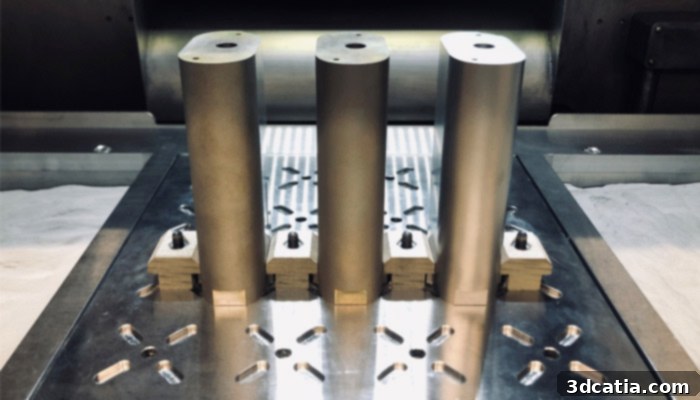
Preforms precisely positioned inside the DMP Flex 350 additive manufacturing machine, ready for the next stage of hybrid production. Image via GF Machining Solutions.
DMP Calibration Tool: Revolutionizing Preform Positioning for Seamless Hybrid Manufacturing
Addressing the critical preform positioning challenge, GF Machining Solutions, a renowned expert in metal additive manufacturing, has collaborated with its long-standing partner 3D Systems, one of the pioneering forces in the 3D printing market, to develop an innovative solution. This groundbreaking tool, aptly named the DMP Calibration Tool, is specifically engineered to dramatically reduce operator errors and significantly cut down the time required for preform alignment. Rather than a purely hardware-based approach, it is an advanced software solution that ingeniously leverages the inherent monitoring capabilities of the melting tank integrated into the DMP machine range, known as DMP Monitoring. This sophisticated feature was originally designed with the crucial objective of detecting potential defects and anomalies in real-time during the additive manufacturing process, ensuring part quality and integrity. However, GF Machining Solutions has brilliantly re-purposed its primary function for a different, equally critical application in hybrid manufacturing.
Dogan Basic, Product Manager at GF Machining Solutions, elaborates on this ingenious adaptation: “The DMP Calibration Tool repurposes this light-sensing monitoring equipment for an entirely different, yet equally vital, purpose: scanning preforms to precisely identify pre-machined positioning holes within the workpiece surface.” In practice, the process unfolds with exceptional precision and speed. A high-resolution laser system integrated within the DMP machine scans the strategically designed positioning holes in the preform. During this scan, highly sensitive sensors meticulously analyze the subtle differences in light reflection patterns as the laser interacts with the preform’s surface. Through advanced triangulation algorithms and subsequent precise correction of the x, y, and z axes orientation by the intelligent software, the exact three-dimensional positioning of the preforms is determined with unparalleled accuracy. This entire calibration process can be executed remarkably quickly, often on multiple preforms simultaneously, drastically reducing setup times. Moreover, this automated and software-driven approach entirely eliminates the risk of human error associated with manual alignment methods, ensuring consistent and repeatable precision. This technological leap allows users to additively deposit material onto an already machined workpiece in a far more optimized, efficient, and reliable manner, opening up new possibilities for complex part production.
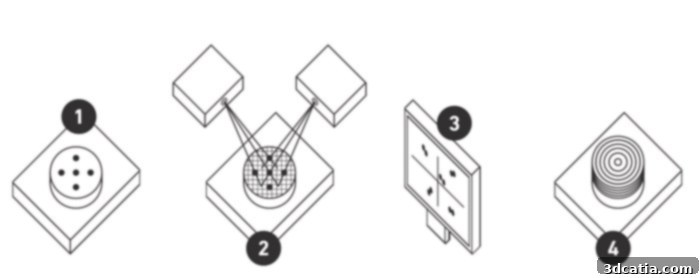
Detailed diagram illustrating the sophisticated preform calibration and scanning process developed by GF Machining Solutions, ensuring ultimate precision in hybrid manufacturing.
The versatility and precision offered by this hybrid manufacturing approach, empowered by the DMP Calibration Tool, position it as a game-changer across numerous high-stakes industries. GF Machining Solutions anticipates significant adoption in sectors such as aerospace, where the production of lightweight, complex parts with optimized internal structures for performance enhancement (e.g., lattice structures, internal cooling channels for turbine components) is paramount. The medical industry stands to benefit immensely as well, particularly in the creation of patient-specific implants like tibial tray-type prosthetics. These customized implants can achieve superior geometric accuracy and better anatomical fit, leading to improved patient outcomes and enhanced biocompatibility. Furthermore, the tool is expected to provide particular benefits to manufacturers of mold inserts and dies. Here, hybrid manufacturing allows for the integration of conformal cooling channels that closely follow the contours of the mold cavity, significantly improving thermal management, reducing cycle times, and extending tool life – features nearly impossible to produce through conventional machining alone.
Dogan Basic concludes by highlighting another crucial application demonstrating the efficacy of hybrid manufacturing: “Cutting tools represent another compelling application example where our solution truly shines. Increasingly, these tools are produced through hybrid manufacturing, involving a conventionally machined preform onto which an additive section is meticulously printed. Hybrid methods are preferred because the core geometry of the preform, which constitutes the bulk of the tool, is relatively simple to produce efficiently using conventional machining. The strategic use of additive manufacturing then enables the creation of highly complicated lubrication and cooling channels, or specialized cutting geometries, that would be exceptionally difficult, if not impossible, to produce with traditional subtractive machining methods. A slight lack of precision in the additive manufacturing phase can lead to a significant deficit in the overall performance and longevity of the cutting tool. This is precisely why our unique, highly precise reference solution is so highly appreciated by manufacturers striving for peak performance and reliability.” For more detailed information on GF Machining Solutions’ pioneering work in additive and hybrid manufacturing, interested parties can visit their website HERE.
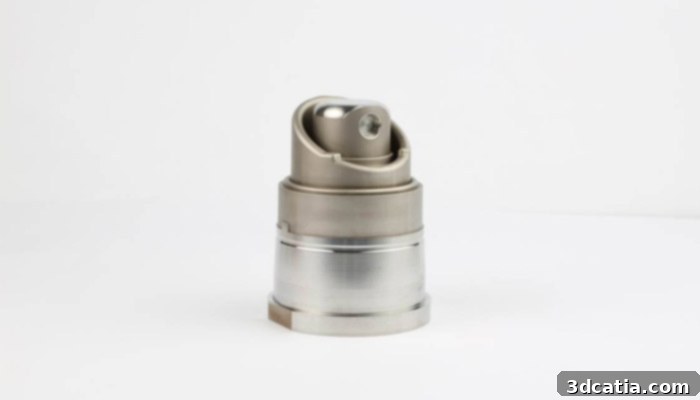
A complex mould showcasing features created through various manufacturing processes, highlighting the seamless integration achieved with additive manufacturing. Image via GF Machining Solutions.
What are your thoughts on the transformative potential of hybrid manufacturing and its impact on the future of industrial production? We invite you to share your insights and opinions in a comment down below or join the conversation on our Facebook and Twitter pages! Don’t miss out on the latest advancements and news in the world of 3D printing; remember to sign up for our free weekly Newsletter, delivered directly to your inbox!