
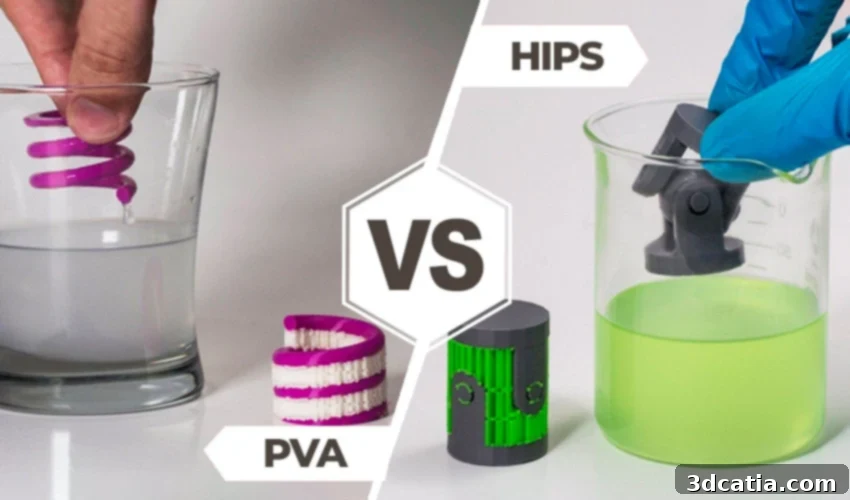
PVA vs. HIPS: Choosing the Ultimate Soluble Support Material for FDM 3D Printing
When tackling intricate 3D print designs featuring complex geometries, challenging overhangs, lengthy bridges, or internal cavities, the necessity of support structures becomes undeniable. While powder-based additive manufacturing technologies inherently support printed parts with their powder bed, filament and resin-based methods, particularly Fused Deposition Modeling (FDM) or Fused Filament Fabrication (FFF), mandate robust support. These supports are crucial for preventing print failures and ensuring the final object maintains its integrity throughout the printing process. Among the most popular and effective soluble support materials in FFF 3D printing are PVA (Polyvinyl Alcohol) and HIPS (High Impact Polystyrene). This comprehensive guide delves into a detailed comparison of PVA and HIPS, exploring their unique characteristics, printing properties, and specific applications within the realm of FFF printing.
Selecting the appropriate support material is a critical decision that directly impacts print quality, post-processing effort, and overall efficiency. Ideal support materials should be effortlessly removable without leaving blemishes on the printed object, and ideally, they should be a different material from the main print to prevent undesirable interactions. For this reason, utilizing an FFF printer equipped with dual extruders is highly recommended. A dual extruder setup allows for simultaneous printing of the main object and its supports, significantly reducing print time and minimizing the risk of material cross-contamination. Fortunately, the filament market offers a wide array of materials specifically engineered for support applications. We have thoroughly examined PVA and HIPS, contrasting their properties, optimal printing conditions, and typical uses to help you make an informed choice for your 3D printing projects. While PVA is predominantly recognized as a water-soluble support material, HIPS serves a dual purpose, often used both as a dissolvable support and as a standalone printing material for final parts. Our focus here, however, will primarily be on their functions as indispensable support structures.
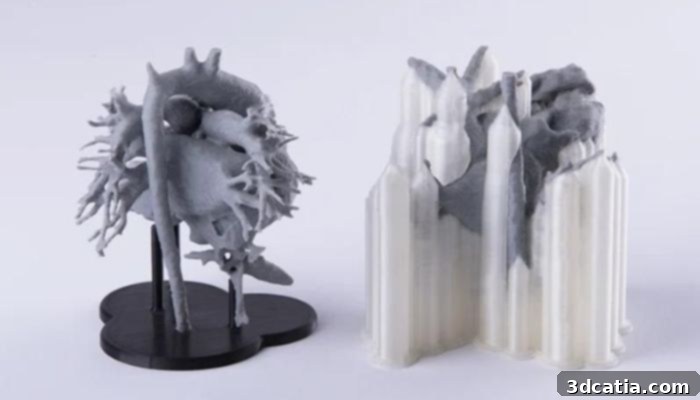
Complex 3D-printed object with supports made of PVA (photo credits: Zortrax)
Key Properties of PVA and HIPS Filaments
Both PVA and HIPS belong to the family of thermoplastic polymers, each boasting distinct chemical compositions and physical attributes that dictate their performance in 3D printing. PVA, or polyvinyl alcohol, is synthetically produced through the alkaline hydrolysis or saponification of polyvinyl acetate (PVAC), a process involving the splitting of chemical bonds via a reaction with water. This manufacturing method directly contributes to PVA’s defining characteristic: its water solubility.
HIPS, on the other hand, is a copolymer formulated from a blend of high-impact polystyrene and polybutadiene rubber. This unique combination gives HIPS its name, “High Impact Polystyrene,” and endows it with properties that marry the elastic qualities of rubber with the rigidity and strength of polystyrene. This makes HIPS a highly versatile material, not just for supports but also for functional parts.
HIPS: A Robust & Impact-Resistant Polymer
In terms of its properties, HIPS bears a strong resemblance to ABS, a widely used 3D printing material, but it distinguishes itself by offering enhanced hardness and superior impact resistance. HIPS is celebrated for its excellent impact strength, lightweight nature, impressive resistance to wear, and remarkable mechanical resilience. Objects printed with HIPS typically feature a smooth, scratch-resistant surface and exhibit antibacterial properties, adding to its appeal for various applications. Despite its hardness, HIPS is not brittle, making it a reliable choice for parts that need to withstand physical stress.
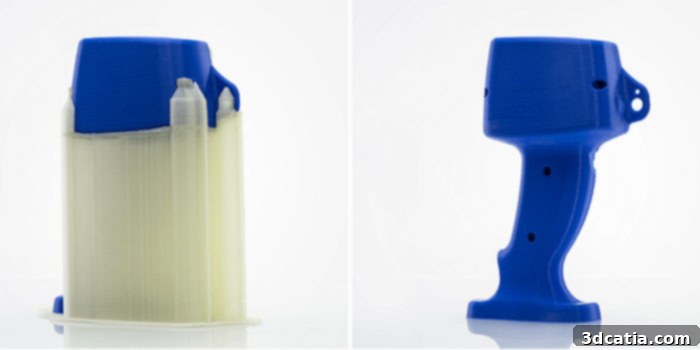
HIPS as a support structure (photo credits: Zortrax)
PVA: The Water-Soluble Marvel
PVA stands in stark contrast to HIPS, particularly concerning its interaction with water. While inherently brittle and somewhat fragile, PVA progressively gains elasticity and flexibility upon absorbing moisture. Water acts as a plasticizer for PVA, eventually leading to its dissolution. The rate at which PVA dissolves is influenced by its specific composition and degree of saponification, or hydrolysis. Typical PVA types used in 3D printing have a hydrolysis degree ranging from 70 to 100 mol%. This degree directly impacts the material’s melting point and its dissolution speed. A significant advantage of PVA is its environmental friendliness; once dissolved in water, the solution can usually be safely disposed of, making it a sustainable choice for support structures. However, due to its inherent water solubility, PVA is entirely unsuitable for creating durable, standalone objects, unlike HIPS. Its primary strength lies precisely in this solubility, making it an outstanding and convenient material for easily removable supports.
When pairing PVA with a main printing material, it’s crucial to select materials with similar melting points to avoid printing errors, such as PLA. The theoretical melting point for PVA is approximately 230°C, though this can vary from 160°C to 180°C for fully hydrolyzed forms. HIPS, by comparison, has a melting point around 220°C.

Unlike HIPS, PVA dissolves easily in water (photo credits: XYZ Printing)
Chemical Interactions and Compatibility
While HIPS resists water, it is susceptible to breakdown by specific acids, alkalis, organic solvents, and other chemicals. For instance, limonene (a natural solvent derived from citrus peels) and gasoline cause HIPS to become brittle, discolor, and ultimately decompose. This chemical reactivity is leveraged when HIPS is used as a support material. Post-processing involves treating the printed object with limonene, causing the HIPS supports to degrade and detach. However, this also implies that HIPS cannot be used as a support for main printing materials that react adversely to limonene or similar solvents. Printing with HIPS supports is ideally paired with ABS, which is notably resistant to such acids. Conversely, HIPS is generally unsuitable for supporting PLA or PETG due to potential incompatibility during the dissolution process. For these materials, PVA remains the superior choice for support structures.
In terms of mechanical properties like tensile strength, both PVA and HIPS exhibit relatively low values, typically around 22 MPa, indicating they are not inherently highly flexible in their solid state. However, as noted, PVA’s flexibility significantly increases when exposed to water. Both materials are generally non-toxic and odorless during handling, though HIPS printing can sometimes produce unpleasant fumes, notably styrene, necessitating proper ventilation. Visually, PVA is naturally transparent to a cream-colored hue. HIPS is commonly available as a white filament, which can be easily colored if intended for standalone applications. For support structures, the natural color of either material is largely inconsequential, as they are ultimately removed.
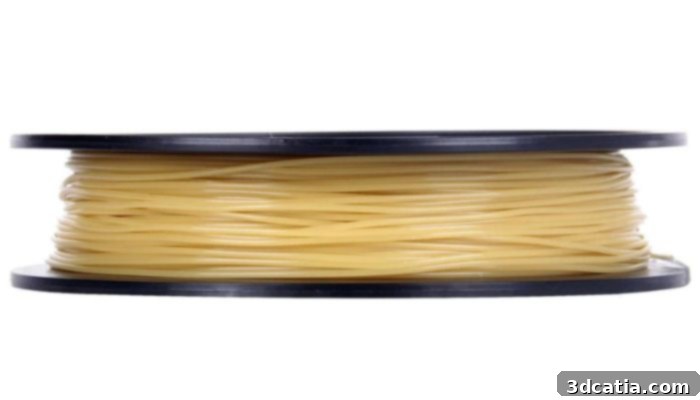
PVA spool from ESUN (photo credits: ESUN)
Optimizing Your 3D Printing Process with PVA and HIPS
Storage Requirements: A Crucial First Step
Proper storage is paramount for successful 3D printing with both PVA and HIPS. PVA filament is particularly sensitive to moisture and must be stored in a cool, dry place, shielded from both natural and artificial light, as well as dust. Both HIPS and PVA possess limited resistance to UV light, which can degrade their properties over time. For PVA, an optimum storage temperature ranges from 15 to 25 °C. PVA’s hygroscopic nature means it readily absorbs atmospheric moisture, which can lead to significant printing problems such as warping, bubbling, stringing, and extruder clogging. If PVA has absorbed moisture, it absolutely must be dried before use, typically requiring 8 to 12 hours at temperatures between 50 and 80 °C. To proactively prevent moisture absorption, storing PVA in an airtight container with desiccant packets is highly recommended. HIPS, in contrast, is far less hygroscopic and generally does not require pre-drying before printing, simplifying its storage requirements.
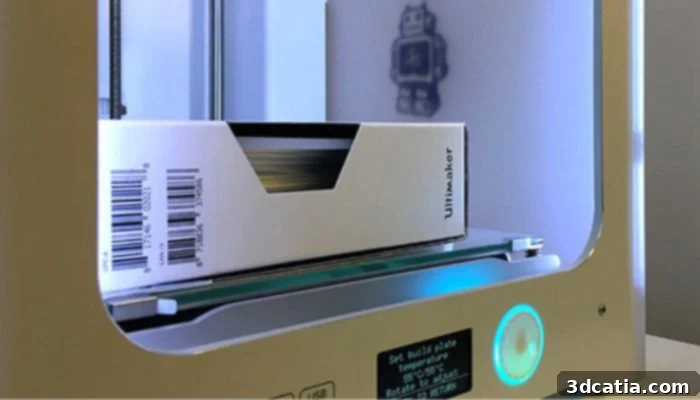
PVA is dried on the print bed (photo credits: IGO3D)
The Printing Process: Settings and Compatibility
When utilizing support materials, a critical configuration setting is the distance between the support structure and the main printed part. For optimal surface finish and easy removal, it is generally recommended to set this distance to zero layers. This allows the support to adhere closely during printing, ensuring robust support, yet its eventual dissolution or chemical breakdown means perfect separation is guaranteed, preventing segregation or surface imperfections on the final object.
Achieving good print bed adhesion is vital for both materials. For HIPS, solutions like glue sticks or adhesive tapes are effective. An ABS and acetone slurry (often called “ABS juice”) can also be applied to the print bed to enhance adhesion. For PVA, painter’s tape often provides an ideal surface for reliable adhesion without excessive sticking.
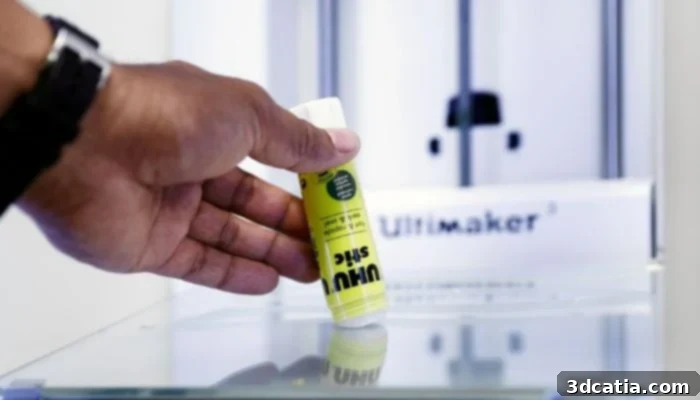
To make HIPS better adhere to the print bed, you can use glue (photo credits: Makerbot)
Temperature Settings
For PVA, the print bed should be preheated to 45 to 60 °C, and the extruder temperature should be maintained between 185 and 200 °C. HIPS, conversely, demands significantly higher temperatures: a print bed temperature of 100 to 115 °C and an extruder temperature ranging from 230 to 245 °C are necessary for optimal results.
Material Compatibility & Environmental Controls
As a general rule, a support material should have a similar melting temperature to the main printed object to ensure good adhesion during the print and prevent thermal discrepancies. PVA is best suited for supporting materials like PLA, TPLA, PETG, and CPE. HIPS is predominantly used with ABS. The primary reason for this specific pairing is that, unlike many other common printing materials, ABS is largely unaffected by limonic acid (D-limonene), the solvent employed to dissolve HIPS supports. This chemical compatibility ensures that the main part remains intact while the support is removed.
For PVA printing, it’s advisable to use an ooze shield to protect both the main part and the supports from oozing filament, which can occur if a nozzle remains heated but inactive, potentially leading to clogs. Additionally, cooling the parts during PVA printing is recommended as it accelerates plastic solidification, thereby reducing stringing and enhancing overall print quality. With HIPS, particularly when printed in a heated chamber, an ooze shield is often not necessary, and the use of a cooling fan is generally not required.
When printing with HIPS, especially given its high temperature requirements, operating the printer within a closed enclosure is highly recommended. This helps to stabilize the temperature around the printed object, minimizing the risk of warping, curling, or delamination caused by sudden temperature fluctuations. Furthermore, an efficient ventilation system or a HEPA air filter is crucial when printing HIPS due to the potential emission of unpleasant and potentially harmful styrene fumes. PVA, being largely odorless and non-toxic during printing, does not require these same stringent ventilation measures.
PVA generally requires a slower printing speed, approximately 30 mm/second, due to its inherent fragility and characteristics. This slower pace helps ensure better adhesion and reduces the chance of print failures. HIPS, being more robust, can be printed at higher speeds, typically ranging from 40 to 80 mm/sec. Both filaments are relatively straightforward to print once the printer is properly configured. A common issue with HIPS is shrinkage during cooling, which can lead to warping in standalone objects. However, when HIPS is employed purely as a support structure, this warping effect is usually inconsequential, as the support is destined for removal.
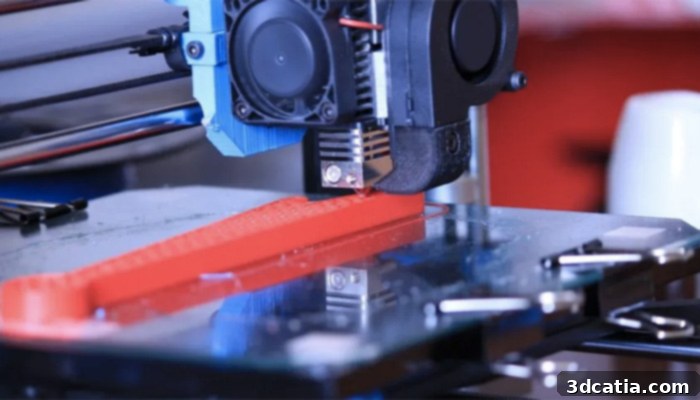
Just like ABS, HIPS tends to curl and warp under pressure (photo credits: Sculpteo)
Post-Processing: Simplicity vs. Chemical Removal
One of PVA’s most compelling advantages lies in its incredibly simple post-processing. After printing, the entire object with its PVA supports is simply submerged in a bath of warm water. Within 1-2 hours, depending on the volume of support and water temperature, the PVA fully dissolves, leaving behind the pristine final part. The resulting water solution, being biodegradable, can be safely poured down the drain, making PVA an exceptionally convenient and environmentally conscious choice.
Post-processing with HIPS supports, however, involves a more elaborate and chemically intensive procedure. The supports are removed by dissolving them in limonene, a specialized organic solvent. This process necessitates careful handling and adherence to safety protocols, including the use of a respiratory mask and protective gloves, as limonene can be an irritant. Limonene can also be relatively expensive, so a practical tip is to manually break away larger HIPS support structures before submerging the part in the chemical solution. This reduces the amount of limonene required and speeds up the dissolution process, ultimately saving costs and time. Despite the added complexity, HIPS remains a highly effective support for compatible materials like ABS.
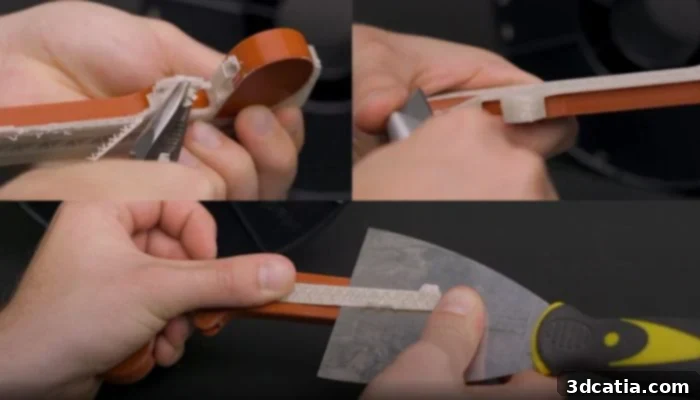
If HIPS is used as a support material, it is beneficial to cut away the larger pieces before machining the part with limonene (photo credits: MatterHackers)
Applications of PVA and HIPS in 3D Printing and Beyond
While their primary role in 3D printing is as dissolvable support structures for other materials, both PVA and HIPS possess versatility that extends beyond this function. PVA, for example, can be employed in the creation of prototypes and molds where temporary structures are beneficial. Its ability to dissolve makes it ideal for sacrificial molds or for demonstrating complex internal geometries that would otherwise be inaccessible. In the design field, PVA finds uses in producing decorative models that require a smooth finish without visible support remnants.
HIPS offers even broader applications beyond supports. Its inherent lightness, high impact resistance, and durability make it a popular material for manufacturing toys and children’s articles, where robustness and safety are paramount. The automotive industry frequently utilizes HIPS for interior components such as dashboards due to its mechanical properties and ease of processing. Furthermore, HIPS is a common material for housings for electrical and electronic devices, offering protection and a good aesthetic finish. The packaging industry also extensively uses HIPS; many takeaway meal trays and cosmetic packaging containers are made from this versatile polymer. However, it is crucial to reiterate that in the context of 3D printing, both PVA and HIPS are primarily valued for their indispensable role as support materials, enabling the creation of otherwise unprintable designs.
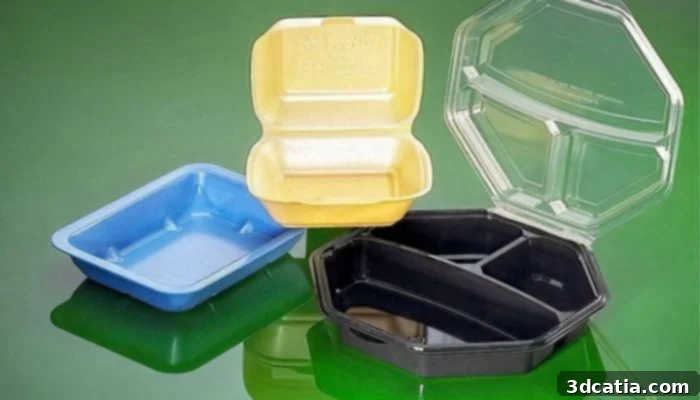
HIPS is used as a stand-alone material for packaging (photo credits: Plastics Technology)
Manufacturers and Pricing Considerations
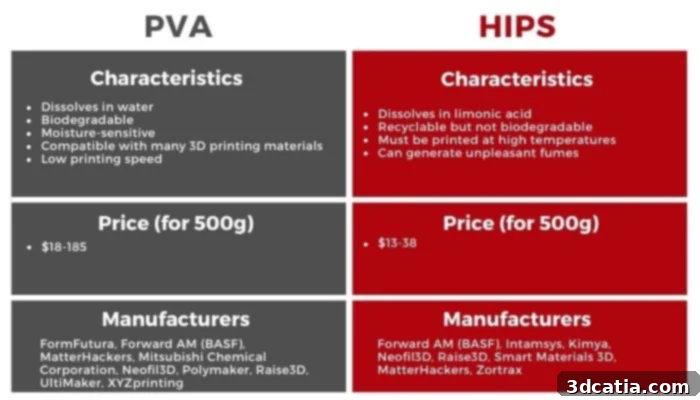
PVA filament is readily available on the market in standard diameters of both 1.75 mm and 2.85 mm. Before purchasing, always confirm that the filament diameter is compatible with your 3D printer’s extruder. The price of a 500-gram spool of PVA filament typically ranges from $18 to $185, with an average price point around $50. However, prices can fluctuate significantly depending on the brand, quality, and specific chemical composition. Prominent manufacturers offering PVA filaments include Arianeplast, eSUN, FormFutura, Forward AM (BASF), Infinite Material Solutions, INNOVATEFIL, MatterHackers, Mitsubishi Chemical Corporation, Neofil3D, Polymaker, PrimaCreator, Raise3D, RS PRO, UltiMaker, and XYZprinting.
HIPS filament is generally more economical than PVA. A standard spool of HIPS filament can be found for prices ranging between $13 and $38, making it a more budget-friendly option. Reputable manufacturers of HIPS filaments include Arianeplast, eSUN, Forward AM (BASF), Intamsys, Kimya, Nanovia, Neofil3D, Raise3D, RS PRO, Smart Materials 3D, MatterHackers, and Zortrax. An important consideration when selecting HIPS is to pay close attention to its specific composition, as not all HIPS filaments are identical. Some may contain additives designed to improve the printing process, but these additives can, in certain cases, make the post-printing removal of the support structure more challenging. Always check product specifications and user reviews when making your choice.
Do you currently use PVA or HIPS as a support material for your 3D printing projects? Share your experiences, tips, and preferences in the comments section below, or connect with us on our LinkedIn, Facebook, and Twitter pages! Don’t forget to subscribe to our free weekly Newsletter here to get the latest 3D printing news delivered straight to your inbox. You can also explore all our informative videos on our dedicated YouTube channel.