
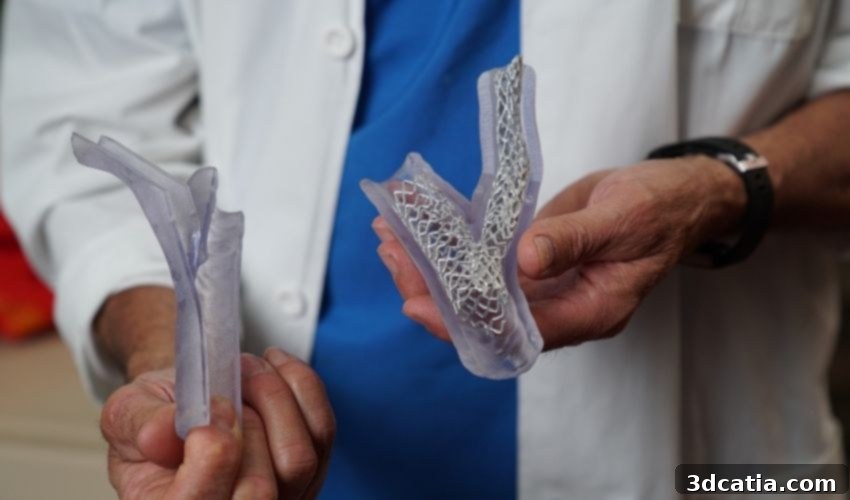
Stratasys 3D Printers Revolutionize Medical Education and Cardiac Research at University of Minnesota’s Visible Heart Laboratories
The dynamic fields of education and medicine have consistently embraced the transformative potential of additive manufacturing. Recognizing the immense value this technology brings, global leader Stratasys has forged a powerful partnership with the University of Minnesota Medical School. In a significant move to advance medical training and research, Stratasys has generously donated an array of cutting-edge 3D printers, including their flagship J750™ Digital Anatomy™ 3D printers, alongside MakerBot METHOD X® and MakerBot SKETCH® 3D printers, to the renowned Visible Heart Laboratories. This strategic donation aims to equip students with invaluable insights into the diverse applications of 3D printing within the medical landscape, while simultaneously enriching their understanding of intricate cardiac anatomy through unparalleled realism and hands-on experience.
The concept of utilizing 3D printing to fabricate precise anatomical models for both educational instruction and pre-surgical planning is a well-established practice within the medical community. The level of accuracy achievable with these models can be truly remarkable, varying significantly depending on the specific additive manufacturing technology employed. In particular, material jetting technology, exemplified by Stratasys’ PolyJet platform, stands out for its ability to replicate not only intricate forms but also realistic colors and even textures, thereby creating an immersive and highly accurate learning experience. This advanced capability is precisely what Stratasys has brought to the Visible Heart Laboratories with the J750 Digital Anatomy printer. Complementing this, the donation also includes robust FDM (Fused Deposition Modeling) printers from MakerBot, which offer versatile and accessible solutions for various prototyping and educational needs.
Dr. Paul Iazzo, a distinguished professor at the Visible Heart Laboratories within the University of Minnesota Medical School, has emphatically underscored the transformative utility of 3D printing within their facility. He remarked, “Mixed reality education utilizing high resolution 3D printing greatly impacts our abilities to better educate residents, fellows, medical students, biomedical engineers and many others.” This statement highlights how these tangible, highly accurate models seamlessly integrate with digital learning environments, offering a holistic educational approach that surpasses traditional methods. Students can now physically interact with complex cardiac structures, gaining a depth of understanding that was previously unattainable through textbooks or even cadaveric dissection alone, fostering a new generation of medical professionals with unparalleled anatomical comprehension.
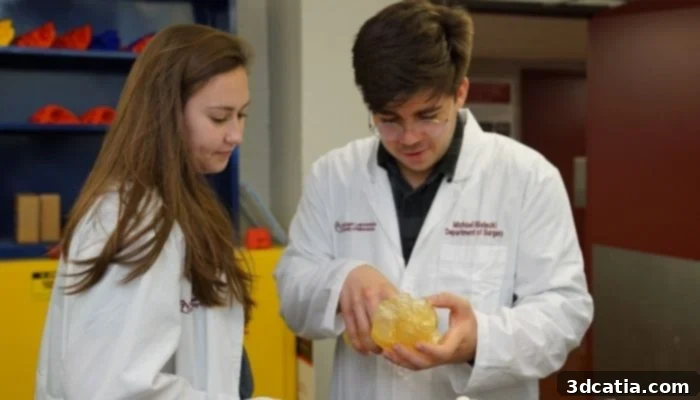
Two students examine a replica of a heart made using Stratasys’ 3D technology (photo credits: Stratasys)
Strategic Philanthropy: Stratasys’ Vision for Advancing Healthcare Innovation
In its official press release, Stratasys meticulously outlined the multifaceted benefits that this generous donation will bring to the Visible Heart Laboratories and the broader University of Minnesota community through the strategic integration of 3D printing technology. The foremost advantage, as expected, lies in the realm of enhanced medical education. Beyond merely presenting exact replicas of the human heart, these advanced models will serve as critical tools to demonstrate how precise anatomical models can profoundly assist physicians in their daily practice. This hands-on learning extends far beyond academic understanding, bridging the gap between theoretical knowledge and practical application in real-world clinical scenarios.
Moreover, the utility of these patient-specific models extends significantly to direct patient engagement and communication with the medical team. Surgeons can now leverage these tangible anatomical models to vividly illustrate complex conditions and proposed treatment plans to their patients. This visual and tactile aid empowers patients to grasp what is occurring within their own bodies, leading to improved understanding, reduced anxiety, and ultimately, more informed consent for critical procedures. For the surgical team, these models become indispensable planning tools, enabling them to meticulously strategize treatment options and rigorously prepare for upcoming surgeries. Given the staggering volume of cardiac operations performed annually – exceeding an estimated 900,000 procedures each year in the United States alone, with projections indicating further growth – the ability to refine surgical planning is invaluable. This precision contributes significantly to reducing the mortality rates associated with prevalent cardiovascular diseases such as coronary artery disease, heart attacks, arrhythmias, and many more. By utilizing highly accurate anatomical models for pre-operative planning and intra-operative guidance, healthcare providers can achieve superior patient outcomes, significantly reduce the duration of surgical procedures, and realize substantial cost savings for hospitals and healthcare facilities.
Beyond the Operating Room: Advancing Medical Device Development and Research
The impact of Stratasys’ donation extends well beyond direct teaching and surgical applications, venturing deep into the realm of medical device innovation and groundbreaking research. 3D printing plays a pivotal role in the accelerated creation and testing of coronary medical devices. By leveraging precise anatomical models, researchers and engineers can design and develop devices that perfectly mimic actual human anatomy and pathology. This capability dramatically streamlines the prototyping process, allowing for rapid iteration and refinement of new instruments, implants, and prosthetics, ultimately leading to safer, more effective medical solutions that are tailored to individual patient needs. This directly contributes to a faster time-to-market for innovative medical technologies, ensuring that critical advancements reach patients sooner.
Furthermore, these advanced 3D printing capabilities will significantly bolster the University of Minnesota’s esteemed Atlas of Human Cardiac Anatomy. This unparalleled collection currently houses over 800 meticulously preserved hearts, each representing a unique case study in cardiac morphology and pathology. The ability to recreate these intricate specimens with high-fidelity 3D printing revolutionizes their utility. This means that researchers, educators, and device developers can now have access to exact physical replicas of these rare hearts, facilitating detailed study, comparative analysis, and rigorous testing of new medical devices without compromising the original specimens. This digital and physical library of 3D printed hearts represents an invaluable resource for understanding the vast spectrum of cardiac conditions and for training future generations of cardiologists and cardiovascular surgeons.
Rich Garrity, President of Americas for Stratasys, articulated the profound vision behind this philanthropic endeavor, stating, “We believe that widespread use of 3D printed anatomic models in healthcare would translate into better and more cost-effective patient care and shorter time to market for new medical device innovations. This sponsorship allows us to support the world-class education and medical device research happening right here in Minnesota.” This sentiment underscores Stratasys’ commitment not only to technological advancement but also to fostering an ecosystem where innovation directly translates into tangible improvements in human health. By empowering institutions like the University of Minnesota, Stratasys is helping to shape the future of medicine, where personalized care, precision surgery, and rapid innovation become the standard. This collaboration serves as a powerful testament to the synergistic relationship between cutting-edge technology and dedicated medical expertise, promising a brighter future for patients and healthcare providers alike. You can find out more details in the official press release HERE.
What are your thoughts on the profound impact of 3D printing in medical education and healthcare innovation? We invite you to share your insights in a comment below or join the conversation on our Linkedin, Facebook, and Twitter pages! Don’t forget to sign up for our free weekly Newsletter here to receive the latest 3D printing news directly to your inbox. You can also explore all our informative videos and content on our dedicated YouTube channel.
Cover Photo Credits: Stratasys