
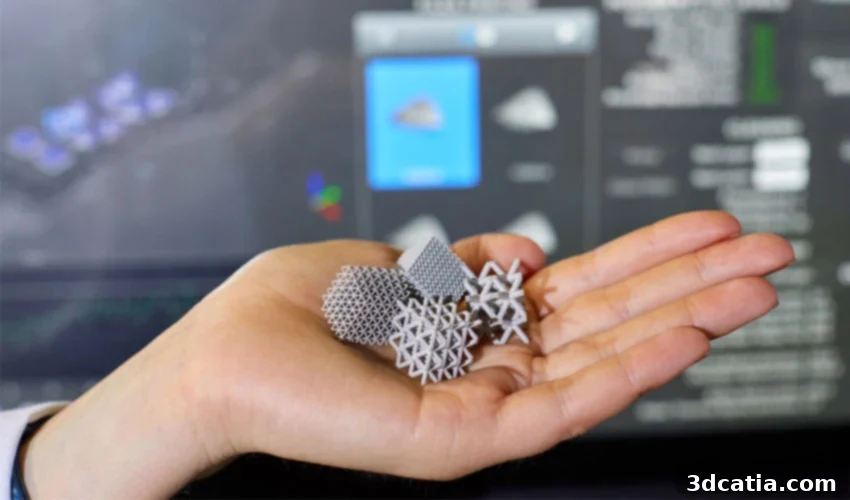
Mastering Binder Jetting 3D Printing: A Comprehensive Guide to Materials, Advantages, and Industrial Applications
Binder Jetting stands as a prominent and highly versatile additive manufacturing process within the dynamic landscape of modern industrial production. This innovative 3D printing method distinguishes itself by employing a unique mechanism: the selective deposition of a liquid binder, in the form of micro-droplets, onto a meticulously prepared bed of powdered material. This powder can range from metals, often requiring subsequent sintering for densification, to specialized sands for intricate foundry molds, advanced ceramics for high-performance applications, and even sophisticated composites. The process systematically builds parts layer by layer, solidifying the desired geometry with remarkable precision and detail. Depending on the specific binder and powder combination chosen, subsequent post-processing steps, such as curing, debinding, and sintering, are often crucial to achieve the final mechanical, structural, and aesthetic properties of the manufactured components.
Renowned for its unparalleled flexibility in material compatibility and offering extensive design freedom, Binder Jetting also boasts an impressive capability for producing large-format parts and facilitating high-volume, batch production. These inherent strengths position it as a critical and transformative technology for numerous manufacturers across diverse industries, from the demanding sectors of automotive and aerospace to precision medical devices and innovative consumer goods. However, for companies contemplating the integration of Binder Jetting into their existing or future production workflows, several key strategic considerations arise. What are the definitive strengths that make it a compelling choice for specific applications, and what challenges must be effectively identified and navigated for successful implementation? To illuminate these pertinent questions and provide practical insights, we’ve engaged with leading experts in the field, gathering their invaluable perspectives on this powerful additive manufacturing technology.
Our esteemed panel of experts brings a wealth of specialized knowledge to this comprehensive discussion. First, we have Andreas Müller, Product Manager at ExOne, a recognized global leader in Binder Jetting technology. Andreas’s primary focus lies in developing and significantly improving the capabilities of industrial sand 3D printing machines, an area where ExOne excels, particularly with systems designed for large-scale sand applications in foundry and other industrial contexts. Our second expert is Lefteris Havouzis, Managing Director of Lino3D. His Greek company specializes in providing crucial support to businesses and manufacturers in their additive manufacturing endeavors, leveraging deep expertise across various processes, including the intricate complexities of metal Binder Jetting for high-performance components. Completing our expert lineup is Vincent Poirier, the visionary founder and president of Novadditive. Novadditive stands out as the first custom production center dedicated to ceramic parts utilizing multi-process 3D printing, making Vincent a leading authority on the specialized applications and challenges of ceramic Binder Jetting. Their collective experience provides a comprehensive and practical overview of the technology’s immense potential and the practical considerations across its most prevalent material applications.
- Andreas Müller
- Lefteris Havouzis
- Vincent Poirier
Delving into the Mechanics: How Does Binder Jetting Work?
Like any advanced additive manufacturing process, Binder Jetting is utilized to produce a part by meticulously superimposing successive layers of material. The process initiates with the preparation of a powder bed, where a thin, uniform layer of powdered material is spread across the build platform. For optimal results, the powder particles are ideally spherical in shape and typically possess a diameter in the micrometer range, attributes that significantly contribute to consistent packing density and superior flowability within the powder bed. Once a precise layer of powder is spread, a sophisticated print head, remarkably similar in principle to those employed in conventional 2D inkjet printers, travels rapidly and accurately across the entire bed. This print head selectively deposits micro-droplets of a specialized liquid binder onto specific locations, guided by the precise digital instructions derived from a computer-aided design (CAD) model. The binder then acts as an adhesive, selectively gluing the powder particles together to form the cross-sectional geometry of the part for that particular layer.
After a layer is successfully completed, the build platform is lowered incrementally, and a fresh, uniform layer of powder is spread over the newly bound section. This precise process is meticulously repeated, layer by layer, with the binder selectively joining powder particles, until the entire three-dimensional object is fully formed and encased within the surrounding unbound powder bed. Andreas Müller of ExOne vividly describes the iterative nature and inherent efficiency of this method: “Similar to the rapid and precise process of printing on sheets of paper, the Binder Jetting process is repeated layer by layer. It meticulously follows a digital map derived from a CAD design file, continuing this sequence until the entire object is complete. After the printing phase concludes, an entire job box filled with multiple parts can typically be processed and removed from the print area in about half a day, showcasing the technology’s capability for efficient batch production. Depending on the specific material and binder combination employed, additional curing steps and subsequent post-processing may be necessary to achieve the desired final mechanical properties and robust structural integrity.” This ability to simultaneously produce multiple parts within the same build volume, supported by the surrounding powder, significantly enhances productivity and positions Binder Jetting as an exceptionally attractive option for serial and customized batch manufacturing.
As can be observed, the Binder Jetting process fundamentally requires two distinct material components to function optimally: the chosen 3D printing material in its precise powder form and a specifically formulated liquid binder. What is particularly noteworthy and advantageous about Binder Jetting is the remarkable diversity of materials that are compatible with this market-leading process. This broad material palette sets it apart from many other additive manufacturing techniques, which often have more restrictive material libraries. This expansive material compatibility significantly broadens the scope of potential applications across various industrial sectors, establishing Binder Jetting as a highly adaptable and future-proof solution for complex and diverse manufacturing challenges.
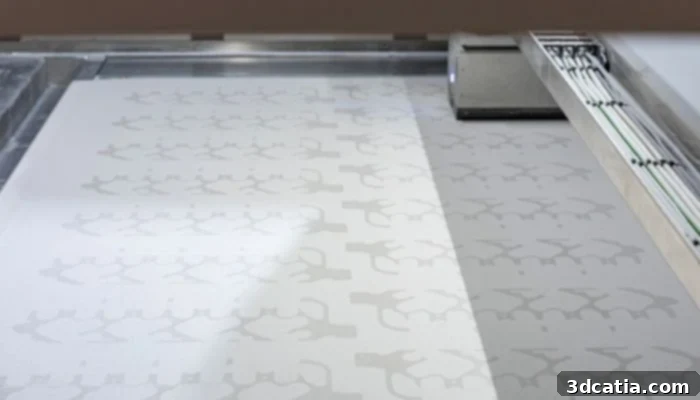
During jetting, binder is selectively placed on the material, sand in this example (photo credits: ExOne)
Unrivaled Material Flexibility in Binder Jetting for Diverse Applications
One of Binder Jetting’s most compelling and advantageous attributes is its extraordinary material compatibility, extending across a remarkably broad spectrum of powdered materials. This includes various engineering metals, specialized industrial ceramics, readily available sands, and even advanced composites. This inherent versatility makes it a technology exceptionally capable of addressing an expansive range of demanding applications across numerous, highly specialized sectors, from heavy industry to high-tech manufacturing.
Sand Binder Jetting: Precision for Foundry and Beyond
For instance, sand Binder Jetting has successfully carved out a significant and irreplaceable niche, particularly in the rapid design and precision production of highly intricate foundry cores and molds. This application fundamentally revolutionizes traditional casting processes by completely eliminating the often expensive, time-consuming, and labor-intensive need for conventional tooling, while simultaneously offering unprecedented design freedom for creating complex internal geometries, intricate undercuts, and fine features that are impossible with traditional methods. Andreas Müller meticulously details ExOne’s advanced approach in this domain: “ExOne sand 3D printing strategically utilizes high-quality foundry grade sand in conjunction with specialized, high-performance binders to accurately create complex metalcasting molds and precision cores. Beyond these indirect manufacturing applications, sand can also be precisely printed into other highly complex designs and subsequently infiltrated with resin to form durable, robust, and functional end-use parts. The specific combination of print media and binder is always meticulously customized for each unique application to ensure optimal performance, structural integrity, and material properties. Our advanced 3D printers are engineered to handle a wide variety of sandcasting materials, including commonly used silica sands and high-performance ceramic sands, each offering distinct advantages. Furthermore, a diverse range of binders, such as furan, phenolic, and inorganic binders, are readily available to facilitate the casting of a broad spectrum of alloys, from lightweight and strong aluminum and magnesium to robust iron and high-strength steel.” This remarkable adaptability underscores its profound value for both rapid prototyping of molds and the efficient production of complex, high-performance functional components.
Metal Binder Jetting: Enabling Complex Geometries and Advanced Alloys
Shifting our focus to metals, Binder Jetting also demonstrates remarkable material diversity, making it an increasingly compelling alternative to more conventional and often restrictive metal additive manufacturing techniques. Lefteris Havouzis highlights this inherent adaptability and its strategic importance: “In general, nearly all engineering alloys can be effectively processed and subsequently sintered with Binder Jetting. This primarily encompasses a wide range of iron-based alloys such as various stainless steels, robust tool steels, high-performance nickel-based superalloys, chromium-cobalt alloys, as well as challenging-to-weld and refractory alloys. A particularly crucial and differentiating advantage of Binder Jetting is its exceptional capability to effectively work with alloys that are notoriously difficult or even impossible to process successfully using conventional laser-based additive manufacturing techniques, often due to inherent issues like cracking, high reflectivity, or specific thermal sensitivities.” This profound capability opens significant doors for critical industries such as aerospace, automotive, and medical, where the demand for high-performance, complex metal parts with intricate internal structures and superior material properties is constantly increasing.
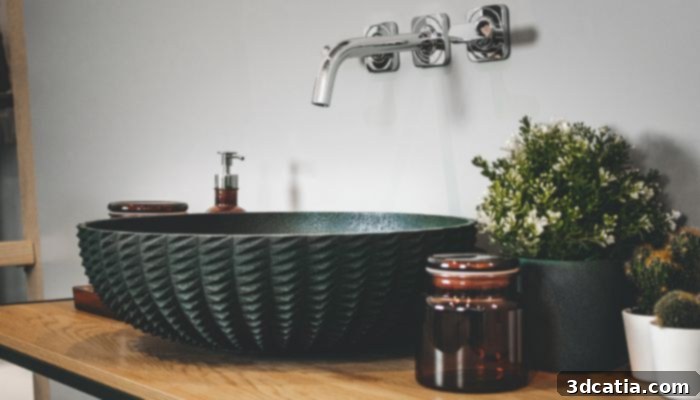
Though often used for indirect processes, sand binder jetting can also create durable end-use parts (photo credits: ExOne)
It is critically important to remember that for metal Binder Jetting, a crucial and typically multi-stage sintering process following the initial printing phase is always absolutely necessary. Immediately after emerging from the 3D printer, the part, often referred to as a “green part,” is inherently highly fragile and porous, lacking its final structural integrity. It therefore requires precise and carefully controlled thermal treatment in a specialized furnace to fully densify the material, consolidate the individual powder particles, and ultimately achieve its final robust mechanical properties, desired hardness, and specific microstructure. A distinct and significant advantage over some other metal 3D printing processes, such as Powder Bed Fusion (e.g., DMLS/SLM), is that metal Binder Jetting typically does not require extensive and complex print support structures. The surrounding unbound powder within the build box naturally acts as a highly effective support structure for the part during the entire printing process, significantly simplifying both the design phase and subsequent post-processing steps.
Ceramic Binder Jetting: Tailored for Extreme Environments
Finally, on the highly specialized ceramics side, Binder Jetting is also one of the leading technologies increasingly employed by advanced manufacturers for the creation of intricate, high-performance ceramic components. Vincent Poirier provides crucial insights into both the theoretical possibilities and practical realities: “Theoretically, all types of ceramics are potentially compatible with Binder Jetting, provided that a suitable and highly effective binder has been specifically developed that effectively interacts with the ceramic particles, and crucially, that high-quality powders with spherical grains or exceptional flowability can be consistently produced. In practical application, however, the specific ceramics developed for this process must offer a distinct and compelling advantage or address a unique functional challenge that competing additive manufacturing technologies cannot effectively or economically overcome.” This expert perspective profoundly emphasizes that the specific application itself is absolutely paramount when considering ceramic powder bonding. Manufacturers must have a very specific project or a highly demanding functional requirement in mind, such as extreme temperature resistance, superior chemical inertness, exceptional wear resistance, or unique biocompatibility, otherwise, the justification for choosing this complex and specialized process may not be fully realized or economically viable. Commonly utilized and high-performance ceramics in Binder Jetting include advanced materials like alumina, zirconia, boron carbide, and infiltrated silicon carbide, each offering unique and specialized properties for highly demanding industrial applications.
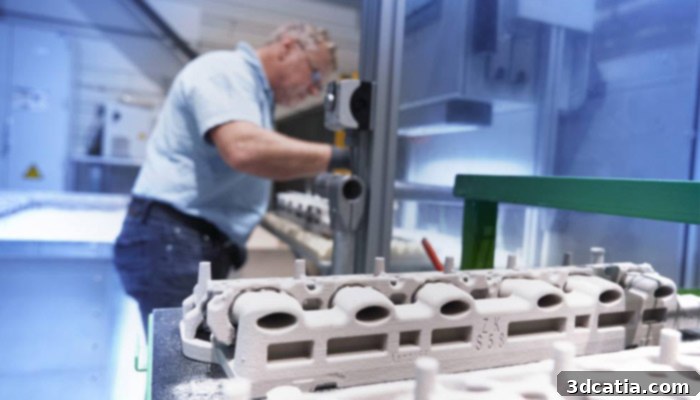
Sand binder jetting is widely used to create molds and cores (photo credits: BMW Group)
Key Advantages and Current Limitations of Binder Jetting Technology
As thoroughly explored, one of the foremost and most compelling advantages of powder bonding, or Binder Jetting, is its remarkable and expansive material compatibility. While it is important to acknowledge that the immediate range of directly printable metals, for example, may initially seem more limited compared to some laser-based processes (such as DMLS/SLM), the unparalleled ability to judiciously combine various specialized powders with specific binders for diverse and demanding applications offers an unparalleled degree of flexibility and innovation potential. This inherent adaptability allows manufacturers to experiment with and ultimately produce components from materials that might otherwise be significantly challenging or even impossible to process effectively with other conventional or even advanced 3D printing methods.
Advantages: Speed, Scale, and Design Freedom
Beyond its impressive material flexibility, Binder Jetting is also widely lauded for its inherent capacity to efficiently produce exceptionally large parts, constrained only by the physical build volume of the machine itself. This remarkable capability stems from a critical and distinguishing aspect of the process: the printing stage occurs entirely at room temperature. This fundamental characteristic completely eliminates the significant risk of thermal distortion, warping, or the build-up of detrimental residual stresses, issues frequently encountered in other additive manufacturing processes that rely on high-temperature melting or curing mechanisms, such as laser-based or extrusion methods. Consequently, users gain the confidence and freedom to design and subsequently manufacture significantly larger, more intricate, and structurally complex parts without compromising dimensional accuracy or incurring material defects.
Lefteris Havouzis of Lino3D further highlights the profound operational efficiencies and strategic advantages: “If we undertake a comparative analysis of Binder Jetting with other established technologies prevalent in the metal industry, we should generally emphasize a significantly greater freedom of design, a substantial reduction in both manufacturing lead times and time-to-market due to the complete absence of dedicated and expensive tooling, and a much greater complexity in the production mix that we can effectively achieve. For instance, within the exact same print job, we possess the capability to print dozens of different batches or unique part designs without requiring any modifications, reconfigurations, or costly downtime between them.” This exceptional batch production capability, synergistically combined with the inherent absence of complex print supports, directly translates into faster turnaround times and significantly reduced overall costs per part, making Binder Jetting an ideal solution, particularly for high-volume and customized manufacturing scenarios.
In addition to accommodating larger volumes and complex designs, the inherent speed and comparative simplicity of the Binder Jetting process are particularly noteworthy. Andreas Müller elaborates on its superior volumetric output: “Binder Jetting is widely renowned among various additive manufacturing methods specifically for its exceptionally high volumetric output, distinguishing it as a leader in productivity. Among all additive manufacturing technologies, it’s also the most conceptually similar to traditional 2D printing in its straightforward approach and impressive speed. The binder functions much like ink, as it precisely and rapidly moves across the layers of powder, which, analogous to printing on paper, quickly forms the desired final product. By stark contrast, many other forms of 3D printing construct parts with a single point — often a laser or a nozzle — that extrudes, melts, or welds material together in a linear fashion. Such point-by-point processes inherently require significantly more material and considerably more time to meticulously ‘draw out’ each part with that single point, layer by layer, leading to substantially slower build speeds.” Binder Jetting machines, conversely, can simultaneously deposit numerous micro-droplets of binder across vast areas in a single pass over the entire powder bed, drastically reducing per-part manufacturing time and substantially increasing overall productivity. It is crucial to acknowledge, however, that while the initial printing phase is remarkably fast, the essential and often time-intensive post-processing steps can subsequently lengthen the total production cycle.
Limitations and Challenges: Navigating Post-Processing and Material Properties
Indeed, post-processing represents one of the most significant considerations, and in certain contexts, a notable limitation, of Binder Jetting technology, particularly when working with advanced metal and ceramic powders. Achieving the desired robust mechanical properties, precise dimensional accuracy, and optimal material density necessitates critical debinding and subsequent sintering steps. Debinding is the crucial process that meticulously removes the binder material from the “green part” after printing, typically through thermal or chemical means, leaving behind a porous structure of raw powder. Following this, sintering involves heating the part to a precisely controlled high temperature, often just below its melting point, causing the individual powder particles to fuse together and the part to densify. These complex processes add considerable time, specialized equipment, and expertise to the overall manufacturing workflow and can profoundly affect the final part’s dimensions, microstructure, surface finish, and overall integrity.
Lefteris from Lino3D strongly emphasizes the criticality of this intricate stage: “When evaluating this transformative technology, it is absolutely imperative to understand that the sintering phase is arguably the most critical and complex stage of Binder Jetting, where numerous intricate phenomena related to advanced material science, precise thermal expansion, and controlled shrinkage must be meticulously accounted for and managed. Partnering with a specialist who possesses comprehensive expertise across the entire value stream, from initial design optimization through to advanced post-processing and rigorous quality control, can therefore be exceptionally beneficial for mitigating potential risks, optimizing material properties, and ensuring successful outcomes.”
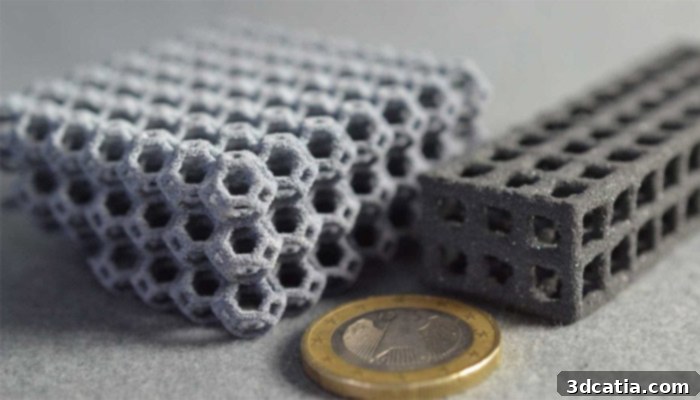
The use of ceramics requires post-processing (photo credits: WZR)
The outcome of these demanding post-processing steps can sometimes result in a final part that is inherently more porous than those produced by full melting processes (such as laser powder bed fusion), potentially leading to slightly weaker mechanical properties or requiring specific design considerations, depending on the material and intended application. Vincent Poirier further concludes on the paramount importance of meticulous material selection for achieving optimal density: “The greater the powder’s intrinsic ability to settle uniformly and densely within the powder bed during printing, the less porous the initial ‘green part’ will be, and consequently, the more robust, dense, and structurally sound the final sintered ceramic component. It is therefore absolutely essential to meticulously choose the right powder, ideally opting for spherical powders which inherently promote superior packing density, enhanced flowability, and more predictable and controlled sintering behavior.” Achieving uniformly dense parts with consistent and reliable mechanical properties remains an ongoing and active area of advanced research and development within the Binder Jetting community. Additionally, while the surface finish of green parts is often quite rough due to the nature of the powder bed, post-sintering parts may still necessitate additional finishing operations like precision machining, grinding, or polishing to meet specific aesthetic, dimensional, or functional requirements.
Expert Advice for Successful Binder Jetting Integration
Integrating Binder Jetting into an existing or new manufacturing ecosystem requires careful strategic planning, a deep understanding of its technological nuances, and a holistic approach. Our esteemed experts provide invaluable final thoughts and actionable advice for successful adoption:
“The most important keyword for success is INTEGRATION: Binder Jetting, much like any other advanced and transformative manufacturing technology, is emphatically not a standalone solution. To truly realize its vast potential, unlock its full benefits, and achieve optimal results, it must be thoughtfully, strategically, and comprehensively integrated into the company’s entire operational ecosystem, spanning from the initial digital design phase, through material selection and printing, all the way through to advanced post-processing, rigorous quality control, and final application.” – Lefteris Havouzis, Managing Director of Lino3D
“Sand 3D printing is an incredibly flexible, adaptable, and highly versatile production technology. It proves exceptionally suitable as a rapid manufacturing method for efficiently producing complex sandcasting tooling, offering unparalleled speed, significant cost savings, and extensive design freedom. Furthermore, it can also be effectively utilized to produce unique, highly customized, and robust functional end-use products for various industries. The paramount consideration is consistently identifying and implementing the precise combination of technology, specifically the machine parameters, and the right material, meaning the optimal sand and binder, that perfectly suits those specific application needs. At ExOne, we are deeply dedicated to offering comprehensive, all-round sand 3D printing support, which includes a dedicated service center for our European customers conveniently located right here in Germany. Through this specialized center, we meticulously guide customers through the myriad of different options, thoroughly evaluate the best possible solutions, and provide expert technical assistance to effectively solve their most pressing and complex production challenges.” – Andreas Müller, Product Manager at ExOne
“For ceramics, it is absolutely crucial to have a very specific, well-defined, and highly demanding application that unequivocally necessitates this particular Binder Jetting technology. As is often the case with other advanced ceramic additive manufacturing technologies, we simply cannot cover all possible scenarios or applications indiscriminately. Moreover, it is critically vital to grasp that the specialized know-how and expertise are not confined solely to the printing process itself. Deep and profound ceramic material know-how is equally important to master, for example, the intricate firing cycles, precise thermal profiles, and critically, understanding and meticulously controlling the complex consequences of sintering shrinkage on the final finished products to ensure exceptional dimensional accuracy, consistent structural integrity, and desired functional performance.” – Vincent Poirier, Founder and President of Novadditive
Do you currently utilize Binder Jetting technology in your operations, or are you actively considering its potential for your next project? We invite you to share your valuable experiences, insights, and questions in a comment below, or connect with us and join the conversation on our Linkedin, Facebook, and Twitter pages! Don’t miss out on the latest advancements, breaking news, and expert analyses in the rapidly evolving world of additive manufacturing – be sure to sign up for our free weekly Newsletter here, delivering the most up-to-date 3D printing news straight to your inbox! You can also explore all our informative videos, insightful interviews, and practical tutorials on our dedicated YouTube channel.
*Cover Photo Credits: Tecnalia