
UMaine Unveils World’s Largest 3D Printer: The Factory of the Future 1.0 Revolutionizing Advanced Manufacturing and Sustainable Solutions
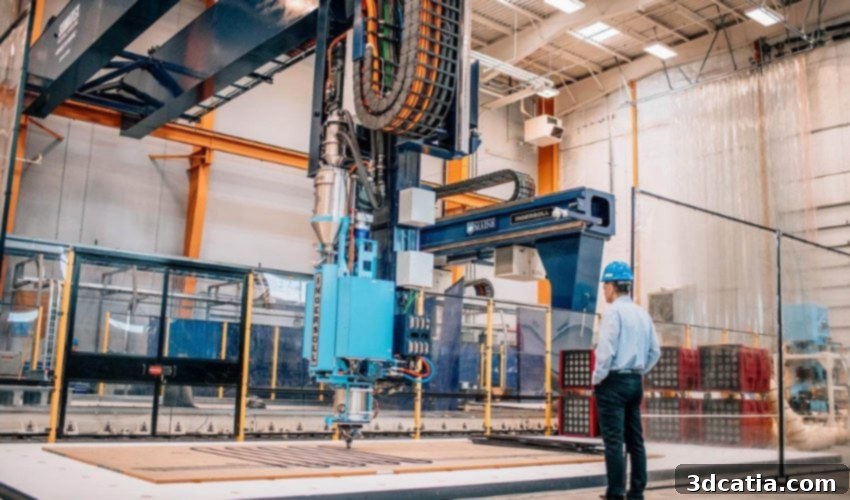
The University of Maine (UMaine) has once again cemented its position at the forefront of innovation in manufacturing with the groundbreaking unveiling of its latest technological marvel: the Factory of the Future 1.0 (FoF 1.0). This monumental achievement not only represents the world’s largest 3D printer but also signifies a colossal leap forward in additive manufacturing technology. Building upon UMaine’s rich legacy of record-breaking accomplishments in large-scale composite and additive manufacturing, the FoF 1.0 surpasses the capabilities of its impressive predecessors, promising to redefine the possibilities of modern production across a multitude of sectors.
Unveiled last week at the cutting-edge Advanced Structures and Composites Center (ASCC) – a hub of engineering excellence – the FoF 1.0 was presented to distinguished representatives from the U.S. Department of Defense, the U.S. Department of Energy, and the Maine State Housing Authority. This event underscored the immense potential of the FoF 1.0 for an extensive range of applications, from defense and infrastructure to energy and housing, highlighting its strategic importance on both national and regional levels. With staggering dimensions, this colossal machine is capable of producing objects up to an astonishing 96 feet long, 32 feet wide, and 18 feet high. Furthermore, it boasts an impressive printing speed of up to 500 pounds per hour, making the FoF 1.0 truly unparalleled in its capacity for large-scale additive manufacturing. Its ability to produce massive structures quickly and efficiently positions it as a game-changer for industries requiring rapid prototyping and fabrication of large components.
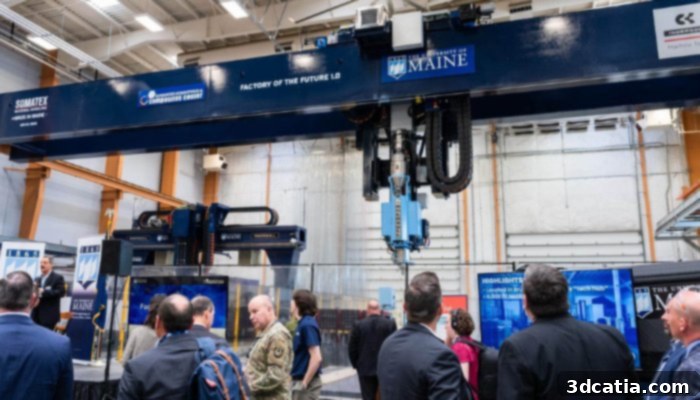
The development of the FoF 1.0 is a testament to the power of collaborative effort, supported significantly by the Office of the Secretary of Defense through the U.S. Army Corps of Engineers. This initiative exemplifies a successful partnership between government entities, industry leaders, and academic institutions, all united by a common goal: to push the boundaries of manufacturing technologies and address critical national challenges. Senator Susan Collins, Vice Chair of the Senate Appropriations Committee and Subcommittee on Defense, lauded the innovative technology, emphasizing its transformative potential to overcome significant hurdles in areas vital to national security and urgent housing needs. Reflecting on the profound impact of the FoF 1.0, she passionately stated, “UMaine and the Advanced Structures and Composites Center possess the innovation, capacity, and workforce to support the future needs of the Department of Defense in advanced manufacturing. This is a great day for our university, our state, and our nation.” Her words resonate with the belief that this technology is not just an academic achievement but a strategic national asset.
Beyond its impressive size and rapid print speed, the FoF 1.0 stands as a significant technological milestone due to its remarkable versatility across diverse manufacturing processes. It seamlessly integrates additive manufacturing, subtractive manufacturing, continuous tape layup, and sophisticated robotic arm operations. This multi-process capability is anticipated to unlock entirely new avenues for pioneering research and development, fostering an environment where innovation can flourish and bring about further advancements within the state of Maine and beyond. ASCC Executive Director Habib Dagher eloquently captured this sentiment, stating, “FoF 1.0 opens up new research frontiers to integrate these collaborative robotics operations at a very large scale with new sensors, high-performance computing, and artificial intelligence to create born-certified systems that meet high-quality standards.” This holistic approach to manufacturing, combining various techniques with advanced digital technologies, ensures not only efficiency but also unparalleled quality and reliability in the produced outputs, crucial for demanding applications in defense and critical infrastructure.
A particularly profound and equally significant aspect of this revolutionary printer lies in its substantial sustainability advantages. The FoF 1.0 is engineered to integrate bio-based materials, ingeniously derived from wood residuals found in Maine’s extensive network of sawmills. This innovative approach harnesses the state’s vast and renewable forest resources, turning what was once waste into valuable feedstock for advanced manufacturing. Given Maine’s distinguished status as home to one of the largest and most vibrant wood industries in the U.S., this sustainable strategy significantly enhances environmental stewardship and economic resilience. Furthermore, it plays a critical role in addressing pressing societal challenges, especially as the state actively seeks to get ahead of its acute housing shortage. By utilizing local, renewable resources, UMaine is demonstrating a scalable model for eco-friendly construction and manufacturing that can be replicated globally.
The impact of FoF 1.0 on sustainable housing solutions cannot be overstated. With an urgent need for an estimated 80,000 additional homes by 2030 in Maine, many of which are specifically required for households with incomes at or below the area median income, the FoF 1.0 offers a beacon of hope. This new technology empowers the UMaine-ASCC to dramatically scale up its research and production capabilities for its innovative biobased 3D printed home technology. This pioneering effort not only creates another efficient means of producing quality, affordable housing but also actively drives down construction costs, making homeownership more accessible to a wider demographic. Mark Wiesendanger, Development Director of MaineHousing, articulated the critical importance of this initiative, stating, “Maine needs an estimated 80,000 additional homes by 2030, many specifically for households with incomes at or below the area median income. This new technology allows UMaine-ASCC to scale up its research and production of its innovative biobased 3D printed home technology. This effort creates another means of producing quality affordable housing, while further driving costs down.” The FoF 1.0 stands as a tangible solution to a complex societal problem, showcasing how advanced manufacturing can directly contribute to human well-being and economic equity.
The Factory of the Future 1.0 is more than just a large-scale printer; it’s a vision for the future of manufacturing, where sustainability, innovation, and strategic national interests converge. By integrating cutting-edge robotics, advanced sensors, high-performance computing, and artificial intelligence, the FoF 1.0 is not merely fabricating objects but is creating “born-certified systems.” This ensures that every product meets stringent quality standards from its inception, minimizing waste and maximizing reliability. This paradigm shift in production methodologies promises to accelerate development cycles, reduce material consumption, and foster a new era of localized, resilient supply chains, especially critical for national security applications and disaster relief. The University of Maine, through its ASCC, is not just breaking records; it is establishing a foundational framework for future factories that are smarter, greener, and more capable than ever before.
To delve deeper into the extraordinary capabilities and far-reaching implications of the FoF 1.0, we encourage you to click here for additional information directly from UMaine. The FoF 1.0 represents a significant step towards a future where manufacturing is more efficient, sustainable, and capable of addressing some of humanity’s most pressing challenges, proving once again that innovation knows no bounds when driven by collaboration and a clear vision.
What are your thoughts on UMaine’s revolutionary FoF 1.0 3D printer and its potential to shape the future? We invite you to share your insights in a comment below or join the conversation on our LinkedIn, Facebook, and Twitter pages! Don’t miss out on the latest advancements in additive manufacturing – sign up for our free weekly newsletter here to get the newest 3D printing news delivered straight to your inbox! You can also find all our compelling videos and interviews on our YouTube channel.
*All Photo Credits: The University of Maine