
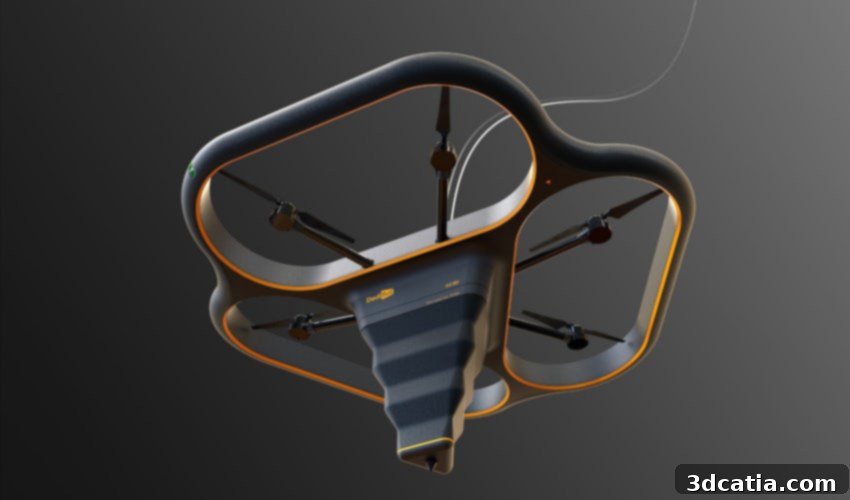
The Sky’s the Limit: DediBot’s Fly Elephant and the Dawn of Flying 3D Printers
Prepare to have your perception of 3D printing revolutionized. In a development that sounds more like science fiction than reality, DediBot unveiled the world’s first flying 3D printer, aptly named the “Fly Elephant,” during TCT Asia 2018. This groundbreaking machine possesses the unprecedented ability to print parts while airborne, pushing the boundaries of what additive manufacturing can achieve. Rooted in DediBot’s innovative ‘Open Additive Manufacturing’ technology, the Fly Elephant’s operational scope is primarily dictated by the drone’s battery life, rather than the traditional physical constraints typically associated with static 3D printing systems.
This remarkable innovation signals a significant leap forward, not just for 3D printing technology, but for industries reliant on large-scale construction and remote deployment. The concept of a mobile, aerial manufacturing unit opens up a myriad of possibilities, from constructing towering structures to aiding in disaster relief efforts, and even paving the way for extraterrestrial and underwater habitats. The Fly Elephant is more than just a novelty; it represents a paradigm shift in how we approach large-scale, complex manufacturing and construction in challenging environments.
Flying 3D Printers: A New Horizon for Construction and Infrastructure Development
DediBot envisions a future where flying 3D printers fundamentally transform the construction industry. The core principle of their technology is to “use drones as print execution units, while maintaining a very high printing accuracy to achieve rapid prototyping of large structures.” This approach directly addresses some of the most persistent challenges in construction, such as working at great heights, accessing remote or hazardous locations, and building intricate geometries that are cumbersome with conventional methods.
Traditional construction often involves complex scaffolding, heavy machinery, extensive labor, and significant time investment, particularly for tall or uniquely shaped buildings. The Fly Elephant, by contrast, offers a nimble, scalable, and potentially autonomous solution. Imagine construction sites where drones swarm collaboratively, precisely depositing materials layer by layer to erect structures faster and more safely than ever before. This vision could drastically cut down project timelines and reduce labor costs, while enhancing architectural flexibility.
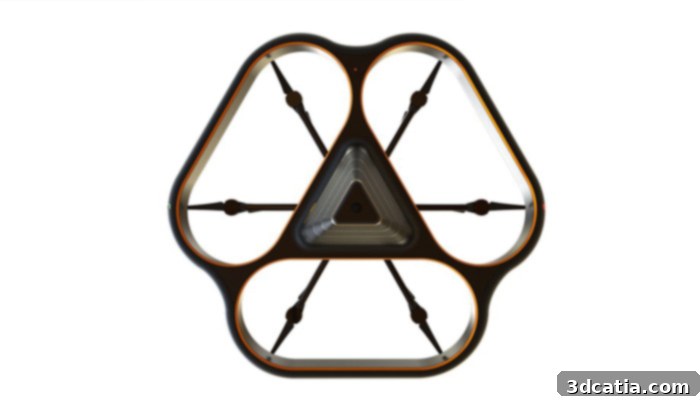
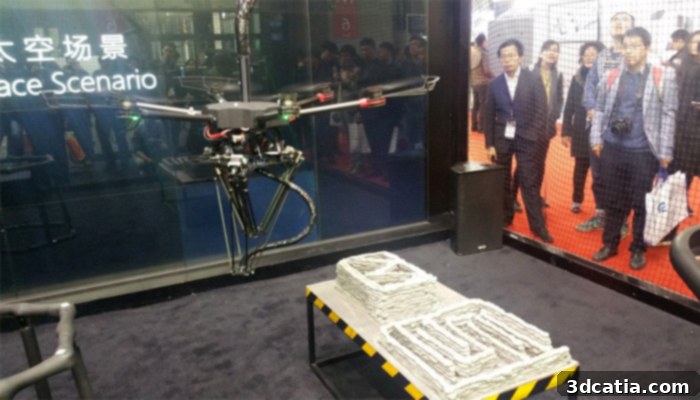
The Fly Elephant 3D printer, demonstrating its aerial capabilities.
While the Fly Elephant is currently in its prototype phase, primarily printing small cement structures, the potential implications of this Chinese company’s technology are immense. It could eventually scale up to facilitate the 3D printing of massive construction projects, including future skyscrapers and expansive infrastructure. The field of 3D printing in construction has already made remarkable strides, showcasing its viability and growing capabilities. Recent examples include innovative 3D printed bus stops in China and the astonishing feat of an entire house being 3D printed in just 24 hours. These projects underscore the rapid progression and increasing ambition within the sector, setting the stage for what airborne 3D printers could accomplish.
The ability to bypass the need for traditional support structures, combined with the agility of drones, presents an unprecedented advantage for building in challenging terrains or densely populated urban environments where space for conventional construction equipment is limited. Furthermore, the capacity for on-site, on-demand manufacturing could drastically reduce material transportation costs and environmental impact, fostering more sustainable building practices. This vision aligns perfectly with the global push towards smarter cities and more efficient, eco-friendly construction methodologies.
Technical Ingenuity: Delta Printing, Swarm Intelligence, and Unlimited Volume
While specific technical details about the Fly Elephant remain somewhat limited, we do know it incorporates a delta 3D printer mounted on a drone platform. Delta printers are known for their speed and precision, making them an excellent choice for dynamic applications like aerial additive manufacturing. This configuration allows for rapid and accurate deposition of materials, crucial for maintaining structural integrity while printing in motion.
One of the most compelling aspects of DediBot’s vision for the Fly Elephant is its capability to operate autonomously, either individually or as part of a synchronized swarm. In a swarm scenario, multiple drones could work in concert, each contributing to a different section of a large structure. This concept of distributed, collaborative manufacturing dramatically enhances scalability, accelerates construction timelines, and introduces a level of redundancy that improves reliability. Imagine a fleet of these flying printers collectively constructing a building, dynamically adapting to environmental conditions or design changes – a truly intelligent and efficient construction force.
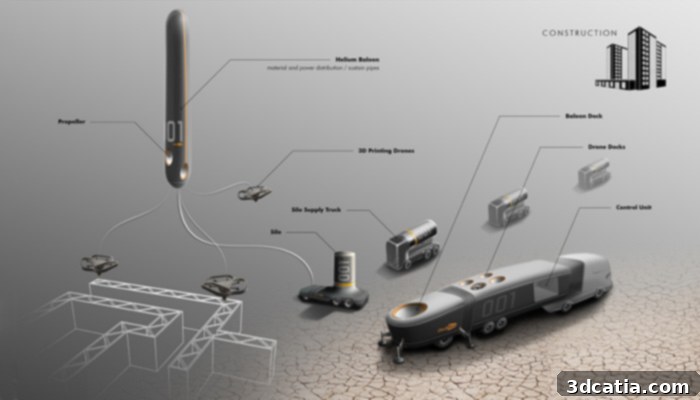
DediBot proudly states that their printer offers an impressive layer thickness of 0.1mm, ensuring a high level of detail and surface finish, even for large-scale constructs. More significantly, they highlight an “unlimited print volume.” This isn’t just hyperbole; it refers to the printer’s mobility. Unlike static 3D printers constrained by their build plate dimensions, a flying printer can continuously move around a structure, enabling it to build objects of virtually any size, limited only by material supply and drone battery life. This freedom from conventional build envelopes unlocks unprecedented design possibilities and application potential for truly gargantuan projects.
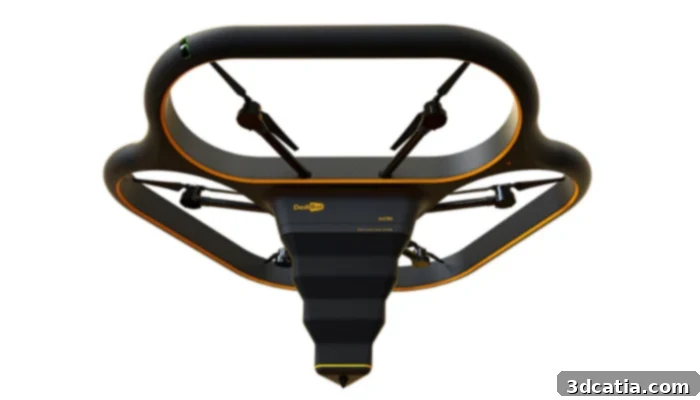
The Endgame: 3D Printing in Space and Under the Sea
The ambitions for the Fly Elephant extend far beyond terrestrial construction. Its creators boldly claim the printer could even operate in the vacuum of space, joining pioneers like Made In Space, which has already demonstrated zero-gravity 3D printing. This theoretical capability positions the Fly Elephant as a potential game-changer for space exploration and colonization. One of the greatest hurdles for establishing human presence on the Moon or Mars is transporting vast quantities of building materials from Earth. With flying 3D printers, future astronauts could potentially utilize in-situ resources (local lunar or Martian regolith) to 3D print habitats, tools, and infrastructure directly on site. This would drastically reduce mission costs and increase self-sufficiency for off-world settlements, making long-term colonization a more tangible reality.
Beyond the cosmos, the Fly Elephant’s design also lends itself to underwater applications. The ability to print aquatic structures opens up new frontiers for marine engineering and research. This could include the creation of bespoke subsea infrastructure for offshore energy, underwater research stations, or even artificial reefs to support marine ecosystems. Operating in challenging underwater environments requires robust, autonomous systems capable of withstanding immense pressure and corrosive conditions, areas where drone-based additive manufacturing could offer significant advantages by minimizing human intervention and maximizing precision in difficult-to-reach depths.
Addressing Global Challenges: Housing, Disaster Relief, and Sustainable Development
While these applications might seem futuristic, the core technology holds immediate potential for addressing pressing global issues. The Fly Elephant, even as a prototype, represents a viable solution to the escalating global housing crisis. If the technology can advance to a point where teams of these drones can efficiently print large, habitable structures, it could offer a rapid and cost-effective method for mass housing production. This could revolutionize urban planning, enabling the swift construction of affordable, customizable homes in areas with high demand, or in regions lacking established construction infrastructure.
Moreover, the humanitarian implications are profound. In the wake of natural disasters, communities are often left devastated, with countless individuals displaced or made homeless. Imagine autonomous swarms of these flying 3D printers descending upon disaster zones, rapidly constructing temporary or even permanent shelters. This capability could significantly accelerate recovery efforts, provide immediate refuge for survivors, and reduce the logistical complexities of traditional relief operations. The ability to quickly deploy self-sufficient construction units would be invaluable in critical situations, offering hope and immediate assistance where it’s most needed.
From an environmental perspective, drone-based additive manufacturing could also contribute to more sustainable construction practices. By enabling on-demand, localized production, it minimizes the need for extensive transportation of materials, reducing carbon emissions. Furthermore, the precision of 3D printing can lead to less material waste compared to traditional methods. This efficiency, combined with the potential to use locally sourced or recycled materials, positions flying 3D printers as a tool for driving eco-friendly development and resilient infrastructure globally.
For those interested in delving deeper into this innovative technology, more information about the Fly Elephant and DediBot’s vision can be found on the official website of DediBot.
The advent of flying 3D printers like DediBot’s Fly Elephant heralds a new era for additive manufacturing, promising to redefine construction, enable off-world habitats, and provide crucial solutions for global challenges. This blend of drone technology and advanced printing techniques represents an exciting frontier, pushing the boundaries of innovation and automation.
What are your thoughts on the future of automation in 3D printing and the potential impact of flying printers? We’d love to hear your insights! Share your opinions in the comments below or join the conversation on our Facebook and Twitter pages. Don’t miss out on the latest advancements in this dynamic field – sign up for our free weekly Newsletter and get all the essential 3D printing news delivered straight to your inbox!