
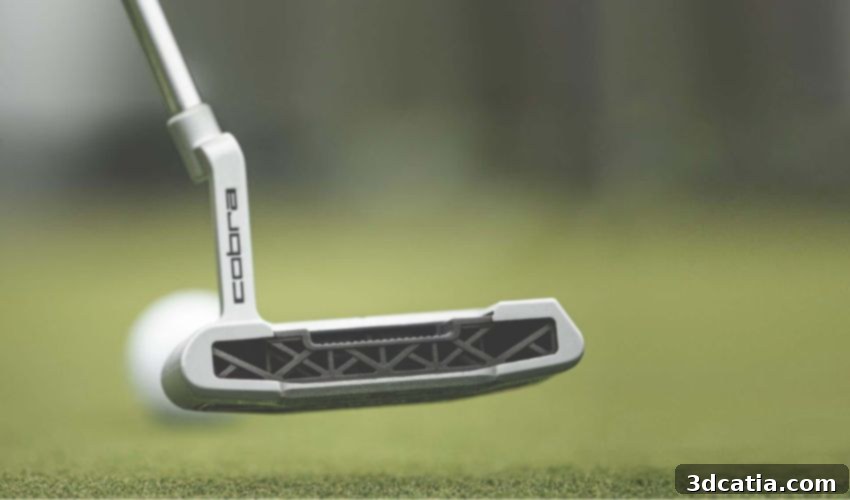
The Forefront of Innovation: How 3D Printing is Revolutionizing Golf Equipment and Player Performance
From the high-octane world of Formula 1 to the strategic courts of basketball, the intense rinks of hockey, and the colossal stadiums of American football, additive manufacturing has firmly established its presence across the sporting landscape. Yet, perhaps one of the most surprising and impactful adopters of this transformative technology is golf – a sport steeped in centuries of tradition, dating back to at least the 15th century in Scotland. Despite its ancient roots, golf is proving itself to be remarkably innovative, finding a “hole-in-one” with the integration of 3D printing into its equipment design and manufacturing processes. But what exactly is the current state of 3D printing in golf? Who are the pioneers driving this change, and what benefits are they unlocking? We decided to delve deep into how this cutting-edge technology is reshaping the beloved game.
The allure of 3D printing in golf lies in its unparalleled ability to offer customization, enhance performance, accelerate prototyping, and enable radical new designs previously impossible with traditional manufacturing methods. This makes it an ideal fit for a sport where precision, feel, and individual player characteristics are paramount to success. Whether it’s crafting clubs perfectly tailored to a golfer’s swing, optimizing the comfort and stability of footwear, or creating innovative training aids, additive manufacturing provides a flexible and powerful tool for pushing the boundaries of what’s achievable on the green.
For those keenly following the advancements in this exciting field, a unique opportunity awaits at upcoming industry events. For example, at RAPID + TCT 2025, attendees will have the chance to hear directly from Ryan Roach, Director of Innovation at COBRA PUMA GOLF, who will deliver a compelling talk titled “How COBRA is Using Additive Manufacturing to Disrupt Golf.” This session promises to offer invaluable insights into how one of the industry’s leading brands is leveraging 3D printing to revolutionize golf equipment. As an added bonus, if you register for RAPID + TCT 2025 HERE using the code “3DNATIVES” by a specific date, you could also be entered into a special giveaway for the latest 3D printed putter from Cobra Golf, a testament to the brand’s commitment to cutting-edge technology.
The Genesis of 3D Printing in Golf: Early Adopters and Pioneering Steps
While 3D printing in golf has only recently captured widespread attention, its journey began several years ago with forward-thinking collaborations and product introductions. One of the earliest significant ventures dates back to 2018, when Titomic, a prominent Australian additive manufacturing company, partnered with golf giant Callaway Golf. This collaboration aimed to explore the potential of 3D printing for golf clubs, signaling a clear interest from established manufacturers in leveraging advanced technologies for performance enhancement. The goal was to develop stronger, lighter, and more precisely engineered components that could offer a competitive edge on the course.
Beyond clubs, 3D printing also began to make inroads into other critical aspects of a golfer’s gear. In 2023, Adidas unveiled its innovative golf shoe, the MC87 4D, which prominently featured a 3D printed midsole. This application highlights one of additive manufacturing’s core strengths: the creation of complex lattice structures. These intricate designs, impossible with traditional molding, allow for precise control over cushioning, stability, and energy return, offering golfers unparalleled comfort and support throughout their round. Such designs can be tuned to the specific demands of golf, providing stability during the swing while ensuring comfort during long walks.
However, it was truly in 2024 that 3D printing began to capture the golf world’s imagination on a larger scale. Bryson DeChambeau, affectionately known as “The Mad Scientist” of golf for his unconventional approach and relentless pursuit of performance optimization, made headlines at the 2024 Masters Tournament. He wielded a custom set of 3D printed irons from Avoda Golf, sparking immense interest and debate across the sport. These irons were not merely a novelty; they were meticulously designed and manufactured to his exact specifications, perfectly adapting to his unique swing style. The club faces featured a subtle curve, engineered to reduce sidespin and dramatically increase accuracy on off-center strikes – a crucial advantage for DeChambeau’s powerful, high-speed swing. His impressive sixth-place finish at the Masters with these innovative clubs underscored the tangible performance benefits offered by personalized, 3D printed equipment, proving that this technology wasn’t just for show.

Bryson DeChambeau with a 3D printed golf club (photo credits: PGA)
DeChambeau’s success with his custom 3D printed irons has certainly paved the way for more professionals to explore additive manufacturing. The return of his tailored irons is highly anticipated, reinforcing the belief in their performance capabilities. But he is not alone in this innovative pursuit. Fellow tour professional Rickie Fowler also made significant waves last year through his high-profile partnership with COBRA PUMA GOLF, further cementing 3D printing’s legitimate place in professional golf.
COBRA PUMA GOLF: Setting the Standard for 3D Printing in Golf
Without question, COBRA PUMA GOLF, a dynamic subdivision of the global sports giant Puma, has emerged as a leading force in the application of 3D printing within the golf industry. This established manufacturer of golf gear has rapidly embraced additive manufacturing, making a significant name for itself through a series of groundbreaking product launches. Their journey into this cutting-edge realm truly accelerated in January 2024, with the exciting announcement that Rickie Fowler would be debuting a specially designed 3D printed RJ Cobra lob wedge at The American Express 2024 golf tournament. This pioneering club was created using HP’s advanced Metal Jet technology, showcasing the potential of metal 3D printing to produce complex, high-performance golf club components with extreme precision and optimized weight distribution.
COBRA PUMA GOLF’s commitment to innovation didn’t stop there. In a landmark move, the company introduced their revolutionary LIMIT3D irons in May, developed in close partnership with nTop, a leader in generative design software. These irons marked a significant milestone, being the first-ever commercially available irons that extensively leverage 3D printing technology for their core design and manufacturing. The LIMIT3D irons proved to be an instant sensation, generating considerable buzz at RAPID + TCT 2024, where a dedicated talk and an interactive booth allowed attendees to experience their innovative design firsthand. Fully 3D printed with durable 316L stainless steel, the ingenious internal lattice structure of the club enabled an impressive 33% redistribution of weight. This critical design feature allowed COBRA to optimize the club’s center of gravity and moment of inertia (MOI) for enhanced forgiveness and stability, all without compromising the overall strength or feel of the club. The ability to create such intricate internal geometries is a direct benefit of additive manufacturing, providing performance advantages that are simply unachievable with traditional casting or forging methods.
Building on the success of their limited-edition releases, Cobra further solidified its position in January by announcing its new COBRA 3D Printed TOUR Irons. Unlike the LIMIT3D irons, which were introduced as a special run, these TOUR Irons represent a major step towards making 3D printed technology accessible to a wider market, becoming a core part of the company’s main product offerings. Starting at a competitive price point, with a 4-PW set retailing for $2450 and individual 3-irons and gap wedges available through custom order, these clubs have been available since March 21st. They stand alongside a growing number of other innovative solutions from the company, including 3D printed putters and custom components, demonstrating COBRA’s strategic vision for integrating additive manufacturing into its entire product line. This widespread availability signals a paradigm shift, moving 3D printing from niche prototyping to mainstream golf equipment, offering unprecedented levels of design freedom and performance benefits to golfers of all skill levels.
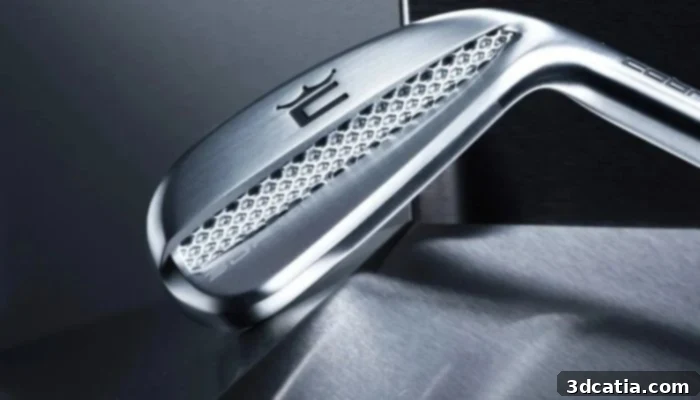
A closer look at a 3D printed golf club from COBRA (photo credits: COBRA PUMA GOLF)
Beyond Clubs: The Broader Impact of 3D Printing in Golf
While 3D printed clubs often grab the headlines, the reach of additive manufacturing in golf extends far beyond just irons and putters. The technology is also proving invaluable for creating advanced training aids that help golfers refine their swing, improve consistency, and address specific biomechanical challenges. Custom grips, for instance, can be designed to perfectly fit a player’s hand, enhancing comfort and control. Similarly, 3D printing enables the rapid production of prototypes for various golf equipment, allowing designers to quickly iterate and test new concepts for drivers, wedges, and even golf ball dimple patterns without significant investment in traditional tooling. This rapid prototyping capability dramatically shortens design cycles and accelerates innovation across the entire industry.
Furthermore, 3D printing plays a crucial role in manufacturing jigs, fixtures, and other specialized tools used in the assembly and quality control of golf equipment. These custom tools can improve manufacturing efficiency, ensure tighter tolerances, and ultimately contribute to higher quality final products. Even in the realm of golf accessories, additive manufacturing offers benefits, from personalized ball markers and divot tools to lightweight, durable components for golf carts. The ability to produce bespoke items on demand also opens doors for mass customization, allowing every golfer to have equipment and accessories that are truly unique to them, enhancing their overall experience on the course.
The Future is Bright: Continuing Evolution of 3D Printing in Golf
So, where do we stand precisely when it comes to 3D printing in golf? The evidence is clear: additive manufacturing has unequivocally proven its immense value in the sport. It offers an unprecedented ability to create golf gear that is better suited to individual golfers, a critical advantage in a game where the slightest nuance in equipment can dramatically impact performance. The success stories of brands like COBRA PUMA GOLF and innovative players like Bryson DeChambeau, alongside companies such as Avoda Golf and Adidas, paint a remarkably hopeful picture for the future.
Looking ahead, we can anticipate continued exponential growth and innovation. The integration of artificial intelligence with generative design software will likely lead to even more optimized and radical club geometries, pushing the boundaries of what is mechanically possible. New materials, including advanced composites and specialized metals, will further expand the performance envelope of 3D printed golf equipment, offering new levels of strength, weight reduction, and vibration dampening. Hyper-customization, where every single piece of a golfer’s equipment is precisely tailored to their unique biometrics and swing characteristics, could become the standard, moving beyond professional players to amateurs seeking to improve their game.
The future of golf with 3D printing promises not just enhanced performance but also a more sustainable manufacturing approach, with reduced material waste and the potential for localized, on-demand production. The technology is set to redefine not only how equipment is made but also how golfers interact with their gear, fostering a new era of personalized excellence on the green.
To delve deeper into the pioneering work of COBRA PUMA GOLF, be sure to attend RAPID + TCT 2025. Ryan Roach’s conference session, “How COBRA Is Using Additive Manufacturing to Disrupt Golf,” will provide a comprehensive look at their success story, particularly focusing on the development and impact of the first commercially available 3D printed golf irons. Don’t miss this opportunity to learn about the innovations shaping the sport. Additionally, if you register for RAPID + TCT 2025 before Friday, March 28th, using this specific link and applying the code “3DNATIVES,” you will automatically be entered to win a COBRA GOLF LIMIT3D Steel Mallet Tour Prototype Putter. This advanced putter, crafted using state-of-the-art Metal Jet 3D printing technology, is currently being rigorously tested on professional tours, offering a glimpse into the future of golf performance.
What are your thoughts on the revolutionary use of 3D printing in golf? We invite you to share your insights in a comment below or join the conversation on our LinkedIn, Facebook, and Twitter pages! For the very latest updates and news in the world of 3D printing, don’t forget to sign up for our free weekly Newsletter here, delivered straight to your inbox! You can also explore all our insightful videos and interviews on our dedicated YouTube channel.