
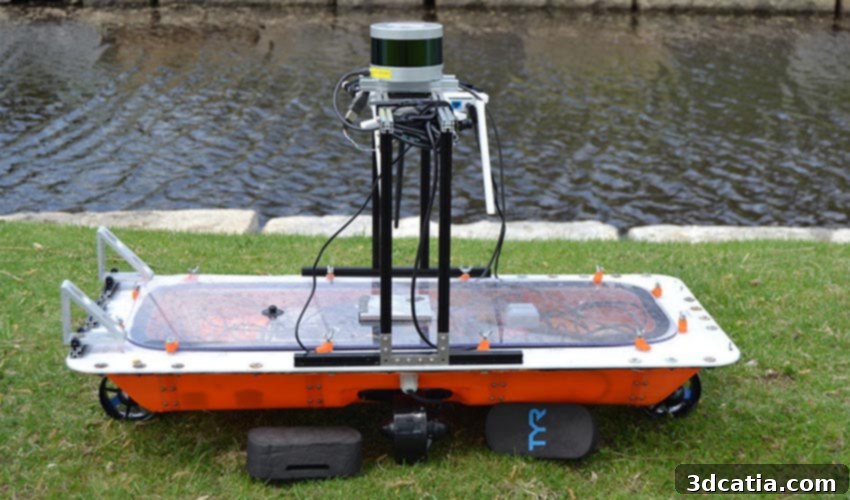
Autonomous 3D Printed RoBoats: Revolutionizing Urban Water Transportation in Amsterdam
In a pioneering collaboration between MIT’s Computer Science and Artificial Intelligence Laboratory (CSAIL) and the Amsterdam Institute for Advanced Metropolitan Solutions (AMS Institute), an innovative project known as RoBoat is poised to transform urban mobility. The initiative focuses on developing a sophisticated system of autonomous boats designed to navigate Amsterdam’s extensive network of over 100 kilometers of canals. These small, versatile prototypes, ingeniously crafted using advanced 3D printing technologies, promise to introduce a new era of water-based transportation, potentially revolutionizing the way residents and tourists move through the iconic Dutch capital. This ambitious endeavor not only showcases the cutting-edge capabilities of additive manufacturing but also addresses pressing urban challenges, offering a sustainable and efficient solution for metropolitan transport.
The Netherlands has long been at the forefront of embracing additive manufacturing, demonstrating a strong national commitment to integrating 3D printing across various sectors. This progressive stance is evident in several groundbreaking initiatives, such as the widely acclaimed 3D printed steel bridge created by MX3D, which stands as a testament to the country’s innovative spirit. Furthermore, the establishment of dedicated research centers focused on advancing 3D technologies underscores the nation’s strategic investment in this field. Given the country’s unique geography and dense urban areas, optimizing transport networks is a matter of significant national interest. As cities worldwide grapple with increasing traffic congestion and environmental concerns, the Netherlands actively seeks smart, sustainable solutions. The RoBoat project emerges as another compelling example of how 3D printing is being harnessed to tackle complex transportation dilemmas, offering a forward-thinking response to the evolving demands of urban mobility and showcasing the power of advanced manufacturing techniques.
In 2016, both partners proudly presented their groundbreaking RoBoat project to the public, outlining its potential for urban transformation.
The Vision Behind RoBoat: Autonomous Water Taxis and Beyond for Smart Cities
While much of the innovation buzz often surrounds autonomous cars, the RoBoat project invites us to envision a future where urban waterways are just as accessible and efficient as roadways. Imagine a boat, entirely without a human captain, seamlessly navigating you through the city’s canals to your workplace every morning, or to a cultural event in the evening. This core concept drives the RoBoat initiative: to alleviate urban road congestion by leveraging the often underutilized network of canals and waterways. The vision extends beyond simple passenger transport, aiming to redefine urban logistics, infrastructure, and even public spaces, all within the framework of a smart city. The project was initially unveiled to the city of Amsterdam in 2016, captivating stakeholders with its potential. Just two years later, the teams showcased their significantly advanced prototype designs, featuring hulls meticulously crafted using state-of-the-art 3D printing techniques. This rapid progression from concept to tangible prototype highlights the agility and innovative potential of combining robotics with additive manufacturing.
The RoBoat system is designed to provide a flexible and scalable solution for urban transport challenges. By offering on-demand water taxis, it could reduce reliance on traditional road infrastructure, easing traffic bottlenecks and contributing to a quieter, cleaner urban environment. Furthermore, the modular nature of the RoBoats allows for dynamic reconfiguration, transforming them from individual transport units into temporary floating infrastructure. This adaptability positions RoBoat not just as a means of transport but as an integral component of future urban planning, capable of responding to evolving city needs for events, public spaces, and logistical support. The collaboration between MIT’s deep technological expertise and the AMS Institute’s focus on metropolitan solutions ensures that the project is both scientifically rigorous and practically applicable to real-world urban scenarios, making it a truly groundbreaking endeavor in autonomous urban mobility.
Advanced Engineering: How 3D Printing Powers RoBoat Prototypes
The current RoBoat prototypes are impressive feats of engineering, each measuring approximately 4 meters in length and 2 meters in width – dimensions carefully chosen for navigating Amsterdam’s diverse canal system while ensuring stability and maneuverability. A significant innovation lies in their construction: these autonomous vessels were designed and produced using a desktop 3D printer. While the specific model of the printer remains undisclosed by the teams, its application underscores the growing accessibility and capability of additive manufacturing for producing substantial, functional components. 3D printing offers unparalleled design freedom, allowing researchers to rapidly iterate on hull designs, optimize hydrodynamics, and integrate complex internal structures that would be challenging or impossible with traditional manufacturing methods. This accelerates the development cycle, moving from concept to physical prototype with remarkable speed and cost-efficiency.
The hull of each RoBoat is not a single monolithic piece but rather an assembly of 16 distinct sections. These sections are individually 3D printed, a process that takes around 60 hours per boat, before being meticulously assembled. This modular approach offers numerous advantages beyond just manufacturing. It simplifies logistics, as smaller components are easier to transport and handle. It also facilitates maintenance and repairs; if one section is damaged, it can be replaced without needing to rebuild the entire hull. Furthermore, modularity supports future upgrades and customization, allowing for the integration of new sensors or propulsion systems as technology evolves. This innovative construction method exemplifies how 3D printing can enhance durability and functionality in complex robotic systems designed for challenging environments.
Post-assembly, ensuring the watertight integrity of the hull is paramount for continuous and safe operation. To achieve this, the entire hull is sealed with multiple layers of fiberglass. This crucial step not only prevents any risk of leakage but also adds significant structural rigidity and resistance to wear and tear from constant exposure to water. Beyond the physical structure, each RoBoat is outfitted with a sophisticated array of electronics essential for autonomous navigation and communication. This includes a Wi-Fi antenna for reliable data exchange with a central control system or other RoBoats, a high-precision GPS module for accurate positioning within centimeters, a powerful microcomputer to process complex navigational algorithms and sensor data, and a micro-controller to manage various onboard systems such as power distribution and thruster commands. For propulsion and precise maneuverability, each boat is equipped with four thrusters. These strategically placed thrusters enable comprehensive control, allowing the RoBoat to move forwards, backwards, and laterally with remarkable agility, a critical feature for navigating narrow canals, executing precise docking maneuvers, and avoiding obstacles in dynamic urban waterways.
The Brain of the RoBoat: Nonlinear Model Predictive Control (NMPC) and Modular Applications
A cornerstone of the RoBoat’s advanced autonomy is the sophisticated control system developed by the MIT team: a Nonlinear Model Predictive Control algorithm (NMPC). This algorithm is a powerful tool in modern robotics, commonly employed to control and navigate complex autonomous systems in environments characterized by various dynamic constraints, uncertainties, and real-time objectives. For the RoBoat, NMPC enables real-time decision-making, allowing the vessel to continuously predict its future states and adjust its thruster outputs accordingly. This predictive capability is crucial for maintaining a desired trajectory, efficiently conserving energy, and, most importantly, safely avoiding both static and dynamic obstacles such as other boats, kayaks, or even debris in the canals. By anticipating future movements and optimizing control inputs, NMPC ensures that RoBoats operate smoothly and reliably, even in the bustling and often unpredictable environment of urban waterways.
To rigorously test the efficacy and precision of this NMPC algorithm, researchers conducted extensive experiments by placing a prototype boat in a controlled pool environment. The objective of these meticulous tests was multifaceted: primarily, to “find optimal force for the thrusters that can take the boat back to the path and minimize errors.” This involved simulating various navigational challenges and meticulously analyzing the RoBoat’s response to different commands and disturbances. The data collected from these tests allowed the team to fine-tune the algorithm, enhancing its ability to follow predetermined routes with exceptional accuracy, responsiveness, and energy efficiency. This iterative testing process is crucial for ensuring reliable and safe operation, building confidence in the RoBoat’s autonomous capabilities before deployment in the complex, real-world environment of Amsterdam’s intricate canal system.
Beyond their immediate utility as autonomous water taxis, the RoBoat project harbors an even more ambitious vision for urban infrastructure. The researchers intentionally designed these autonomous boats in a distinctive rectangular shape. This specific geometry is not merely aesthetic but serves a highly functional purpose: it allows multiple RoBoats to seamlessly join together, much like LEGO blocks on water. Imagine a fleet of these intelligent vessels autonomously connecting to form temporary, dynamic floating structures. This unprecedented modularity opens up a world of possibilities for dynamic urban planning and resource management. Such formations could enable the rapid deployment of temporary pedestrian bridges during festivals, adaptable piers for various public events, mobile research platforms for environmental monitoring, or even expansive, reconfigurable stages for concerts and public gatherings directly on the water. This innovative concept highlights the potential of autonomous aquatic robotics to not only solve conventional transportation challenges but also to dynamically reshape and enhance urban spaces, offering flexible and sustainable solutions for modern cities grappling with evolving infrastructural needs.
Extensive tests were conducted in a controlled pool environment to precisely evaluate the RoBoat’s ability to follow complex trajectories and navigate accurately, a critical step in its development.
The Future of RoBoat and Smart Urban Waterways
While the RoBoat project has made tremendous strides, transforming these advanced prototypes into a fully integrated, scalable system capable of operating autonomously and reliably across Amsterdam’s bustling canals will undoubtedly require a few more years of dedicated research, development, and rigorous testing. This includes addressing complex regulatory frameworks for autonomous navigation in public waterways, ensuring robust cybersecurity against potential threats, developing advanced collision avoidance systems capable of handling unpredictable canal traffic (including traditional boats, kayaks, and even swimmers), and scaling up manufacturing processes to meet future demand. Public acceptance and integration into the existing urban fabric also present significant social and logistical hurdles that need careful consideration. However, the foundational work laid by MIT CSAIL and the AMS Institute represents an incredibly promising start.
The project serves as a compelling proof-of-concept, demonstrating the viability of 3D printed autonomous watercraft for diverse urban applications and showcasing the power of interdisciplinary collaboration between academia and urban innovation centers. As technology continues to evolve, we can anticipate these intelligent boats becoming a common sight, not just as water taxis but potentially as automated delivery platforms for goods, efficient waste collectors improving canal cleanliness, environmental monitors gathering crucial data on water quality, or even rapid emergency response units reaching inaccessible areas. RoBoat’s potential contribution to the smart city paradigm, enhancing sustainability, efficiency, and livability, is immense. The success of this project could inspire similar initiatives in other canal-rich cities globally, from Venice to Stockholm, providing blueprints for sustainable urban development and innovative transport solutions tailored to unique geographical and infrastructural contexts. This blending of robotics, artificial intelligence, and additive manufacturing signals a transformative era for maritime technology and urban planning, highlighting how digital fabrication methods like 3D printing can accelerate prototyping, reduce costs, and enable bespoke designs, ultimately leading to more adaptable and resilient city infrastructures. The journey from conceptual design to widespread deployment is long, but the RoBoat project undeniably charts an exciting course towards a future where urban waterways are active, intelligent arteries of city life.
For more detailed insights into the RoBoat project and the ongoing research, please visit the official MIT website.
What are your thoughts on the innovative RoBoat project and its potential to reshape urban transportation? We’d love to hear your perspective! Share your comments below or engage with us on our Facebook and Twitter pages! Don’t miss out on the latest advancements in additive manufacturing – remember to sign up for our free weekly Newsletter, delivering all the essential news and updates in 3D printing directly to your inbox!