
OpenFlexure: Revolutionizing Global Science with Affordable, 3D Printed Open-Source Microscopes
The world of scientific discovery and education has long been constrained by the prohibitive cost of specialized laboratory equipment. Professional microscopes, essential tools for exploring the microscopic world, often come with price tags ranging from hundreds to many thousands of dollars, placing them far beyond the reach of countless educational institutions, community laboratories, and research initiatives, particularly in resource-constrained regions. This financial barrier severely limits access to critical scientific education and research opportunities, hindering progress and innovation on a global scale. However, in an era defined by the burgeoning DIY (Do-It-Yourself) movement and an ever-growing culture of open collaboration and knowledge sharing, innovative solutions are emerging to tackle such challenges.
One such groundbreaking initiative is the OpenFlexure project, a remarkable endeavor championed by Joel Collins and Richard, researchers at the prestigious University of Bath in the UK. Their vision was clear: to democratize access to high-quality microscopy. With the ambitious goal of offering an efficient, high-performance, yet incredibly affordable solution to schools, small laboratories, clinics, and even universities worldwide, the OpenFlexure project leverages the power of additive manufacturing to create sophisticated, open-source microscopes. What makes this project truly revolutionary is that these laboratory-grade instruments can be built for an astonishingly low cost, often less than $20, transforming the landscape of scientific accessibility.
The financial implications of acquiring traditional high-end microscopes are substantial. Such devices can easily cost hundreds, if not thousands, of dollars, making them a significant capital investment. However, one of the most compelling advantages of 3D printing technology lies in its ability to dramatically reduce manufacturing costs, particularly for small series production or custom-designed parts. This cost-efficiency is at the core of the OpenFlexure microscope’s accessibility. The project not only minimizes the initial financial outlay but also simplifies equipment maintenance and repair, as parts can be printed on demand. For a mere $18, the OpenFlexure covers the essential costs of the 3D-printed plastic components, a standard camera module (often a Raspberry Pi camera), and a few necessary fixing accessories. This low entry point ensures that cutting-edge microscopy is within reach for virtually anyone with access to a 3D printer.
Joel Collins passionately articulated the project’s expansive vision, stating, “We want these microscopes to be used all over the world: in schools, laboratories, clinics, and even homes, if they want the microscope to play with. You just need to make it and start using it. And we want it to be affordable.” This statement perfectly encapsulates the OpenFlexure ethos: universal access, ease of deployment, and unparalleled affordability. The implications of this approach are profound, extending beyond mere cost savings to foster a global community of scientists, educators, and curious minds. By empowering individuals and institutions with the tools for scientific exploration, the OpenFlexure project aims to inspire the next generation of innovators and facilitate critical research where it’s needed most, without being hampered by budgetary constraints. It’s a testament to how open-source principles and accessible manufacturing can democratize scientific inquiry and discovery on an unprecedented scale.
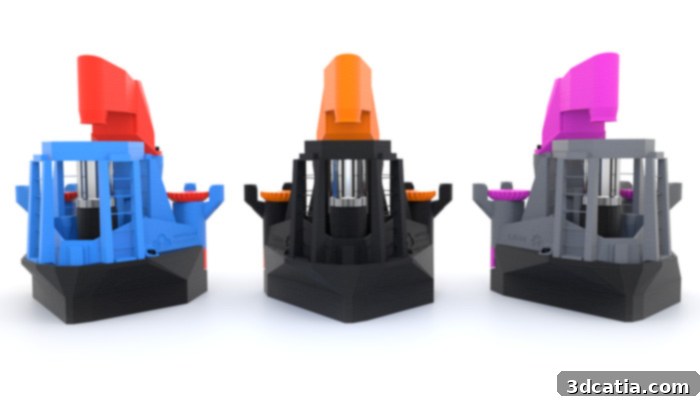
Three versions of the OpenFlexure open source microscope
How Do You Make Your Own OpenFlexure Microscope?
For those inspired to embark on this innovative project, understanding the creation process is key. The OpenFlexure is far more than a simple optical device; it’s a fully automated, laboratory-grade instrument, leveraging the computational power of a Raspberry Pi. This integration enables sophisticated features such as motorized sample positioning, allowing precise manipulation of specimens, and advanced autofocus control, which ensures sharp, clear images without manual adjustments. Its ingenious design method prioritizes compactness and efficiency, making it perfectly suited for environments with limited space, from bustling school science labs and university research benches to the confined settings of small clinics or even a curious individual’s home workshop. This thoughtful engineering ensures that high-quality microscopy is not confined to expansive, dedicated laboratories but can be deployed wherever scientific curiosity flourishes.
Beyond its core automated functions, the OpenFlexure microscope offers remarkable versatility through a range of customizable options. Users can enhance its capabilities with specialized lighting modules, including trans-illumination (for viewing light passing through a sample) and epi-illumination (for viewing light reflected from a sample surface). Further customization allows for advanced imaging techniques such as polarization contrast imaging, which highlights features based on their effect on polarized light, and epifluorescence imaging, crucial for observing fluorescently tagged biological samples. These advanced features, typically found only in much more expensive commercial microscopes, are seamlessly integrated into the OpenFlexure’s modular design. Complementing its powerful hardware, the microscope is designed with an intuitive software interface, simplifying its operation and making advanced microscopy accessible and straightforward for users of all experience levels, from students to seasoned researchers. This user-friendly approach significantly lowers the barrier to entry for complex scientific exploration.
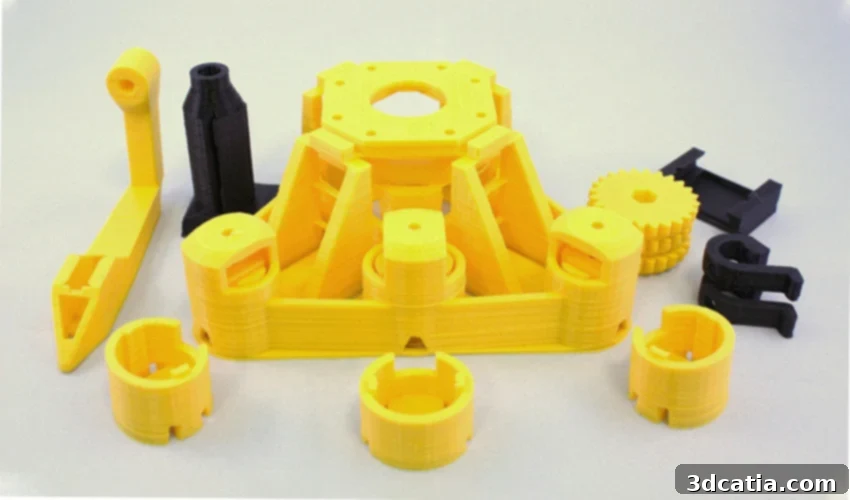
The defining characteristic of the OpenFlexure project, and a cornerstone of its global appeal, is its commitment to local assembly through entirely open-source models. This empowers individuals and communities to produce and maintain their own scientific instruments. The journey begins by 3D printing the microscope parts, which are readily available as STL files. These files, complete with all necessary design specifications, can be found HERE on the project’s official website. It’s crucial to note that one should not simply print every file in the STL folder, as the OpenFlexure system supports several possible configurations and customization options. To ensure a successful build, the comprehensive assembly guide, also provided on the same web page, offers detailed instructions on which specific parts to print for a desired configuration and how to meticulously construct the microscope step-by-step. This guided approach makes the complex process manageable even for those with limited prior experience in electronics or mechanics, further democratizing access to advanced scientific tools.
The design philosophy behind the OpenFlexure microscope is centered on minimizing both the complexity of post-printing assembly and the reliance on numerous unprinted, commercially sourced components. This thoughtful engineering approach reduces potential points of failure and keeps the overall cost remarkably low. The majority of the expense for building the OpenFlexure microscope is typically attributed to the acquisition of the Raspberry Pi single-board computer and its accompanying camera module, which serve as the brain and eye of the instrument, respectively. The physical manufacturing process itself requires only about 200 grams of standard 3D printing plastic filament and a small assortment of nuts and bolts for secure assembly. Once the physical structure is complete, the final step involves downloading and installing the open-source software onto the Raspberry Pi. This software provides the user interface and control logic, allowing users to immediately begin capturing images, manipulating samples, and exploring the microscopic world with their newly constructed, high-performance OpenFlexure microscope. This seamless integration of hardware and software underscores the project’s commitment to making advanced microscopy accessible and operational with minimal effort and expense.
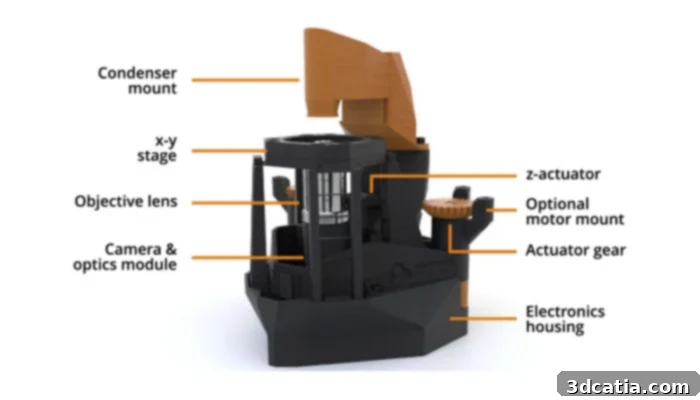
Once you have 3D printed the parts you must follow the assembly instructions.
The profound impact of this initiative is already being felt across the globe. Since its inception, the OpenFlexure project has expanded its reach significantly, with more than 100 microscopes already produced and deployed for vital educational and medical projects, particularly in regions such as Tanzania and Kenya. These deployments demonstrate the microscope’s practical utility and its capacity to meet real-world needs in diverse settings. Dr. Bowman, a key figure in the project, highlighted a crucial aspect of this global outreach: “Our Tanzanian partners, STICLab, have modified the design to better suit their local market. We have demonstrated another key strength of open source hardware: the ability to customize, enhance and take ownership of a product.” This statement powerfully underscores the transformative potential of open-source hardware. It’s not just about providing a low-cost tool; it’s about fostering local innovation, enabling communities to adapt technologies to their unique requirements, and empowering them with a sense of ownership over the tools that drive their progress. This adaptability is critical for sustainable development and building scientific capacity in developing nations, moving beyond simple donation to genuine collaboration and empowerment.
The OpenFlexure project stands as a shining example of how combining accessible technologies like 3D printing with the collaborative spirit of the open-source movement can overcome significant barriers to scientific progress. It’s more than just a microscope; it’s a testament to the democratization of scientific tools, enabling education, research, and diagnostics in areas that were once underserved. This initiative facilitates a shift from reliance on expensive, proprietary equipment to a model of locally manufacturable, customizable, and community-supported instrumentation. Such a paradigm has far-reaching implications, fostering a global network of innovators and empowering individuals to contribute actively to scientific understanding. By making advanced microscopy accessible, the OpenFlexure project is not just building microscopes; it’s building capacity, fostering curiosity, and cultivating a more inclusive global scientific community.
What are you waiting for to start creating your own OpenFlexure microscope? Dive into the project, explore its possibilities, and become part of a growing movement that’s making science accessible to everyone. We’d love to hear your thoughts on this groundbreaking project! Share your insights and experiences in a comment down below or connect with us on our Facebook and Twitter pages! Don’t forget to sign up for our free weekly Newsletter, with all the latest news in 3D printing delivered straight to your inbox, ensuring you stay at the forefront of additive manufacturing innovations!