
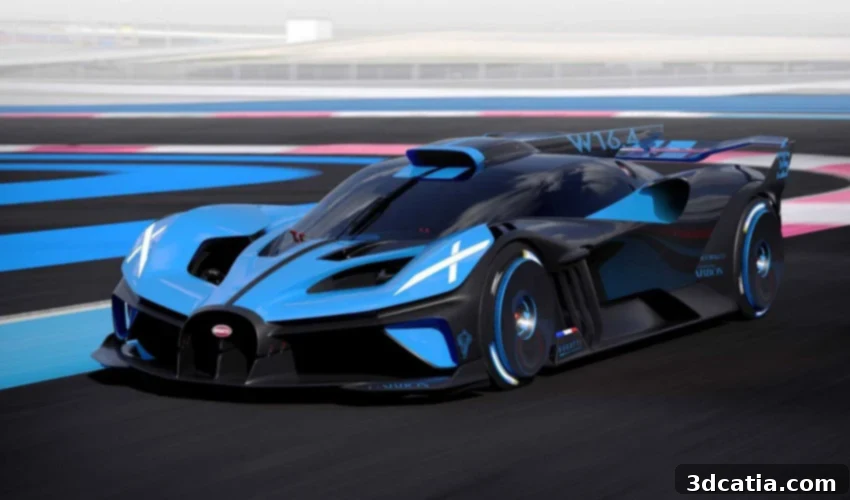
Bugatti Bolide: Redefining Hypercar Performance Through Advanced Additive Manufacturing
The automotive world is constantly pushing the boundaries of speed, performance, and engineering. French luxury carmaker Bugatti has once again captivated enthusiasts with its experimental hypercar, the Bolide. This track-focused marvel represents the pinnacle of Bugatti’s ambition, designed to be the lightest, fastest, and most aggressive vehicle in its illustrious lineup. More than just a concept, the Bolide is a showcase of groundbreaking new technologies, heavily relying on advanced additive manufacturing techniques to achieve its astonishing weight reduction and structural integrity.
Weighing in at a mere 1,240 kg (approximately 2,733.7 lbs), the Bolide stands in stark contrast to its iconic sibling, the Chiron, which tips the scales at 1,996 kg (around 4,400.4 lbs). This incredible diet results in an extraordinary weight-to-power ratio of just 0.67 kg per horsepower, promising an unparalleled driving experience. While currently an experimental study, the Bugatti Bolide serves as a powerful demonstration of the transformative benefits of automotive additive manufacturing, hinting at a future where such innovations become standard in high-performance vehicles.
Bugatti’s Pioneering Journey with 3D Printing in Automotive
Bugatti’s commitment to additive manufacturing is not a recent development. The brand has been at the forefront of integrating 3D printing into its vehicle development for several years, recognizing its immense potential for creating lighter, stronger, and more complex components. A significant milestone occurred in January 2018 when the French manufacturer unveiled the world’s first brake caliper printed in 3D metal, specifically titanium. This pioneering achievement in the automotive sector resulted in a substantial 40% weight reduction for the part, shedding an impressive 2 kg (4.4 lbs) from its traditional counterpart. This marked a clear signal of Bugatti’s strategic direction towards innovative manufacturing processes.
Building on this success, just one year later, Bugatti further solidified its confidence in 3D printing technologies. They expanded their application of additive manufacturing to include not only a spoiler support but also a critical engine mount, utilizing the advanced Selective Laser Melting (SLM) process. Henrik Hoppe, a doctoral student at Bugatti deeply involved in these innovations, emphasized the advantages: “Through the process known as selective laser melting, commonly known as 3D printing, new, hollow, ultracomplex components that are stiffened from the inside can be produced which are very lightweight and yet extremely rigid and strong. We are using these advantages for a growing number of components in our hyper-sporty cars.” His statement underscores the core benefits that 3D printing brings to hypercar design: the ability to create geometries impossible with conventional methods, leading to parts that are optimized for both minimal weight and maximum structural integrity.
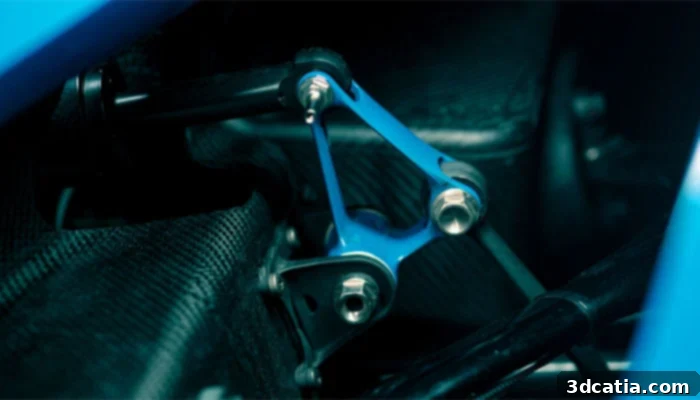
A close-up of one of the advanced 3D printed components integrated into the Bugatti Bolide, highlighting the intricate designs possible with additive manufacturing. (photo credits: Bugatti)
The Bugatti Bolide: A Masterclass in Additive Manufacturing Applications
The Bugatti Bolide is, by all accounts, a compilation of the latest technologies, with additive manufacturing playing a pivotal role in its development. Bugatti has meticulously leveraged its extensive experience in 3D printing to engineer this revolutionary sports car. The ultimate objective across all these applications is a drastic reduction in overall vehicle weight without compromising, and often enhancing, the rigidity and performance characteristics. Every 3D printed part on the Bolide tells a story of meticulous design and engineering innovation, optimized for extreme conditions.
Innovative Components and Their Impact
A prime example of these additively manufactured components is the set of push rods. These crucial suspension elements weigh a mere 100 grams each. Their exceptional lightness is achieved through an internal support arch design, which provides astonishing strength, allowing them to withstand loads of up to 3.5 tons. This incredible feat is largely thanks to the application of topology optimization methods during their design phase. Topology optimization is an advanced computational technique that determines the optimal material distribution within a given design space, based on specific loading conditions. In the case of the Bolide’s push rods, this method enabled engineers to create a structure that efficiently handles pressures concentrated mainly in the center of the part, eliminating unnecessary material while maximizing strength where it’s most needed. This results in components that are not only lighter but inherently more efficient in their function.
Another critical 3D printed part found on the Bugatti Bolide is the mounting bracket for the front wing. Crafted from titanium, this bracket weighs a mere 600 grams, boasting an incredibly thin inner wall thickness of just 0.7 mm. Despite its featherlight nature, Bugatti states that this component is engineered to withstand an astonishing aerodynamic force of 800 kilograms! This demonstrates the exceptional strength-to-weight ratio achievable with titanium 3D printing, crucial for maintaining aerodynamic stability at extreme speeds.
Continuing with the vehicle’s aerodynamic surfaces, the rear wing assembly also incorporates innovative 3D printed elements. The main central carbon fiber wing is connected to the vehicle body by another titanium component, precisely manufactured using 3D printing. This intricate joining element contributes to the overall structural integrity and aerodynamic efficiency of the rear wing, all while weighing only 325 grams. Its complex geometry, tailored for specific load paths, would be exceedingly difficult, if not impossible, to produce through traditional manufacturing methods.
Furthermore, the Bolide features radial compressors mounted on its wheels. These components serve a dual purpose: they efficiently cool the high-performance brakes and simultaneously reduce aerodynamic lift at higher speeds, ensuring maximum grip and stability. These sophisticated parts are made with a 3D printed titanium bowl, achieving an astonishing thickness of just 0.48 millimeters. The ability to create such intricate, thin-walled structures with robust materials like titanium is a direct result of additive manufacturing’s precision and freedom of design, allowing for optimized thermal management and aerodynamic performance.
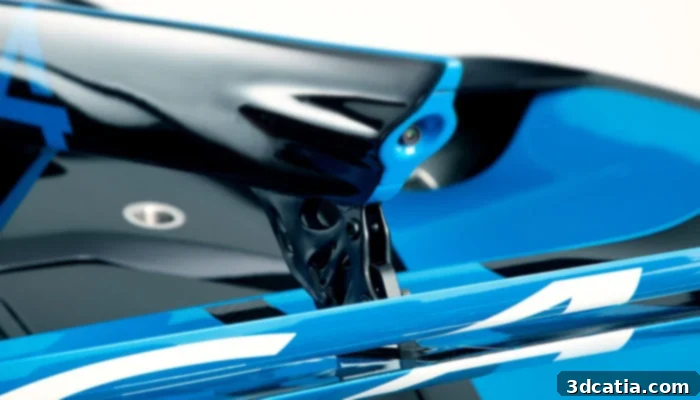
Additive manufacturing plays a crucial role in enabling automakers to dramatically reduce the overall weight of their vehicles, enhancing performance and efficiency. (photo credits: Bugatti)
The Bolide: A Blueprint for Future Bugatti Innovations
The Bugatti Bolide is more than just an exotic track machine; it is a vital testbed for future production vehicle technologies. Frank Götzke, Bugatti’s Head of New Technologies, perfectly encapsulates this vision: “As an experimental vehicle in the form of a racing car, the Bolide is no show car: it is an uncompromisingly road-ready extract of Bugatti’s complete technological expertise. Bugatti enthusiasts will also find these cutting-edge technologies in other vehicles in the future. It is the Bolide’s many technological highlights that make it so special. But these can also be transferred to production vehicles. This is what we are continuing to develop and work on, because Bugatti has set itself apart with its impressive innovations for over 110 years – and will continue to do so in the future.”
Götzke’s statement highlights Bugatti’s long-standing heritage of innovation, ensuring that the advancements made with the Bolide are not confined to a single experimental project. Instead, they represent a strategic investment in the future of the brand’s entire portfolio. The lessons learned, the materials tested, and the processes refined on the Bolide will undoubtedly pave the way for lighter, more efficient, and even more exhilarating Bugatti models in the years to come. This commitment to pushing boundaries through relentless research and development is a hallmark of Bugatti’s enduring legacy.
The Broader Impact of Additive Manufacturing in Hypercars
The Bugatti Bolide exemplifies how additive manufacturing is revolutionizing the hypercar segment. The ability to produce incredibly complex geometries, optimize material usage down to the microscopic level, and significantly reduce component weight is invaluable for vehicles operating at the extreme limits of performance. This technology allows engineers to create parts with integrated functions, superior strength-to-weight ratios, and bespoke designs that are simply unattainable through traditional subtractive or formative manufacturing methods.
Beyond Bugatti, the success of the Bolide’s additive manufacturing integration is a beacon for the wider automotive industry. It showcases how 3D printing can lead to more efficient vehicle development cycles, enhanced performance, and new levels of customization. As materials and printing technologies continue to evolve, we can expect to see even more widespread adoption of these advanced techniques, not just in niche hypercars but potentially trickling down to more mainstream production vehicles, delivering benefits like improved fuel efficiency and dynamic performance across the board. For now, the Bolide remains a fascinating glimpse into what is possible when cutting-edge technology meets unparalleled automotive ambition.
Bugatti has undoubtedly not finished surprising us with its relentless pursuit of automotive excellence. The Bolide stands as a testament to their innovative spirit and a harbinger of things to come in the world of high-performance vehicles. For those eager to delve deeper into the specifics of this remarkable vehicle, more information can be found HERE.
What are your thoughts on Bugatti Bolide’s extensive use of additive manufacturing and its implications for the future of hypercars? Share your insights in a comment below or connect with us on our Facebook and Twitter pages! Don’t forget to sign up for our free weekly Newsletter here to receive the latest 3D printing news directly in your inbox!
*Thumbnail photo credits: Bugatti