
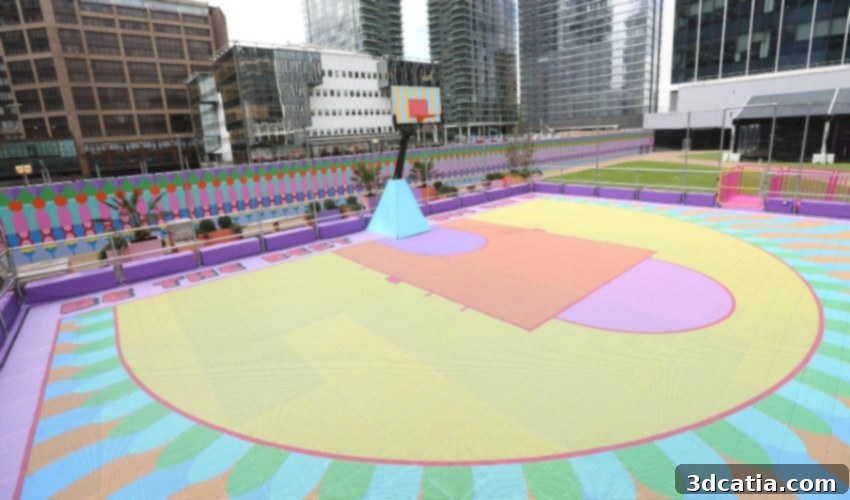
Yinka Ilori’s Vibrant 3D-Printed Basketball Court: A Game-Changer for Public Spaces in Canary Wharf
Life in the bustling metropolis can often be characterized by relentless stress, routine monotony, and occasional frustration. This sentiment has been particularly amplified over the past eighteen months, a period during which global circumstances necessitated significant restrictions on quality of life and minimized social interactions. In a commendable effort to rekindle public joy and foster a stronger sense of community, London’s iconic Canary Wharf financial district embarked on an innovative project. They commissioned local designer Yinka Ilori, widely celebrated for his distinctive and colorful artistic creations, to conceptualize and bring to life the district’s very first public basketball court. What makes this initiative truly groundbreaking is its realization through the cutting-edge capabilities of 3D printing technology, marking a significant milestone in urban design and additive manufacturing.
Upon first glance, Yinka Ilori’s basketball court is undeniably a spectacular visual magnet. Its vibrant hues and dynamic geometric patterns immediately capture attention, transforming an otherwise conventional sports facility into a captivating piece of public art. However, the uniqueness of this court extends far beyond its striking aesthetic appeal. Unlike traditional basketball courts, which typically feature surfaces crafted from hardwood or poured concrete, this innovative court boasts a floor composed of specially engineered 3D-printed tiles. These tiles are meticulously manufactured from polypropylene, a robust and versatile thermoplastic polymer, by the British company OnCourt. The decision to utilize 3D printing for these tiles offers a significant advantage: the court markings, such as boundary lines and the key, are not merely painted onto the surface but are intrinsically embedded within the material itself during the printing process. This ingenious approach ensures that the colors are far more durable and resistant to wear and tear compared to conventional painted markings. Ilori himself attests to this benefit, stating, “The colors used on the court are very vibrant and I think they will last a long time. It’s still a sports court so there will be wear and tear but I think the colour and material will keep. People already started using it over the weekend but it’s still in good condition so I think that’s one of the key benefits.” This innovative technique not only preserves the court’s visual integrity but also reduces the frequency and cost of maintenance.
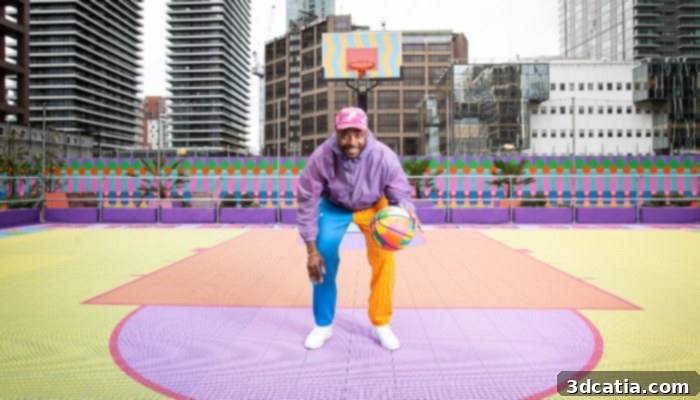
Designer Yinka Ilori in his custom-designed basketball court, showcasing the vivid colors and unique patterns (photo credits: Matt Alexander and Sean Pollock).
The Technological Edge: 3D Printing and Advanced Materials
Beyond its aesthetic and durability advantages, the 3D-printed floor, branded by OnCourt as “Traction²,” delivers substantial performance benefits for players. OnCourt emphasizes that this advanced surface provides superior traction and grip, significantly reducing the risk of slips and falls during intense gameplay. Furthermore, the specialized composition and structure of the 3D-printed tiles are designed to absorb impact more effectively, thereby lessening the stress placed on players’ knees and ankles. This ergonomic consideration is crucial for promoting player safety and extending playing comfort, making the court accessible to a wider range of athletes, from casual enthusiasts to more serious competitors. This entire project stands as a monumental achievement, proudly claiming the title of the world’s first fully machine-printed sports court surface. It serves as a powerful testament to the transformative potential of additive manufacturing, continually demonstrating its capacity to push the boundaries of what is conventionally considered possible. While specific intricate details regarding the proprietary 3D printing process employed for this groundbreaking installation have not yet been publicly disclosed, the outcome unequivocally underscores the immense innovation driving this sector.
Canary Wharf’s New Community Hub and Ilori’s Inspiring Message
As previously noted, this pioneering basketball court is strategically situated within London’s Canary Wharf financial district. This location is particularly symbolic, bringing a splash of vibrant color and a spirit of play into an area predominantly known for its towering skyscrapers and corporate environment. However, this court is intentionally designed to be half the size of traditional full-sized basketball courts. This compact configuration makes it perfectly suited for exhilarating 3×3 basketball games, a dynamic and increasingly popular variant of the sport. In 3×3 basketball, teams consist of only three players on the court at any given time, as opposed to the traditional five, and play revolves around a single basket. This format is ideal for urban settings, requiring less space and fostering a more intimate and fast-paced game. Designer Yinka Ilori poured a considerable amount of creative thought and personal philosophy into every aspect of the court’s design.
His artistic touch is evident not only in the kaleidoscope of colorful patterns that adorn the court’s walls but also in the powerful, uplifting slogan prominently displayed: “Be the best you can be.” Through this resonant statement, Ilori aims to inspire and motivate athletes of all skill levels, particularly after a period marked by inactivity and social constraints. The message encourages individuals to re-engage with their physical and mental well-being, to embrace challenges, and to strive for personal excellence in all facets of life. Ilori eloquently explains his motivation, remarking, “It was about trying to inject this sense of hope and positivity into the space. All you can do is give your best – I think that applies to everything that we do in our lives.” This sentiment transforms the court from a mere sporting venue into a beacon of optimism and a reminder of human potential. The court thus becomes more than just a place to play basketball; it’s a canvas for community engagement, a catalyst for physical activity, and a vibrant symbol of resilience and positive outlook in the heart of a bustling urban landscape.
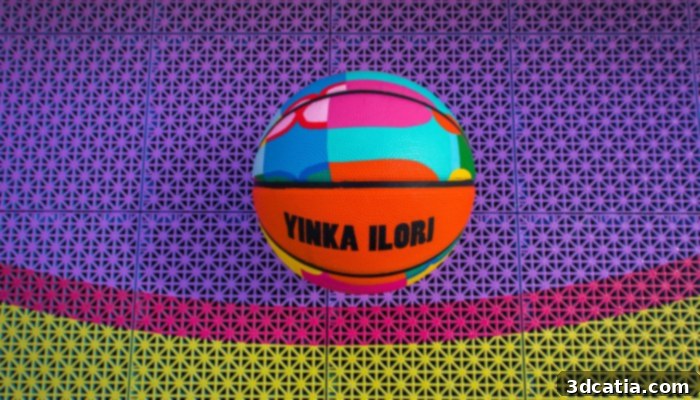
A detailed view of the innovative 3D-printed tiles that form the playing surface, highlighting their embedded markings and texture (photo credits: Matt Alexander and Sean Pollock).
The Future of Urban Design and Additive Manufacturing
The success of Yinka Ilori’s 3D-printed basketball court in Canary Wharf is not merely an isolated design triumph; it represents a significant leap forward in the integration of advanced manufacturing technologies with urban development and public art. This project serves as a compelling case study for how additive manufacturing can be leveraged to create functional, aesthetically pleasing, and highly durable public infrastructure that actively contributes to community well-being. The ability to rapidly produce customized, resilient components like the polypropylene tiles for the court opens up new avenues for architects, urban planners, and artists. Imagine custom-designed street furniture, interactive public installations, or even bespoke building facades, all brought to life with the precision and efficiency of 3D printing. Furthermore, the use of advanced materials such as polypropylene, known for its longevity and potential for recyclability, aligns with growing global demands for sustainable construction practices.
This pioneering court showcases how thoughtful design, combined with technological innovation, can transform overlooked or underutilized urban spaces into vibrant, active community hubs. It challenges conventional notions of what public spaces can and should be, encouraging more dynamic, engaging, and inspiring environments. As cities continue to evolve and adapt to the needs of their residents, projects like this will undoubtedly become more common, paving the way for a future where urban landscapes are not just functional but also profoundly enriching and creatively stimulating. The lessons learned from the Canary Wharf court — from material science to user experience and community impact — will inform countless future endeavors, solidifying additive manufacturing’s critical role in shaping the cities of tomorrow.
For those interested in delving deeper into this remarkable project and exploring other inspiring works by Yinka Ilori, additional information can be found HERE. What are your thoughts on this innovative 3D-printed basketball court and its implications for urban design? We invite you to share your perspectives in a comment below or join the conversation on ourFacebook,Twitter andLinkedIn pages! Don’t miss out on the latest advancements in additive manufacturing – sign up for our free weeklyNewsletter here, delivering the most current 3D printing news straight to your inbox!