

General Atomics Pioneers Advanced Unmanned Aircraft Systems with New Additive Manufacturing Center
General Atomics Aeronautical Systems (GA-ASI), a prominent subsidiary of General Atomics, stands as a leading American designer and manufacturer of sophisticated Unmanned Aircraft Systems (UAS). Renowned for its innovation and commitment to cutting-edge technology, GA-ASI has consistently invested in integrating advanced capabilities into its product lines and services over the past decade. In a move that underscores its dedication to the future of aerospace manufacturing, the company has announced a significant development for the realm of additive manufacturing: the establishment of a specialized center dedicated entirely to additive design and production.
This newly formed Additive Design & Manufacturing (AD&M) Center of Excellence is poised to become a cornerstone of GA-ASI’s operational strategy. Its primary focus will be on the comprehensive application of additive manufacturing techniques, commonly known as 3D printing, specifically for the creation of its advanced UAS line. Beyond direct production, the center will also spearhead critical research and development efforts, innovate tooling solutions, and fabricate next-generation flight hardware. While GA-ASI has not yet disclosed the specific additive manufacturing processes it intends to utilize, the establishment of such a dedicated facility signals a profound commitment to leveraging the full potential of this transformative technology across its product lifecycle.
Strategic Vision for the Future of UAS Production
Commenting on this pivotal decision, David R. Alexander, President of GA-ASI, articulated the company’s forward-thinking approach. He stated, “GA-ASI is continually looking for ways to enable, accelerate, and integrate Additive Manufacturing technologies into our designs, our operations, and our products. Through our AD&M Center of Excellence, we’re using a structured and stringent qualification process for AM applications that delivers a positive business case for us over conventional manufacturing methods. Through a comprehensive and holistic approach, our team of AM professionals are working to increase the adoption of AM parts for the benefit of our aircraft and ultimately, our customers.” This statement highlights a clear strategic intent: to embed additive manufacturing deeply within the company’s core operations, not merely as a supplementary tool but as a fundamental pillar of its manufacturing and design philosophy.
The emphasis on a “structured and stringent qualification process” is particularly crucial in the aerospace and defense sectors, where the reliability and safety of components are paramount. GA-ASI’s commitment to such rigorous validation underscores its dedication to producing flight-ready parts that meet the highest standards. Furthermore, Alexander’s reference to a “positive business case” demonstrates that the adoption of additive manufacturing is not just about technological advancement but also about achieving tangible economic advantages over traditional manufacturing methods. This includes potential savings in material usage, reduced lead times, optimized supply chains, and the ability to produce highly complex geometries that are otherwise unfeasible or prohibitively expensive.
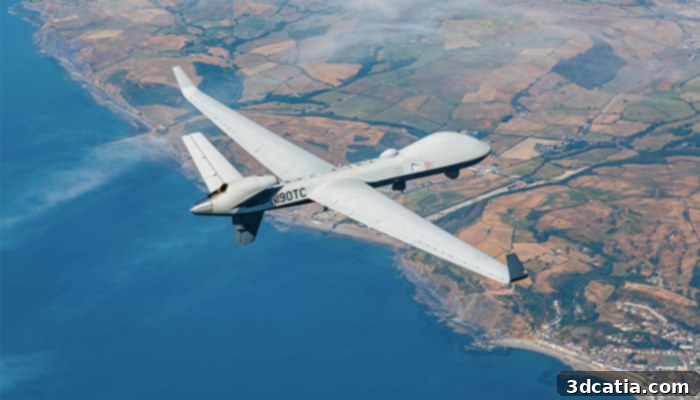
The MQ-9B SkyGuardian, General Atomics’ advanced UAS model, now incorporates additive technology (photo credit: GA-ASI)
Accelerating Innovation: The Role of 3D Printing in Flight Systems
To ensure the rapid development of flight-ready 3D printed components, General Atomics Aeronautical Systems has significantly accelerated its research and advancement efforts in additive manufacturing within the company. This initiative was strategically supported by the formation of a specialized applications team dedicated to new technologies and the meticulous creation of a defined roadmap for AM integration. The overarching objective has been to systematically identify which components within their complex UAS designs are best suited for 3D printing, leveraging the unique capabilities of additive processes.
Through this concerted effort, GA-ASI has already achieved impressive milestones, qualifying more than 300 distinct flight components across various additive manufacturing processes for production use. This rigorous qualification process for each part underscores the company’s commitment to ensuring the highest levels of performance and reliability, essential for aerospace applications. The extensive number of qualified components highlights not just the technical feasibility of 3D printing in critical flight systems but also GA-ASI’s leading position in adopting and scaling this technology for complex aerospace demands.
Tangible Benefits: Cost Savings and Enhanced Efficiency
The financial and operational benefits of GA-ASI’s commitment to additive manufacturing are already profound and well-documented. In terms of cost efficiency, the company estimates that the strategic utilization of additive manufacturing on its advanced MQ-9B model has yielded substantial savings. Specifically, GA-ASI reports savings exceeding $2 million in tooling costs alone, a significant reduction attributable to the elimination or simplification of traditional manufacturing tooling. Furthermore, the adoption of 3D printing has resulted in savings of approximately $300,000 per aircraft, demonstrating the direct economic advantages throughout the production cycle. These figures highlight the powerful return on investment that additive manufacturing can offer, particularly for complex, high-value aerospace components.
Beyond direct cost savings, the number of successful additive manufacturing applications within GA-ASI continues to expand at a rapid pace. The company already incorporates more than 10,000 additively manufactured components across its fleet of aircraft, a testament to the versatility and reliability of 3D printed parts. This latest Additive Design & Manufacturing Center of Excellence is specifically designed to further accelerate this growth, pushing the boundaries of what is possible with advanced manufacturing. By centralizing expertise and resources, the center will undoubtedly unlock new applications, optimize existing processes, and foster continuous innovation.
The Future of Unmanned Aircraft: MQ-9B SkyGuardian and SeaGuardian
GA-ASI’s commitment to additive technology is particularly evident in its most advanced platforms. The new MQ-9B SkyGuardian and SeaGuardian models, representing the pinnacle of modern Unmanned Aircraft Systems, will extensively incorporate additive manufacturing. These cutting-edge combat aircraft are engineered for a variety of critical missions, including sophisticated land and sea surveillance operations. They play a vital role in supporting the United States armed forces and allied nations, providing persistent intelligence, surveillance, and reconnaissance (ISR) capabilities over vast areas. The integration of 3D printed components into these advanced systems enhances their performance, reduces weight, and allows for more intricate and optimized designs, ultimately improving mission effectiveness and operational readiness.
The ability to rapidly prototype, iterate, and produce complex parts with additive manufacturing is particularly advantageous for platforms like the SkyGuardian and SeaGuardian, which often require highly customized components for specific sensor payloads or operational environments. This agility shortens development cycles and enables faster deployment of enhanced capabilities. The enhanced design freedom offered by 3D printing allows engineers to create lightweight structures with optimized internal geometries, contributing to improved fuel efficiency and extended flight durations—critical factors for long-endurance surveillance missions. This strategic integration of AM ensures that GA-ASI remains at the forefront of defense technology, providing robust, high-performance UAS solutions to meet evolving global security challenges. For more detailed information, the official press release can be found HERE.
Broader Impact and Industry Trends
The move by General Atomics Aeronautical Systems to establish a dedicated Additive Design & Manufacturing Center of Excellence is not just a strategic decision for the company; it reflects and contributes to a broader trend within the aerospace and defense industry. Manufacturers globally are increasingly recognizing the immense potential of additive manufacturing to revolutionize production processes, enhance product performance, and streamline supply chains. The benefits extend beyond cost savings to encompass accelerated design iterations, the ability to produce highly customized components on demand, and the consolidation of multiple parts into a single, complex 3D-printed component, thereby reducing assembly time and potential points of failure.
As the technology matures and material science advances, the adoption of 3D printing in critical applications like UAS will only grow. This shift represents a paradigm change, moving from traditional subtractive manufacturing to an additive paradigm where material is strategically added layer by layer. This approach inherently reduces material waste, which is particularly appealing for high-value materials often used in aerospace. Furthermore, the capacity to quickly adapt and innovate new designs for evolving mission requirements or technological upgrades provides a significant competitive advantage in a fast-paced sector like defense. GA-ASI’s proactive investment positions them as a leader in this advanced manufacturing revolution, setting a benchmark for others in the industry.
What are your thoughts on this exciting new center for additive manufacturing in aerospace? Share your insights and opinions in a comment below or join the conversation on our LinkedIn, Facebook, and Twitter pages! Don’t forget to sign up for our free weekly Newsletter here to receive the latest 3D printing news directly to your inbox! You can also find all our compelling videos and industry updates on our YouTube channel.
*All Photo Credits: General Atomics