
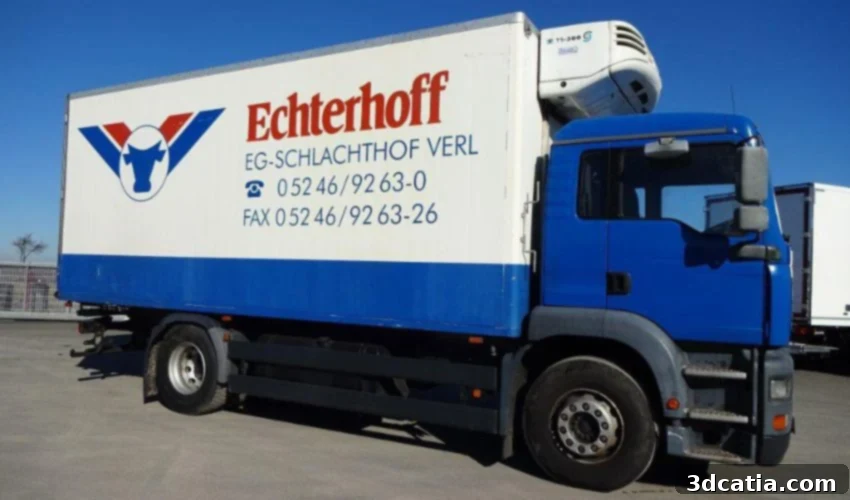
Revolutionizing Truck Maintenance: How Stegmaier Group Leverages 3D Printing for On-Demand Spare Parts
The global transport and logistics sector is the backbone of modern commerce, with trucks playing an undeniably critical role in moving vast quantities of goods. In 2021 alone, U.S. trucks transported an astonishing 10.93 billion tons of freight, underscoring their economic significance. However, maintaining these indispensable vehicles presents inherent challenges, particularly concerning the procurement of spare and replacement parts. Issues such as lengthy delivery times, escalating storage costs, minimum order quantities for infrequently needed components, and even quality inconsistencies can significantly disrupt operations. To proactively address these persistent hurdles and enhance efficiency, the renowned German company Stegmaier Group has strategically embraced additive manufacturing, quickly recognizing its transformative potential for spare part production.
Established in 1927 and based in Baden-Württemberg, Germany, the Stegmaier Group has a long-standing heritage centered on the manufacture and supply of commercial vehicles and trucks. Their extensive experience in this demanding field has made them acutely aware that even the most robust vehicles are susceptible to wear and tear, especially during long-haul journeys. A common yet disruptive problem, for instance, is the breakage of an oil filler neck cap. Such a seemingly minor component failure can lead to severe consequences: engine oil loss, potential engine damage, and the immediate incapacitation of the truck, halting its journey. The ripple effects can be substantial, including significant loss of sales, penalties for delayed deliveries, and spoilage of perishable goods, all culminating in considerable economic setbacks.
Traditionally, Stegmaier Group’s only recourse was to reorder the faulty part from a supplier and await its arrival before replacement. This conventional process often entailed lead times of several days or even weeks, which, when coupled with the risk of compromised cargo quality, forced the company to reconsider its approach. This critical evaluation led them to explore and ultimately adopt industrial 3D printing as a robust solution. As a direct result of this innovative shift, their subsidiary, STEBAG Land- und Nutzfahrzeugtechnik in Ellwangen, is now equipped with its own advanced 3D printer, bringing the future of on-demand manufacturing directly into their operations.
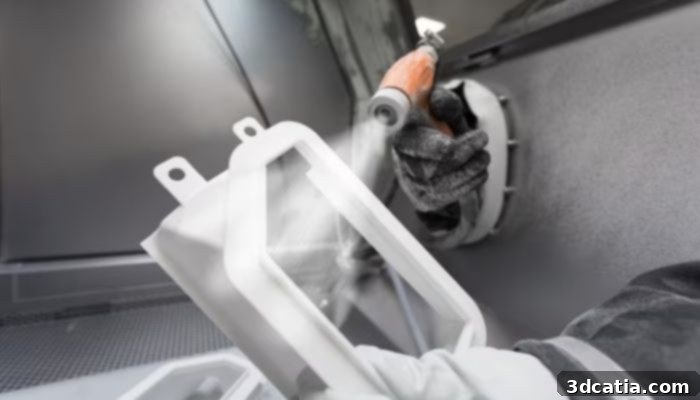
Mercedes-Benz utilizes 3D printing for efficient spare part manufacturing, demonstrating the broader industry adoption. (Photo credit: Mercedes-Benz)
Accelerating Availability: The Core Benefit of 3D Printed Spare Parts
For the Stegmaier Group, the advantages of integrating 3D printing into their workflow are manifold and immediately apparent. Components such as prototypes for new designs, specialized tools for maintenance, small-batch series of custom parts, and even essential signage can now be produced directly from their in-house 3D printer, moving swiftly from digital design to practical application. The paramount benefit highlighted by the transport company is the dramatically reduced lead time, ensuring that these critical parts are available with unprecedented speed. This capability fundamentally transforms their maintenance strategy, minimizing vehicle downtime and enhancing operational fluidity.
A particularly impressive aspect of this shift has been the ability to replace certain metal components with 3D-printed parts made from materials like PA-6 (Nylon 6). While thermoplastics, these advanced materials exhibit remarkable properties crucial for demanding automotive applications. PA-6 boasts low wear and tear, high toughness, and exceptional durability, making it an ideal choice for many non-structural components. Furthermore, the light-weight nature of these polymeric parts can contribute to marginal improvements in fuel efficiency over the long term, adding another layer of advantage. Should such a part break again, the solution is immediate: a new, identical component can be produced from the 3D printer in a matter of hours, entirely bypassing the cumbersome traditional supply chain. This rapid response capability is a game-changer for critical fleet maintenance.
Strategic Inventory Reduction and Environmental Sustainability
Sven Groß, Project Manager for 3D printing at STEBAG Land- und Nutzfahrzeugtechnik, offers further insights into the profound benefits derived from this technological adoption. He emphasizes, “A 3D printer allows the spare parts inventory for rarely needed items to be reduced, because many parts are only needed a few times a year, but are only available in larger packaging units.” This statement encapsulates a major economic and logistical advantage. Traditional procurement often necessitates purchasing parts in bulk, even for components with low demand, leading to significant capital tied up in slow-moving inventory. This excess stock requires valuable warehouse space, incurs storage costs, and carries the risk of obsolescence as vehicle models evolve.
By shifting to an on-demand production model through 3D printing, Stegmaier Group has dramatically optimized its inventory management. Parts are printed only when and where they are needed, virtually eliminating the need for extensive physical stock for specific items. This approach not only frees up capital and reduces warehousing expenses but also delivers substantial environmental benefits. As Sven Groß points out, localized 3D printing eliminates the need for additional costs and CO2 emissions associated with the long-distance transport of parts. Fewer shipments mean a smaller carbon footprint, aligning perfectly with modern sustainability goals and contributing to a greener logistics supply chain.
To ensure the highest quality and authenticity, Stegmaier Group utilizes a 3D printer from Schubert Additive Solutions. This robust partnership enables them to produce officially licensed original parts directly from the manufacturer’s digital database. This secure and efficient process ensures that every 3D-printed component meets stringent quality standards, providing peace of mind and upholding the integrity of the vehicles. The ability to download and print certified parts instantly represents a paradigm shift from a physical to a digital inventory, offering unparalleled flexibility and responsiveness in maintenance, repair, and operations (MRO).
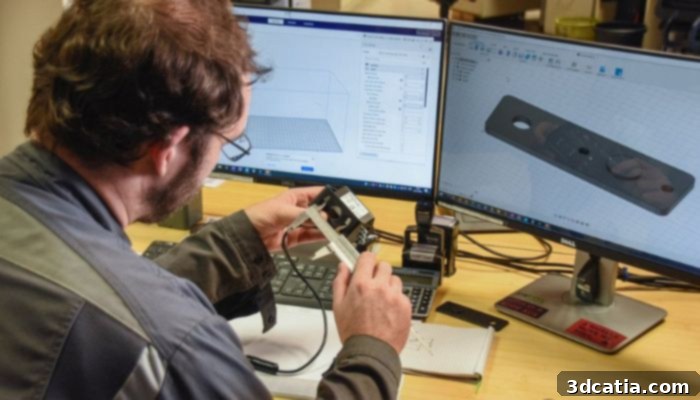
Sven Groß meticulously overseeing the modeling of a mount for a rear view camera, showcasing the precision and customization possible with 3D printing. (Photo credit: Stegmaier Group)
The Future of Fleet Management: Beyond Simple Replacements
The implementation of 3D printing at Stegmaier Group signifies more than just a solution for broken parts; it represents a strategic advancement in fleet management and industrial operations. Beyond addressing immediate replacement needs, additive manufacturing opens doors to numerous future possibilities. For instance, the technology allows for rapid prototyping and iteration of new designs, enabling the company to test and refine components quickly, potentially improving existing parts for better durability or performance. This agility is invaluable in a fast-evolving industry where constant innovation is key.
Furthermore, 3D printing empowers the creation of highly customized parts and specialized tooling. If a specific truck model requires a unique bracket or a particular jig for a repair, it can be designed and printed in-house, tailored precisely to the task. This level of customization reduces reliance on external suppliers for niche items and enhances the efficiency of repair and maintenance tasks. The ability to manufacture these items on-site also drastically cuts down the time vehicles spend off the road, maximizing their operational uptime and profitability.
Stegmaier Group’s adoption of 3D printing positions them as a pioneer in modern logistics and vehicle maintenance. They are not merely replacing parts; they are reshaping their entire supply chain, embracing a model that prioritizes speed, efficiency, cost-effectiveness, and environmental responsibility. This strategic move highlights how advanced technologies like additive manufacturing are becoming indispensable tools for companies seeking to overcome traditional operational hurdles and gain a competitive edge in an increasingly complex global market. The future of truck fleet management will undoubtedly involve more localized, on-demand production, and Stegmaier Group is at the forefront of this transformative wave.
What are your thoughts on the revolutionary use of 3D printing in the transport and logistics sector? Do you envision widespread adoption for other types of vehicles or industries? Share your insights and join the conversation in the comments below or on our LinkedIn, Facebook, and Twitter pages! Don’t forget to sign up for our free weekly Newsletter here to receive the latest 3D printing news straight to your inbox! You can also find all our compelling videos and industry updates on our YouTube channel.
*Cover photo credit: Mercedes Benz