
3D Printed Hydrogels: Revolutionizing Astronaut Radiation Protection for Deep Space Missions
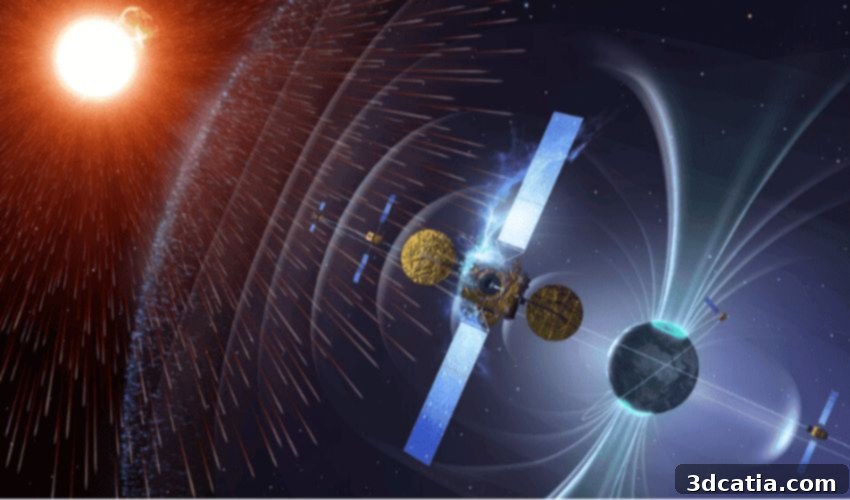
Space is an inherently hostile environment, characterized by numerous perils, among which radiation stands as one of the most significant and insidious threats. During space missions, astronauts and their critical equipment are exposed to radiation levels far exceeding those encountered on Earth. Without adequate protection, this high-energy radiation can lead to severe malfunctions in electronic systems, potentially jeopardizing mission success. More critically, prolonged exposure poses profound health risks to astronauts, ranging from acute radiation sickness to an increased lifetime risk of cancer, neurological damage, and cardiovascular disease. Consequently, developing robust and effective radiation shielding solutions is not merely an engineering challenge but a fundamental imperative for the continued safety and expansion of human space exploration, particularly as missions venture further beyond Earth’s protective magnetosphere towards the Moon and Mars.
Addressing this formidable challenge, an innovative team of researchers at Ghent University in Belgium is pioneering a groundbreaking solution: 3D printed hydrogels. These remarkable materials, well-known for their exceptional capacity to absorb and retain vast quantities of water, are now being investigated for their potential to act as powerful shields against the relentless barrage of cosmic radiation. But what precisely are hydrogels, and how can these seemingly simple materials offer such vital protection against energetic particles traveling at relativistic speeds? This comprehensive article delves into the science behind hydrogels, their unique properties that make them suitable for space radiation shielding, and the transformative role of 3D printing in realizing this vision.
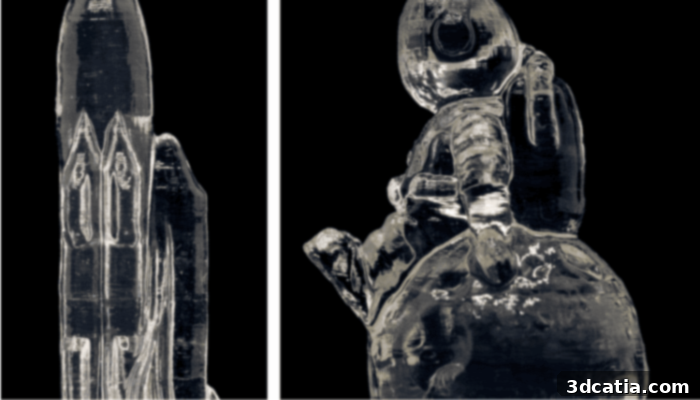
A 3D printed hydrogel astronaut and space shuttle model demonstrates potential applications for advanced radiation shielding.
Understanding the Threat: Protecting Astronauts from Space Radiation
Contrary to popular belief, space is far from an empty void; it is permeated by a constant flux of highly energetic particles moving at speeds approaching the speed of light. These particles originate primarily from two major sources: solar particle events (SPEs), which are bursts of high-energy protons and heavy ions ejected from the Sun during solar flares and coronal mass ejections, and galactic cosmic rays (GCRs), which are extremely energetic atomic nuclei originating from outside our solar system, remnants of supernovae and other cosmic phenomena. GCRs, in particular, are a continuous threat, difficult to shield against due to their high energy and ability to fragment into secondary radiation upon impact with shielding materials. The cumulative effect of this exposure can be devastating. For astronauts, this means an elevated risk of developing various cancers, damage to the central nervous system leading to cognitive impairment, acute radiation sickness during severe SPEs, and potential long-term degenerative effects on organs such as the heart and eyes. For spacecraft electronics, radiation can cause single-event upsets (SEUs), leading to data corruption or even permanent damage to vital components, compromising mission safety and success.
Recent scientific investigations have increasingly highlighted water as a surprisingly effective material for radiation protection. Its efficacy stems from its unique molecular structure: water molecules (H₂O) contain a high concentration of hydrogen atoms. Hydrogen, with its single proton and electron, is exceptionally adept at slowing down and scattering high-energy charged particles, particularly protons and lighter ions, without producing significant amounts of harmful secondary radiation. Furthermore, water’s density allows for the absorption of a considerable amount of energy from incoming radiation. When considering conventional shielding materials like aluminum, which is common in spacecraft, water often offers a superior mass efficiency for shielding against certain types of radiation. However, incorporating large tanks of liquid water into spacecraft or spacesuits presents a myriad of logistical and practical challenges. Adding substantial water tanks to spacesuits would severely restrict astronauts’ mobility and dexterity, making essential tasks cumbersome or even impossible. Moreover, achieving uniform distribution of water for comprehensive protection is difficult, and any leaks could lead to catastrophic damage to sensitive electronic equipment, creating more problems than they solve. The sheer mass required for effective shielding with bulk water also adds significantly to launch costs, a critical consideration for any space mission.
In light of these formidable challenges, researchers at Ghent University are pursuing an innovative and highly promising alternative approach to radiation protection. Their work centers on superabsorbent polymers (SAPs), which offer a potentially safer and far more effective solution for creating advanced protective shields. SAPs are a class of polymers renowned for their extraordinary ability to absorb and retain liquid up to several hundred times their own weight. Upon saturation with water, these polymers undergo a remarkable transformation, swelling to form a stable, gel-like substance known as a “hydrogel.” This gelled state effectively immobilizes the water, mitigating the risks associated with free-flowing liquids in a microgravity environment. Researcher Lenny Van Daele elaborates on the ubiquity and potential of these materials: “Hydrogels are found in many things we use every day, from contact lenses, which require excellent biocompatibility and water retention, to disposable diapers and sanitary products, where their superabsorbent properties are crucial. Our research group has extensive experience with their applications in the medical field – specifically using hydrogels as soft, biocompatible, and implantable materials designed to repair damaged tissues and organs. This background gives us a unique perspective on their potential in other demanding applications, such as space exploration.” The ability of SAPs to securely encapsulate water while maintaining a stable form makes them an ideal candidate for overcoming the inherent limitations of using bulk water for radiation shielding in space.
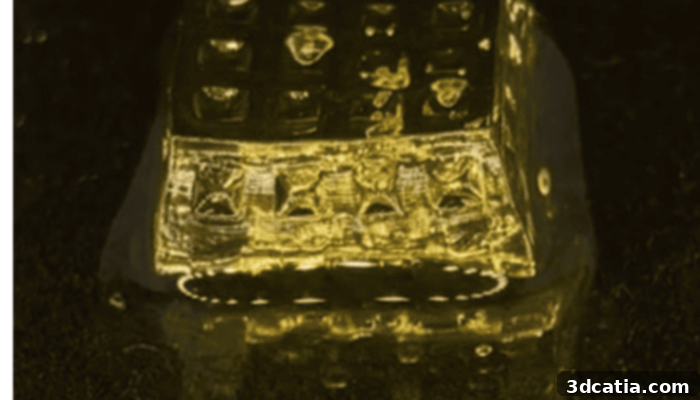
An illustration depicting hydrogel swelling, highlighting its significant water absorption capability.
3D Printed Hydrogels: A Breakthrough in Space Radiation Protection
Hydrogels present an exceptionally compelling solution for radiation protection in the unforgiving environment of space, whether integrated into permanent space habitats, temporary modules, or directly into astronaut suits. The primary advantage lies in their unique capacity to retain water in a stable, gelled form. Unlike liquid water, the water held within a hydrogel does not readily spill or slosh around, even in microgravity, guaranteeing consistent and reliable protection. This stability is critical, as any displacement of shielding material would create vulnerable areas. Furthermore, in the unlikely event of a breach or leak, the water contained within the hydrogel escapes much more slowly than free-flowing liquid, providing astronauts with precious time to identify and mitigate the issue, thereby ensuring their continued safety and preventing damage to sensitive equipment. Manon Minsard, another key researcher from Ghent University, highlights a crucial aspect of their chosen material: “The specific superabsorbent polymer that we are utilizing possesses a rare and highly advantageous quality amongst polymers: it can be processed using multiple different manufacturing techniques. While traditional methods like injection molding or extrusion are viable, our method of choice is 3D printing. This advanced additive manufacturing technique allows us to precisely create a hydrogel in almost any intricate shape or customized geometry we desire, offering unparalleled design freedom and customization for space applications.”
The integration of 3D printing technology with hydrogels represents a transformative leap forward in the development of space radiation shields. The ability to customize shapes means that shielding can be perfectly contoured to fit the unique dimensions of spacecraft walls, equipment compartments, or even integrate seamlessly into the layers of a spacesuit. This level of customization ensures maximum coverage and efficiency, minimizing gaps where radiation could penetrate. Moreover, 3D printing enables the creation of complex internal structures within the hydrogel, potentially optimizing its radiation-attenuating properties without significantly increasing mass. The potential for on-demand manufacturing in space is another revolutionary benefit. Imagine astronauts being able to print replacement shielding parts or augment existing protection using a compact 3D printer and raw hydrogel materials, significantly reducing the payload mass that needs to be launched from Earth. This approach aligns perfectly with the future vision of sustainable deep-space exploration, where resources are maximized, and self-sufficiency is paramount. The precision and repeatability of 3D printing also ensure a high degree of quality control, critical for life-support systems and protective gear in space.
Having successfully demonstrated that these innovative hydrogels are well-suited for the demanding space environment and offer superior properties compared to traditional approaches, the Ghent University researchers are now intensifying their efforts on refining and improving their manufacturing methods. Their immediate objective is to further develop techniques for creating robust and functional 3D structures from these advanced materials, with a strong focus on enhancing production efficiency. This includes optimizing printing parameters, exploring different polymer formulations, and ensuring the structural integrity of the printed hydrogel components. Their ultimate vision is to scale up production, moving from laboratory prototypes to large-scale manufacturing capabilities, making these specialized radiation shields viable for future long-duration missions to the Moon, Mars, and beyond. This pioneering research not only addresses a critical safety concern for astronauts but also opens new avenues for material science and additive manufacturing in the context of expanding humanity’s footprint in the cosmos.
What are your thoughts on the revolutionary potential of 3D printed hydrogels for enhancing astronaut safety in space? Share your insights and perspectives in a comment below or join the conversation on our LinkedIn, Facebook, and Twitter pages! If you are interested in exploring more about 3D printing applications in the aerospace and defense sectors, we invite you to check out our dedicated page HERE. Don’t forget to subscribe to our free weekly Newsletter here to receive the latest 3D printing news directly in your inbox! You can also find all our engaging videos and exclusive content on our YouTube channel for a deeper dive into additive manufacturing innovations.
*All Photo Credits: The European Space Agency