
The Evolving World of 3D Printing: Etsy’s Handmade Debate, Industrial Advances, and Material Innovations
The landscape of manufacturing is continually reshaped by advancements in 3D printing technology, blurring traditional lines between mass production and artisanal craftsmanship. This dynamic evolution impacts everything from global online marketplaces like Etsy, which grapples with defining “handmade” in the digital age, to industrial powerhouses unveiling cutting-edge metal printers, and innovative designers pushing the boundaries of consumer products. This article delves into the latest developments, including Etsy’s updated policy on 3D printed goods, Farsoon’s revolutionary metal 3D printer designed for challenging materials, the imaginative fusion of design and anatomy in new footwear, and pioneering material releases from Formlabs that promise greater customization and precision.
Etsy Redefines “Handmade” with Stricter Rules for 3D Printed Items
Etsy, the renowned global marketplace celebrated for its unique and handcrafted items, has recently introduced significant revisions to its Creativity Standards, particularly impacting the sale of 3D printed products. This policy update signals a crucial shift for the platform, which has historically allowed a broader interpretation of what constitutes a “handmade” item. The core of the new directive mandates that all 3D printed products sold on Etsy must now originate from a seller’s original design. Furthermore, these items are often expected to be personalized or customized to meet a buyer’s specific requirements. This contrasts sharply with previous guidelines, which permitted sellers to utilize templated designs or third-party STL files for their 3D prints, effectively blurring the line between unique creations and mass-produced goods.
The tightened regulations align with Etsy’s overarching mission to “Keep Commerce Human” by actively promoting genuinely original items crafted by real individuals. The company aims to preserve the authenticity that defines its brand, ensuring that buyers perceive true value in the artisanal nature of products purchased on the platform. However, the practical enforcement mechanisms for this new policy remain somewhat unclear, posing questions for both sellers and the platform itself. This update is poised to have substantial implications, especially for larger-scale 3D print farms and sellers who have relied on mass-produced items derived from readily available digital files. The announcement has already sparked considerable discussion and debate within the vast 3D printing maker community, as stakeholders ponder the long-term impact on their businesses and the broader interpretation of “handmade” in an era dominated by advanced digital manufacturing techniques. This move underscores Etsy’s commitment to its founding principles, even as it navigates the complexities of modern production methods and the digital supply chain.
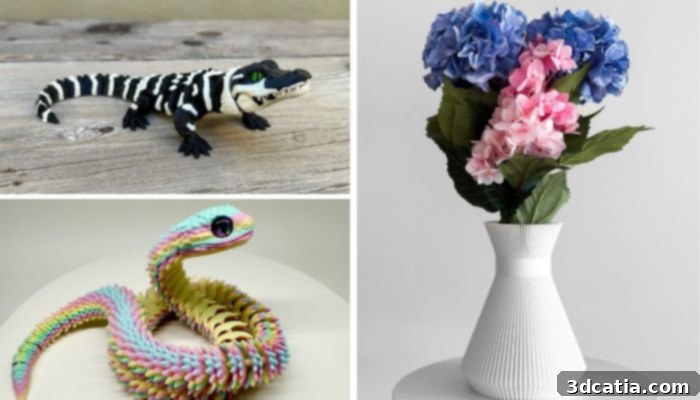
3D printed products available on Etsy. (Photo Credits: Top left: 3DSideShow. Bottom Left: 3DPrintEngine. Right: PotsAndPetalsDesign)
Farsoon Unveils FS621M-Cu: A New Frontier in Copper Metal 3D Printing
Farsoon Technologies, a leading manufacturer specializing in industrial-grade 3D printers, has announced its latest innovation: the FS621M-Cu metal 3D printing solution. This cutting-edge machine is specifically engineered for high-performance applications utilizing challenging copper alloys, marking a significant step forward in additive manufacturing capabilities. Copper, known for its exceptional electrical and thermal conductivity, is a highly sought-after material in various industries, including aerospace, electronics, and automotive. However, its high reflectivity and specific thermal properties present considerable difficulties for traditional laser-based additive manufacturing processes, often leading to inconsistent prints and limited material densities.
The FS621M-Cu addresses these challenges head-on with its robust design. It is a large-format system equipped with four powerful 1,000 W lasers, which are crucial for ensuring print stability and reliability when working with such a reflective material. This multi-laser configuration allows for a more efficient and uniform energy distribution, leading to denser, higher-quality parts. Farsoon asserts that the FS621M-Cu is ideally suited for the most complex aerospace applications, a sector known for its stringent material requirements and intricate component designs. Indeed, a key player in the aerospace industry is already leveraging this technology, underscoring its potential for producing lightweight, high-performance components with optimized thermal management. The increasing adoption of copper in 3D printing signifies a growing recognition of its unique advantages, and Farsoon’s FS621M-Cu is poised to accelerate its integration into advanced manufacturing workflows, unlocking new possibilities for innovation in demanding engineering fields.
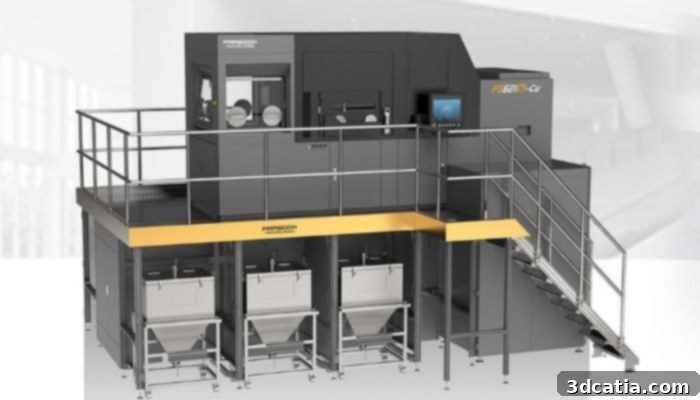
3D printer FS621M-Cu (Photo Credits: Farsoon)
EXOSKYN: A Futuristic 3D Printed Sneaker Blending Anatomy and Algorithmic Design
The world of footwear design is undergoing a profound transformation, driven by the innovative capabilities of 3D printing. A compelling example of this evolution is the EXOSKYN sneaker, a creation by designer Mahi Naim that transcends conventional shoe manufacturing. While its striking, almost eccentric appearance immediately catches the eye, it is the underlying design philosophy and production methodology that truly captivates. EXOSKYN is presented as a limited-edition sneaker, notably free from overt branding, emphasizing its artistic and experimental nature. This unique footwear is the culmination of a sophisticated blend of 3D printing technology, advanced algorithmic design principles, and a deep understanding of human anatomy.
The design of the EXOSKYN is profoundly inspired by the intricate structure of the human foot, aiming to create an organic, almost symbiotic “interface between body, code, and material.” This approach, as articulated by its creator, opens an “alternative path in sneaker design, balancing experimentation and targeted industrialization.” The model rigorously explores a bio-inspired structure of the human foot, meticulously generated through algorithmic design processes. This digital blueprint is then translated into a tangible product through 3D printing, resulting in a flexible monoblock construction. The profound advantage of this method lies in its efficiency and seamlessness: the sneaker is produced on-demand, without the need for traditional seams or complex assembly steps. This means that the entire shoe, from its continuous lines to its intricate ribbed patterns and lattice structure, is printed in a single, cohesive unit. This groundbreaking approach not only offers unparalleled design freedom and customization potential but also hints at a more sustainable future for footwear production, minimizing waste and labor involved in conventional manufacturing.
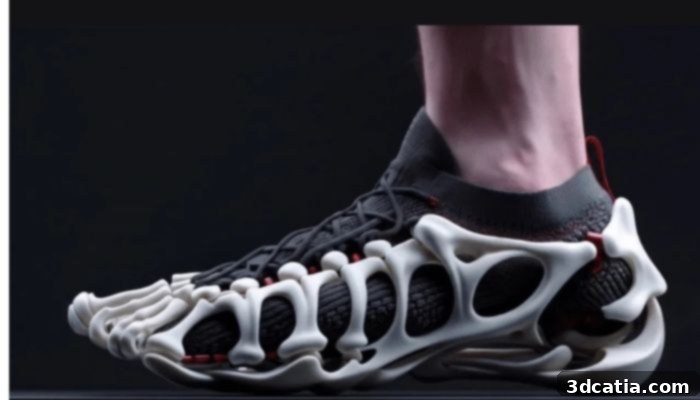
The EXOSKYN sneaker was 3D printed from a single block (Photo Credits: Mahi Naim)
High Above Integrates 3D Printing for Enhanced MTB Pack Breathability
High Above, a renowned U.S. brand celebrated for its specialized mountain biking (MTB) backpacks and gear, has elevated its product line with an innovative upgrade to its Venture pack for cyclists. The latest version introduces a cutting-edge 3D printed back panel, significantly enhancing comfort and breathability for riders. The Venture pack itself is crafted from Challenge Ultra 400X, an exceptionally tough and durable fabric, and features convenient magnetic buckles, along with multiple internal pockets for efficient organization of essentials during rides. However, the most compelling new feature is the integration of additive manufacturing technology.
A meticulously designed 3D printed panel, characterized by an intricate lattice structure, has been strategically incorporated into the section of the pack that makes direct contact with the wearer’s body. This innovative panel serves a dual purpose: it provides superior flexibility, conforming comfortably to the rider’s back, while simultaneously maximizing airflow and breathability. The lattice design creates numerous channels and open spaces, allowing heat and moisture to dissipate efficiently, thereby preventing the discomfort often associated with traditional pack designs. This advanced component was developed through a collaborative effort with Carbon, a leader in Digital Light Synthesis (DLS) 3D printing technology, ensuring both precision and performance. The design prioritizes practicality and ease of washing, aspects that High Above consistently emphasizes in its products. The fanny pack boasts a practical capacity of 2.5 liters, measures 9.5″ x 6″ x 3″, weighs a mere 357g, and is priced at $200. This exemplifies how 3D printing is revolutionizing athletic gear, offering unprecedented levels of customization, comfort, and performance.

High Above’s Venture 3D fanny pack features a 3D printed back panel for comfort and breathability (Photo Credits: High Above)
Formlabs Expands SLA 3D Printing Capabilities with New Custom Color and Precision Casting Resins
Formlabs continues to push the boundaries of Stereolithography (SLA) 3D printing, further enhancing its versatility with the launch of two innovative new resins: Color Resin V5 and True Cast Resin. These new materials are specifically designed to address advanced aesthetic design requirements and demanding precision casting needs, catering to a broader spectrum of professional applications. Both resins are exclusively compatible with Formlabs’ state-of-the-art Form 4 series printers, ensuring optimal performance and consistency.
The Color Resin V5 represents a significant advancement for creators seeking unparalleled aesthetic control. This resin enables the direct printing of parts in custom colors, eliminating the need for time-consuming and labor-intensive post-processing steps such as painting or dyeing. It is offered as a made-to-order solution, with a rapid one-week manufacturing lead time, available starting from just one liter. This resin delivers high-quality SLA finishes with colors that are remarkably true to specific branding guidelines or intricate creative designs. Formlabs highlights that Color Resin V5 effectively bridges the gap between the color flexibility often found in FDM filaments and the superior precision and surface finish characteristic of SLA technology. This innovation empowers designers and engineers to produce prototypes, marketing models, and end-use parts with precise color matching, accelerating product development cycles and ensuring visual fidelity.
On the other hand, True Cast Resin is meticulously engineered for highly precise wax 3D printing applications. Formlabs emphasizes its capability to create complex and exceptionally detailed casting prototypes up to 5mm thick. A key differentiator of True Cast Resin is its outstanding performance during the casting process, attributed to its remarkably low thermal expansion and minimal shrinkage. These properties are critical for achieving accurate and consistent castings, particularly in industries where dimensional stability is paramount. As such, True Cast Resin is an ideal choice for intricate jewelry manufacturing, enabling designers to produce highly detailed master patterns for investment casting. It also proves invaluable for engineering components that demand extreme precision, offering a reliable alternative to traditional wax pattern creation and significantly streamlining the investment casting workflow.
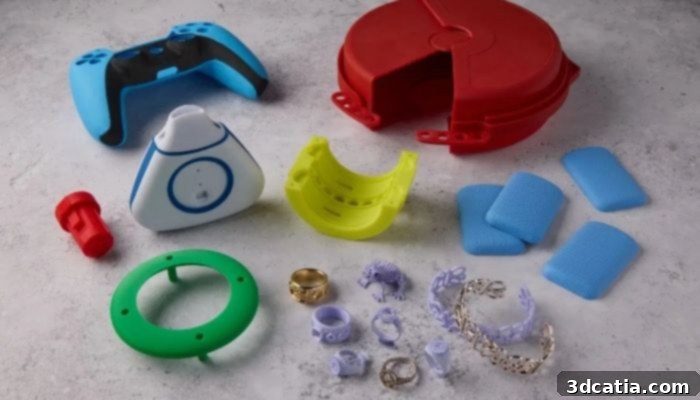
Parts printed with the new Formlabs resins (Photo Credits: Formlabs)
From Etsy’s evolving definition of “handmade” to the industrial breakthroughs in metal additive manufacturing and the ingenious application of 3D printing in consumer products and advanced materials, the world of 3D printing continues its rapid and transformative expansion. These developments highlight a critical moment in manufacturing, where digital processes are not just replicating, but actively innovating how products are designed, produced, and perceived. What do you think of Etsy’s policy changes and these exciting new innovations? Let us know in a comment below or on our LinkedIn or Facebook pages! Plus, don’t forget to sign up for our free weekly Newsletter to get the latest 3D printing news straight to your inbox. You can also find all our videos on our YouTube channel.
*Cover Photo Credits: 3DSideShow via Etsy