
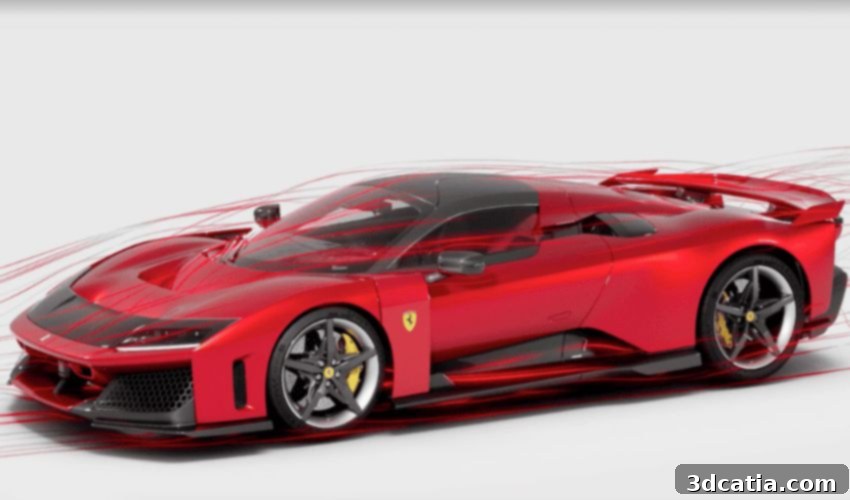
Ferrari F80: How 3D Printing Redefines the Future of High-Performance Supercars
Ferrari, the legendary Italian luxury car manufacturer and racing icon, recently made headlines with the highly anticipated unveiling of its new limited-edition F80 supercar. On October 17th, the world caught a glimpse of this automotive masterpiece, slated for production between 2025 and 2027 to commemorate the automaker’s momentous 80th anniversary. A truly exclusive offering, only 799 units of the F80 will ever be produced, and remarkably, all have already been pre-sold at an astounding unit price of 3.6 million euros each. This rapid sell-out underscores the immense desirability and prestige associated with Ferrari’s most groundbreaking models. Beyond its breathtaking aesthetics and exorbitant price tag, the F80 harbors a significant technological leap that positions it at the forefront of automotive innovation: the strategic integration of metal parts manufactured through advanced 3D printing technology. This marks a historic first for the Maranello-based brand, which has traditionally maintained a veil of secrecy around its production methodologies, particularly regarding the adoption of cutting-edge manufacturing techniques like additive manufacturing.
The F80 is not merely a new model; it represents a profound turning point in Ferrari’s engineering philosophy, pushing the boundaries of performance, technology, and design. It boldly asserts Ferrari’s superior production capabilities and extends its appeal to a new generation of enthusiasts and collectors who demand both tradition and innovation. This spectacular new supercar proudly takes its place alongside an illustrious lineage of iconic Ferrari models, echoing the revolutionary spirit of predecessors such as the legendary F40 and the hybrid marvel LaFerrari. The F80 stands as a testament to the unparalleled excellence in internal combustion engine engineering that Ferrari is renowned for, while simultaneously embracing and expertly integrating the latest generation of hybrid advancements. This fusion creates a vehicle that is not only a powerhouse of raw performance but also a symbol of sustainable progress in the ultra-luxury automotive sector. The integration of 3D printing into such a critical component highlights Ferrari’s commitment to leveraging state-of-the-art technologies to achieve previously unattainable levels of precision, strength, and lightweight construction, setting a new benchmark for the entire automotive industry.
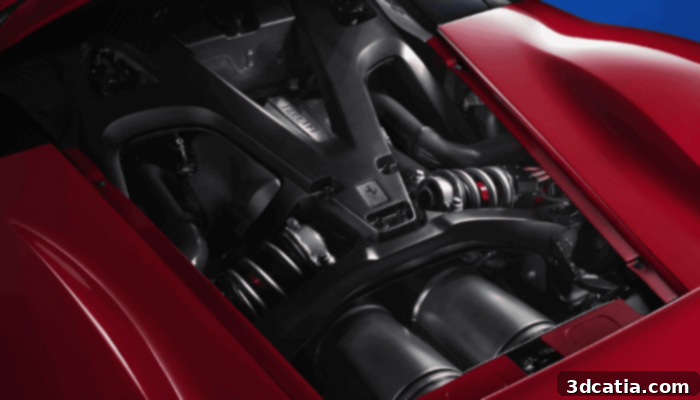
Unlocking Performance: 3D Printed Parts in the F80’s Advanced Suspension System
At the heart of the F80’s groundbreaking performance lies its sophisticated active suspension system, where 3D printing plays a pivotal and transformative role. This cutting-edge supercar is equipped with a fully independent four-wheel suspension setup, meticulously engineered with a double wishbone system at each corner. This intricate design is further enhanced by four potent 48V electric motors, which provide instantaneous and precise control over the vehicle’s dynamics. Crucially, the suspension system incorporates active shock absorbers and, most notably, suspension arms manufactured using advanced additive manufacturing techniques. Specifically, the upper wishbones, critical components for wheel control and structural integrity, are produced via metal 3D printing. This represents an unprecedented application for a Ferrari road-going model, signifying a major leap forward in the brand’s adoption of advanced manufacturing processes.
The completely redesigned active suspension system stands as one of Ferrari’s most significant innovations for the F80, optimized to deliver unparalleled vehicle performance across diverse driving conditions, whether on a demanding racetrack or navigating everyday roads. It masterfully reconciles two often conflicting engineering objectives: ensuring rock-solid stability and precision on the racetrack by minimizing height variations and body roll, while simultaneously providing effective absorption of road irregularities and delivering a supple, comfortable ride during regular road use. This dual capability is a direct result of the design freedom and material properties afforded by 3D printing. Traditional manufacturing methods often impose design constraints that compromise one aspect for the sake of the other. However, additive manufacturing enables engineers to create complex, lightweight geometries for components like the wishbones, allowing for precise control over stiffness, damping, and overall suspension kinematics, without the compromises inherent in conventional fabrication.
The Transformative Advantages of 3D Printing in High-Performance Automotive Engineering
The adoption of metal 3D printing for critical suspension components in the F80 offers a multitude of engineering and performance advantages. These benefits extend beyond simple weight reduction, encompassing optimized component configuration, vastly improved precise wheel control, and the clever elimination of the traditional stabilizer bar. Furthermore, it allows for highly precise camber angle adjustment, enabling unparalleled tuning flexibility for different driving scenarios. The ability to create complex internal structures and optimized external geometries through additive manufacturing means that engineers can place material exactly where it is needed for strength, while removing it from areas where it contributes only to excess weight. This leads to a significant reduction in unsprung weight – the weight of the vehicle not supported by the suspension – which is crucial for improving handling, responsiveness, and ride quality in high-performance vehicles.
Beyond these specific applications in the F80, it is crucial to highlight the broader benefits that 3D printing, or additive manufacturing, offers to the entire automotive sector. Foremost among these is the dramatic potential for weight reduction. By enabling the creation of intricate lattice structures and topology-optimized designs, 3D printing can produce components that are significantly lighter than their conventionally manufactured counterparts, without compromising strength. This is vital for supercars like the F80, where every gram saved translates into enhanced acceleration, braking, and fuel efficiency, while also reducing emissions. Another significant advantage is the unparalleled design flexibility. Additive manufacturing liberates designers and engineers from the constraints of traditional tooling and machining processes, allowing them to realize highly complex geometries, consolidate multiple parts into a single component, and integrate functional features directly into the design. This freedom fosters innovation and enables the creation of components that were previously impossible to produce.
Furthermore, 3D printing facilitates rapid prototyping and production, dramatically shortening development cycles. Automakers can quickly iterate on designs, test various configurations, and move from concept to final part much faster than with conventional methods. This agility is invaluable in the fast-paced world of automotive development, especially for limited-edition, cutting-edge models. Efficient material usage is another eco-friendly benefit, as additive processes build parts layer by layer, minimizing waste compared to subtractive manufacturing techniques that cut away material from a larger block. While Ferrari has historically been discreet about specific production techniques, this groundbreaking integration of 3D printing in the F80 marks an undeniable and important milestone for the brand and the industry as a whole. It signals a future where advanced manufacturing is not just for niche applications but is integrated into the core engineering of even the most exclusive vehicles. The F80’s staggering total power output of 1,200 hp, making it the most powerful Ferrari model ever designed for the road, combined with its blistering acceleration from 0 to 100 km/h in just 2.15 seconds and a top speed of 350 km/h, are all tangible demonstrations of the technological prowess that innovations like 3D printing help to unlock.
Ferrari’s Legacy of Innovation and the Road Ahead with 3D Printing
Ferrari has always been synonymous with pushing the boundaries of automotive engineering, from its triumphant successes on the racetrack to its iconic road cars that define luxury and performance. The integration of 3D printed metal parts into the F80 is not an anomaly but a natural evolution of this relentless pursuit of excellence. It demonstrates Ferrari’s proactive approach to adopting advanced manufacturing technologies to enhance vehicle dynamics, optimize structural integrity, and ultimately deliver an unparalleled driving experience. This strategic move could set a precedent for other high-performance automakers, signaling a broader shift towards leveraging additive manufacturing for critical, load-bearing components. As the capabilities of 3D printing continue to advance, we can anticipate even more intricate and functional applications in future automotive designs, ranging from optimized engine components to bespoke interior elements.
The F80, with its blend of a powerful internal combustion engine and sophisticated hybrid advancements, perfectly encapsulates Ferrari’s vision for the future of supercars – one that respects its rich heritage while boldly embracing cutting-edge technology. The early adoption of 3D printing for essential parts like suspension wishbones not only contributes to the F80’s incredible performance metrics but also positions Ferrari as a leader in sustainable innovation within the luxury automotive segment. It highlights a commitment to lighter, stronger, and more efficiently produced components. As the automotive industry faces increasing pressures for sustainability and personalized manufacturing, Ferrari’s move with the F80 serves as a powerful example of how additive manufacturing can meet these challenges head-on, delivering both performance benefits and production efficiencies. This landmark decision reinforces the idea that true innovation often lies at the intersection of traditional craftsmanship and revolutionary technology.
What are your thoughts on Ferrari’s strategic use of 3D printed metal parts for the new F80 supercar? Do you believe this will accelerate the adoption of additive manufacturing across the entire automotive industry, or will it remain a domain for ultra-luxury and high-performance vehicles? We invite you to share your insights in a comment below or join the conversation on our LinkedIn, Facebook, and Twitter pages! For the latest breaking news and developments in 3D printing, don’t forget to sign up for our free weekly Newsletter here, delivered straight to your inbox. You can also explore all our informative videos and engaging content on our YouTube channel.
*All Photo Credits: Ferrari