
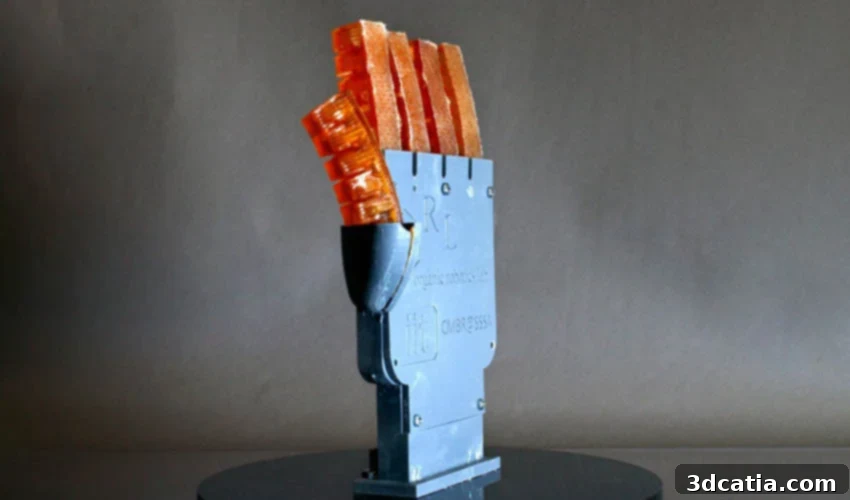
Cornell Researchers Unveil 3D Printed Sweating Robot Muscles for Superior Thermal Management
In a groundbreaking development that promises to revolutionize the field of robotics, a team of dedicated researchers at Cornell University has successfully engineered a 3D printed robot muscle capable of self-regulating its temperature through a process remarkably similar to mammalian perspiration. This innovative “sweating” capability addresses one of the most significant challenges facing advanced robotics today: thermal management. Just as humans and other mammals release sweat to cool down, these pioneering robotic components can dissipate heat, enabling robots to operate efficiently and reliably for extended periods without succumbing to overheating. According to Rob Shepherd, the lead researcher on this transformative project, the advent of additive manufacturing has been absolutely critical in making this sophisticated form of thermal management a practical and viable solution.
The detailed findings of the team’s extensive research, aptly titled Automatic Perspiration in 3D Printed Hydrogel Actuators, were published in the esteemed journal Science Robotics. This publication meticulously outlines the ingenious method that allows the robot muscle to actively perspire. The necessity for such a system stems from a fundamental operational challenge in robotics: when the high-torque density motors and exothermic engines that power a robot begin to overheat, the robot’s performance inevitably degrades, eventually leading to a complete shutdown. This issue is particularly pronounced and challenging in the realm of soft robotics, where components are often fabricated from synthetic materials that can be more susceptible to thermal stress and deformation. Recognizing this critical limitation, the Cornell team drew profound inspiration from the natural world, posing the question: why not equip robot hands, and by extension, other robotic systems, with the biological advantage of sweating?
As one of the research scientists eloquently explained, the concept of integrating perspiration into robotic design was a direct nod to nature’s efficiency: “The ability to perspire is one of the most remarkable features of humans. Sweating takes advantage of evaporated water loss to rapidly dissipate heat and can cool below the ambient environmental temperature. So as is often the case, biology provided an excellent guide for us as engineers.” This biological inspiration underlines a growing trend in robotics where natural mechanisms are mimicked to overcome complex engineering hurdles, leading to more resilient and adaptable machines.
The Critical Challenge of Overheating in Robotics
Modern robots, from industrial arms performing repetitive tasks to advanced soft robots interacting with delicate objects, generate a substantial amount of heat during operation. This thermal byproduct is primarily due to the intense energy consumption of their motors, actuators, and electronic control systems. Without effective cooling mechanisms, this heat accumulates, leading to several critical problems. High temperatures can degrade the performance and lifespan of electronic components, decrease the efficiency of motors, and even compromise the structural integrity of the robotic materials, especially in soft robots made from polymers and elastomers. Traditional cooling methods, such as fans or bulky heat sinks, can add significant weight, complexity, and energy consumption, often counteracting the benefits of lightweight, agile robotic designs. For soft robots, which are designed to be compliant and flexible, these conventional solutions are often impractical or entirely unsuitable, making novel thermal management approaches absolutely essential for their widespread adoption and reliable long-term deployment.
Pioneering Design: How the 3D Printed Muscle Works
The Cornell team’s breakthrough lies in its innovative use of materials and sophisticated manufacturing techniques. To achieve the sweating functionality, the scientists employed multimaterial stereolithography, a cutting-edge additive manufacturing process that uses focused light to meticulously cure and shape liquid polymer resins layer by layer. This method allowed for the precise fabrication of intricate geometries and the integration of diverse materials within a single, coherent structure. To realize this complex design, the team first had to develop specialized nanopolymer materials tailored for their specific thermal and hydric properties.
The Hydrogel Actuator System
At the core of this innovation are the fabricated finger-like actuators, which are ingeniously composed of two distinct hydrogel materials. Hydrogels are polymer networks that have the remarkable ability to swell and retain large amounts of water, making them ideal for mimicking biological tissues. In this specific application, these hydrogel materials were engineered not only to hold water but also to respond dynamically to changes in temperature. The lower, or base, layer of the actuator is specifically designed to react by shrinking when the ambient temperature rises above a critical threshold of 30°C. This temperature-induced contraction is a key element in the active cooling process.
The Sweating Mechanism Explained
When the base layer shrinks in response to elevated temperatures, it effectively squeezes the water it contains upwards into a second, upper layer. This upper layer is ingeniously perforated with a multitude of tiny, microscopic pores. Crucially, these pores are also temperature-sensitive, exhibiting a similar responsive behavior to the hydrogel in the base layer. When the temperature surpasses 30°C, these pores dilate, or open up, allowing the trapped water to escape to the surface of the robot muscle. As this water evaporates, it carries away heat from the robot, providing an efficient cooling effect, much like human sweat. Conversely, when the temperature drops back below 30°C, these intelligent pores automatically constrict and close, preventing unnecessary water loss and maintaining the system’s efficiency. This elegant, self-regulating mechanism ensures that cooling occurs precisely when and where it is needed most, without external intervention.
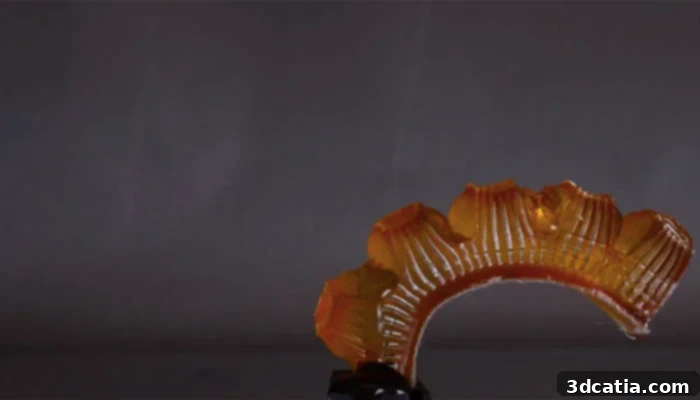
Cornell researchers used 3D printing to create fingerlike actuators that can regulate their temperature through sweating | Credits: Cornell University
Unprecedented Efficiency and Autonomy in Thermal Regulation
One of the most astonishing discoveries made by the Cornell team was the remarkable efficiency of this synthetic sweating process. Their research indicated that this biomimetic cooling system was actually three times more efficient at dissipating heat than natural human perspiration. This extraordinary efficiency highlights the potential for robots equipped with such technology to perform in even more demanding thermal environments than humans could tolerate without significant discomfort or danger. Furthermore, a pivotal aspect of this innovation is its inherent autonomy, eliminating the need for complex control systems or external sensors.
Co-lead author on the paper, T.J. Wallin, emphasized this self-regulating quality, stating: “The best part of this synthetic strategy is that the thermal regulatory performance is based on the material itself. We did not need to have sensors or other components to control the sweating rate. When the local temperature rose above the transition, the pores would simply open and close on their own.” This intrinsic responsiveness of the material significantly simplifies the design and operation of future robots, reducing computational load and potential points of failure, thereby increasing their reliability and robustness. The absence of additional sensors and actuators for cooling means that robots can be lighter, less energy-intensive, and more agile, opening up new possibilities for their application in fields ranging from exploration to assistive technology.
Applications and Future Challenges
These sophisticated finger-like actuators were successfully integrated into a robot hand, demonstrating its capability to grasp and lift various objects while maintaining an optimal operating temperature. This proof-of-concept showcases the immediate potential for this technology to enable robots to perform intricate tasks in environments where overheating is a constant threat. Imagine robots working tirelessly in hot industrial settings, performing search and rescue operations in extreme climates, or even assisting astronauts during spacewalks, all thanks to their ability to regulate their own temperature autonomously.
However, like any nascent technology, there are considerations and challenges that require further research and development. One potential concern is that the presence of water on the robot’s surface, while necessary for cooling, could inadvertently hinder the robot’s mobility by making its hand or gripping surfaces slippery. The team is already exploring solutions for this, suggesting that modifications to the hydrogel’s texture could effectively compensate for any loss of friction. Another practical consideration is the need for a continuous supply of water. Just as humans need to rehydrate after sweating, these robots will require a mechanism to replenish their water reserves if they are to operate for extended durations. This could involve onboard reservoirs or docking stations for refilling. Rob Shepherd underscored the importance of material science in advancing these capabilities, adding: “I think that the future of making these more biologically analogous materials and robots is going to rely on the material composition.” This statement highlights the ongoing quest to develop smarter, more functional materials that can intrinsically imbue robots with life-like properties and capabilities.
The Indispensable Role of Additive Manufacturing
The creation of these incredibly intricate and functional finger actuators would have been nearly impossible without the precision and versatility offered by additive manufacturing, specifically the layer-by-layer process inherent to stereolithography. This advanced fabrication technique allowed the Cornell team to precisely control the placement and integration of the different hydrogel materials, ensuring the accurate formation of the temperature-sensitive base layer and the perforated upper layer with its responsive pores. The ability to build such complex, multi-material structures with micron-level accuracy is a testament to the power of 3D printing in driving innovation in material science and robotics. It underscores why additive manufacturing is not just a tool for prototyping but a fundamental technology for realizing previously impossible designs and functionalities in the realm of soft robotics and biomimetics.
Shepherd concluded his remarks by emphasizing the collaborative nature of such breakthroughs: “This brings up a point multidisciplinary research in this area, where really no one group has all the answers.” This sentiment perfectly encapsulates the spirit of modern scientific discovery, where breakthroughs often emerge from the convergence of expertise across various disciplines, including material science, mechanical engineering, computer science, and biology. This innovation from Cornell University not only pushes the boundaries of robotic capabilities but also serves as a compelling example of how bio-inspired design, combined with advanced manufacturing techniques, can lead to truly transformative technologies. You can find more comprehensive information on their research HERE.
What are your thoughts on this remarkable 3D printed robot hand and its groundbreaking sweating capabilities? Do you foresee this technology transforming how robots operate in extreme environments, or perhaps opening doors to entirely new applications? Share your insights in a comment below or join the conversation on our Facebook and Twitter pages! Don’t miss out on the latest advancements and news in the world of 3D printing; remember to sign up for our free weekly Newsletter, delivered directly to your inbox!