
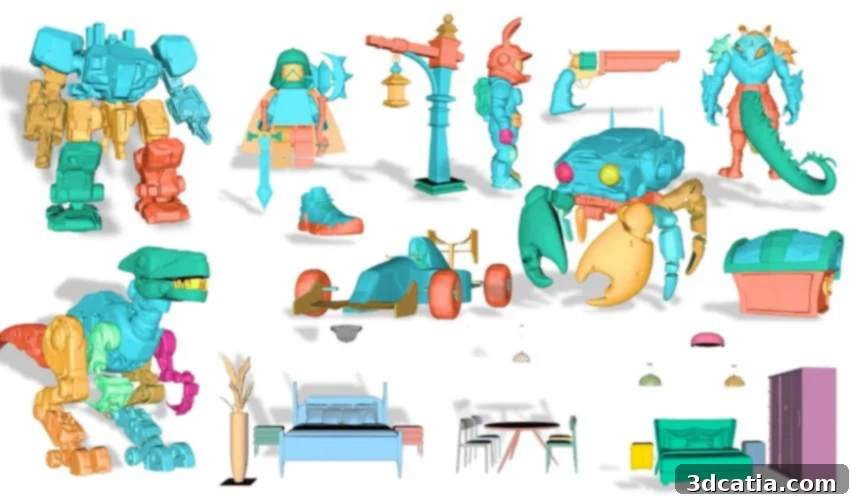
PartCrafter: Revolutionizing 3D Printing with AI-Powered 2D to 3D Model Generation
The landscape of 3D printing continues to evolve at an unprecedented pace, driven significantly by advancements in artificial intelligence. This powerful synergy is once again demonstrating its transformative potential through groundbreaking innovations. A dedicated team of researchers and developers has leveraged AI to create a sophisticated 3D model generator named PartCrafter. This innovative tool boasts the remarkable capability of synthesizing multiple 3D meshes of varying geometries from a single RGB image. PartCrafter is designed to generate highly complex models directly from a 2D illustration, offering a paradigm shift for additive manufacturing. The implications are profound: if PartCrafter lives up to its immense promise, it could enable users to 3D print diverse components of an object without the often-arduous and time-consuming process of manual 3D modeling.
The Persistent Challenge of 3D Modeling in Additive Manufacturing
Designing a 3D model stands as a critically foundational step in the entire additive manufacturing workflow. It is the very genesis of any project, dictating the feasibility, functionality, and aesthetic outcome of the final printed object. However, this initial phase is frequently plagued by a multitude of obstacles. Traditional 3D modeling requires significant expertise, specialized software, and a considerable investment of time, often making it the most protracted segment of the entire production cycle. For many aspiring innovators and industrial users alike, the complexity of translating a concept into a print-ready 3D file can be a formidable barrier.
While numerous alternatives exist today, such as downloading pre-made 3D files from dedicated online platforms or utilizing scanning technologies, the ability to generate or modify a custom part remains essential for bespoke solutions and innovation. The perpetual quest within the 3D printing community revolves around fundamental questions: How can we drastically reduce design time? How can we enhance efficiency throughout the modeling process? Crucially, how can we mitigate the risk of human errors that inevitably arise in intricate manual design? It appears that PartCrafter is emerging as a compelling answer to these pressing questions, offering solutions that, while perhaps still in their nascent stages, represent a monumental leap forward in accessibility and productivity for 3D printing.
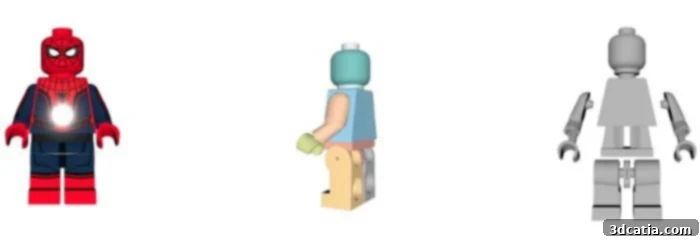
A visual representation of an object processed and generated by the PartCrafter tool, demonstrating its capability to create complex 3D meshes from simple 2D inputs.
Unveiling the Mechanics: How PartCrafter Transforms 2D into 3D
At its core, PartCrafter operates as an ingenious open-source platform, meticulously engineered by a collaborative team of brilliant minds from Peking University, Carnegie Mellon University in the USA, and ByteDance. The operational process is remarkably straightforward for the end-user, yet underpinned by highly sophisticated AI algorithms. Users initiate the process by uploading a standard 2D image. Upon submission, PartCrafter springs into action, employing advanced computer vision and deep learning techniques to intelligently deconstruct and interpret the uploaded 2D image. It segments the image, identifying distinct features and components, which it then translates into volumetric representations.
The tool’s ability to understand the intricate structure and potential 3D form embedded within a 2D illustration stems from its access to and training on an incredibly extensive and meticulously curated database. According to the platform’s developers, this dataset was compiled by synergistically combining several diverse sources, resulting in a colossal collection of approximately 130,000 3D objects. A significant proportion of these, specifically 100,000 objects, are uniquely structured to contain multiple individual parts. This multi-part characteristic is crucial, as it allows PartCrafter to learn how complex objects are assembled from simpler components, a key challenge in accurate 3D reconstruction.
The Data Foundation: Fueling PartCrafter’s Intelligence
The sheer volume of the initial dataset is impressive, but its quality is further guaranteed through a rigorous refinement process. The research team meticulously filtered this vast collection based on several critical criteria: texture quality, the number of distinct parts within each object, and the average Intersection over Union (IoU) between parts and their overall union. These filtering parameters are not arbitrary; they are strategically chosen to ensure high-quality supervision during the AI’s training phase. High texture quality ensures that the visual fidelity of generated models is superior. The number of parts criterion helps in training the AI to recognize and separate distinct functional or structural components. The IoU metric, on the other hand, is vital for evaluating how well the individual parts fit together and form a coherent whole, preventing the generation of disjointed or ill-fitting geometries.
This diligent refinement process culminates in a robust and highly optimized dataset comprising approximately 50,000 meticulously tagged 3D objects and an astonishing 300,000 individual parts. This rich, clean, and well-structured data forms the bedrock of PartCrafter’s intelligence, enabling it to learn complex geometric relationships, understand object semantics, and ultimately, synthesize accurate and detailed 3D meshes from seemingly flat 2D images. The iterative nature of this learning process ensures that PartCrafter is an evolutionary tool, continually improving its generative capabilities as it is exposed to more data and refined algorithms, much like any advanced artificial intelligence system.
Transformative Impact Across Industries
It is effortlessly apparent to envision the profound and far-reaching impact PartCrafter could have across a myriad of industries that currently employ, or could benefit from, additive manufacturing. Imagine the ability to reverse-engineer a complex, custom aircraft part simply from a photograph, perhaps of a historical component or one that lacks existing CAD files. PartCrafter could rapidly generate the precise 3D meshes of its constituent components, which could then be effortlessly transformed into production-ready 3D printable files. This capability could dramatically accelerate maintenance, repair, and overhaul (MRO) operations in aerospace, automotive, and heavy machinery sectors, where obtaining or recreating parts can be a costly and time-intensive bottleneck.
Beyond specialized industries, PartCrafter holds immense promise for consumer product design, rapid prototyping, and even educational applications. Designers could quickly iterate on concepts, transforming sketches or images into tangible 3D prototypes in minutes rather than hours or days. Small businesses and individual creators, who might lack advanced 3D modeling skills or expensive software licenses, could now bring their ideas to life with unprecedented ease. This democratizes access to advanced manufacturing capabilities, fostering innovation at a grassroots level. From customized medical implants based on patient scans to intricate architectural models derived from blueprints, the potential applications are vast and exciting, pushing the boundaries of what is possible with 3D printing.
The Road Ahead: Precision, Resolution, and Integration
While the initial demonstrations and underlying technology of PartCrafter are undoubtedly captivating, it is still early days in fully assessing whether the final generated results will consistently match the exacting standards of a model meticulously designed on professional 3D printing software like SOLIDWORKS, Fusion 360, or Blender. Critical questions naturally arise regarding the ultimate precision and resolution of the synthesized 3D meshes. How accurately can PartCrafter capture intricate details and fine tolerances? What about surface finish and texture mapping – will the generated models be smooth, geometrically accurate, and visually appealing, especially for applications requiring high aesthetic quality or tight mechanical fits?
Further developments will likely focus on enhancing these attributes, ensuring that PartCrafter can generate models that are not only geometrically plausible but also functionally viable and aesthetically refined for diverse additive manufacturing needs. Integration with existing CAD/CAM ecosystems will also be crucial for widespread adoption, allowing designers and engineers to seamlessly incorporate PartCrafter’s capabilities into their established workflows. One thing, however, is unequivocally certain: the PartCrafter project is profoundly attractive, holding a vast array of possibilities that promise to reshape how we approach 3D design for additive manufacturing. As we eagerly await further developments and real-world implementation case studies, you can delve deeper into the technical specifics of this groundbreaking research by consulting the original paper, available HERE.
Engage with the Future of 3D Printing
What are your thoughts on PartCrafter and its potential to democratize and accelerate 3D design? We encourage you to share your insights and predictions in a comment below, or join the ongoing discussions on our LinkedIn or Facebook pages! Furthermore, don’t miss out on the latest advancements and news from the dynamic world of 3D printing; make sure to sign up for our free weekly Newsletter to receive cutting-edge information directly in your inbox. For a visual exploration of innovative 3D printing applications and technologies, you can also find all our compelling videos on our dedicated YouTube channel. Your perspective is invaluable as we navigate the exciting future shaped by technologies like PartCrafter!