
Revolutionizing Cancer Treatment: The Power of FDM 3D Printing for Personalized Patient Care
In the rapidly evolving landscape of medical innovation, advanced manufacturing technologies are reshaping the future of healthcare. Among these, Fused Deposition Modeling (FDM) 3D printing stands out as a transformative force, spearheading efforts to develop highly personalized treatments, particularly in oncology. This groundbreaking technology is now being leveraged to investigate and implement customized solutions for complex conditions such as breast and prostate cancer. The inherent ability of 3D printing to create objects with unparalleled precision and customization makes it an indispensable tool for fabricating fully personalized support and immobilization devices. These tools are absolutely crucial for ensuring the accurate, reproducible, and ultimately successful delivery of intricate medical treatments, enhancing both efficacy and patient comfort.
HeroSupport: Pioneering Sensitive Cancer Care with Advanced 3D Printing
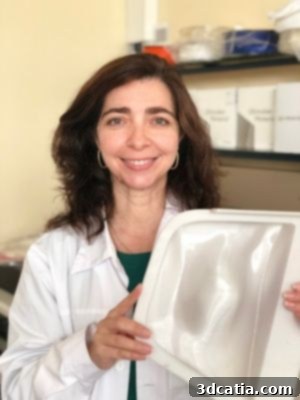
Giovanna di Pasquale with a 3D-printed component (photo credits: 3ntr)
At the forefront of this innovation is HeroSupport, a visionary startup founded by Giovanna Dipasquale, a distinguished medical physicist at the University Hospital of Geneva (HUG). HeroSupport’s mission is to profoundly simplify and improve the cancer treatment journey through the deployment of innovative, personalized patient supports. These meticulously designed tools are engineered to precisely reproduce and securely fix a patient’s body in an exact, predetermined position across all treatment sessions. This level of consistency is paramount for highly precise treatments like radiation therapy, where even minor discrepancies in positioning can compromise therapeutic outcomes and potentially increase side effects to healthy tissues.
The development and production of these advanced immobilization tools rely heavily on the invaluable contribution of a specialized FDM 3D printer manufactured by 3ntr: the A2v4 MED. This particular printer has been meticulously engineered with specific features to not only meet the rigorous demands of the medical environment but also to perfectly align with HeroSupport’s unique requirements. Its robust construction, high precision, and compatibility with medical-grade materials make it an ideal choice for producing devices that interact directly with patients. The utilization of FDM technology in this context offers significant advantages, including cost-effectiveness, material versatility, and the ability to produce complex geometries quickly, which are all critical factors in accelerating medical innovation and making advanced care more accessible.
Breast Cancer Treatment Transformed: Enhancing Comfort and Precision with 3D Printing
The application of 3D printing in breast cancer treatment exemplifies HeroSupport’s commitment to patient-centric care, prioritizing a woman’s comfort, dignity, and privacy. Giovanna Dipasquale elaborates on this revolutionary approach: “The core idea for breast cancer treatment is a 3D-printed rigid immobilization system that precisely adapts to the unique personal shape of each woman. With the transformative power of 3D printing, we convert complex imaging data and standard treatment tables into personalized supports. This innovative method ensures that the patient no longer has to conform uncomfortably to the table; instead, the table—or rather, the support system—is uniquely adapted to each individual patient. This paradigm shift dramatically enhances precision, simplifies clinical procedures, vastly improves reproducibility, saves valuable time, and significantly boosts patient comfort in clinical practice.” This bespoke approach addresses many of the long-standing challenges associated with traditional immobilization methods, which often lead to discomfort, anxiety, and potential inaccuracies in treatment delivery.
These sophisticated immobilization systems, aptly named VENUS shellTM, are meticulously 3D printed using the A2v4 MED printer. The choice of material is equally critical: the ABS HD MED polymer, also specifically developed to meet HeroSupport’s exacting standards. The VENUS shellTM is uniquely designed for breast cancer radiotherapy, particularly when the patient is positioned in a prone (face-down) orientation. In this specific position, the affected breast hangs freely and away from the body, achieving several crucial clinical benefits. Most notably, it helps to minimize the radiation dose to critical adjacent organs such as the lungs and heart, thereby reducing the risk of treatment-related side effects and enhancing long-term patient outcomes. The shells are customized to flawlessly accommodate the specific contours of each individual woman’s body and breast in the prone position, ensuring maximum stability, comfort, and, most importantly, unparalleled treatment accuracy.
The entire production process, from initial prototypes to the final clinical product, is executed with exceptionally high accuracy on the 3ntr 3D printer. This meticulous precision ensures millimetric accuracy in breast positioning, which is vital for delivering targeted radiation while sparing healthy tissue. Beyond the technical advantages, this personalized approach significantly elevates the dignity and comfort experienced by the patient. The use of custom-fitted shells eliminates the need for uncomfortable compression or awkward positioning, reducing patient anxiety and improving their overall experience during what can be an incredibly challenging time. Such a profound enhancement in patient care, combining both technical precision and human-centric design, would simply not have been feasible without the advanced capabilities of the A2v4 MED 3D printer and the innovative vision of HeroSupport.
FDM 3D Printing: An Economic Catalyst in the Care Pathway
Beyond its profound impact on precision and patient comfort, 3ntr’s A2v4 MED 3D printer has also emerged as a valuable contributor in economic terms. This advanced FDM system enables the production of these highly specialized personalized supports at a remarkably advantageous cost, offering a sustainable solution for healthcare providers. Traditional methods for creating custom medical devices often involve labor-intensive processes, specialized tooling, and significant material waste, leading to prohibitive expenses that limit their widespread adoption. FDM 3D printing, by contrast, operates on an additive principle, building objects layer by layer and only using the necessary material, thereby minimizing waste and optimizing resource utilization.
Giovanna Dipasquale strongly emphasizes the financial viability of this technology: “FDM technology also presents a perfect solution in terms of price efficiency. It simply didn’t make economic or strategic sense to explore alternative manufacturing methods and risk incurring unaffordable figures when, with the 3ntr solution, we can achieve highly targeted therapy, significantly reduce preparation time, decrease patient waiting times, and consequently lower overall hospital costs.” This statement underscores a critical advantage: FDM 3D printing does not just offer technical superiority; it also provides a financially responsible pathway to delivering advanced personalized care. By streamlining the production of custom devices, hospitals can optimize their operational budgets, allocate resources more effectively, and ultimately make cutting-edge treatments more accessible to a broader patient population. The ability to produce complex, patient-specific devices on-demand and on-site further contributes to cost savings by reducing inventory requirements and logistics overhead.
The Name HeroSupport: A Vision Inspired by Superheroes
The thoughtful naming of the startup, HeroSupport, carries a deep significance that resonates with its overarching mission. Giovanna Dipasquale eloquently concludes: “The name HeroSupport profoundly reflects both the literal and metaphorical support we aspire to provide to our patients. We consider them real superheroes, individuals who bravely fight every single day not only with incredibly challenging therapies but also with a myriad of big and small daily problems that accompany their journey.” This name encapsulates the dual nature of their work: providing tangible, physical support through custom-designed devices, and offering emotional, psychological reinforcement to individuals undergoing immense personal battles.
The concept of “support” extends beyond physical immobilization; it encompasses the holistic care and empowerment of patients. By offering solutions that enhance comfort, dignity, and the effectiveness of treatment, HeroSupport aims to alleviate some of the burdens patients face. The metaphorical “hero” acknowledges the incredible resilience, strength, and courage displayed by cancer patients, recognizing their daily fight as an act of heroism. This human-centered philosophy ensures that while the technology is advanced, the ultimate focus remains firmly on the well-being and experience of the individual patient, reminding everyone involved of the profound human element at the heart of medical innovation. It’s a powerful reminder that behind every technological advancement lies a commitment to improving lives and supporting those who need it most.
*Cover Photo Credits: 3ntr