
Revolutionizing 3D Design: The Immersive Power of Virtual Reality CAD with flyingshapes°
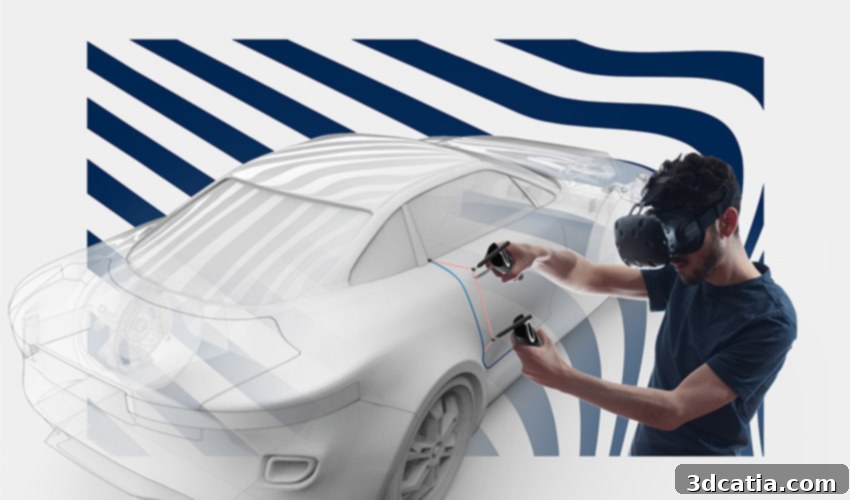
The landscape of CAD solutions is undergoing a significant transformation with the introduction of flyingshapes°’s next-generation virtual reality CAD application. For those unfamiliar, VR CAD is a groundbreaking concept that redefines how designers interact with three-dimensional objects. Instead of meticulously modeling designs on a conventional 2D screen using traditional CAD software, VR CAD empowers users to intuitively sketch and manipulate 3D models directly within a virtual environment, leveraging controllers in their hands. This innovative approach is specifically tailored to enhance and streamline the entire 3D modeling and design process for professionals across a multitude of industrial sectors. Its applications span product design, automotive engineering, manufacturing, general engineering, architecture, rapid prototyping, and the burgeoning field of 3D printing, promising unprecedented levels of efficiency and creative freedom.
flyingshapes°’s solution transports users into a completely immersive virtual environment, moving beyond the limitations of flat screens. This digital workspace is brought to life through intuitive haptic controls and a suite of interactive tools designed for dynamic sketching, precise surfacing, and seamless collaboration with global teams via the cloud. While modeling on a 2D screen has long been the established norm in fields like 3D printing and industrial design, VR CAD offers a powerful alternative that significantly reduces time-consuming iteration cycles. This acceleration is particularly critical during the crucial early stages of design and prototyping, where frequent adjustments are common. By enabling designers to work directly within a three-dimensional space, flyingshapes° facilitates greater efficiency, enhances design accuracy, and fosters a more natural and productive workflow, potentially shaving weeks off product development timelines.

Image via flyingshapes°
Dr. Johannes Mattmann, Co-Founder of flyingshapes°, articulates the company’s ambitious vision: “Our vision is to make CAD as accessible as an iPhone app. Traditional CAD applications have a steep learning curve and require designers to create 3D models in 2D workspaces. We’re disrupting classic CAD workflows by allowing designers to sketch 3D models to scale in a fully virtual environment, using their hands to build and manipulate objects.” This statement highlights a fundamental shift from the often complex and counter-intuitive nature of conventional CAD software. The steep learning curve associated with traditional systems often presents a significant barrier to entry and slows down experienced designers. By transforming the design process into an intuitive, hand-driven interaction within a virtual realm, flyingshapes° aims to democratize 3D design, making it more approachable for new users while simultaneously empowering seasoned professionals with unprecedented creative control and efficiency, bridging the gap between imagination and digital creation.
What are the Benefits of Virtual Reality CAD?
The advantages of adopting a Virtual Reality CAD solution like flyingshapes° are numerous and profound, offering a substantial upgrade over traditional 2D design methods. One of the most compelling benefits, as previously highlighted, is the ability to experience and interact with all three dimensions of a product directly. Unlike flat images or wireframes on a screen, VR CAD provides a true sense of scale, depth, and form, allowing designers to virtually “hold” and inspect their creations from every angle. This immersive perspective is invaluable for spotting design flaws, understanding spatial relationships, and evaluating aesthetics in a way that is simply not possible in a 2D environment.
flyingshapes° further enhances the design process with specialized tools, such as an integrated mirror function for symmetrical object creation. This feature allows users to design one half of an object, and the VR CAD system automatically duplicates and mirrors it along a designated plane, drastically speeding up the design of symmetrical components common in automotive, product, and architectural design. Crucially, this mirror can be toggled off at any moment, providing designers with the flexibility to introduce intricate irregularities or unique asymmetrical elements into their 3D models when creative vision demands it. This blend of automated efficiency and manual control empowers designers to maintain creative freedom while accelerating repetitive tasks.
Moreover, drawing parallels with modern cloud-based CAD software solutions, VR CAD facilitates seamless collaboration among team members. In a virtual environment, designers can co-create, review, and iterate on projects in real-time, regardless of their physical location. This real-time, shared virtual workspace transcends geographical barriers, fostering a more integrated and efficient design process. Teams can provide immediate feedback, make collaborative adjustments, and visualize changes instantly, significantly reducing communication inefficiencies and bottlenecks that often plague traditional design workflows. This collaborative capability is a game-changer for large organizations and distributed teams seeking to accelerate product development.
The ultimate goal for any modeled piece is often its physical realization, frequently involving conversion to an STL file for 3D printing or further processing. VR CAD serves as an excellent foundational step in a designer’s 3D modeling workflow. Its intuitive nature makes it ideal for rapid ideation and conceptualization. Models created within flyingshapes° can be easily exported to industry-standard formats, allowing for seamless integration with traditional CAD software for more detailed engineering, analysis, or final manufacturing preparations. This hybrid workflow leverages the strengths of both VR’s intuitive conceptualization and traditional CAD’s precision engineering, providing designers with a versatile and powerful toolset that covers the entire design lifecycle from initial sketch to final production.
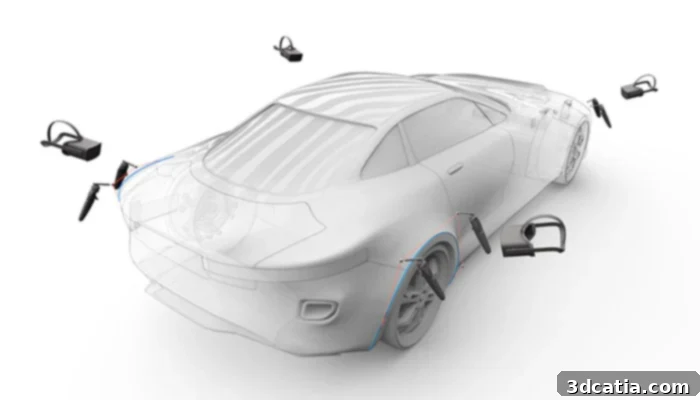
Image via flyingshapes°
Jonas Kunze, Co-Founder of flyingshapes°, further emphasizes the transformative impact of their technology: “We’re leveraging VR technology to solve the challenges and design bottlenecks that hinder traditional CAD workflows. Lengthy iteration cycles, communication inefficiencies and discrepancies between the initial prototype and final model waste resources and can delay time to market for new products. We’ve engineered flyingshapes° to revolutionize design workflows and help teams maximize time spent perfecting models.” This powerful statement underscores the core mission of flyingshapes°: to address and overcome the inherent limitations of conventional design processes. The repetitive, often drawn-out nature of iteration cycles in 2D CAD can lead to significant resource wastage, both in terms of time and materials. Furthermore, miscommunications between design, engineering, and manufacturing teams often result in discrepancies between the initial design intent and the final product, causing costly rework and delays in getting products to market. flyingshapes° is meticulously engineered to mitigate these issues, providing a unified, intuitive platform where design teams can collaborate efficiently, refine models with unparalleled speed, and ensure a higher degree of accuracy and consistency from concept to completion, thereby maximizing the value of every design hour.
You can find more information about this innovative VR CAD solution HERE.
What are your thoughts on the groundbreaking concept of Virtual Reality CAD and its potential to reshape industrial design? We invite you to share your insights and opinions in a comment below or join the discussion on our vibrant Facebook and Twitter pages! Don’t miss out on the latest advancements and news in the world of 3D printing; sign up for our free weekly Newsletter to have all the essential updates delivered straight to your inbox!