
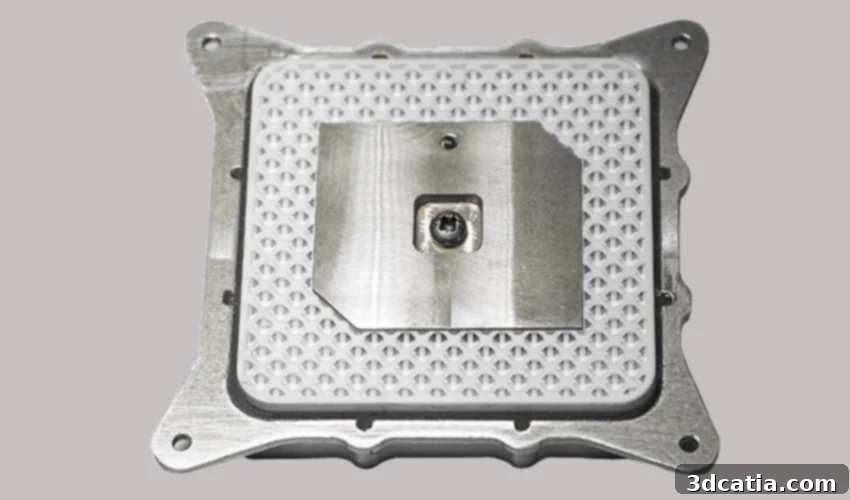
Anywaves and 3DCeram Pioneer High-Performance Ceramic 3D Printed Antennas for Small Satellites
Based in Toulouse, France, Anywaves is a highly innovative spin-off company from the Centre National d’Etudes Spatiales (CNES), strategically positioning itself to become the world’s leading manufacturer of high-performance antennas specifically designed for the rapidly expanding small satellite market. This ambitious vision necessitates cutting-edge technology and collaborative partnerships. It was with this forward-thinking objective that Anywaves approached French ceramic 3D printer manufacturer, 3DCeram. The collaboration between these two pioneering companies began with a comprehensive dialogue focused on the intricate technical specificities required for next-generation satellite antennas, the critical mechanical properties demanded by the harsh space environment, and the overarching economic aspects of such a sophisticated project. This crucial initial phase was facilitated through 3DCeram’s expert service, 3D-AIM, which is dedicated to guiding companies through the complexities of ceramic additive manufacturing. Following these in-depth discussions, the companies embarked on a joint development initiative to create an entirely new type of ceramic antenna, specifically tailored for future SmallSats satellites, promising significant advancements in space communication capabilities.
For several years now, additive manufacturing has become increasingly used in space, profoundly transforming numerous industries, with its impact on the space sector being particularly monumental. This revolutionary technology has consistently made headlines, demonstrating its versatility and effectiveness through the creation of 3D printed rockets, intricate satellite components, and even sophisticated 3D printers engineered to function flawlessly in zero-gravity environments. The aerospace industry, known for its stringent demands and relentless pursuit of innovation, has unequivocally demonstrated its profound trust in 3D printing technologies. This trust stems from the clear and compelling advantages additive manufacturing offers, including its remarkable ability to drastically reduce manufacturing costs, significantly decrease the weight of components – a critical factor for launch efficiency – and substantially increase design freedom and overall operational efficiency. Beyond large-scale production, 3D printing also presents an invaluable solution for astronauts on long-duration missions, enabling them to design and produce essential spare parts or other critical objects in the event of an emergency, thereby enhancing mission safety and autonomy. Anywaves, recognizing these unparalleled benefits and the strategic imperative for lightweight, high-performance components, has decisively embraced ceramic additive manufacturing, turning to the specialized 3D-AIM service offered by 3DCeram. This service is meticulously tailored to support companies operating in demanding sectors like aerospace, guiding them through the entire process of additively manufacturing complex ceramic pieces. Over an intensive 18-month period, the two companies collaborated closely on the sophisticated development of a GNSS L1 / E1 band antenna. This intricate project was meticulously guided by a strict three-step process: an initial, thorough feasibility analysis, continuous and iterative discussions between the design and manufacturing teams, and a rigorous risk analysis to mitigate any potential challenges, ensuring the optimal performance and reliability of the final product.
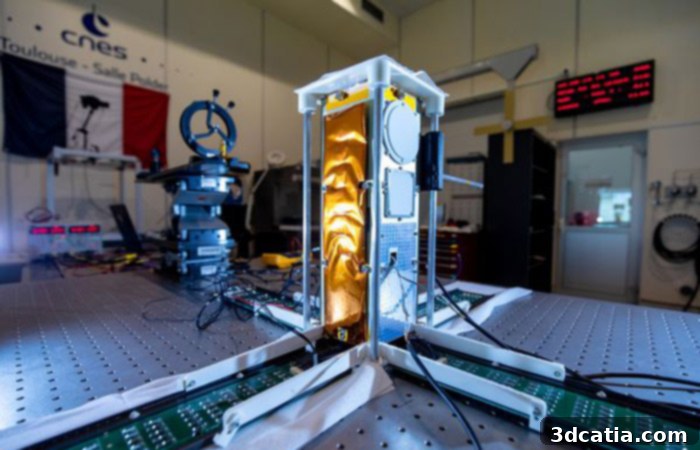
CNES’s Eyesat satellite is equipped with two antennas developed by Anywaves (photo credits: CNES / Tronquart Nicolas)
The Meticulous Three-Step Design and Manufacturing Process
The development of a cutting-edge ceramic antenna for space applications is an inherently complex endeavor, necessitating a structured and rigorous approach. Before Anywaves and 3DCeram could commit to ceramic additive manufacturing, a comprehensive assessment of all related risks and technical challenges was paramount. This initial phase involved meticulously defining all the specific technical requirements, such as frequency bands, gain patterns, polarization, and impedance matching, as well as the critical economic aspects of producing such a specialized component. 3D-AIM’s expertise was crucial here; their team thoroughly examined the Computer-Aided Design (CAD) file provided by Anywaves from every conceivable angle. This exhaustive analysis covered all stages of the ceramic 3D printing process: the optimal printing strategy itself, the subsequent post-processing steps (including cleaning and support removal), the precise debinding process (which involves removing the organic binder from the printed “green” part), and the final sintering process (where the ceramic particles are heated to fuse together, densifying the part and achieving its final mechanical and electrical properties). This holistic evaluation ensured that the design was not only manufacturable but also optimized for the unique demands of ceramic additive manufacturing.
The second pivotal step in this development journey involved the intricate modification and refinement of the initial CAD model. This iterative process was conducted in close coordination between Anywaves’ design engineers and 3DCeram’s additive manufacturing specialists, with modifications directly informed by the detailed analysis obtained during the first feasibility phase. The goal was to enhance the robustness and printability of the antenna design, mitigating potential defects that could arise during the manufacturing process. The 3DCeram teams elaborated on this crucial stage, explaining: “We meticulously created several CAD proposals, each designed to make the antenna model more robust and resilient to the inherent stresses of the manufacturing process. The primary objective of this iterative design phase is to significantly reduce the likelihood of defects such as scratches, warping, or internal failures, which can potentially appear during the printing, debinding, or sintering stages. A key decision at this point is to strategically choose the optimal orientation of the part on the build platform, which is a critical factor influencing both the achieved tolerances of the final part and the overall target unit price. This careful consideration ensures that the part meets stringent performance criteria while remaining economically viable.” Following these design refinements, a series of comprehensive 3D printing tests were diligently carried out. These tests involved prototyping various iterations of the antenna, evaluating their structural integrity, dimensional accuracy, and material properties. This rigorous testing phase was essential to fine-tune the process parameters and ultimately led to the achievement of the optimal final manufacturing file, ready for high-precision production.
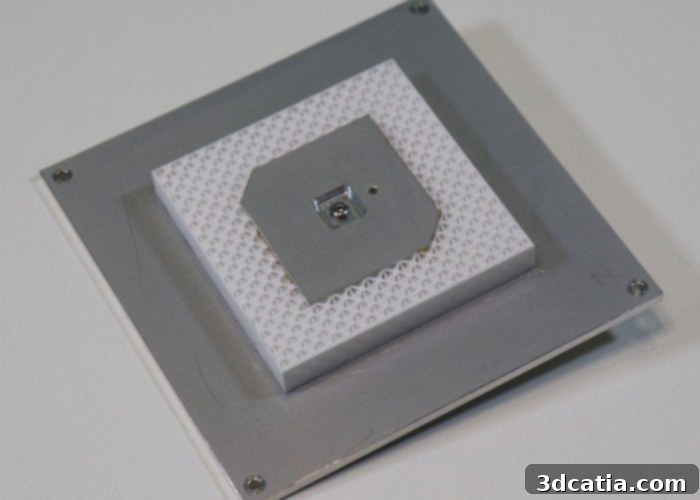
Photo credits: Anywaves
The third and final step in this transformative process is the actual manufacturing of the ceramic antennas. At this juncture, Anywaves had a strategic decision to make: either invest in its own specialized ceramic additive manufacturing machine and establish in-house production capabilities, or continue to entrust the high-precision production to 3DCeram, leveraging their established expertise and infrastructure. Regardless of the chosen path, this groundbreaking partnership has already yielded significant benefits. Through their collaborative efforts, the teams successfully developed a highly advanced zirconia antenna featuring an innovative lattice structure. This specific material choice and intricate geometric design are not arbitrary; zirconia is known for its excellent dielectric properties and thermal stability, making it an ideal candidate for high-frequency applications in space. The lattice structure, a hallmark of additive manufacturing’s design freedom, plays a crucial role in optimizing the antenna’s performance. It allows for precise control over the material distribution, enabling significant weight reduction while simultaneously enhancing radiofrequency characteristics, such as gain, bandwidth, and radiation pattern. This optimization translates directly into superior performance for small satellites, empowering them with more reliable and efficient communication capabilities. The successful development of such a complex, high-performance ceramic antenna marks a significant milestone in the evolution of space technology, paving the way for more resilient and capable satellite constellations. You can find out more about Anywaves and their innovative solutions on their official website HERE.
The Unrivaled Advantages of Ceramic 3D Printing for Space Antennas
The decision by Anywaves to embrace ceramic 3D printing for their small satellite antennas is underpinned by a compelling array of advantages that this technology offers, particularly critical for the demanding space environment. Firstly, ceramics possess exceptional thermal stability, meaning they can withstand extreme temperature fluctuations encountered in orbit without degrading performance. This is crucial for maintaining antenna integrity and functionality when transitioning between direct sunlight and deep shadow. Secondly, the dielectric properties of ceramics are highly advantageous for radiofrequency (RF) applications. They can be engineered to exhibit very low dielectric loss, ensuring that signal power is efficiently transmitted and received with minimal attenuation, thus maximizing communication range and clarity. Thirdly, ceramics are inherently radiation-resistant, a vital characteristic for components operating in the harsh radiation belts surrounding Earth and in deep space. This resistance helps prolong the operational lifespan of the antenna and the satellite itself. Furthermore, additive manufacturing allows for the creation of incredibly complex geometries, such as the lattice structure developed for Anywaves’ antenna. This geometric freedom enables engineers to optimize the antenna’s form factor for specific RF performance requirements, leading to enhanced gain, improved beamforming capabilities, and overall higher efficiency. It also facilitates significant weight reduction compared to traditionally manufactured metallic or composite antennas, which is a paramount consideration for small satellites where every gram counts towards launch cost savings and payload capacity. The ability to customize each antenna design precisely for its mission profile further solidifies ceramic 3D printing as a game-changer for space communications.
Pioneering the Future of Small Satellite Communication
This strategic partnership between Anywaves and 3DCeram, and their success in developing advanced ceramic antennas through additive manufacturing, is not merely a technical achievement; it represents a significant step forward in pioneering the future of small satellite communication. Small satellites, or SmallSats, are rapidly transforming the space industry, offering cost-effective access to orbit for a diverse range of applications, including Earth observation, telecommunications, scientific research, and global connectivity. However, their compact size often imposes severe limitations on payload mass and volume, making lightweight and high-performance components absolutely essential. The ceramic antennas developed through this collaboration directly address these challenges. By reducing weight without compromising on critical RF performance, and indeed enhancing it through optimized designs, these antennas enable SmallSats to carry more sophisticated payloads, extend their operational capabilities, and perform missions that were previously only feasible for much larger, more expensive satellites. This innovation contributes to lowering the overall cost of space missions, accelerating the deployment of satellite constellations, and fostering greater accessibility to space for governments, commercial entities, and research institutions worldwide. The ability to rapidly iterate and customize antenna designs using 3D printing also means faster development cycles, allowing for quicker responses to evolving technological demands and market needs. This collaborative effort between a space technology innovator and an additive manufacturing expert sets a new benchmark for how advanced materials and manufacturing processes can collectively drive the next generation of space exploration and communication infrastructure.
What are your thoughts on this groundbreaking partnership and the future of ceramic 3D printing in space? Let us know your insights in a comment below or join the conversation on our Facebook and Twitter pages! Don’t miss out on the latest advancements in additive manufacturing – sign up for our free weekly Newsletter here and get the freshest 3D printing news delivered straight to your inbox!