
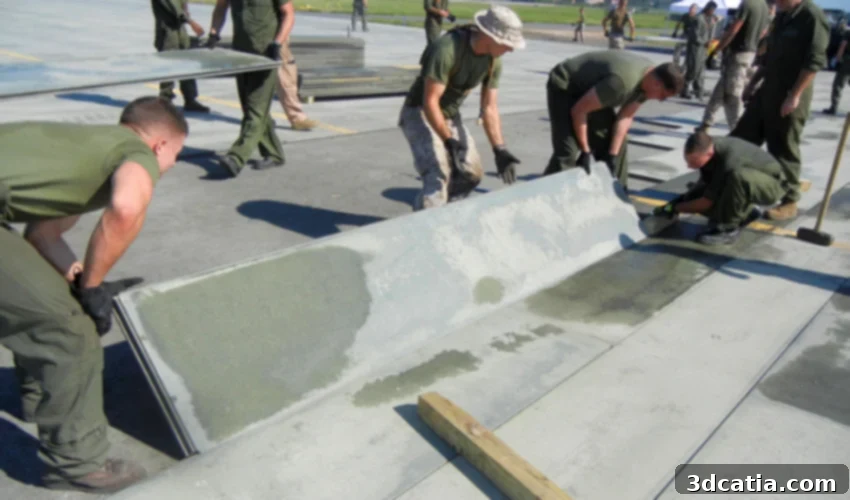
Revolutionizing Expeditionary Airfields: The US Air Force’s 3D Printed Runway Mat by ITAMCO and Purdue
In a significant stride towards modernizing military infrastructure, ITAMCO (Indiana Technology and Manufacturing Companies) has partnered with Purdue University, under the expert guidance of Professor Pablo Zavattieri, to spearhead the development of a groundbreaking 3D printed runway mat. This innovative solution is specifically designed for Expeditionary Airfields (EAFs) of the US Air Force. The project recently reached a pivotal milestone, securing a substantial $1 million grant, propelling the collaborative team into the crucial prototyping and testing phases. This achievement underscores the immense potential of additive manufacturing to transform critical military operations, offering unprecedented advantages in durability, deployability, and operational efficiency.
The journey began with their participation in Phase 1 of the Small Business Innovation Research (SBIR) program. During this initial stage, the ITAMCO-Purdue team presented a meticulously detailed project plan, emphasizing the technical merit and practical feasibility of their additively manufactured portable runway mat. Their compelling proposal not only won the first phase but also qualified them for the more demanding Phase 2. The subsequent award of the $1 million grant signifies a strong endorsement from the US Air Force, recognizing the transformative impact this 3D printed technology could have on future military deployments and logistics.
Addressing the Challenges of Expeditionary Airfields
Expeditionary Airfields are a cornerstone of military operations, providing essential infrastructure for aircraft landing and takeoff in remote, underdeveloped, or hostile environments. The ability to rapidly establish and maintain these airfields is critical for tactical flexibility, humanitarian aid, and disaster response. For decades, the United States military has relied on a portable runway system known as AM-2 matting, constructed from aluminum planks. While the AM-2 matting has served reliably since the Vietnam War, its materials and technology are now considered outdated, presenting several operational challenges.
The traditional AM-2 mats are heavy, cumbersome to transport, and labor-intensive to deploy. They are also susceptible to damage from repeated use, environmental factors, and the immense stresses imposed by modern military aircraft. Furthermore, the repair and maintenance of these aluminum mats can be complex and time-consuming, hindering the swift operational readiness vital for expeditionary forces. Recognizing these limitations, the US Air Force initiated the search for a next-generation solution – a lighter, more durable, and rapidly deployable alternative. This quest led them to the innovative 3D printed product conceived by the ITAMCO and Purdue University partnership, promising a leap forward in military logistics and strategic capability.
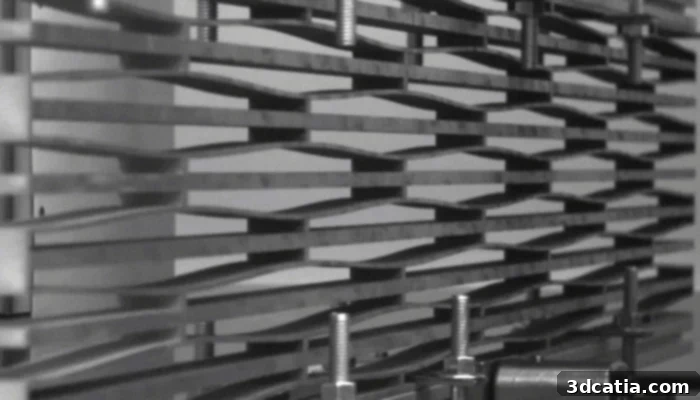
Products made with PXCM geometry have the ability to change from one stable configuration to another stable configuration and back again. (Image courtesy of Purdue University)
The Science Behind the Self-Healing Runway: Phase Transforming Cellular Material (PXCM)
At the core of Professor Pablo Zavattieri’s research was the ambitious objective to develop a robust sheet or roll technology that could serve as a superior alternative to the AM-2 mat for temporary or expeditionary flight operations. The ingenious design of this next-generation matting solution incorporates an upper surface seamlessly integrated with a lower surface, encapsulating a revolutionary architectured material known as Phase Transforming Cellular Material (PXCM) geometry. This advanced material is specifically engineered to effectively mitigate the anticipated loading and shear stresses experienced during aircraft operations, promising unparalleled resilience and longevity.
Professor Zavattieri elaborated on the groundbreaking capabilities of PXCM geometry, stating, “Products made with PXCM geometry have the ability to change from one stable configuration to another stable or metastable configuration and back again. This means the new runway mat could potentially heal itself, resulting in a much longer lifespan than a runway made with AM-2 matting. Another benefit is that debris on the runway will not hamper the runway’s performance with our technology.” This self-healing characteristic is a game-changer, significantly reducing maintenance requirements and extending the operational life of the runway in challenging field conditions.
The intricate geometry and functional requirements of the PXCM material made metal 3D printing the ideal, if not indispensable, manufacturing solution. Additive manufacturing techniques, particularly those involving metals, allow for the creation of complex internal structures and precise geometries that would be impossible or prohibitively expensive to produce with traditional manufacturing methods. This capability is crucial for realizing the full potential of PXCM, ensuring the material’s ability to transform and recover under stress. The flexibility and precision offered by 3D printing also enable rapid iteration and optimization of the design, accelerating the development process and ensuring the final product meets the stringent demands of military aviation.
The Role of Additive Manufacturing: From Design to Deployment
ITAMCO leveraged advanced 3D printer technology, specifically the EOS M290, for the manufacturing of the prototype runway sections. The EOS M290 is a leading system for direct metal laser sintering (DMLS), capable of producing high-quality, complex metal parts with excellent mechanical properties. This choice of equipment was critical in translating the sophisticated PXCM designs into a tangible, robust product. The DMLS process, which uses a laser to selectively melt and fuse metallic powders layer by layer, is perfectly suited for creating the intricate cellular structures required for the self-healing functionality.
The initial designs and prototypes have already demonstrated significant advantages over the legacy AM-2 matting. The 3D printed product has proven to be notably lighter, which directly translates to reduced logistical burden and lower transportation costs for military operations. More importantly, it exhibits superior durability, capable of withstanding the extreme conditions and repeated heavy loads characteristic of expeditionary airfields. This enhanced durability, combined with the self-healing properties of PXCM, promises a significantly longer operational lifespan and reduced need for frequent repairs or replacements.
With the successful completion of initial design and prototyping, ITAMCO and Professor Pablo Zavattieri are now accelerating the development of the 3D printed runway, moving into the comprehensive prototyping and testing stage. A key objective during this phase is to rigorously evaluate the additively manufactured runway’s ability to restore itself to its original contour and full operational capability within a challenging target period of 30 minutes. This rapid recovery time is essential for maintaining continuous flight operations in dynamic and time-sensitive military scenarios, ensuring that any damage sustained during landings or takeoffs can be quickly addressed without prolonged downtime.
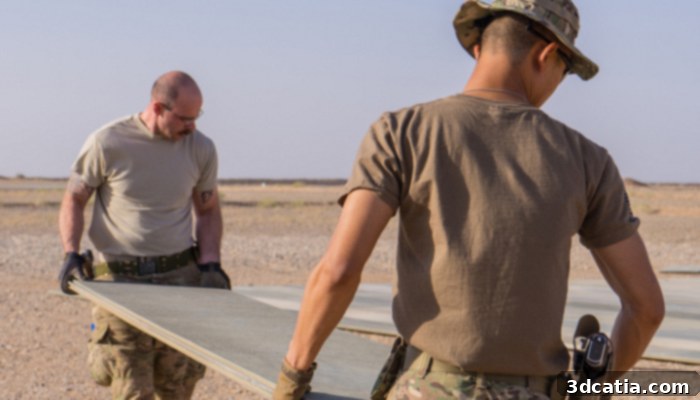
Courtesy photo by 451 Air Expeditionary Support Squadron (Source: ITAMCO)
Future Implications and Broader Impact
The development of this 3D printed, self-healing runway mat represents more than just an upgrade to existing military equipment; it signifies a paradigm shift in how infrastructure for expeditionary forces can be conceived, manufactured, and deployed. The project showcases the power of interdisciplinary collaboration between academia and industry, leveraging cutting-edge material science and advanced manufacturing techniques to solve real-world, high-stakes problems. The $1 million grant from the US Air Force is not just funding; it’s an investment in a future where military logistics are more agile, resilient, and cost-effective.
The successful deployment of this technology could have far-reaching implications. Beyond military applications, the principles of PXCM geometry and advanced 3D printing could be applied to various civil engineering projects requiring durable, self-healing, and rapidly deployable surface solutions. Imagine temporary roads, emergency landing strips for disaster relief, or even modular construction elements that can repair themselves. The work by ITAMCO and Purdue University is pushing the boundaries of what’s possible with additive manufacturing, paving the way for a new generation of resilient and intelligent materials.
What are your thoughts on the US Air Force’s adoption of 3D printed runway technology? Do you foresee this innovation revolutionizing military operations and potentially impacting other sectors? We invite you to share your insights in a comment below or join the conversation on our Facebook and Twitter pages! For all the latest news and advancements in the world of 3D printing, don’t forget to sign up for our free weekly Newsletter, delivered straight to your inbox!