
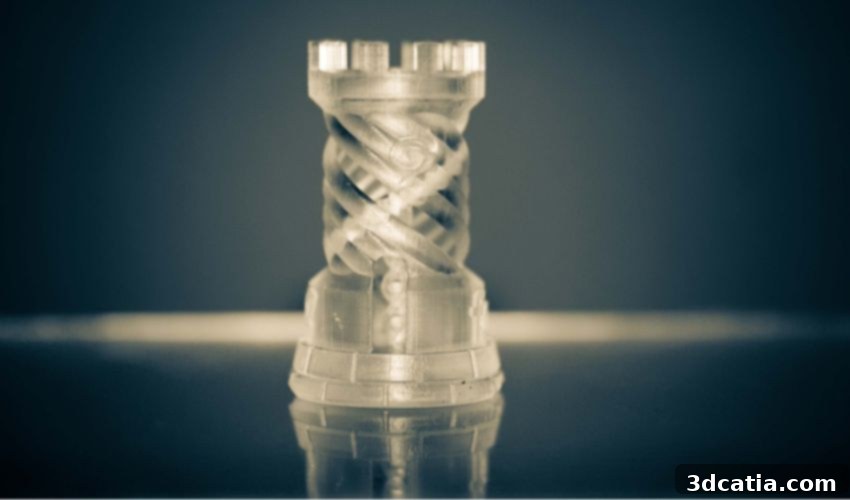
The Ultimate Guide to Transparent 3D Printing: Materials, Technologies, and Applications
The ability to create transparent or translucent objects using additive manufacturing opens up a vast array of possibilities, from purely aesthetic designs to critical functional components. Whether the goal is to enhance the visual appeal of a part or to enable specific functionalities like fluid observation or light guidance, 3D printing offers unique flexibility in design, material selection, and processing techniques to achieve various levels of optical clarity. However, achieving true transparency in 3D printed parts can be a complex endeavor, primarily because the fundamental principle of layer-by-layer deposition inherently creates micro-gaps and surface imperfections that scatter light, preventing a clear view. While materials like glass are emerging for specialized transparent 3D printing applications, this guide will focus primarily on the more common and accessible methods involving plastic materials.
Before diving into the technical aspects, it’s crucial to understand the distinction between transparency and translucency. A **transparent** object allows light to pass through with minimal scattering, enabling clear, undistorted vision of objects viewed through it, much like clear glass. In contrast, a **translucent** object permits light to pass through but scatters it significantly, resulting in a diffused image where details are obscured, similar to frosted glass. Depending on the desired outcome for your 3D printed part, either transparency or translucency might be acceptable or even preferred. This article will explore two primary 3D printing technologies compatible with transparent plastic materials, detail the critical factors influencing optical clarity for each, and highlight the diverse applications of transparent 3D printed parts.
Technologies for Achieving Transparent 3D Parts
The choice of 3D printing technology significantly impacts the potential for achieving transparency. Different methods offer varying degrees of surface finish, layer resolution, and material compatibility, all of which are critical for optical clarity.
Resin-Based Processes: Superior Clarity and Smoothness
When the highest degree of transparency is required for 3D printed parts, resin-based processes are often the go-to solution. Technologies such as Vat Photopolymerization (Stereolithography – SLA, and Digital Light Processing – DLP) are particularly well-suited for producing parts with exceptional surface smoothness and high optical clarity. These methods work by selectively curing liquid photopolymer resin with a light source, creating layers that are typically much finer and blend more seamlessly than those produced by filament-based methods. The resulting smooth surfaces are crucial because they minimize light scattering, allowing more light to pass directly through the object. The market offers a wide range of transparent resins, each formulated with specific properties to cater to diverse clear optics applications. For example, Formlabs Clear Resin for SLA printers is renowned for its ability to produce parts that approach the transparency of glass, capturing intricate details without requiring extensive post-processing to achieve a clear finish. Other clear resins might offer enhanced impact resistance, heat deflection, or specific optical indices, broadening their utility.
Beyond SLA and DLP, Material Jetting is another advanced resin-based technology that excels in producing transparent parts. This process works by jetting tiny droplets of photopolymer resin onto a build platform and then instantly curing them with UV light, similar to how an inkjet printer operates. A significant advantage of material jetting is its multi-material capability, allowing different resins to be loaded and combined simultaneously within the same print job. This feature is particularly valuable for transparent applications, as it enables the creation of parts with varying levels of transparency or even complex optical gradients within a single object. For instance, a part could transition from opaque to translucent to fully transparent, or incorporate specific clear lens elements alongside colored structural components. Material jetting is also celebrated for its exceptional resolution and the extremely smooth surface finish it produces, which further enhances the aesthetic and functional qualities of transparent parts by minimizing light scattering at the surface.
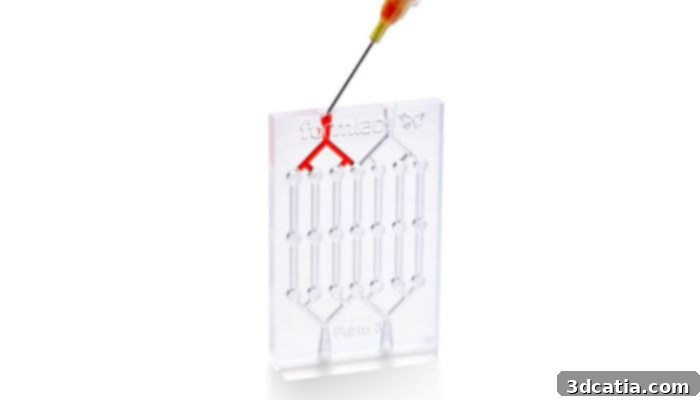
Transparent 3D printing is useful in the study of microfluidics (Credits: Formlabs).
Despite their advantages, resin parts often have a common drawback: a tendency to yellow over time, especially when exposed to UV light, or to lose some clarity after the rinsing and post-curing stages. To counteract this and achieve optimal optical clarity, a comprehensive post-processing workflow is frequently required. This typically involves several steps: initial cleaning to remove uncured resin, followed by wet sanding with progressively finer grits (e.g., from 400 to 2000 grit) to eliminate surface layer lines and smooth out imperfections. After sanding, parts are often polished using specialized compounds and buffing wheels to bring out a high-gloss, mirror-like finish. Finally, applying a clear coat or varnish can further enhance transparency, protect the surface from scratches, and provide UV resistance to mitigate future yellowing. While this multi-step process can be time-consuming, the combination of these techniques significantly increases both the transparency and overall aesthetic quality of the final part, making the effort worthwhile for demanding applications.
Material Extrusion: Affordable Translucency
Compared to resin-based technologies, fused deposition modeling (FDM/FFF) is a significantly more affordable and widely accessible 3D printing technology. However, FDM inherently struggles to achieve the same degree of transparency as vat photopolymerization. This limitation stems from its operational principle: the deposition of material in successive layers creates microscopic ridges and internal voids between filament lines, which scatter light extensively. Consequently, parts printed with FDM technology are typically more translucent than truly transparent. Nevertheless, FDM can still produce parts with excellent translucent properties, and with careful attention to material selection and print parameters, it is possible to achieve very clear, glass-like effects. The most suitable materials for transparent FDM 3D printing include PLA (Polylactic Acid), Polycarbonate (PC), and PETG (Polyethylene Terephthalate Glycol). Among these, PETG often stands out as the most appropriate choice for achieving higher translucency due to its molecular structure, which allows for good light transmission and its relatively low crystallinity.
To optimize FDM printed parts for a transparent effect, several key printing parameters must be carefully considered and adjusted:
- Layer Height: Minimizing the layer height (e.g., 0.1mm to 0.2mm) is crucial. Thinner layers reduce the visibility of individual layer lines, leading to a smoother, more uniform surface that scatters less light and can be more effectively post-processed for clarity.
- Extrusion Multiplier/Flow Rate: Maintaining a continuous and consistent material flow is paramount to prevent internal air bubbles, under-extrusion gaps, or over-extrusion blobs, all of which significantly hinder light transmission. Precise calibration of the extrusion multiplier ensures that layers are fully fused without creating voids.
- Print Speed: Printing at a slower speed allows the material to cool and bond more effectively, reducing warping and improving layer adhesion. This results in denser, more uniform walls with fewer internal imperfections that could scatter light.
- Printing Temperature: Using a slightly higher print temperature than typically recommended can help melt the filament more thoroughly, promoting better layer adhesion and reducing the likelihood of internal air gaps. However, care must be taken to avoid stringing or thermal degradation of the material.
- Nozzle Diameter: While a smaller nozzle generally produces finer details, for transparency, it’s often more beneficial to ensure layers are fully fused. A slightly larger nozzle with a very low layer height might sometimes yield a denser part, but minimizing layer lines through other means is usually more effective.
- Infill Density and Pattern: Opting for a minimal infill percentage (e.g., 0-20%) or even printing with 100% infill for smaller parts can allow light to pass through more uniformly. Specific infill patterns like concentric or rectilinear with minimal overlap can also be more effective than complex patterns that create more internal structures.
- Wall Thickness/Perimeters: Increasing the number of perimeters can lead to a more solid, less porous shell, improving the overall clarity.
- Cooling: While cooling is essential for preventing warping, excessive cooling can lead to stress points and reduce layer adhesion, creating micro-voids. A balanced cooling strategy is necessary.
The main limitation of FDM in printing transparent parts remains the inherent difficulty of completely eliminating visible layer lines and internal imperfections, even after extensive post-processing such as sanding and applying clear coatings. While significant improvements in translucency can be achieved, true optical transparency comparable to glass or high-quality resin prints is challenging to attain.
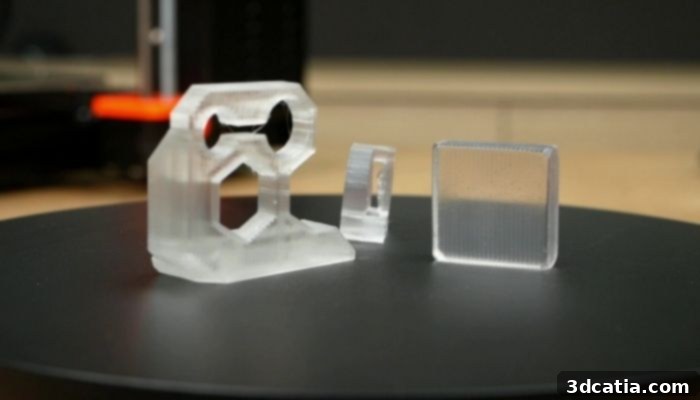
Transparent parts printed with PETG (Credits: CNCKitchen)
Applications of Transparent and Translucent 3D Printed Parts
Transparent or translucent 3D printed parts are highly valued not only for their aesthetic appeal but, more importantly, for their diverse functional benefits across numerous industries. Their ability to allow visibility into internal structures or through material barriers unlocks innovative solutions for various challenges.
One of the most significant applications is in **prototyping and functional testing**. Designers and engineers can create clear prototypes that enable direct observation of the inner workings of mechanisms, making the interaction between moving parts, gears, or electronic components visibly apparent. This property is also immensely beneficial in the study of fluid dynamics and **microfluidic devices**, where transparent channels allow researchers to visualize and analyze fluid flow patterns, mixing, and reactions in real-time. Similarly, for **airflow studies**, clear models can reveal ventilation paths or aerodynamic behaviors. Beyond these, transparent parts are crucial in the design and prototyping of **optical systems**, serving as housings for LED lights, intricate light guides, diffusers, or even rudimentary custom lenses where precise optical properties are less critical than overall light transmission and path visualization.
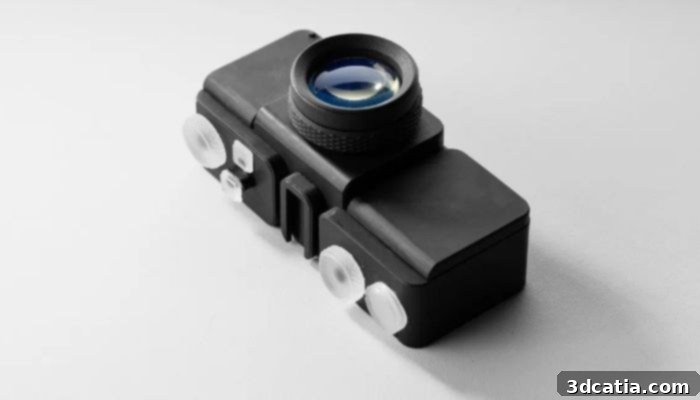
Camera with a 3D printed lens (Credits: Formlabs)
The medical sector has seen a particular surge in demand for transparent 3D printing. The technology is invaluable for producing highly realistic **surgical planning models**. By creating transparent anatomical replicas, healthcare professionals can visualize the exact anatomy of a patient, including intricate details like blood vessels, nerves, and internal organ structures. This allows surgeons to meticulously plan complex operations, anticipate potential risks, and rehearse procedures with greater precision, ultimately leading to better patient outcomes. Furthermore, these transparent anatomical models serve as powerful tools for **patient education**, helping patients better understand their condition, the proposed surgical intervention, and their body’s inner dynamics, thereby fostering reassurance and informed consent. In biomedical research, transparent models facilitate the observation of cell growth or drug delivery mechanisms.
Beyond functional applications, the most popular use of transparent 3D printing for many remains the creation of **decorative objects**. Designers and artists leverage the ability to produce translucent or transparent parts to craft unique pieces with captivating glass-like finishes, custom lighting fixtures, artistic sculptures, or architectural models that incorporate internal lighting or reveal structural details. The versatility of transparent materials also extends to **consumer goods**, such as clear casings for electronics, display components, or innovative packaging designs. In the **automotive industry**, transparent parts can be used for prototyping headlight designs, interior lighting elements, or dashboard displays. Additionally, in **education and research**, transparent models provide invaluable visual aids for teaching complex scientific principles or observing physical phenomena.
In conclusion, transparent and translucent 3D printing offers a compelling range of possibilities for creating parts with varying degrees of optical clarity. The successful achievement of desired transparency is a nuanced process that hinges on several critical factors: the judicious selection of the 3D printing technology (resin-based systems generally offer superior clarity), the choice of suitable transparent material (like clear resins, PETG, or PC), precise calibration of printing parameters, and diligent application of post-processing techniques. By carefully considering these elements, manufacturers and designers can unlock the full potential of transparent 3D printing, enabling the creation of innovative and functional components across a multitude of industries.
What are your thoughts on transparent 3D printing? Let us know in a comment below or on ourLinkedIn,Facebook, andTwitter pages! Don’t forget to sign up for our free weeklyNewsletter here, the latest 3D printing news straight to your inbox! You can also find all our videos on ourYouTube channel.