
Revolutionizing Bee Conservation: The Rise of 3D Printed Hives for Sustainable Beekeeping
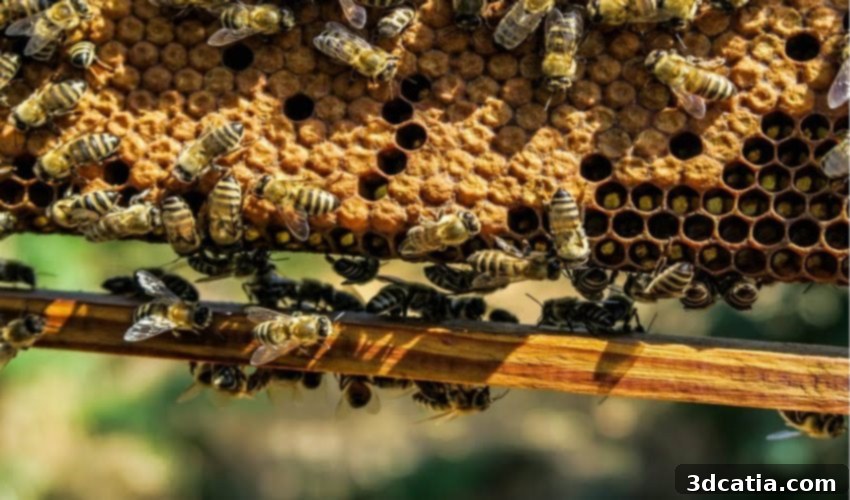
Ecosystems worldwide are undergoing significant transformations due to both natural forces and human activities. These changes directly impact the myriad species that call these habitats home. Among the most profoundly affected are bees, essential pollinators facing an unprecedented array of challenges. Issues such as widespread habitat loss, the pervasive use of pesticides in agricultural landscapes, and the increasing pressures of climate change have led to a alarming global decline in bee populations. Recognizing the indispensable role bees play in maintaining biodiversity and ensuring global food security, a surge of concerted efforts is underway to mitigate these threats and bolster pollinator health. Amidst this vital endeavor, innovative technological solutions are emerging, with 3D printing standing out as a particularly promising avenue. Projects such as HIIVE and LACRIMA have already showcased the potential of additive manufacturing in creating advanced bee habitats. Building on this progress, a visionary master’s student from the Autonomous University of Chapingo in Texcoco, Mexico, has taken this innovation a step further, developing sophisticated 3D printed hives designed to significantly improve bee habitats and enhance their overall well-being and productivity.
Traditionally, bees are master architects, meticulously constructing their intricate homes using wax and other natural secretions. This laborious process is fundamental to their survival, involving the creation of hexagonal cells for storing honey, pollen, and raising their young. In parallel, human ingenuity has long contributed to beekeeping practices, with beekeepers crafting specialized hive boxes that attract bees and streamline honey production. These conventional hives, often made of wood, provide a basic structure that bees can adapt to, but they frequently present challenges related to temperature regulation, ventilation, and pest control. With the global decline in bee populations reaching critical levels, there is an urgent and undeniable need for innovative, more effective approaches to enhance bee habitats and support their dwindling numbers. In this quest for solutions, 3D printing has emerged as a revolutionary technology, introducing a novel paradigm: 3D printed hives. But what distinguishes these technologically advanced hives from their traditional counterparts, and how precisely can additive manufacturing revolutionize the entire process of hive production and, by extension, bee conservation?
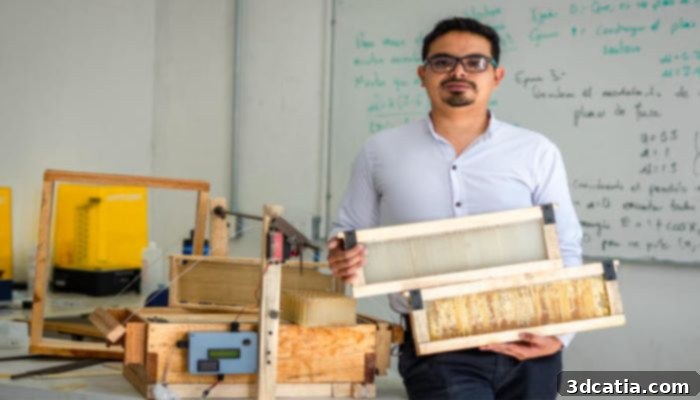
The resin 3D printer used is of the Anycubic brand, a common choice for high-precision additive manufacturing.
Innovating Beekeeping: The Potential of Systematic 3D Printed Hives
The pioneering work of José Francisco Arteaga Alarcón, a dedicated master’s student at the esteemed University of Chapingo in Mexico, represents a significant leap forward in beekeeping technology. His meticulously designed 3D printed hive aims not just to support bee populations but to fundamentally revolutionize honey production and bee health. By harnessing the precision and versatility of resin 3D printing technology, Arteaga Alarcón has been able to flawlessly replicate the intricate, robust hexagonal structures that form the core of natural beehives. This innovative approach effectively liberates bees from the intensely laborious and time-consuming task of constructing their foundational habitat from scratch. With these pre-fabricated, perfectly formed structures in place, bees can redirect their vital energy and efforts primarily towards honey production, pollen collection, and the critical processes of foraging and reproduction. This reduction in structural building stress is anticipated to have a cascade of positive effects, including enhanced bee proliferation, a significant decrease in overall stress levels, and a stronger, healthier colony capable of more effectively pollinating vital plant species and contributing to agricultural ecosystems.
Beyond Traditional Hives: Enhancing Bee Well-being Through Design
While Arteaga Alarcón’s 3D printed hive undeniably introduces a modification to the bees’ natural process of habitat construction, this intervention is precisely designed to create superior conditions for the species. The primary benefit lies in significantly reducing the ‘working times’ bees dedicate to building comb, allowing them to conserve energy. This saved energy can then be channeled into more productive activities, leading to more robust colonies, increased honey yield, and potentially stronger immune systems for the bees. Beyond mere efficiency, these innovative hives are engineered to systematically address and solve several critical environmental factors that commonly induce stress in bee colonies within traditional setups. These include precise control over temperature fluctuations, mitigation of disruptive noise, alleviation of cramped space, and optimization of ventilation. Traditional hives often struggle with these issues, leading to overheated or overly cold colonies, susceptibility to pests, and decreased productivity. By designing 3D printed hives with optimized insulation properties, integrated airflow channels, and modular, expandable structures, it is anticipated that the stress levels of bees will decrease dramatically, fostering a more stable and healthy environment for colony development. Just as bees have historically adapted to producing honey and raising their young within the frames and structures provided by beekeepers, it is strongly predicted that they will readily acclimate to this new technological advancement, perceiving it as a ready-made, efficient, and comfortable home.
The Power of Precision: How 3D Printing Transforms Hive Design
The ability of 3D printing to create highly precise and complex geometries offers unparalleled advantages for beehive design. Unlike traditional manufacturing methods, additive manufacturing allows for the exact replication of natural honeycomb structures, ensuring optimal cell size and depth crucial for bee development and honey storage. This precision not only saves bees immense energy but also contributes to the structural integrity and longevity of the hive. Furthermore, 3D printing enables the use of specialized materials that can be optimized for specific environmental conditions. While Arteaga Alarcón utilized resin 3D printing, future iterations or different projects could explore various food-grade, non-toxic polymers that offer superior insulation, resistance to moisture, and durability compared to wood. This customizability means hives can be tailored for diverse climates, ranging from arid deserts to humid tropics, ensuring bees always have an optimally conditioned environment. The technology also facilitates rapid prototyping, allowing researchers and beekeepers to quickly test and refine new designs, integrating features like enhanced ventilation systems, integrated pest control mechanisms, or modular expansion capabilities with unprecedented ease.
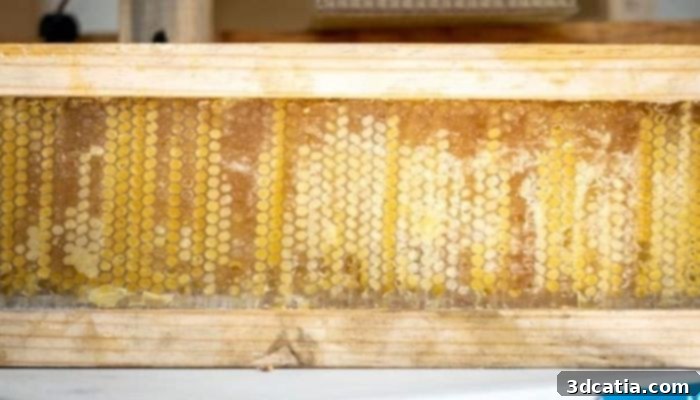
A glimpse of the innovative 3D printed beehive developed by José Francisco Arteaga Alarcón. (Photo Credits: Voragine)
Mexico’s Pivotal Role in Bee Conservation and Technological Advancement
The institutional backing for Arteaga Alarcón’s project is robust, given that the Autonomous University of Chapingo operates under the direct purview of Mexico’s Ministry of Agriculture and Rural Development. This strategic alignment ensures that the project is poised to receive substantial support for future research, development, and scaling endeavors. Such governmental support is crucial for translating innovative prototypes into widespread, impactful solutions. Mexico itself is a global powerhouse when it comes to bee diversity, boasting an astounding variety of over two thousand species and genera, as highlighted by the Secretariat. This rich biodiversity underscores the nation’s ecological significance and its potential to lead in bee conservation efforts. Furthermore, Mexico’s beekeeping activity is a vital economic and cultural pillar. The Secretariat reports an impressive average annual production exceeding 60 thousand tons of honey, harvested from an estimated two million hives. This thriving industry directly benefits more than 43 thousand beekeepers and their families, sustaining livelihoods and rural economies. Projects like Arteaga Alarcón’s have the potential to further enhance this sector, improving productivity and sustainability for Mexican beekeepers while also safeguarding their invaluable native bee populations.
The Broader Impact: 3D Printing for a Sustainable Future
The emergence of 3D printed beehives represents more than just a technological curiosity; it signifies a pivotal shift in how we approach environmental conservation through innovation. These advanced habitats offer a tangible solution to complex ecological problems, demonstrating how cutting-edge technology can be leveraged for the benefit of biodiversity and human well-being. The implications extend beyond just honey production and bee health, touching upon global food security, agricultural sustainability, and the broader health of our planet’s ecosystems. By reducing bee stress and increasing colony vitality, 3D printed hives can contribute significantly to reversing pollinator decline, ensuring the pollination of essential crops, and supporting the natural flora critical for ecosystem balance. Furthermore, the modular nature and design flexibility of these hives could open new avenues for urban beekeeping, making it easier for city dwellers to contribute to bee conservation in limited spaces. For hobbyist beekeepers, they could offer a more manageable and optimized environment for their colonies, while for large-scale commercial operations, they might provide a more efficient and durable alternative to traditional wooden hives, potentially reducing maintenance costs and increasing yields. This intersection of technology and conservation also offers valuable educational opportunities, inspiring future generations about the importance of bees and the potential of additive manufacturing to solve real-world challenges.
What are your thoughts on these innovative 3D printed hives and their potential to transform bee conservation? We invite you to share your insights in a comment below or join the conversation on our LinkedIn, Facebook, and Twitter pages! Don’t forget to sign up for our free weekly newsletter here to receive the latest 3D printing news directly to your inbox! You can also find all our compelling videos and interviews on our YouTube channel, exploring the many facets of additive manufacturing.
*Cover Photo Credits: Pixabay