
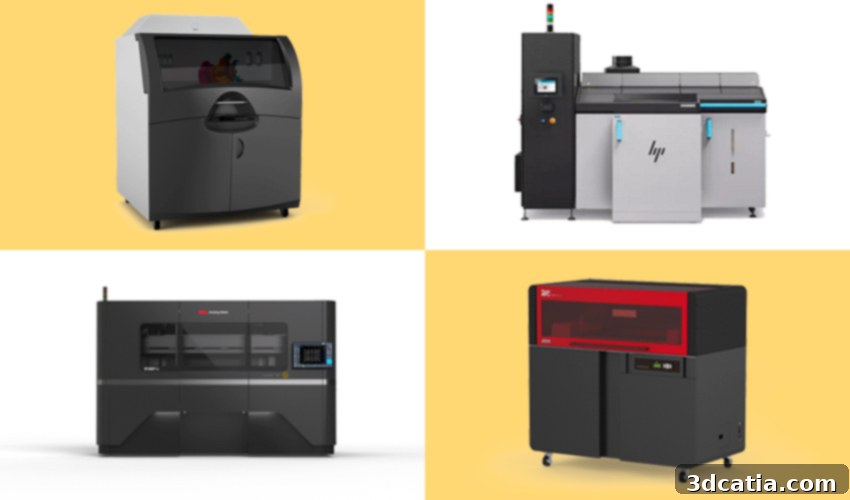
The Ultimate Guide to Binder Jetting Solutions: Top 3D Printers for Industrial Production
Binder jetting stands as a pivotal additive manufacturing process within today’s dynamic market. This innovative technology functions by meticulously coating a thin layer of powder with a liquid binder, precisely jetted via inkjet technology, to construct parts layer by layer. The versatility of binder jetting is evident in its compatibility with a wide array of materials, including advanced ceramics, robust metals, and fine sands. However, the process often necessitates significant post-processing steps, such as curing, and frequently involves more complex procedures like sintering or infiltration to achieve desired material properties.
Recent years have seen a surge in the popularity of binder jetting, largely attributed to its impressive speed, cost-effectiveness, and the extensive range of materials it can process. For businesses and innovators looking to leverage the power of industrial 3D printing, selecting the optimal binder jetting solution can be a complex decision. This comprehensive guide is designed to navigate that very challenge. We delve into some of the leading binder jetting solutions currently available, offering insights to help you identify the best fit for your specific manufacturing needs and applications. Below, you will find our curated selection presented in alphabetical order, detailing the unique capabilities and advantages of each system.
ComeTrue T10
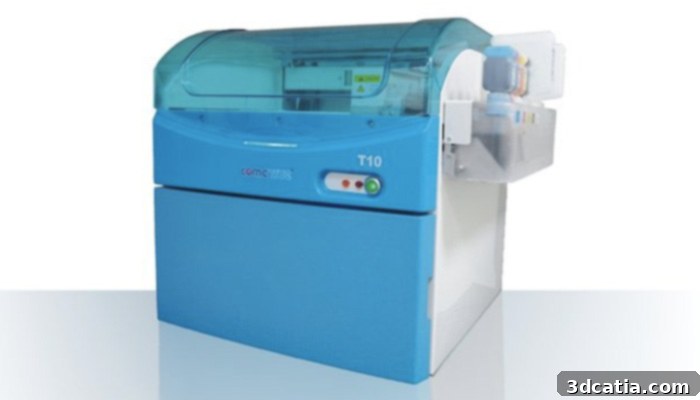
The ComeTrue T10 emerges as a noteworthy desktop 3D printer, developed by ComeTrue, a prominent company based in Taiwan. This machine integrates the patented ComeTrue Binder Jetting technology, a proprietary system that ensures precision and efficiency. A key feature of the T10 is its dual extruder, which enhances its operational flexibility and material handling capabilities. In terms of build capacity, the ComeTrue T10 offers a generous print volume, allowing for structures measuring up to 200 mm x 160 mm x 150 mm. Despite its robust capabilities, the printer maintains a manageable footprint with overall dimensions of 800 mm x 620 mm x 700 mm and a weight of 60 kg, making it suitable for various lab or studio environments.
Powering the T10 is the ComeTrue Print software, an intuitive platform designed for efficient 3D file preparation and slicing. This printer is particularly well-suited for manufacturing in diverse sectors such as architecture, where it can produce intricate scale models, and the medical field, for creating detailed anatomical models or prototypes. Its ability to create complex geometries that would be unachievable with traditional manufacturing methods truly sets it apart. Furthermore, ComeTrue has prioritized optimizing the machine’s printing speed. Compared to many competitors in the desktop binder jetting space, the T10 boasts an impressive vertical construction speed of 20 mm/hr, significantly accelerating project timelines and increasing throughput for smaller-scale industrial applications or rapid prototyping needs. This blend of precision, versatility, and speed makes the ComeTrue T10 an attractive option for educational institutions, design studios, and businesses exploring entry into binder jetting.
Digital Metal DM P2500
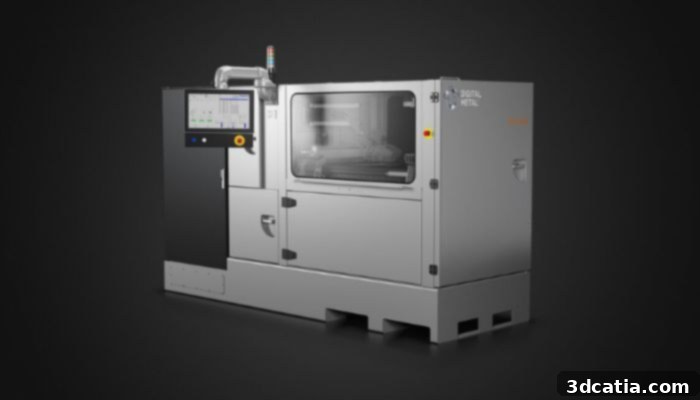
Digital Metal, a company renowned for its expertise in metal binder jetting, experienced a significant development earlier this year with its acquisition by Markforged, having originally been part of Höganäs AB. This strategic move brought together Digital Metal’s specialized metal additive manufacturing prowess with Markforged’s strong position in the industrial 3D printing market. Digital Metal currently offers a portfolio of three advanced machines, including the PPS 1000, DPS 1000, and its flagship and most popular model, the DM P2500.
The DM P2500 boasts a substantial build volume of 250 x 217 x 70/186 mm, making it ideal for the rapid and flexible production of high-quality metal parts. Its versatility is further enhanced by compatibility with an impressive range of industrial-grade materials, including various grades of Stainless steel, high-performance Ti6AI4V, an equivalent to the heat-resistant Inconel 636, robust Tool Steel, and highly conductive Pure Copper, among others. These material options open doors for applications across aerospace, automotive, medical, and consumer electronics industries where specific material properties are critical.
This advanced metal binder jetting solution comes equipped with a suite of compelling features. One significant advantage is its ability to print without the need for support structures, a common benefit of binder jetting that simplifies post-processing and reduces material waste. It also facilitates efficient production through component stacking, allowing multiple parts to be nested and printed within a single build, maximizing throughput. Users benefit from the DM P2500’s high accuracy and repeatability, ensuring consistent part quality across production runs. Moreover, the system incorporates an almost 100% recycling rate for unused powder, significantly reducing material costs and promoting environmental sustainability. The printer’s capability to operate efficiently at room temperature further contributes to its cost-effectiveness and simplifies operational requirements, making it a highly attractive solution for industrial metal additive manufacturing.
Desktop Metal X160 Pro
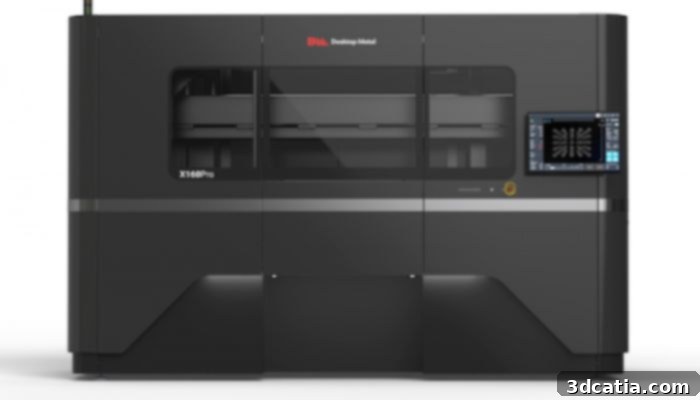
Within the Desktop Metal X Series, the X160 Pro stands out as a truly monumental machine, proudly hailed by its manufacturer as the world’s largest binder jetting printer. This colossal system is engineered for large-scale industrial production, boasting an impressive machine footprint of 3,498 x 2,010 x 2,220 mm (137.7 x 79.1 x 87.5 in). More importantly, its spacious print volume of 500 x 800 x 400 mm (19.7 x 31.5 x 15.8 in) allows for the fabrication of exceptionally large parts or numerous smaller components in a single build, catering to demanding industrial applications that require significant part dimensions or high throughput.
The X160 Pro demonstrates remarkable material versatility, capable of processing a diverse range of powders. This includes ultra-fine metal injection molding (MIM) powders for high-precision metal parts, to coarse sands for casting applications, specialized ceramics for advanced functional components, and various other specialty materials. This broad material compatibility makes it a highly adaptable solution for industries ranging from automotive and heavy machinery to aerospace and energy. With a print resolution exceeding 30 µm voxels, the X160 Pro ensures excellent detail and surface finish for the parts it produces, even at its immense scale.
Designed explicitly for production at scale, this binder jetting behemoth delivers production-capable repeatability, ensuring consistent quality and performance across large batches of parts. Achieved sintered part densities, often higher than 97%, signify robust and functionally equivalent components. The printer operates unidirectionally, a design choice contributing to its efficiency and speed. With a maximum build rate of 3,120 cc/hr (190 in³), the X160 Pro is capable of rapidly producing large volumes of parts, significantly accelerating manufacturing timelines. This makes it an indispensable tool for companies seeking to industrialize additive manufacturing for large-scale component production or mass customization across a variety of material platforms.
ExOne S-Max Flex
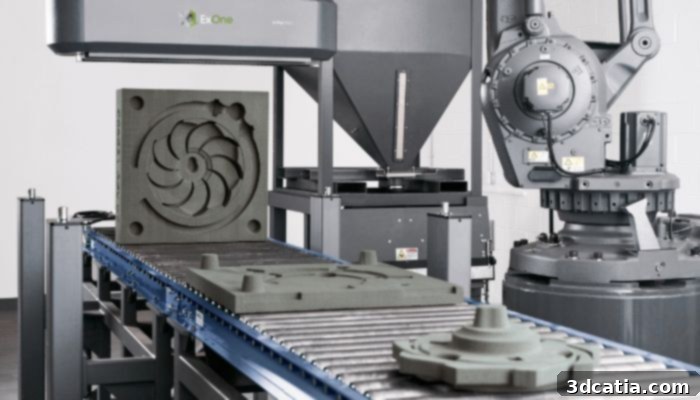
The ExOne S-Max Flex is a large-format sand 3D printer that made its debut in 2022. It was developed by ExOne, a German-based 3D printer manufacturer with a long-standing reputation in binder jetting, which was recently acquired by Desktop Metal – a strategic consolidation that has strengthened their combined market presence in industrial additive manufacturing. According to the manufacturer, the S-Max Flex was specifically engineered to empower small and medium-sized foundry businesses, providing them with advanced capabilities to produce intricate sand molds and cores more efficiently and cost-effectively than traditional methods.
This innovative system utilizes Desktop Metal’s patent-pending Single Pass Jetting (SPJ) technology, a high-speed process that significantly enhances production rates. The S-Max Flex boasts an impressive build rate of up to 115 liters per hour, translating to faster turnaround times for complex casting patterns. A standout feature of the S-Max Flex is its integrated industrial robot, which not only enables a highly flexible layout within the foundry but also ensures ease of access for maintenance and material handling. This robotic integration contributes to a streamlined workflow and increased operational efficiency.
To ensure the highest quality and consistency of parts, the printer incorporates advanced environmental controls and sand drying capabilities. These features are critical for maintaining optimal print conditions and producing reliable, dimensionally accurate sand molds and cores. Furthermore, the all-new printhead mount design eliminates common challenges associated with calibration and alignment, significantly reducing setup time and operator intervention. This focus on user-friendliness and reliability makes the ExOne S-Max Flex an excellent investment for foundries looking to modernize their operations, reduce lead times, and expand their capabilities in producing complex metal castings for industries such as automotive, aerospace, and general engineering.
GE Additive Binder Jet Line Series 3
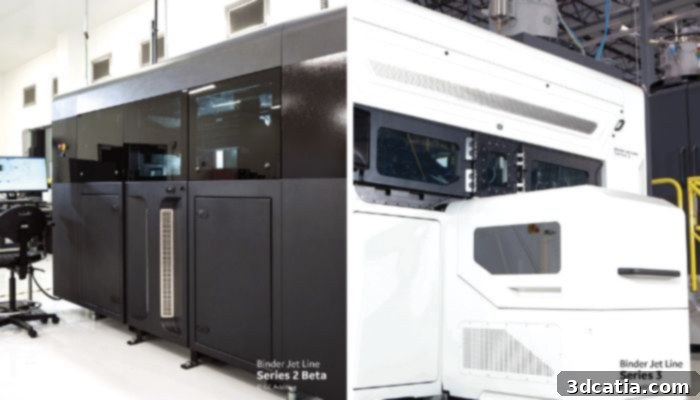
GE Additive, a specialized subsection of the American multinational conglomerate General Electric, is at the forefront of industrial additive manufacturing. Their latest offering in this domain is the GE Additive Binder Jet Line Series 3, representing the culmination of years of research and development in binder jetting technology. This advanced system is engineered to deliver high-quality metal parts, capable of manufacturing components ranging from small, intricate designs to larger structures, meeting precise dimensional and feature resolution tolerances for parts up to 25kg, particularly in stainless steel. This versatility in part size and material capability makes it highly adaptable for various demanding industrial applications.
The Series 3 incorporates GE’s proprietary binder systems, which are meticulously optimized for specific materials to ensure superior part quality and performance. Complementing this is GE Additive’s advanced Amp software, featuring sophisticated distortion prediction and compensation capabilities. This intelligent software minimizes errors during the printing process and post-sintering, facilitating efficient and high-quality part production while reducing iterative development. A significant advantage of this binder jetting line is its ability to produce casting-equivalent metal parts far more quickly than traditional manufacturing methods, drastically cutting lead times for complex components.
Designed for robust industrial environments, the Binder Jet Line Series 3 boasts a high Overall Equipment Effectiveness (OEE), signifying its reliability, quality, and efficiency in production. It is also built with automation readiness in mind, allowing for seamless integration into existing or future automated manufacturing workflows, further boosting productivity. The system ensures top-quality material properties in the final parts, critical for demanding applications in aerospace, energy, and defense. According to GE Additive, this machine can print up to 100 times faster than other additive manufacturing modalities, underscoring its potential for mass production of metal parts at an unprecedented industrial scale. With production deliveries of the machine slated to commence in 2023, the GE Additive Binder Jet Line Series 3 is poised to redefine high-volume metal additive manufacturing.
HP Metal Jet S100
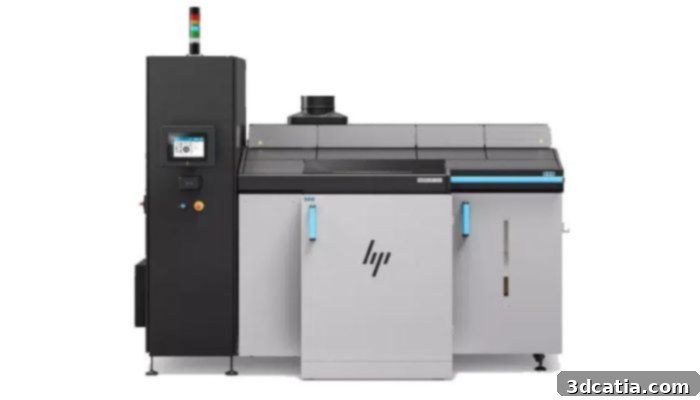
The HP Metal Jet S100 represents a significant leap forward from the 3D printing giant HP, marking its strong entry into the metal additive manufacturing sector. This binder jetting printer is not merely a standalone machine but an integral part of a comprehensive ecosystem of 3D solutions for metal printing, designed to streamline the entire production workflow. Beyond the core binder jetting printer, the HP Metal Jet S100 system includes dedicated stations for powder management, ensuring efficient material handling; a curing station, critical for green part strength; and a powder removal station, which facilitates clean and safe post-processing.
This new HP solution, introduced relatively recently, signifies HP’s strategic expansion into metal processing, leveraging its extensive inkjet technology expertise. The Metal Jet S100 is engineered to cater to a broad spectrum of industries. Both the consumer goods sector, for producing intricate and durable components, and the automotive sector, for lightweight and complex parts, stand to benefit immensely from its capabilities. Furthermore, the robust and scalable nature of the S100 makes it an ideal solution for the broader industrial sector, enabling the mass production of high-quality metal parts at competitive costs.
Weighing in at a substantial 851 kg, the HP Metal Jet S100 is built for industrial reliability and performance. It features a generous build volume of 430 mm x 309 mm x 200 mm, allowing for the efficient production of multiple parts or larger single components. The overall size of the printer, at 2975 mm x 1350 mm x 2410 mm, reflects its capacity as a high-throughput industrial system, designed to integrate seamlessly into modern manufacturing facilities. The HP Metal Jet S100 offers a compelling solution for businesses aiming to transition from traditional metal manufacturing processes to a faster, more flexible, and potentially more cost-effective additive approach.
ProJet CJP 860Pro, from 3D Systems
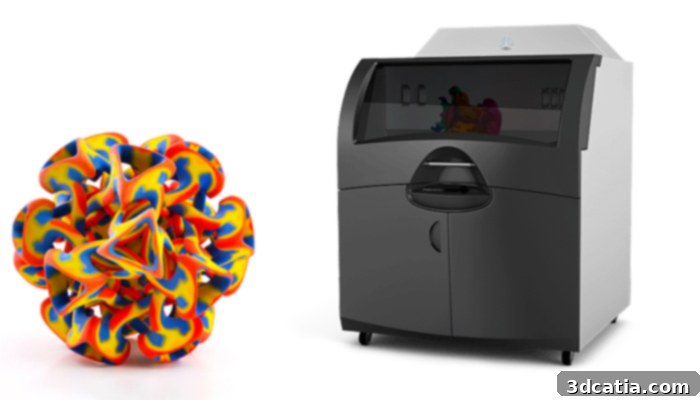
3D Systems, a widely recognized manufacturer, stands as one of the pioneering forces in the realm of additive manufacturing. With a rich history of innovation, the company offers an extensive portfolio of products that harness various 3D printing technologies, among which Binder Jetting holds a significant place. The ProJet® CJP 860Pro is a prime example of their expertise, utilizing the company’s proprietary ColorJet® Printing (CJP) technology to deliver unparalleled color capabilities.
This advanced system is equipped with five CMYK 3D printing heads, enabling the creation of high-quality, full-color parts with exceptional vibrancy and detail. The CJP method employed by the ProJet® CJP 860Pro involves the precise injection of cyan, magenta, yellow, and black binders onto a layer of white powder. These binders selectively bind the powder particles, forming each layer of the part and progressively building up the final, full-color model. This unique approach allows for the production of models that accurately reflect design intent, complete with complex textures, gradient colors, and intricate details.
With a maximum print volume of 508 × 381 × 229 mm, the ProJet® CJP 860Pro facilitates the creation of large-scale concept models and prototypes. Its ability to produce parts in a wide range of solid and gradient colors makes it an invaluable tool for applications such as architectural visualization, product design, medical modeling, and educational aids, where visual communication and aesthetic representation are crucial. The ProJet® CJP 860Pro offers designers and engineers the freedom to bring their ideas to life with unprecedented color fidelity and detail, transforming digital designs into tangible, full-color physical models.
Sinterjet M60
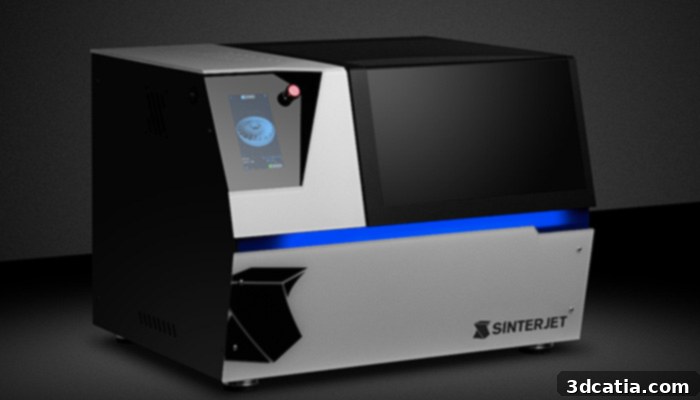
Sintertek, an innovative company based in Istanbul, Turkey, has introduced its metal bonded spray additive manufacturing machine: the Sinterjet M60. This compact yet powerful 3D printer is designed to bring advanced metal part production capabilities to a broader range of users. With machine dimensions of 550 x 350 x 450 mm, it offers a functional build volume of 160 x 60 x 60 mm, while maintaining a relatively light weight of 70kg. The Sinterjet M60 has been meticulously engineered to be both compact and highly efficient, specifically programmed to produce complex metal parts at significantly reduced costs, making industrial metal 3D printing more accessible.
A key advantage of the Sinterjet M60 is its compatibility with a wide selection of metal materials, allowing for versatility in various applications across industries such as jewelry, dental, and small-batch industrial components. Similar to other binder jetting solutions, the use of powder as a build medium inherently eliminates the need for external support structures, as the surrounding powder robustly supports the model during the printing process. This simplifies post-processing and reduces material consumption. The printer delivers impressive detail with a print resolution of 1200 x 1200 dpi, ensuring high accuracy and fine feature reproduction in the final metal parts.
To enhance user efficiency and minimize the effort involved in powder handling, Sintertek has integrated a clever feature: a removable BuildBox. This innovative, easy-to-load input/output system streamlines the workflow significantly. With this feature, operators can load a new print job or switch materials in a matter of seconds at the end of a print run. This dramatically increases production speed and overall machine uptime, making the Sinterjet M60 a highly productive tool for rapid prototyping and small to medium series production of intricate metal components.
Voxeljet VX1000
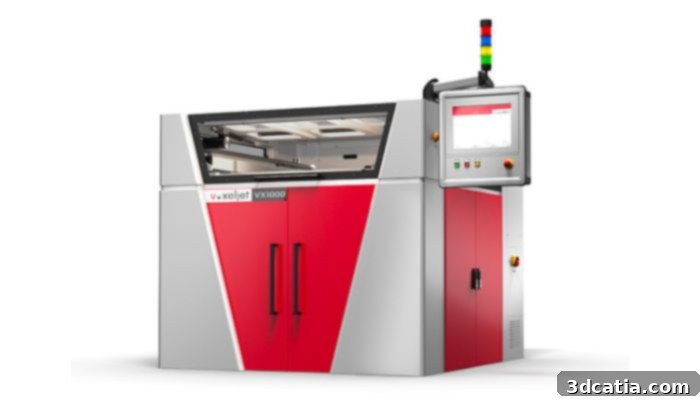
Voxeljet, a leading 3D printing manufacturer based in Friedberg, Germany, proudly features its Voxeljet VX1000 in our curated list of top binder jetting 3D printers. The VX1000 is a robust industrial 3D printing system renowned for its versatility and reliability across numerous applications. Whether the requirement is for the production of medium-sized sand molds or cores destined for subsequent metal casting, intricate investment casting models, or even high-performance ceramic components, the VX1000 is engineered to meet diverse industrial demands.
This system finds its optimal application in areas such as rapid prototyping, where its speed and precision can accelerate design iterations, as well as in low-volume and medium-volume production scenarios. Its generous build volume of 1000 mm x 600 mm x 500 mm is perfectly suited for these applications, allowing for the creation of significant components or multiple smaller parts within a single build. The VX1000 ensures exceptional quality with a material resolution of up to 600 dpi, translating to high precision and meticulous attention to detail in the final printed objects, which is critical for functional parts and complex geometries.
Weighing a substantial 3,000 kg, the VX1000’s build quality speaks to its industrial-grade construction and stability, capable of withstanding rigorous production environments. Beyond its technical specifications, Voxeljet has also committed to environmental responsibility; the VX1000’s process is considered environmentally friendly due to its compatibility with inorganic binders. These binders offer a greener alternative to traditional organic resins, reducing emissions and improving workplace safety, making the VX1000 an appealing choice for companies prioritizing both performance and sustainability in their additive manufacturing processes.
XYZPrinting PartPro350 xBC
The XYZPrinting PartPro350 xBC stands out in the binder jetting landscape as an advanced color 3D printer, bringing vibrant possibilities to additive manufacturing. This machine leverages Binder Jetting technology with a specific focus on speed and color fidelity. It boasts an impressive performance, being up to 150% faster than other color binder jetting printers on the market. This speed is evident in its ability to print at rates up to 18 mm per hour for a fully loaded print volume, making it highly efficient for color prototyping and intricate model production.
The PartPro350 xBC offers a substantial print volume measuring 222 x 350 x 200 mm (8.7 x 13.8 x 7.9 inches), allowing for the creation of sizable models or multiple smaller parts in a single run. It supports a fine layer thickness of 0.10 mm, ensuring smooth surface finishes and detailed reproductions. For seamless integration into various design workflows, the printer supports a range of common 3D file formats, including .stl, .wrl, .obj, and .3mf, making it flexible for designers and engineers.
The accompanying XYZprint AM3DP software enhances the user experience with its dual modes of operation: “cutting and instant printing” for quick jobs, and “pre-cutting” for more optimized and planned print tasks. This flexibility allows users to adapt the workflow to their specific project requirements. Furthermore, the PartPro350 xBC features a practical removable build module, which simplifies part removal and material handling, significantly improving operational efficiency and turnaround times. For those interested in seeing this innovative machine in action and understanding the detailed process XYZPrinting follows to create figurines, the embedded video below offers a comprehensive visual guide to its capabilities and workflow.
We hope this comprehensive overview of leading binder jetting solutions has provided valuable insights into the diverse capabilities of this transformative additive manufacturing technology. From high-speed metal production and large-format sand casting to vibrant full-color prototyping and efficient ceramic component fabrication, the options available today are robust and varied. As binder jetting continues to evolve, these systems represent the cutting edge, offering solutions for complex industrial challenges and enabling new frontiers in design and manufacturing.
What are your thoughts on our selection of binder jetting solutions? Are there any innovative systems you believe we might have overlooked? We invite you to share your perspectives in the comments section below, or connect with us on our LinkedIn, Facebook, and Twitter pages to join the conversation! For the latest updates, breaking news, and in-depth analyses in the world of 3D printing, don’t forget to sign up for our free weekly Newsletter here, delivered straight to your inbox. You can also explore all our engaging video content and interviews on our dedicated YouTube channel.