
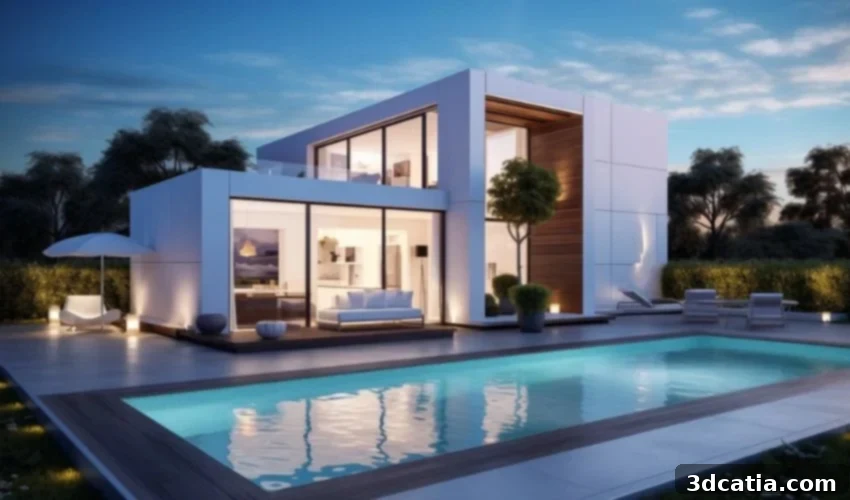
Pioneering the Future: Portugal’s First AI-Designed, 3D-Printed Sustainable Luxury Homes
The landscape of global industry is in constant evolution, with innovative technologies rapidly reshaping traditional sectors. Among these, additive manufacturing, commonly known as 3D printing, stands out as a transformative force, finding implementation in an ever-growing number of fields. Its impact on the construction sector is particularly profound, where the concept of 3D printed housing is experiencing an unprecedented boom. This technological revolution promises not only efficiency and speed but also a pathway to more sustainable and personalized living spaces. A groundbreaking example of this burgeoning trend is soon to emerge in Portugal, where the nation is poised to witness its first 3D printed house. What makes this project exceptionally unique is its ambitious integration of not just 3D printing but also cutting-edge artificial intelligence (AI), signaling a new era for architectural design and construction methodologies.
For those who have been following the advancements in construction technology, the past two years have been replete with revelations of diverse 3D printed homes across the globe. These initiatives span a wide spectrum, from crucial low-cost housing solutions aimed at alleviating housing crises in developing regions to highly optimized, sustainable residences designed for minimal environmental impact. The rapid progression in this niche has been nothing short of remarkable, propelling the construction 3D printing market to significant valuations. Experts project a staggering growth from an estimated $3.5 billion in 2023 to an colossal $400 billion by 2030. This exponential growth underscores the confidence and investment flowing into this innovative sector. It is within this dynamic environment that Litehaus, a forward-thinking company, has chosen to make its mark, embarking on a mission to deliver sustainable construction practices specifically tailored for the luxury housing market, blending high-end living with ecological responsibility.
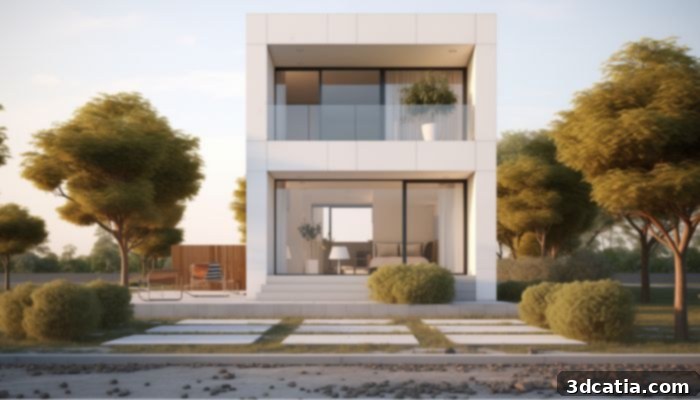
A mock-up of what the house is expected to look like, showcasing modern aesthetics fused with innovative design.
The Synergistic Power of 3D Printing and AI in Home Construction
The pioneering project by Litehaus is set to redefine modern living, with the house strategically located in Torres Vedras, Portugal, a mere 30-minute drive from the vibrant capital city of Lisbon. As highlighted, this residence is not merely a product of 3D printing but a sophisticated fusion of additive manufacturing and artificial intelligence. In the crucial initial phases of creation and design, Litehaus harnessed the immense capabilities of AI to conceptualize and develop both the interior and exterior aesthetics of the home. This strategic integration represents a monumental leap forward for both the construction and 3D printing industries, demonstrating how digital intelligence can unlock new paradigms in architectural innovation and efficiency.
AI’s Role in Modern Architectural Design: Beyond the Blueprint
The application of AI in the design phase is perhaps one of the most exciting aspects of this project. AI algorithms can process vast amounts of data, analyze environmental factors, material properties, and user preferences to generate optimal designs that traditional methods might overlook. This generative design approach allows for rapid iteration and refinement, exploring countless variations to achieve peak performance in terms of structural integrity, energy efficiency, and aesthetic appeal. For Litehaus, AI’s ability to craft intricate and optimized interior and exterior layouts ensures that each home is not only visually stunning but also inherently sustainable and functional. It’s about creating spaces that are not just beautiful but intelligently designed for a modern, eco-conscious lifestyle, reflecting the natural beauty of Portugal’s landscape while embracing minimalist elegance.
The Unparalleled Advantages of 3D Printing in Construction
The manufacturing of these modular buildings through 3D printing offers a suite of highly significant benefits that are set to revolutionize the construction sector. One of the foremost advantages is directly linked to energy consumption and environmental impact. Intuitively, one might expect a 3D printed house to be more energy-efficient than a conventionally built home, but the extent of this efficiency is truly impressive. Studies and project data reveal that a 3D printed house requires approximately 67% less energy to construct compared to a house built using traditional methods. This dramatic reduction in energy consumption during construction translates directly into a smaller carbon footprint and significantly less demand on resources. Given that the construction sector is estimated to be responsible for a staggering 42% of global carbon emissions, integrating 3D printing technologies offers a crucial pathway to substantially mitigate this environmental burden and foster a more sustainable future.
Beyond the construction phase, the inherent design capabilities of 3D printing, especially when paired with AI, allow for optimized insulation and thermal mass properties within the building’s structure. Walls can be printed with intricate lattice patterns or internal voids that enhance thermal performance, keeping homes cooler in summer and warmer in winter, thereby reducing energy consumption for heating and cooling throughout their lifespan. This holistic approach to energy efficiency, from initial construction to daily operation, underscores the transformative potential of additive manufacturing in creating truly sustainable living environments.
Another monumental advantage offered by 3D printing in construction is the incredible speed of execution. Simi Launay, the creative director of Litehaus, eloquently articulates this benefit, stating, “This technology [allows] us to produce as much as 45m² of walls in only 20 hours.” This unprecedented pace is particularly impactful considering that the majority of a home’s 3D printing process often focuses on the structural walls. Such rapid production rates are far from insignificant; they signal a paradigm shift in project timelines and overall construction efficiency. The ambitious goal for Litehaus is to construct up to 100 houses per year in Portugal, commencing with an initial complex of thirteen sophisticated residences. This accelerated construction capability not only reduces labor costs and project durations but also opens up possibilities for addressing housing shortages more effectively and scaling construction operations with remarkable speed and consistency.
Sustainable, Elegant, and Efficient: The Litehaus Philosophy
Launay further elaborated on the core purpose and driving philosophy behind this ambitious project, providing a clear vision for the future of living spaces. She concluded, “Litehaus is embarking on a mission to redefine living spaces, fusing AI technology, 3D printing and modular homes to create buildings that resonate with simplicity, innovation and sustainability. Our goal is to build 70% faster and 20% cheaper, delivering residences that epitomize elegance and minimalism harmonized with Portugal’s natural beauty.” This statement encapsulates the multifaceted benefits that Litehaus aims to deliver: a significant reduction in construction time and cost, coupled with an unwavering commitment to design excellence and environmental stewardship. The combination of speed, cost-effectiveness, and a dedication to elegant, minimalist design harmonized with local aesthetics positions Litehaus at the forefront of the sustainable luxury housing market. It’s an approach that promises not just houses, but intelligently designed, eco-friendly homes that enhance the quality of life for their occupants while respecting the planet. You can discover more about their innovative vision and projects on the company’s official website HERE.
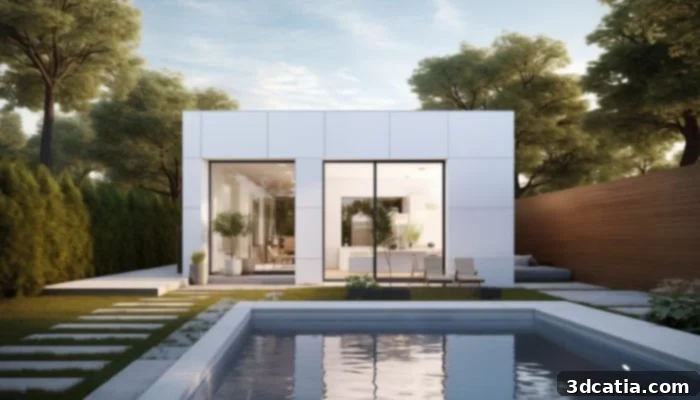
A serene look at the envisioned backyard, complete with a refreshing pool, epitomizing luxury and modern living.
The Future of Construction: Embracing Innovation
The advent of 3D printing and AI in building construction is not merely a fleeting trend; it represents a fundamental shift in how we conceive, design, and construct our habitats. These technologies promise to address critical challenges facing the global construction industry, including housing shortages, the demand for more sustainable practices, and the need for greater customization. By enabling faster, more efficient, and environmentally friendly construction processes, 3D printing coupled with AI holds the potential to democratize access to high-quality housing while simultaneously pushing the boundaries of architectural creativity. The Litehaus project in Portugal serves as a beacon, illustrating the tangible benefits and exciting possibilities that arise when innovation is embraced wholeheartedly. It’s a testament to human ingenuity, charting a course towards a future where homes are not just structures but intelligent, sustainable, and beautifully crafted living ecosystems.
What are your thoughts on the groundbreaking integration of 3D printing and artificial intelligence in building construction? Do you believe this dual technological approach is the key to unlocking more sustainable and efficient housing solutions worldwide? Share your insights and perspectives in a comment below or join the conversation on our LinkedIn, Facebook, and Twitter pages! For all the latest breaking news and developments in the world of additive manufacturing, don’t forget to sign up for our free weekly newsletter here, delivering essential 3D printing news straight to your inbox! Additionally, you can find a wealth of informative and engaging videos on our YouTube channel, exploring various facets of 3D printing technology and its applications.
*All Photo Credits: Litehaus