
Revolutionizing Industries: Top 5 Must-Watch 3D Printing and Additive Manufacturing Innovations
This week, we delve into the forefront of technological advancement, showcasing five compelling videos that underscore how additive manufacturing is fundamentally reshaping global production paradigms. Far from being a niche technology, 3D printing has seamlessly integrated into and transformed numerous industrial sectors, from critical medical applications that save lives to high-performance automotive innovations that redefine mobility. Our meticulously curated selection for the week aims to keep you abreast of these groundbreaking innovations, offering a vivid glimpse into the future of manufacturing. Each video highlights a unique application, demonstrating the versatility and immense potential of 3D printing technology across diverse fields. We invite you to explore these transformative stories and witness the innovative spirit driving the industry forward. Should you find these insights captivating, remember that an even broader array of 3D printing content awaits discovery on our dedicated YouTube channel. We sincerely hope you find these features inspiring and enriching. Enjoy your Sunday!
1. Decathlon’s ADDLAB: Pioneering Sports Innovation with 3D Printing
Decathlon, a global leader in sports goods manufacturing, has strategically embraced additive manufacturing for several years, recognizing its immense potential to accelerate product development and foster rapid, agile innovation. This commitment is vividly demonstrated in their cutting-edge 3D printing laboratory, ADDLAB, which is uniquely integrated within one of their futuristic concept stores located in Villeneuve d’Ascq, in northern France. This visionary approach allows Decathlon to push the boundaries of sports equipment design and production directly within a retail environment, bridging the gap between development and consumer experience.
The ADDLAB facility is equipped with a diverse range of advanced 3D printers, with a notable emphasis on HP Multi Jet Fusion technology. This particular technology is crucial for Decathlon as it facilitates an exceptionally broad spectrum of applications. From crafting high-fidelity prototypes during the initial design phases – enabling quick iterations and thorough testing of new concepts – to producing functional post-sales parts, HP Multi Jet Fusion provides the versatility and speed required to support multiple sports disciplines. This integration of 3D printing not only enhances the design process but also optimizes their supply chain, reduces waste, and allows for rapid customization and repair solutions, ultimately offering superior products and services to athletes and sports enthusiasts worldwide. Decathlon’s investment in additive manufacturing through ADDLAB stands as a testament to their dedication to continuous innovation and improving the sporting experience.
2. Creaform 3D Scanners: Preserving History at Michigan Central Station with Ford
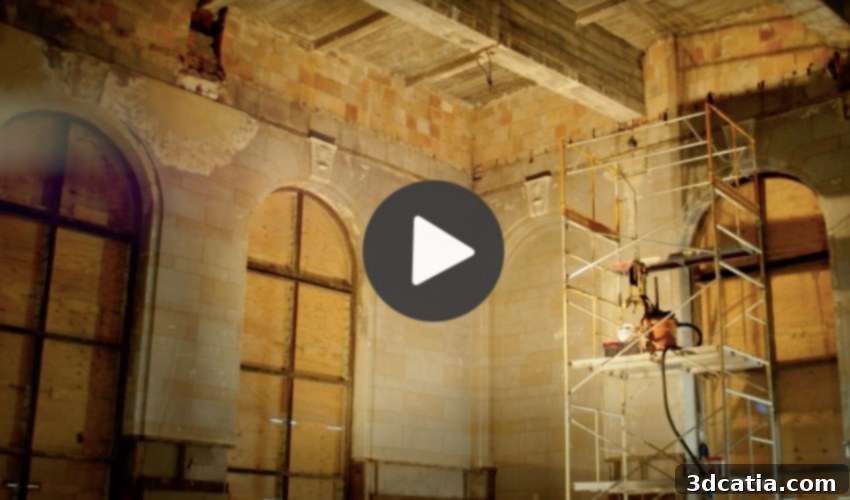
Ford Motor Company is undertaking an ambitious and historically significant project: the meticulous restoration of the iconic Michigan Central Station. This endeavor goes beyond mere renovation; it aims to revive a cherished landmark while ensuring absolute historical accuracy, a task made possible through the application of groundbreaking 3D scanning technology. To achieve this monumental feat, Ford has partnered with Creaform, leveraging their advanced 3D laser scanners to digitally capture and replicate the station’s intricate architectural elements.
The process involves creating highly precise 3D models of various structural and decorative components of the station. These detailed digital blueprints empower contractors to either precisely repair existing structures or authentically replicate lost or severely damaged elements, ensuring that every detail aligns with the building’s original design. Creaform’s sophisticated 3D scanners are particularly adept at this task, utilizing 15 laser crosses to digitally capture the exact shape and dimensions of any physical object with unparalleled precision. This technology is invaluable for heritage preservation, allowing for the faithful reconstruction of complex geometries that would be impossible to replicate using traditional methods. The meticulous digital capture guarantees that the restored Michigan Central Station will stand as a true testament to its original grandeur, bridging the past and the future through cutting-edge technological innovation. This project exemplifies how modern manufacturing and scanning technologies are crucial tools in safeguarding architectural heritage for future generations.
3. New Balance: Elevating Footwear Performance with 3D Printed Sneakers
The footwear industry is undergoing a profound transformation, with 3D printing at its core, enabling manufacturers to deliver unparalleled customized solutions. This technological shift allows for the creation of shoes that offer enhanced comfort, superior performance, and a perfect fit tailored to the unique morphology of each individual. Among the pioneers in this revolution is New Balance, a brand that has made substantial investments in additive manufacturing to develop cutting-edge 3D printed sportswear, particularly focusing on revolutionary sneaker designs.
New Balance’s innovation is largely driven by its strategic partnership with Formlabs, utilizing their advanced 3D printing machines to reimagine the fundamental components of a shoe. This collaboration has allowed them to design and produce intricate shoe soles, effectively replacing the traditional foam materials that have long been the standard. A key aspect of their joint effort involved developing a specialized resin capable of mimicking or even surpassing the desired properties of conventional materials, such as elasticity, durability, and energy return. This breakthrough enables the creation of complex lattice structures within the soles that provide dynamic cushioning and support precisely where needed, optimizing comfort and athletic performance. This shift towards additive manufacturing signifies a move towards mass customization, where each pair of shoes can be perfectly engineered for an individual’s foot mechanics, paving the way for a new era of personalized athletic footwear. Witnessing the meticulous work behind a pair of New Balance shoes, crafted with additive manufacturing and specialized resins, truly showcases the future of high-performance footwear.
4. Industrial Robotics and Cellulose: 3D Printing Wood for Sustainable Architecture
One of the most persistent misconceptions surrounding additive manufacturing is the perceived lack of compatible materials, often leading to a limited understanding of its true potential. However, the reality is quite the opposite, as innovation continues to expand the material palette available for 3D printing. A compelling demonstration of this expansion comes from an architectural project where a team of visionary students successfully created a 3D printed structure utilizing cellulose. Cellulose, the principal biopolymer forming the cell walls of plants, including wood, represents a truly sustainable and renewable resource.
This pioneering project aimed to explore not only the aesthetic and structural possibilities of printing with natural materials but also to rigorously test the durability and environmental responsiveness of such a work. By employing cellulose as the primary material, the students directly addressed specific environmental challenges, demonstrating how additive manufacturing can contribute to more sustainable construction practices. The process involved an industrial robot meticulously extruding the cellulose, which was presented in granular form. This method allowed for the precise deposition of material, enabling the creation of complex, organic geometries that are often difficult or impossible to achieve with traditional construction techniques. This experiment highlights the immense potential of bioprinting in architecture, offering a glimpse into a future where buildings are not only precisely engineered but also environmentally friendly, biodegradable, and intrinsically linked to natural ecosystems. Such advancements could revolutionize the construction industry, paving the way for new material innovations and sustainable design principles.
5. Siemens and Singapore: Driving the Future of Additive Manufacturing and Industry 4.0
Singapore has firmly positioned itself as a global leader in advanced manufacturing, with a strategic vision underscored by significant investments in additive manufacturing research and development. Since 2011, the nation has channeled over 200 million Singapore dollars into fostering innovation in this critical technological domain. Central to this national initiative is the National Additive Manufacturing Innovation Cluster (NAMIC), which plays a pivotal role in accelerating the adoption of advanced technologies across various industries, establishing Singapore as a hub for next-generation production.
Further bolstering Singapore’s ambitious goals in the field of AM, industrial manufacturing giant Siemens has made a substantial commitment by opening its Advance Manufacturing Transformation Center (AMTC) in the western part of the city-state. This state-of-the-art facility is designed to serve as a catalyst, facilitating the seamless transition of businesses and industries into the era of 3D printing and Industry 4.0. The AMTC provides a comprehensive ecosystem for collaboration, research, and workforce development, offering access to cutting-edge equipment, expertise, and training programs. Siemens’ investment in Singapore underscores the strategic importance of this region in the global additive manufacturing landscape, aiming to empower local and international companies to leverage the full potential of digital manufacturing, improve productivity, and drive sustainable growth. This partnership between a leading industrial player and a forward-thinking nation exemplifies the concerted efforts required to propel the global manufacturing sector into an intelligent, interconnected, and highly efficient future.
We hope this week’s exploration into the world of additive manufacturing and 3D printing has been both insightful and inspiring. From enhancing consumer products and preserving historical landmarks to pioneering sustainable construction and driving national industrial transformations, the versatility and impact of this technology are undeniable. Each video offered a unique perspective on how innovation is shaping diverse sectors, demonstrating the profound changes underway globally. We are eager to hear your thoughts: which of these groundbreaking applications captured your imagination the most? Share your favorite video and your insights in the comments section below, or engage with us on our Facebook and Twitter pages. To ensure you never miss out on the latest advancements and news from the dynamic 3D printing industry, remember to sign up for our free weekly Newsletter, delivered directly to your inbox!