
Revolutionizing Defense: How 3D Printing is Transforming Military Vehicle Manufacturing
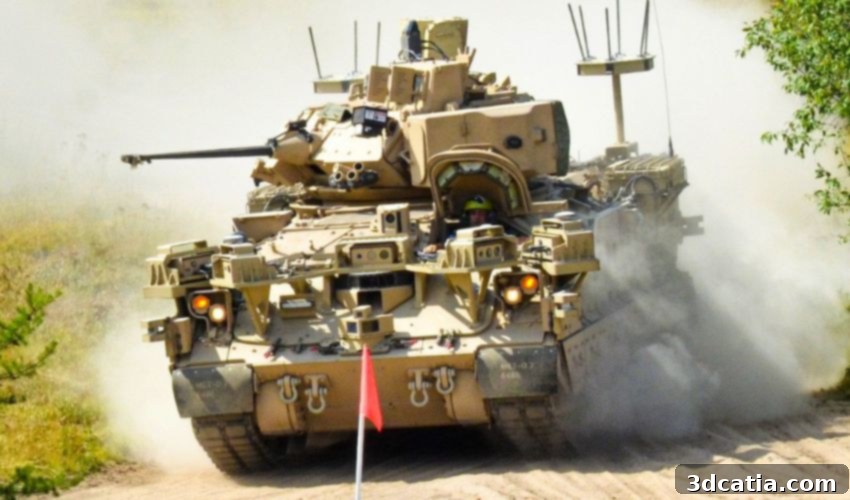
The United States Military has consistently championed innovation, particularly in the realm of advanced manufacturing. Leveraging additive manufacturing, often referred to as 3D printing, the defense sector has explored its potential for producing a wide array of equipment, from critical infrastructure like bunkers and bridges to sophisticated weaponry and drones. This technological embrace positions the U.S. military as a leading proponent of 3D printing across nearly every facet of its operations. The most recent and highly anticipated development, spearheaded by The Army’s Tank-automotive and Armaments Command (TACOM) in collaboration with SAE Government Technologies and the U.S. Army DEVCOM Ground Vehicle Systems Center (GVSC), centers on the groundbreaking use of 3D printing for military ground vehicles, promising unprecedented advancements in defense logistics and readiness.
This ambitious project reached a significant milestone with the recent grand opening of the Advanced Manufacturing Commercialization Center (AMCC) on April 6th. According to official press releases, this state-of-the-art facility is not merely a research hub but a pivotal asset for the future of military manufacturing. Central to the AMCC’s capabilities is the Jointless Hull subsection tool. This innovative machine represents a cutting-edge application of hybrid metal additive manufacturing, designed to serve as both an engineering research platform and a production tool. Its primary function is to support the full-scale Hull machine, which possesses the immense capacity to create massive, intricate metal parts essential for heavy-duty military vehicles, including iconic platforms like Humvees, formidable tanks, and various other crucial ground vehicles. This progress builds upon earlier reports where we highlighted the initial stages of the Jointless Hull project, an initiative by the U.S. Army aimed at developing hull-scale tools for combat vehicles using advanced additive manufacturing technology. The successful establishment and opening of the new center signify a major triumph in this endeavor, marking a new era for defense production.
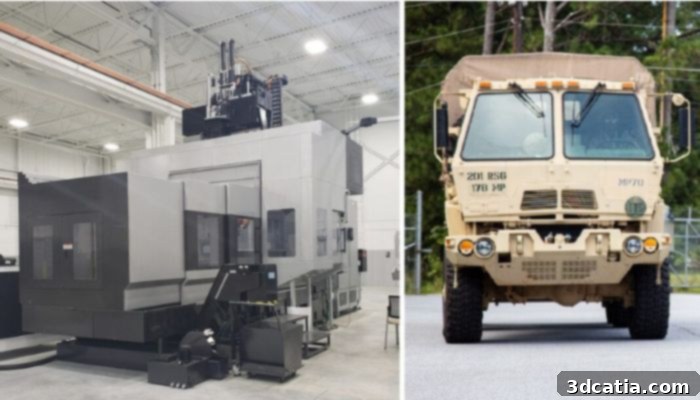
Hybrid metal additive manufacturing machine located in Rock Island, Illinois (photo credits: left, Jerome Aliotta and right, U.S Army)
Enhancing Military Readiness: The Transformative Power of On-Demand 3D Printing
The integration of 3D printing into military vehicle production offers a myriad of strategic advantages, fundamentally altering the traditional paradigms of defense logistics and supply chains. With this advanced technology, parts as large as three cubic feet can be produced on-demand, leading to a dramatic reduction in both manufacturing time and overall cost. Historically, military forces relied on a complex and often protracted process of ordering parts from external manufacturers, enduring waiting periods that could span weeks or even months. Such delays are critically detrimental in military operations where rapid deployment and immediate readiness are paramount.
One of the most pressing challenges for military forces worldwide is the maintenance of aging vehicle fleets. Many combat and support vehicles have been in service for decades, meaning original equipment manufacturers (OEMs) may no longer produce replacement parts. This scarcity often forces the military to resort to costly and time-consuming custom fabrication, or worse, to decommission otherwise functional vehicles due to a lack of a single component. Additive manufacturing provides a powerful solution to this obsolescence crisis. It empowers the military to digitally store designs and then craft desired parts directly on-site, eliminating reliance on external manufacturers and their often-discontinued product lines. This localized, on-demand production capability slashes waiting times from potentially months to a mere few days, ensuring that critical vehicles remain operational and ready for deployment.
Strategic Advantages: Beyond Speed and Cost
The benefits of 3D printing extend far beyond just speed and cost reduction. For the military, it offers profound strategic advantages:
Supply Chain Resilience and Security
Traditional global supply chains are vulnerable to geopolitical tensions, natural disasters, and economic disruptions. By enabling localized, on-demand production, 3D printing significantly enhances supply chain resilience. It reduces the military’s dependence on foreign manufacturers or distant production facilities, minimizing risks associated with transport, customs, and international relations. This localized manufacturing capability ensures a more secure and reliable flow of critical parts, essential for maintaining continuous operational capacity.
Innovation and Customization
Additive manufacturing excels at producing complex geometries that are often impossible or prohibitively expensive with traditional methods. This capability allows military engineers to rapidly prototype new designs, iterate improvements, and even customize parts for specific missions or environmental conditions. Vehicles can be equipped with lighter, stronger components optimized for performance, fuel efficiency, or payload capacity, directly impacting mission success and soldier safety. The ability to innovate and adapt quickly gives military forces a crucial tactical advantage in an ever-evolving threat landscape.
Reduced Logistics Footprint and Distributed Manufacturing
The concept of “digital inventory” – storing part designs electronically rather than physically – dramatically reduces the need for vast warehouses and extensive transportation networks. This not only cuts down on logistical costs and complexities but also opens up possibilities for distributed manufacturing. Imagine mobile 3D printing units deployed closer to the front lines, capable of producing spare parts and custom tools in theater. This proximity to the point of need can significantly reduce downtime for repairs, minimize the exposure of supply convoys, and ensure troops have the equipment they need, when and where they need it.
Environmental and Sustainability Benefits
Additive manufacturing inherently generates less material waste compared to subtractive manufacturing processes, where material is cut away from a larger block. This efficiency contributes to environmental sustainability and reduces the overall resource footprint. Furthermore, by extending the life of existing vehicles through rapid part replacement, 3D printing promotes a more sustainable approach to defense asset management, delaying the need for costly and resource-intensive new vehicle procurements.
Brandon Pender, GVSC Associate Director for the Materials Division, succinctly captures the essence of these advancements: “We’re planning to leverage the technology in this center to more efficiently manufacture parts, reduce weight, lower costs, and improve long-term sustainment efforts, all to improve Army readiness” . His statement underscores the holistic approach the Army is taking, viewing 3D printing not just as a manufacturing tool, but as a strategic enabler for a more agile, cost-effective, and resilient defense force.
A Global Trend: Additive Manufacturing in Combat Worldwide
Bearing all these undeniable advantages in mind, it is no mystery why additive manufacturing is rapidly gaining popularity within the world of combat and defense – and not just within the U.S. military. This transformative technology is being embraced by armed forces globally as they seek to modernize their operations and enhance their strategic capabilities. For example, The Royal Netherlands Army has also proactively adopted 3D printing to produce crucial spare parts for their military vehicles. By bringing the production of these components in-house, rather than outsourcing to traditional manufacturers, the Dutch army has achieved a higher degree of self-sufficiency. This approach yields similar significant perks, including substantial savings in both time and money, alongside improved responsiveness to operational demands.
This international adoption highlights a broader shift in military procurement and sustainment strategies. NATO allies and other defense organizations are increasingly recognizing that additive manufacturing offers a pathway to stronger supply chains, reduced logistical burdens, and enhanced operational flexibility. From rapid prototyping of new equipment to on-demand repair of critical assets in remote locations, 3D printing is proving to be an indispensable tool for maintaining readiness and projecting power in complex global environments. While the full scope of its application is still unfolding, the use of additive manufacturing in the military represents an exciting prospect that is already revolutionizing how spare parts are produced and supplied, setting a new standard for defense logistics in the 21st century. For further details on the U.S. Army’s initiatives, you can find the official press release HERE.
The Future of Defense Manufacturing
The Advanced Manufacturing Commercialization Center (AMCC) and the Jointless Hull project are more than just isolated innovations; they are harbingers of a fundamentally different future for defense manufacturing. This future envisions military forces equipped with the ability to rapidly design, produce, and repair critical components at or near the point of need. It moves beyond static, centralized production models towards a dynamic, distributed network capable of responding with unprecedented speed and agility to emergent threats and operational requirements. This shift will lead to reduced reliance on vulnerable global supply chains, fostering greater self-reliance and strategic independence. As technology continues to advance, we can expect to see even more sophisticated hybrid manufacturing systems, capable of producing larger, more complex, and multi-material components, further embedding 3D printing as a cornerstone of modern military capabilities. The ongoing investment in additive manufacturing technologies by the U.S. Army and its global counterparts is a clear indication that this is not merely a trend, but a foundational transformation in how defense assets are conceived, sustained, and deployed.
What are your thoughts on 3D Printed Military parts and the future of defense manufacturing? We invite you to share your insights in a comment below or join the conversation on our LinkedIn, Facebook, and Twitter pages! Don’t forget to sign up for our free weekly Newsletter here to get the latest 3D printing news delivered straight to your inbox! You can also find all our videos and more in-depth content on our YouTube channel.
*Cover photo credits: U.S Army