
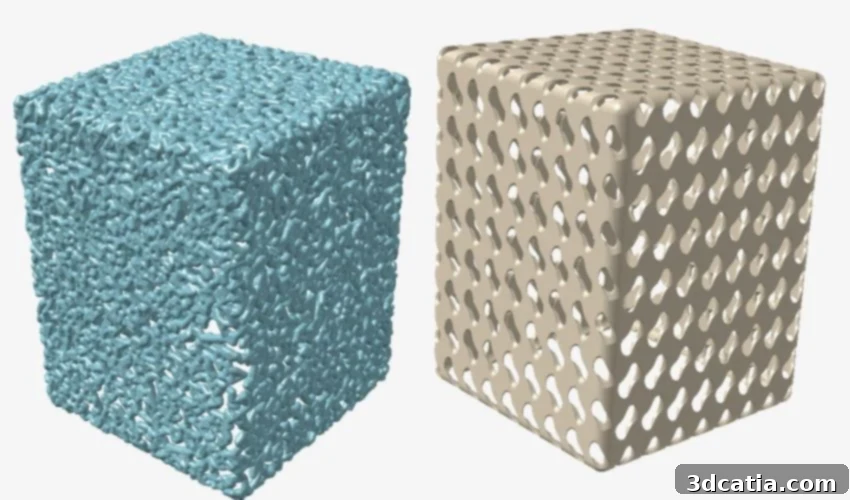
Mastering Lattice Structures in 3D Printing: Unleashing Design Freedom with Altair Inspire and Implicit Modeling
When experts discuss the transformative advantages of additive manufacturing, one core benefit consistently stands out: unparalleled design freedom. This revolutionary capability allows engineers and designers, equipped with sophisticated software, to craft incredibly lightweight, highly optimized components that would be impossible to achieve through conventional manufacturing methods. This principle is particularly evident and crucial when it comes to the creation of lattice structures. Lattices are unique to 3D printing and are highly valued for their exceptional characteristics, offering significant performance enhancements. Consequently, numerous software solutions have integrated advanced lattice generation tools, with Altair Inspire being a prominent example, renowned for its ability to handle even the most complex lattice structures.
Altair Inspire, a flagship product from Altair Engineering, a global leader in computational science and artificial intelligence headquartered in the USA, is a powerful concept design tool specifically tailored for additive manufacturing workflows. It boasts a suite of innovative features meticulously optimized for 3D printing. Among its most lauded functionalities is its versatile capability to generate and manipulate various types of lattice structures, a characteristic frequently highlighted by TrueInsight, a premium channel partner for Altair Engineering. This ease of lattice implementation positions Altair Inspire as a critical tool for modern additive design.
Lattices are intricate, repeated patterns, often inspired by natural biomimicry. They can be designed to fill an entire volume or precisely conform to a specific surface. While they share some functional overlap with infill patterns in 3D printing, lattices represent a far more sophisticated and optimized approach. Their primary advantage lies in their ability to deliver a superior strength-to-weight ratio. By intelligently minimizing material usage while simultaneously ensuring robust part performance, lattices allow for the creation of components that are both lighter and stronger than solid equivalents. This material efficiency not only reduces part weight but also contributes to lower production costs and faster print times, making them invaluable across numerous industries.
However, it’s important to recognize that lattice structures are not a one-size-fits-all solution. The optimal lattice type largely depends on the specific application and desired mechanical properties. To truly leverage the power of lattices in 3D printing, a clear understanding of their diverse forms and functionalities is essential. This comprehensive guide aims to demystify the different types of lattices available, outlining their unique characteristics, how they differ, their ideal applications, and the specific advantages each offers. By exploring these distinctions, designers can make informed decisions to optimize their 3D printed parts for peak performance.
Understanding the Benefits of Lattices in Additive Manufacturing
Lattices are highly prized in additive manufacturing for a multitude of reasons, primarily their ability to drastically improve part performance and efficiency. Key benefits include making parts significantly lighter and stronger, which is critical in industries like aerospace and automotive where every gram counts. They enable a reduction in overall part volume, which not only conserves material but also mitigates the risk of surface defects and prevents excessive stress buildup in solid sections. This material reduction translates directly to cost savings and faster print times. Furthermore, lattices offer superior energy absorption capabilities, making them ideal for applications requiring impact resistance, such as sports equipment or protective gear. Lastly, their intricate geometries can dramatically increase surface area, a vital feature for applications like heat exchangers and biomedical implants where efficient transfer or interaction is paramount.
These advantages, however, are not universally uniform; they vary considerably depending on the specific type of lattice structure employed. This variability underscores the importance of a nuanced understanding of each lattice type, allowing engineers and designers to precisely match the structure to the functional requirements of the part. This ensures optimal utilization of additive manufacturing’s capabilities and maximizes the benefits derived from these advanced cellular designs.
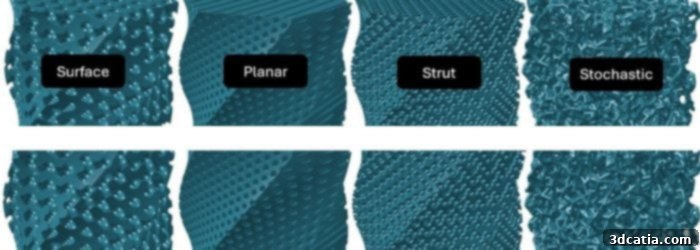
The four different lattice types: Surface, Planar, Strut, and Stochastic.
Exploring the Diverse World of 3D Printing Lattice Types
Surface Lattice
Surface lattices, often the most visually intricate, are cellular structures formed from one or sometimes two continuous surfaces that repeat naturally. Unlike other lattice types that rely on tiling or patterning a discrete unit cell, surface lattices derive their structure from the inherent repetition of these surfaces. They are a staple in high-performance applications, most notably in heat exchangers, where their unique geometry allows for highly efficient thermal management. Generally, these types of lattices exhibit robust and well-rounded mechanical properties across various directions.
Prime examples include Triply Periodic Minimal Surfaces (TPMS) and gyroid lattices. Gyroids, in particular, have demonstrated exceptional effectiveness in heat exchanger designs, often outperforming traditional shell-and-tube configurations. This superior performance stems from the fundamental principle that heat transfer rate is directly proportional to the available heat transfer area. The complex, highly convoluted nature of gyroid lattices inherently provides an expansive surface area within a compact volume, making them incredibly efficient for thermal management applications. A key challenge, however, is that unlike strut lattices, surface lattices may not always conclude uniformly, which can occasionally result in small, localized overhangs that require careful design consideration.
Planar Lattice
Planar lattices, in contrast, are frequently encountered in consumer goods and specific structural components. These are essentially 2.5D cellular structures defined by a clear 2D cross-section that is then extruded or drawn along a third dimension. Common examples include the ubiquitous honeycomb structure found in packaging, aerospace sandwich panels, and even the internal structures of many surfboards. Altair precisely defines a planar lattice as “a 2.5D cellular structure with a clearly defined 2D cross-section that is drawn or extruded along the third dimension.” A distinguishing feature of planar lattices is their capacity to offer very high stiffness in a specific, predetermined direction, making them excellent for unidirectional loading applications. Uniquely among lattice types, planar lattices can also be fabricated using traditional techniques like extrusion, owing to their fundamental 2D cross-sectional nature, which means they are not exclusively reliant on additive manufacturing.
Strut Lattice
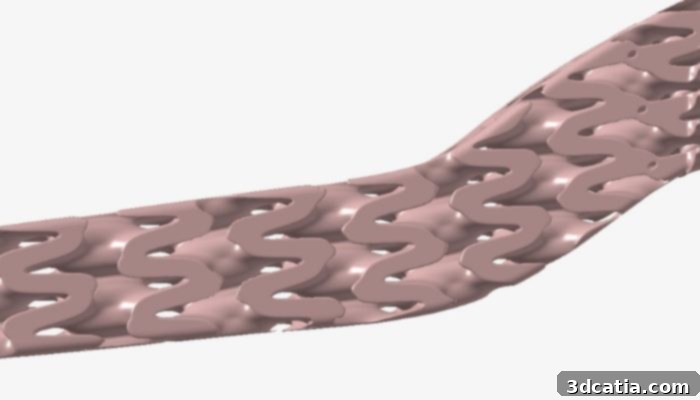
Strut lattices are perhaps the most intuitively understood lattice type, constructed from a network of nodes interconnected by beams or struts. The fundamental concept involves designing a base unit cell, which is then tiled and patterned across one, two, or three dimensions to form the complete lattice structure. These lattices are generally known for being more uniform and predictable in their mechanical behavior compared to planar or stochastic types, yet they can be incredibly complex in their geometric variety. Their form is highly dependent on the chosen cell type, leading to a vast array of possibilities. For instance, a body-centered cubic (BCC) lattice initiates from the center of its defining body, whereas a face-centered cubic (FCC) primitive cell might be visualized as the outer shell of a box. Other common cell types include cubic primitive, isotruss, octagon, hex truss, Kelvin cell, fluorite, diamond, truncated cube, and octet, each offering distinct mechanical properties and aesthetic qualities. This rich diversity allows designers to select a strut lattice precisely optimized for specific load conditions and performance requirements.
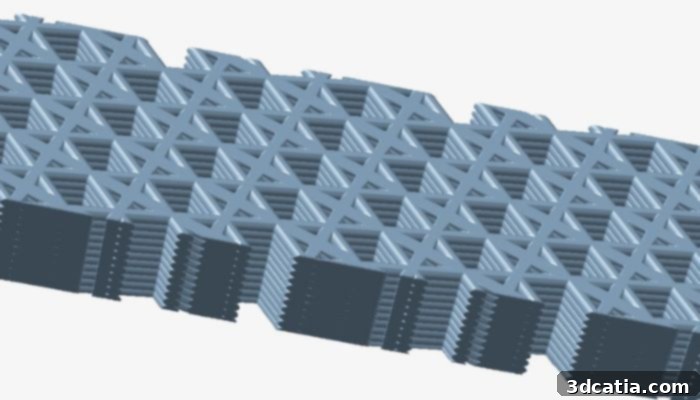
A close up on a strut lattice, demonstrating its interconnected node and beam structure.
Strut lattices find widespread application in structural and architectural engineering, particularly where predictable performance and high strength-to-weight ratios are critical. For example, their highly repeatable patterns make them ideal for demanding aerospace components, where consistency and reliability are paramount, contrasting with some of the more chaotic patterns that can arise with other lattice types. They are highly valued for their ability to form lightweight yet exceptionally strong frameworks, providing robust structural integrity while significantly reducing overall mass. This makes them indispensable for applications requiring high load-bearing capacity coupled with stringent weight constraints, allowing for innovative designs that push the boundaries of traditional engineering.
Stochastic Lattice
Last but certainly not least, stochastic lattices represent a fascinating and increasingly vital category, particularly with their anticipated inclusion and enhancements in software like Altair Inspire’s latest update. The term “stochastic” signifies “having a random probability distribution or pattern that may be analyzed statistically but cannot be predicted precisely.” True to this definition, stochastic lattices are essentially randomized strut lattices. Here, instead of a perfectly uniform, repeating cell, the user defines a set of points, edges between these points, filters to remove undesirable elements, a method to thicken these edges into struts, and outer body treatments—such as combining the lattice with an external shell. This controlled randomness is what gives them their unique properties.
In many respects, stochastic lattices bear the closest resemblance to natural biological structures, most notably bone. Human bone, for instance, consists of two primary components: the dense cortical bone forming the hard outer surface, and the trabecular or cancellous bone, which is the spongy, porous interior. While cortical bone is relatively straightforward to characterize and replicate, the inherent randomized nature of trabecular bone has long posed a significant challenge for engineering replication. This is precisely where stochastic lattices excel. They possess the unique capability to effectively characterize and simulate this biological randomness, making them invaluable for highly specialized applications.
For applications requiring osseointegration—the direct structural and functional connection between living bone and the surface of an artificial implant—stochastic lattices are often the preferred solution. Their random, porous architecture can mimic the natural bone environment, encouraging bone ingrowth and facilitating a more biological integration of implants. This makes them particularly popular and effective in various biomedical applications, from dental implants to orthopedic prosthetics, where creating a harmonious interface between synthetic and biological structures is paramount for long-term success and patient well-being.
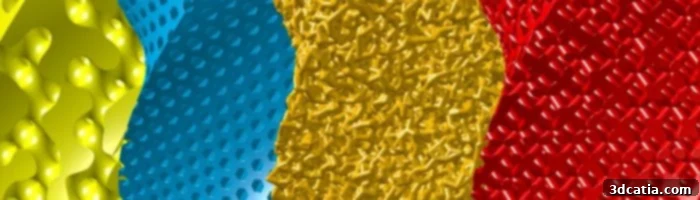
Lattices can be made of different patterns, depending on the type used and the needs of the part, offering vast customization.
How Altair Inspire Sets Itself Apart in Lattice Design
As we’ve explored, there isn’t a single “best” lattice for all 3D printing applications; rather, the optimal choice depends on the specific performance requirements of the part. What undeniably empowers designers, however, is access to advanced software that simplifies and accelerates the creation and integration of these complex lattice structures. This is precisely where Altair Inspire distinguishes itself.
Altair Inspire stands as a premier example of such innovative software. It allows users to rapidly generate surface, strut, planar, and even stochastic lattices through an intuitive interface. By simply navigating to the Implicit Modeling ribbon and selecting the desired lattice tool, designers can quickly define and apply complex cellular structures. Furthermore, the software provides options to adjust visualization quality and precisely select the specific bodies that will be filled with the lattice, among other critical parameters. This streamlined workflow significantly reduces the time and effort traditionally associated with lattice design, making advanced geometries accessible to a wider range of users.
Indeed, a major factor setting Altair Inspire apart from much of the competition is its foundational reliance on implicit modeling, rather than the traditional Boundary Representation (BREP) CAD creation methods typically employed by most conventional CAD software. To understand this distinction, consider the traditional BREP approach: to create a lattice, one would painstakingly construct a series of Non-Uniform Rational B-Spline (NURBS) surface patches, then assemble these into a single lattice unit cell. This unit cell would then be meticulously patterned across one, two, or three dimensions to form the complete lattice structure. While this BREP CAD creation method offers tight control over the geometry of individual lattice elements, it suffers from a critical scalability issue. As the number of unit cells increases, the CAD package’s performance rapidly degrades, often to the point of becoming unusable, stifling the creation of truly complex and large-scale lattice designs.
Implicit modeling is particularly suited to the creation of surface lattices, such as this complex gyroid example.
In stark contrast, implicit modeling leverages the power of implicit surfaces. As detailed in an Altair help article, implicit surfaces are “perhaps best thought of as a field rather than a surface—at every point in space the field defines a scalar value, often some notional or actual distance to the nearest point on the surface. So, if we define the implicit surface as passing through all points in the field where the scalar values equal, say, zero, we call this surface the zero level-set of the field. The zero level-set can be computed and rendered as a single isosurface, which completely removes the need to compute and manage all of the watertight intersections that were present when stitching NURBS patches together.” This fundamental difference provides significant advantages.
Because implicit modeling is driven by fields rather than discrete shapes, the possibilities for creating intricate and varied lattice designs are vastly expanded compared to shape-driven models like BREP. Furthermore, implicit modeling is inherently ideal for hardware acceleration on modern GPUs. This is because it allows for instantaneous inside-outside checks: all points on one side of a surface will have positive scalar values, while points on the other side will have negative values. This efficiency translates into significantly faster computation times, enabling designers to iterate and analyze complex lattice geometries with unprecedented speed.
Beyond raw computational speed, implicit modeling is also the reason Altair Inspire is exceptionally well-suited for generating surface lattices. These structures, often based on complex TPMS geometries, are notoriously difficult to accurately reproduce and manipulate using parametric surfaces like NURBS in traditional CAD. Implicit modeling overcomes this hurdle with ease. Moreover, with implicit modeling, lattices are not created by simply copying and translating a rigid unit cell in different directions. This flexibility means that the number of unit cells and their properties can vary smoothly and continuously across the entire lattice structure, a level of control and organic variation impossible to achieve with traditional, unit-cell-based CAD methods.
Additional powerful benefits of Altair Inspire’s implicit modeling capabilities include the ability to seamlessly layer gradient effects. This allows designers to create lattices where the relative density, unit cell size, or even cell type gradually changes across different sections of the part, optimizing performance for varying load conditions or functional requirements. Similarly, it becomes possible to combine lattice designs with advanced morph operations, enabling smooth transitions from one lattice unit cell configuration to an entirely different one. This feature is a tremendous boon for tackling highly complicated designs and multi-functional parts. For those eager to delve deeper into Altair Inspire’s capabilities, more information can be found HERE, and specific guidance on utilizing it for advanced lattice design in 3D printing is available through TrueInsight HERE.
Which lattice structure would you choose for your next 3D printing project? Let us know your thoughts in a comment below or connect with us on ourLinkedIn,Facebook, andTwitter pages! Don’t forget to sign up for our free weeklyNewsletter here to receive the latest 3D printing news straight to your inbox! You can also find all our insightful videos on ourYouTube channel.