
Digory: The Groundbreaking 3D-Printed Ivory Alternative Revolutionizing Cultural Heritage Restoration
For centuries, ivory has been revered as a precious and rare material, admired for its exquisite beauty, unique texture, and enduring quality. It has been a cornerstone in the creation of countless art pieces, intricate carvings, decorative objects, and sacred artifacts across diverse cultures and historical periods. Sourced primarily from the tusks and canines of various species, most notably Asian and African elephants, ivory’s allure unfortunately led to devastating consequences for these magnificent animals. Recognizing the severe threat posed by the relentless demand, the international ivory trade was largely banned in 1989. Despite these crucial protective measures, the challenge of preserving existing ivory artifacts remains significant, as pieces age, suffer damage, or lose parts over time. Furthermore, ongoing criminal activities related to illegal ivory persist, prompting bodies like the EU Commission to consider further restrictions, including a potential ban on intra-European trade in antique ivory, to close loopholes and enhance conservation efforts.
In response to this pressing need for ethical and aesthetically convincing restoration solutions, a pioneering collaboration has emerged. The Technical University (TU) in Vienna, in partnership with Cubicure GmbH, a leading innovator in additive manufacturing, has developed a revolutionary material called “Digory.” This groundbreaking material, when combined with advanced SLA (Stereolithography) 3D printing technology, offers an unparalleled solution for the precise and respectful restoration of existing ivory objects. Digory is engineered to be deceptively similar to natural ivory in appearance and feel, providing cultural heritage institutions and restorers with a sustainable and ethical alternative. This ambitious project underscores a profound commitment to preserving our shared history without compromising the future of endangered species. The development of Digory was significantly enriched by the practical insights gained from its application in cooperation with the esteemed Art and Monument Preservation of the Archdiocese of Vienna and the renowned Addison restoration studio in Vienna, ensuring its relevance and effectiveness in real-world conservation scenarios.
The Enduring Quest for Authentic Restoration Alternatives
The history of ivory utilization stretches back millennia, with evidence of mammoth ivory carvings dating more than 35,000 years ago. Throughout history, this material captivated civilizations, finding its way into a vast array of objects from elaborate jewelry and personal adornments to functional tools and highly symbolic religious icons. In Christianity, for instance, ivory was frequently used for significant sacred objects such as crucifixes, reliquaries, and devotional panels, prized for its ethereal glow and smooth texture. However, with the increasing awareness of the ethical implications and the subsequent bans on the ivory trade, the field of cultural heritage conservation faced a critical dilemma: how to repair and restore invaluable historical artifacts without resorting to the very material they were designed to protect. The challenge intensified as existing pieces aged, suffered environmental damage, or experienced the loss of intricate, irreplaceable parts.
For many years, restorers explored various alternative materials to address the gaps and damage in ivory artifacts. These efforts often involved substances like mussels, animal bones, or a range of synthetic plastics. While these materials offered practical solutions in some instances, none provided a truly comprehensive or aesthetically convincing substitute for natural ivory. The primary shortcomings revolved around a lack of perfect visual fidelity, particularly in mimicking ivory’s unique translucency, subtle color variations, and distinctive surface texture. Furthermore, the material properties of these alternatives often differed significantly from ivory, potentially leading to discrepancies in durability, aging processes, or reactions to environmental conditions. From an economic perspective, many of these substitute materials were only commercially available in large quantities, making them financially unfeasible and impractical for the restoration of individual, small components on a single artifact. This left conservators in a precarious position, often having to compromise between authenticity, ethics, and cost-effectiveness when faced with the delicate task of preserving precious heritage.
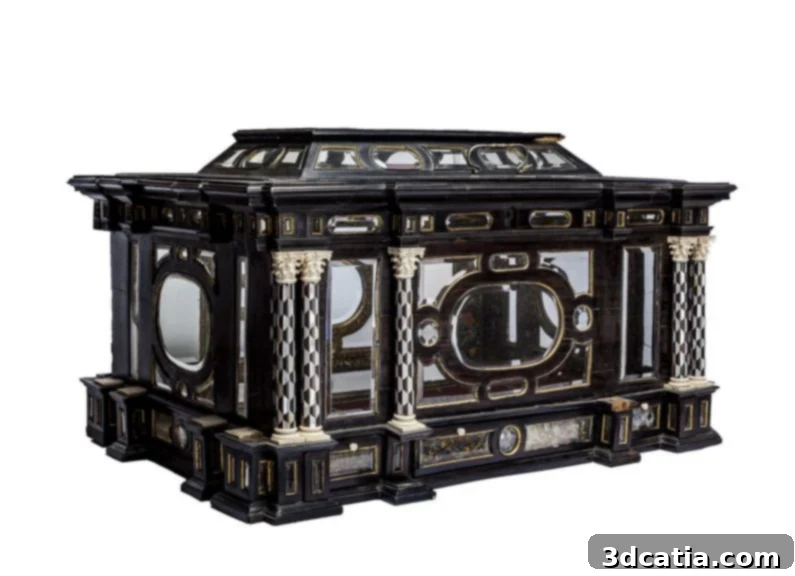
Shrine with ivory decoration from the 17th century (Photo Credit: Stephan Doleschal)
A Real-World Catalyst: The 17th-Century Shrine
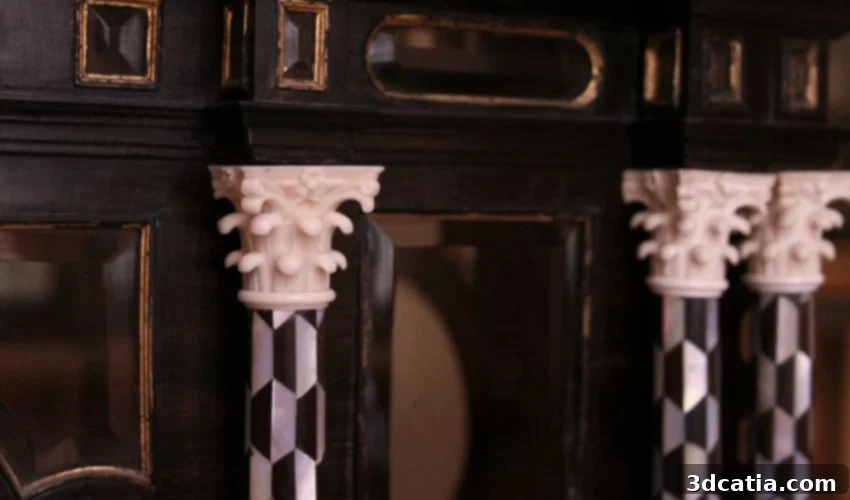
The impetus for the development of Digory originated from a very specific and challenging real-world conservation project: the restoration of a magnificent 17th-century shrine. This historically significant artifact, adorned with delicate ivory ornaments, is housed in a revered church in Mauerbach, Lower Austria. Over the centuries, due to age, environmental factors, or perhaps previous handling, some of its intricate ivory decorations had unfortunately been lost, detracting from its original splendor and historical integrity. The crucial question facing conservators and researchers was how to meticulously restore these missing elements without introducing new, ethically problematic ivory, or using alternative materials that would visibly compromise the shrine’s authentic appearance. As Jürgen Stampfl from the Institute for Materials Science and Technology at the Vienna University of Technology eloquently put it, “It is decorated with small ivory ornaments, some of which have been lost over time. The question was whether they could be replaced with 3D printing technology.” This posed a significant technical and aesthetic challenge, but it also presented a unique opportunity for innovation. It underscored the urgent need for a restoration material that could not only replicate the physical characteristics of ivory but also be precisely manufactured to fit the historical context of the artifact, leading directly to the pioneering research that would result in Digory. This critical case study provided the perfect testbed for demonstrating the potential of advanced additive manufacturing in the sensitive field of cultural heritage preservation.
Digory: A Scientific Marvel – Synthetic Resin with Unique Properties
The material “Digory” stands as a testament to interdisciplinary scientific collaboration, representing the culmination of extensive research and development efforts between TU Vienna and its innovative spin-off, Cubicure. This groundbreaking material was not conceived in a vacuum; its development significantly leveraged Cubicure’s profound expertise in ceramic materials, particularly those developed for highly specialized applications in dental technology. This background provided a robust foundation, allowing the team to draw parallels and adapt sophisticated material science principles to the unique requirements of ivory restoration. Digory is precisely formulated from a sophisticated synthetic resin base, meticulously blended with calcium phosphate particles and silicon oxide powder. These carefully selected components are critical to achieving Digory’s remarkable properties.
What truly sets Digory apart from previous alternatives is its ability to replicate one of ivory’s most distinctive aesthetic qualities: its subtle translucency. Unlike opaque plastics or other bone-based materials, Digory achieves a captivating, lifelike depth and glow. This crucial characteristic is made possible by the precise control over the amount and dispersion of calcium phosphate particles within the synthetic resin matrix. Through careful formulation, the team was able to engineer a material that allows light to penetrate and scatter in a manner strikingly similar to natural ivory. This translucency is not merely an aesthetic detail; it is an essential property that contributes significantly to the visual authenticity and overall aesthetic appeal of restored objects. The manufacturing process for Digory involves the highly precise stereolithography (SLA) 3D printing technique, where specific areas of the material are cured layer by layer using light, allowing for unparalleled accuracy and replication of intricate details. This fusion of advanced material science and cutting-edge additive manufacturing technology positions Digory as a revolutionary solution in the field of cultural heritage conservation, offering a truly convincing and ethically sound alternative for preserving our invaluable past.
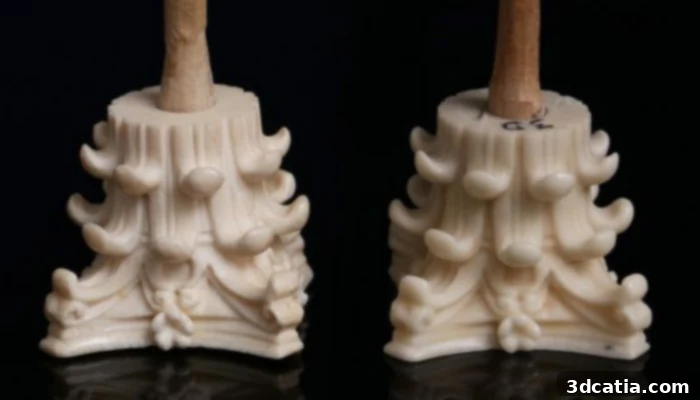
Confusingly similar: ivory on the left, Digory on the right (Photo Credit: TU Vienna)
The Precision and Versatility of SLA 3D Printing
The integration of stereolithography (SLA) 3D printing is not just an arbitrary choice but a critical component in Digory’s success, offering distinct advantages that are paramount in the sensitive field of cultural heritage restoration. SLA is renowned for its exceptional precision, allowing for the creation of incredibly intricate and fine details that would be exceedingly difficult, if not impossible, to achieve with traditional carving or molding techniques. When restoring historical artifacts, every millimeter matters. The ability to reproduce minute features, delicate curves, and complex geometries with sub-millimeter accuracy is indispensable for ensuring that a replacement part seamlessly integrates with the original object, maintaining its historical integrity and aesthetic harmony. Konstanze Seidler from Cubicure aptly noted, “With our specially developed 3D printing systems, we process different material formulations for very different areas of application, but this project was also something new for us.” This highlights the innovative nature of Digory’s development, even for a company at the forefront of additive manufacturing. She added, “In any case, it is further proof of how diverse the possible uses of stereolithography are.” Indeed, the application of SLA to such a niche but vital field demonstrates the technology’s remarkable versatility and potential for specialized custom manufacturing. This precision allows restorers to digitally scan existing fragments or historical documentation, accurately model the missing pieces, and then precisely print them, ensuring a perfect fit and an authentic appearance. For priceless artifacts, this level of customization and accuracy is not merely a convenience but a necessity, underscoring why 3D printing is poised to revolutionize restoration practices.
Beyond Printing: Achieving Aesthetic Perfection with Eco-Friendly Coloring
While 3D printing Digory allows for unparalleled structural and textural replication, achieving a truly authentic aesthetic for restoration involves a crucial post-processing step: coloring. Natural ivory, especially antique pieces, develops a unique patina and varied color structures over time due to exposure, aging, and environmental factors. Simply printing a piece, no matter how precisely, does not fully capture these nuances. To address this, the team behind Digory developed an ingenious and environmentally conscious coloring method. After the Digory parts are printed and cured, their color is meticulously reworked to perfectly match the aged and unique hues of the original ivory. The innovative solution? Common black tea. This inexpensive, readily available, and completely environmentally friendly coloring agent is used to stain the Digory components, allowing restorers to carefully adjust and blend the tones until they achieve a seamless integration with the existing artifact. This subtle tinting process is critical in ensuring that the restored sections are virtually indistinguishable from the original ivory, providing a truly “deceptively similar” result. The use of black tea not only highlights the team’s ingenuity in finding sustainable solutions but also ensures that the restoration process itself remains as non-invasive and eco-friendly as possible. This holistic approach, combining advanced material science, precision 3D printing, and thoughtful post-processing, underscores Digory’s potential to establish itself as the new high-quality standard for ivory substitutes in the conservation market. For those interested in delving deeper into the scientific and technical specifics of this remarkable project, the full paper is available HERE.
A New Era for Cultural Heritage Conservation
The advent of Digory marks a significant milestone in the field of cultural heritage conservation, ushering in a new era where ethical sourcing, advanced technology, and aesthetic fidelity converge. This innovative material, combined with the precision of SLA 3D printing, offers a sustainable and highly effective solution for preserving countless historical artifacts worldwide. For museums, churches, private collectors, and conservators, Digory provides a means to meticulously restore damaged ivory objects without contributing to the illegal ivory trade or compromising on visual authenticity. Its ability to reproduce fine details, achieve crucial translucency, and be cost-effectively processed for individual, custom parts makes it an invaluable tool for ensuring that our rich cultural legacy endures for future generations. The potential market establishment of Digory as a high-quality ivory substitute is not merely a commercial aspiration but a hopeful vision for a more responsible and technologically advanced approach to safeguarding human history.
Would you have recognized which part is made of ivory? Let us know in a comment below or on our Facebook, Twitter and LinkedIn pages! Sign up for our free weekly Newsletter here, the latest 3D printing news straight to your inbox!
* Cover picture credits: Archdiocese of Vienna