
Dental 3D Printing Resins Under Scrutiny: Northwestern Study Reveals Reproductive Toxicity Concerns
The rapid advancement of additive manufacturing has revolutionized various industries, particularly the medical and dental sectors, offering unparalleled precision and customization. However, a recent and critical study conducted by a team of researchers at Northwestern University has cast a shadow of concern over some of the very materials deemed “biocompatible” within these applications. While developing the first female reproductive tract on a chip, known as EVATAR, for sex-based ex vivo (outside of the organism) research, these scientists made a startling discovery: certain 3D printing resins widely utilized in dentistry might pose a significant, previously unrecognized threat to mammalian oocytes, commonly referred to as eggs, in vitro.
The research specifically identified considerable ovo-toxicity leaching from these ostensibly safe materials. This alarming finding strongly suggests an urgent need for more rigorous evaluation and scrutiny of the “biocompatible” materials currently available and approved for use. The implications of this study are far-reaching, potentially calling into question certain established uses of dental additive manufacturing and, more broadly, highlighting persistent obstacles related to the true biocompatibility and current certification processes for many resins on the market. This discovery underscores the critical importance of thoroughly understanding the long-term biological impact of materials that come into contact with human tissues, especially in sensitive medical and reproductive contexts.
The Booming Dental 3D Printing Market and Its Material Challenges
The dental 3D printing market is a burgeoning industry, projected to reach an impressive $9.7 billion by 2025, according to Grand View Research. This growth is driven by the technology’s versatile applications, which include the creation of precise 3D printed aligner trays, custom-made implants, intricate surgical guides, accurate molds for prostheses, and a variety of other patient-specific devices. A significant portion of these applications relies heavily on stereolithography (SLA) technology, a precision additive manufacturing process that uses photosensitive resins to build objects layer by layer. These resins, cured by light, are favored for their ability to produce highly detailed and smooth surfaces, making them ideal for the intricate demands of dental work.
Today, SLA resins are predominantly used in manufacturing molds for clear aligners, which are then thermoformed to create the final orthodontic appliance. However, the groundbreaking results emerging from Northwestern University’s research introduce a serious caveat to this widespread adoption. The study indicates that these supposedly inert resins could release chemical compounds capable of inducing severe toxicity in oocytes. This raises a crucial question that warrants immediate attention from manufacturers, regulatory bodies, and healthcare providers: Should we, as a society, be genuinely concerned about the extensive use of these resins in dental additive manufacturing, particularly given their potential impact on reproductive health?
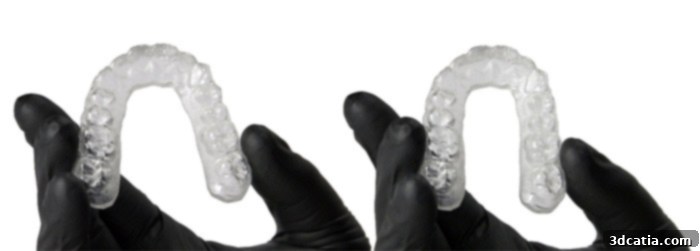
photo credit: EnvisionTec
Unpacking the Study: Oocyte Toxicity and “Biocompatible” Misconceptions
The Northwestern research team meticulously designed their experiment to evaluate the safety of materials intended for sensitive biological applications. They utilized two commercially available resins, marketed as “biocompatible,” to 3D print micro-physiological platforms. These platforms were integral to their efforts in accelerating the development of a prototype reproductive device. Given the extreme sensitivity of reproductive cells to even minute concentrations of leachable compounds, the researchers undertook a rigorous examination of the resins’ toxicity. This critical assessment involved an in vitro mouse oocyte maturation test, a well-established method for evaluating cellular health and developmental capacity.
The findings were unequivocal and deeply concerning. Oocytes cultured within the environment created by these 3D-printed pieces exhibited rapid degeneration. This stark result suggests that despite their “biocompatible” designation, these materials were actively releasing substances detrimental to cellular integrity and viability. Francesca Duncan, a co-author of the study and an Assistant Professor of Obstetrics and Gynecology at Northwestern University’s Feinberg School of Medicine, articulated the gravity of these results: “Our results are important because they demonstrate that leachates from commonly used materials in 3D printing slated as ‘biocompatible’ but that may have adverse effects on reproductive health. There is a critical need to better understand the identity and biological impact of compounds that leach from these materials.” This statement highlights a fundamental challenge: the existing definition and testing protocols for biocompatibility may not be comprehensive enough to capture all potential adverse biological effects, especially those affecting highly sensitive systems like the reproductive tract.
The term “biocompatible” itself, while reassuring, often implies a general lack of acute toxicity or inflammatory response, rather than a guarantee of complete inertness or harmlessness across all biological systems and long-term exposures. Many dental resins, for instance, are methacrylate-based polymers, which can contain unreacted monomers or degradation products that, when leached, can exert cytotoxic, genotoxic, or endocrine-disrupting effects. The Northwestern study provides compelling evidence that these hidden dangers are real and demand immediate attention.
From In Vitro to In Vivo: The Urgent Need for Further Research
It is important to acknowledge that, for the moment, this pioneering study primarily provides evidence of toxicity within an in vitro setting – a controlled laboratory environment outside of a living organism. While in vitro studies are invaluable for initial screening and mechanistic understanding, they cannot fully replicate the complexities of an entire biological system. Therefore, the next crucial step, and one that the researchers themselves emphasize, is to transition to in vivo studies. Investigating the impact of these materials within living organisms will be essential to ascertain whether the same detrimental effects on reproductive health are observed under real-world conditions.
This transition to in vivo research is not merely a scientific formality; it carries profound implications, particularly for the dental 3D printing sector. Dental devices and restorations crafted from these resins often have direct and prolonged contact with the delicate tissues of the mouth. The oral cavity is a highly vascularized environment, meaning any leached compounds could potentially be absorbed into the bloodstream and distributed throughout the body. This systemic exposure raises serious concerns about the potential for harmful impacts on women, particularly regarding reproductive health. The study’s findings necessitate a re-evaluation of how such materials are assessed for safety, especially considering the long-term presence of many dental prosthetics in patients’ mouths.
Francesca Duncan’s further commentary reinforces this urgency: “The results demonstrate reproductive toxicity should be a priority when characterizing all materials humans may come into contact with either in a medical setting or in their day-to-day lives.” This call to action extends beyond dentistry, urging a holistic approach to material safety for all products that interact with the human body. It suggests that current regulatory frameworks and testing standards, which may prioritize acute local reactions, might be falling short in identifying subtler yet profoundly impactful toxicities like those affecting reproductive health. Ensuring patient safety in an era of rapid technological innovation demands that such critical endpoints are explicitly included in material characterization protocols.
Addressing the Regulatory and Certification Gaps in Medical Materials
As the Northwestern study so powerfully illustrates, there remains a significant gap to be filled in the medical sector concerning comprehensive biocompatibility assessment and robust material certification. While regulatory bodies like the FDA in the United States or CE marking in Europe provide guidelines for medical device approval, the depth and breadth of biological testing required for “biocompatible” claims may need urgent reconsideration. Current certification processes often rely on standardized tests that might not adequately capture the nuances of reproductive toxicity, long-term leaching effects, or individual sensitivities.
The lack of transparency regarding the exact chemical composition of many proprietary resins further complicates this issue. Without detailed knowledge of monomers, photoinitiators, crosslinkers, and other additives, it becomes incredibly challenging for researchers and clinicians to predict or identify potential toxicological profiles. This calls for a collaborative effort among material scientists, reproductive biologists, toxicologists, and regulatory experts to develop new, more comprehensive testing paradigms that specifically address reproductive endpoints and potential systemic effects. Furthermore, manufacturers should be encouraged, and perhaps mandated, to provide more detailed compositional information, allowing for better risk assessment and the development of safer alternatives. The debate surrounding material safety and its impact on human health, especially reproductive health, is undoubtedly complex, but this study provides a clear impetus for moving this critical conversation forward.
The Path Forward: Enhanced Safety and Innovation
The findings from Northwestern University serve as a vital wake-up call, urging the additive manufacturing industry, healthcare providers, and regulatory bodies to prioritize patient safety with renewed vigor. The path forward must involve several key initiatives. Firstly, intensified research into truly inert and biologically friendly resins is paramount. This includes exploring novel polymer chemistries, bio-resorbable materials, and advanced post-processing techniques that effectively eliminate or significantly reduce the leaching of potentially harmful compounds. Secondly, regulatory agencies must adapt and evolve their certification processes to incorporate more rigorous and specific testing for reproductive toxicity and long-term systemic effects. This may require the development of new international standards that reflect the nuanced challenges posed by sophisticated modern materials.
Finally, there needs to be greater collaboration and transparency across the entire value chain – from raw material suppliers and resin manufacturers to device producers, clinicians, and academic researchers. Sharing data, best practices, and innovative solutions will accelerate the development of safer materials and ensure that the benefits of dental and medical 3D printing can be fully realized without compromising patient health. This study is not merely a warning; it is an opportunity to redefine what “biocompatible” truly means in the context of advanced medical applications, ensuring that technological progress is always aligned with the highest standards of human well-being.
If you want to learn more about the detailed results of this pivotal study, you can find the scientific paper HERE.
*Thumbnail photo credits: DETAX
What are your thoughts on this significant study and its potential impact on dental and medical 3D printing?
Do you believe current material certification processes are adequate, or is a fundamental shift needed?
Let us know your perspective in a comment below or connect with us on our Facebook and Twitter pages!
For the latest updates and news in the world of additive manufacturing, don’t forget to sign up for our free weekly Newsletter here, delivered straight to your inbox!