
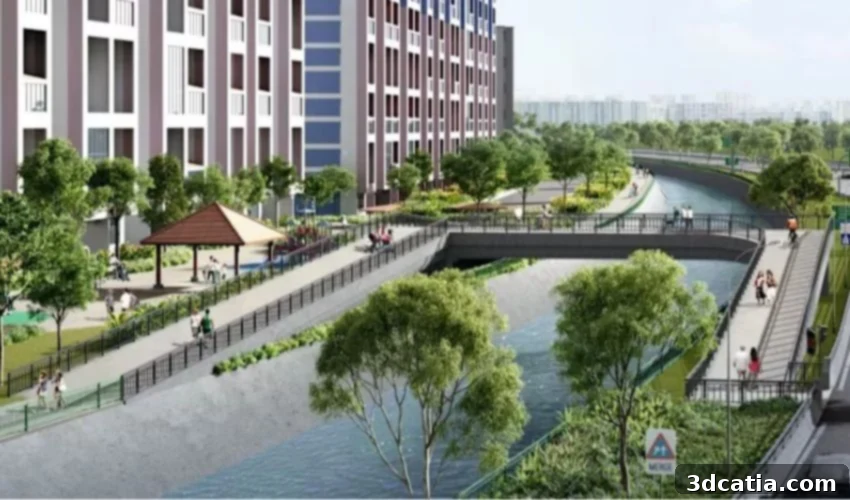
Singapore’s Groundbreaking 3D Printed Pedestrian Bridge: A Leap in Sustainable Construction
While its grand unveiling is still two years away, set for 2028, Singapore’s pioneering 3D-printed pedestrian bridge is already capturing global attention and generating significant buzz within the architectural, engineering, and technology communities. This ambitious project represents a significant leap forward in construction innovation, promising to redefine urban infrastructure development. Slated to span the Jurong River, this state-of-the-art bridge will serve a crucial function: seamlessly connecting two burgeoning new residential districts. This initiative is not merely about creating a pedestrian link; it’s a strategic response to contemporary challenges. At its helm are the Land Transport Authority (LTA), a key player in Singapore’s infrastructure advancement, and the Singapore Centre for 3D Printing at Nanyang Technological University (NTU), renowned for its cutting-edge research. Their collaboration aims to directly address critical labor shortages that have long plagued the construction industry, showcasing 3D printing as a viable and revolutionary solution.
The development of this remarkable structure is the culmination of extensive dedication and investment. The bridge itself is meticulously designed to be 10 meters long and 5 meters wide, providing ample space for pedestrians and cyclists navigating between the new residential hubs. This project’s journey began in January 2023, following several years of intensive research and development, backed by a substantial investment exceeding $1.4 million. This financial commitment underscores Singapore’s serious intent to push the boundaries of conventional construction. A pivotal aspect of this innovation is the proprietary material developed for the bridge: a specialized mixture of concrete, sand, and water. This unique blend has been carefully formulated to allow for precise extrusion by a sophisticated robotic arm, ensuring structural integrity and design flexibility previously unimaginable with traditional methods. The use of robotic additive manufacturing ensures unparalleled precision, material efficiency, and consistency in the fabrication process, setting a new standard for infrastructure projects.
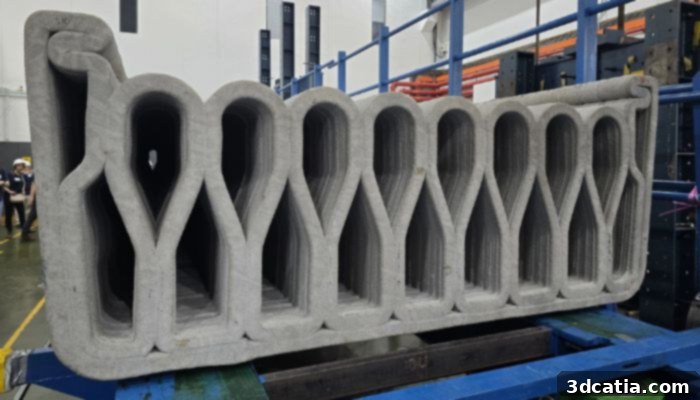
The future bridge will be made up of several 3D printed blocks (photo credits: Kok Hun Goh)
Modular Construction: Revolutionizing Efficiency and Labor Dynamics
One of the most innovative aspects of this 3D-printed pedestrian bridge lies in its modular construction methodology. The entire structure is ingeniously composed of 10 distinct segments, or blocks, each individually 3D printed off-site before being transported and assembled at the construction location. This pre-fabrication approach offers significant advantages in terms of quality control, speed, and reduced on-site disruption. Remarkably, each of these substantial segments requires only four hours of printing time, a testament to the efficiency of advanced additive manufacturing technologies. This rapid production rate translates directly into significant operational benefits, including an impressive 50% reduction in labor requirements compared to traditional construction techniques for similar structures. Such a dramatic decrease in manual labor not only addresses the pressing industry-wide shortages but also enhances worker safety by moving hazardous tasks to a more controlled factory environment.
The assembly of these printed blocks is a critical phase, designed for both strength and durability. The segments are engineered to interlock seamlessly, creating a robust and cohesive structure. This interlocking mechanism is further reinforced by the strategic use of high-strength steel cables, which are threaded through the blocks and tensioned to provide exceptional structural integrity. While the specific duration for this final assembly stage has not yet been detailed, the inherent advantages of modular design suggest a significantly expedited on-site construction timeline compared to building a bridge from scratch using conventional methods. This approach minimizes site impact, reduces noise and traffic disruptions, and accelerates project completion, showcasing a paradigm shift in how urban infrastructure can be rapidly and efficiently deployed.
Unlocking the Potential of 3D Concrete Printing in Modern Infrastructure
This pioneering project serves as compelling, tangible proof of the myriad advantages offered by 3D concrete printing technology in the realm of construction. Beyond mere efficiency, additive manufacturing opens up unprecedented possibilities in design and execution. One of its most celebrated benefits is the allowance for significantly greater geometric freedom. This means architects and engineers are no longer confined to conventional shapes and forms, enabling the creation of intricate, aesthetically pleasing, and functionally optimized structures that would be incredibly complex, expensive, or even impossible to achieve with traditional casting or formwork methods. Imagine organic designs, optimized structural elements, and integrated features that enhance both form and function – all made possible through layer-by-layer printing.
Furthermore, 3D concrete printing profoundly optimizes both costs and labor. By precisely depositing material only where it is needed, waste is dramatically reduced, leading to significant material savings. The automation inherent in the printing process also cuts down on manual labor requirements, as demonstrated by the 50% reduction in labor for the bridge segments. This not only mitigates the impact of skilled labor shortages but also allows human resources to be reallocated to more specialized or supervisory roles, increasing overall project value and safety. From a financial perspective, faster construction times, reduced material waste, and lower labor overheads contribute to substantial cost efficiencies throughout the project lifecycle. This dual optimization of resources positions 3D concrete printing as a highly attractive solution for future construction endeavors, especially in urban environments with tight schedules and escalating costs.
Crucially, this bridge project is intended to serve as a vital testbed for the feasibility and robustness of the technology in real-world applications. It’s an ambitious experiment designed to push boundaries and gather invaluable data. If the trials and subsequent performance of the full-scale bridge prove successful and meet stringent engineering standards, Singapore stands to gain immense confidence in this technology. This success would undoubtedly pave the way for discovering and implementing a multitude of other applications across the city-state’s infrastructure landscape. Potential future uses could range from quickly deploying affordable housing units and creating bespoke urban furniture to constructing complex drainage systems, retaining walls, or even components for larger public buildings. Singapore, known for its forward-thinking approach, could cement its position as a global leader in adopting and integrating advanced manufacturing techniques into its urban development strategy, inspiring other nations to follow suit.
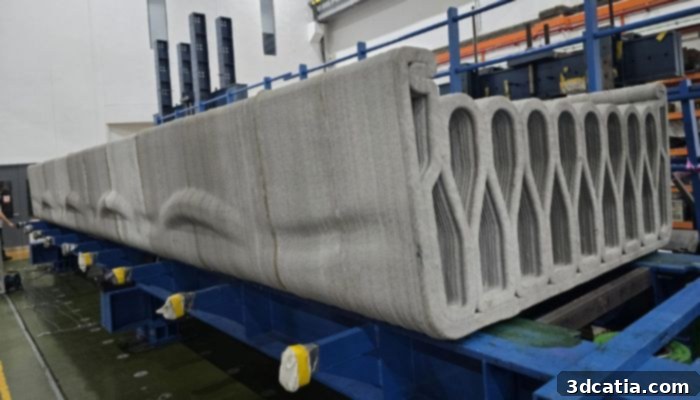
The different blocks are assembled using steel cables (photo credits: Kok Hun Goh)
Rigorous Testing and Validation: Ensuring Safety and Structural Integrity
Before embarking on the full-scale construction of the pedestrian bridge, the dedicated teams at the LTA and NTU recently completed a critical phase of rigorous testing on a meticulously crafted scale model. This essential step is paramount in validating design theories and ensuring the utmost safety for future public use. Just a few days prior, a smaller version of the bridge, scaled to only 2.5 meters wide, was precisely 3D printed and subjected to an exhaustive battery of tests. To evaluate its performance under immense stress, eighteen tanks, each filled with a substantial one ton of water, were strategically placed on the model bridge. This formidable load, totaling 18 tons, was applied to thoroughly assess the structure’s resilience and its ability to withstand significant weight, simulating real-world conditions far beyond typical pedestrian loads. The evaluation focused primarily on key performance indicators such as safety, deflection, and overall structural strength, ensuring that the innovative design could reliably meet stringent engineering benchmarks.
The LTA provided further insight into this critical validation process, emphasizing their commitment to safety and precision:
“Testing of the scale model has been completed, and data collected from the sensors will now be analysed to validate theoretical design calculations and to ensure structural integrity. If results are favourable, we will proceed to construct the full-size bridge, which will undergo similar assessments before opening.”
This statement highlights the meticulous, data-driven approach underpinning the project. Every aspect of the model’s behavior under stress has been captured by an array of sensors, providing a rich dataset for comprehensive analysis. This data will be crucial in cross-referencing against complex theoretical design calculations, ensuring that the bridge’s real-world performance aligns with engineering predictions. The primary goal is to conclusively verify the structural integrity of the 3D-printed design, a non-negotiable requirement for any public infrastructure. Only upon favorable outcomes from this rigorous analysis will the project advance to the construction of the full-size bridge. Furthermore, the LTA confirmed that the completed full-size structure will itself undergo an equally stringent series of assessments before it is officially opened to the public, demonstrating an unwavering commitment to safety and quality at every stage of this groundbreaking endeavor.
The Future of Construction: Singapore Leading the Way with 3D Printing
This 3D-printed pedestrian bridge is more than just a piece of infrastructure; it’s a powerful symbol of innovation and a tangible example of Singapore’s dedication to embracing advanced technology for urban development. By spearheading such a project, Singapore is not only addressing its specific challenges but also positioning itself as a global leader in intelligent, sustainable, and efficient construction practices. The successful implementation of this bridge could serve as a blueprint for future projects worldwide, demonstrating how additive manufacturing can revolutionize the construction sector by offering solutions to labor shortages, environmental concerns, and the demand for more complex and resilient designs. It signifies a shift towards a more automated, precise, and resource-efficient future for civil engineering.
We are thrilled to keep you updated on the continued progress of this extraordinary project, from the ongoing data analysis to the eventual construction and grand opening of the full-size bridge. This journey represents a fascinating intersection of engineering, technology, and urban planning, and your insights are incredibly valuable. In the meantime, we invite you to share your comments and perspectives with us. What are your thoughts on the transformative role of 3D concrete printing in the construction sector? How do you foresee such technologies shaping our cities and communities? Please feel free to engage with us in the comment section below, or join the discussion on our vibrant LinkedIn or Facebook pages! Furthermore, to ensure you never miss out on the latest advancements and news from the world of additive manufacturing, don’t forget to sign up for our free weekly Newsletter, delivering cutting-edge 3D printing news directly to your inbox. You can also explore all our insightful videos and project showcases on our YouTube channel for a visual journey into the future of 3D printing. Your engagement helps foster a community dedicated to innovation and the advancement of construction technology.
*Cover Photo: Illustration of the future 3D printed bridge installed in Singapore (credits : LTA)