
Experience Ultimate Cycling Comfort: The VAEN 3D Printed Bike Saddle by Vasi Ganea
For any dedicated cyclist, the bike saddle is arguably the most crucial point of contact with their machine. It’s a component that can make or break a ride, dictating not just performance but also comfort and endurance. Traditionally, finding the perfect saddle has been a quest filled with trial and error, often leading to discomfort, pressure points, and even pain. However, thanks to the innovative vision of designer Vasi Ganea, a significant leap forward in cycling ergonomics has been made. Ganea has introduced the groundbreaking VAEN bike seat, a product born from the capabilities of advanced 3D printing technology, promising a new era of personalized comfort and peak performance for cyclists worldwide.
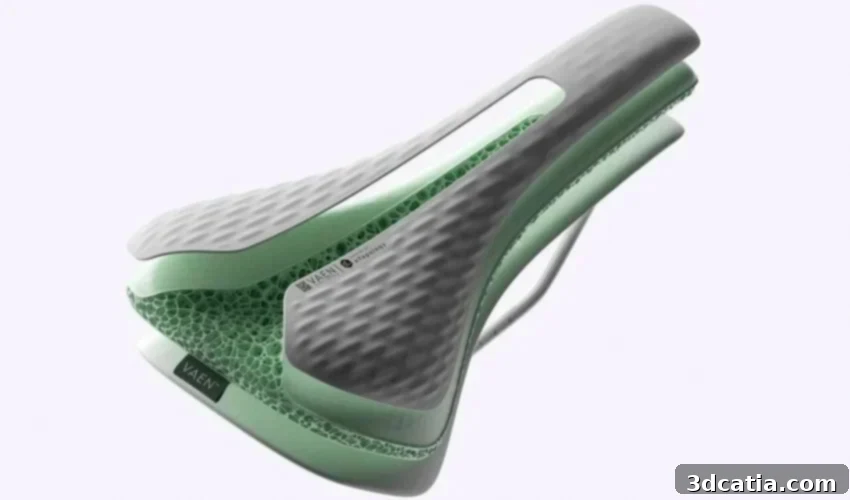
The VAEN saddle stands out immediately with its distinctive and original design. Its structure, entirely brought to life through sophisticated 3D printing processes, features an organic lattice foam. This intricate design is reminiscent of a Voronoi diagram – a geometric concept often found in natural patterns – which not only gives the saddle a visually striking appearance but also contributes functionally to its performance. Composed of several meticulously engineered layers, the VAEN saddle is not just a standard off-the-shelf product; it is a highly customizable solution. Available in a variety of colors, it promises to deliver unparalleled comfort while crucially reducing the notorious pressure peaks that often plague cyclists during long rides.
The integration of additive manufacturing, more commonly known as 3D printing, into the cycling industry is rapidly becoming one of the most exciting trends of the year. Innovative projects leveraging this technology are emerging with increasing frequency, transforming how components are designed, manufactured, and ultimately experienced by riders. While discussions earlier this week revolved around groundbreaking all-wheel-drive bicycles, our focus now shifts to one of the most fundamental yet often problematic components: the saddle. The concept of a 3D printed bike saddle is not entirely new, but its application is continuously being refined. The inherent advantages of 3D printing – such as the ability to create complex geometries, optimize material usage, and achieve significant weight reduction – are perfectly suited for enhancing cycling performance and rider comfort. Industry leaders like Specialized have already embraced this technology as a cornerstone of their product development, showcasing the immense potential it holds.
The initiative by Spanish designer Vasi Ganea is particularly promising because it addresses a critical aspect of cycling comfort: personalization. The VAEN saddle’s adjustability, tailored precisely to the individual cyclist’s needs and unique pressure mapping, represents a paradigm shift from conventional manufacturing approaches. This level of bespoke engineering was previously unattainable or prohibitively expensive, making cutting-edge ergonomic solutions accessible to a broader audience of cycling enthusiasts.
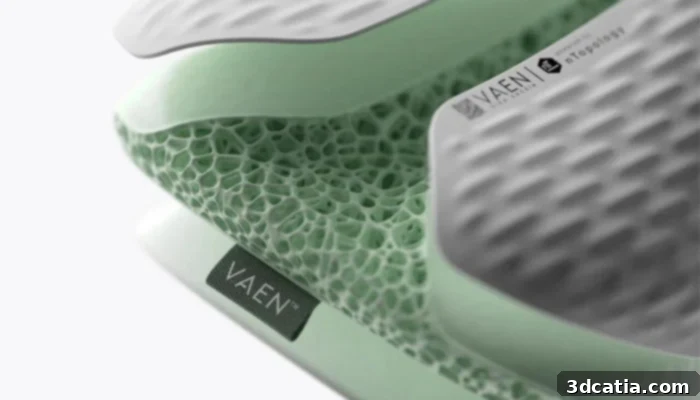
The middle layer has been topologically optimized (photo credits: Vasi Ganea)
Ganea’s inspiration for the VAEN saddle draws deeply from nature itself. He meticulously studied organic shapes and structures, seeking to reproduce their inherent efficiency and resilience in his design, which directly led to the development of the distinctive lattice foam structure. This bio-inspired approach isn’t just aesthetic; it’s fundamental to the saddle’s functional superiority. The VAEN saddle is ingeniously composed of three distinct layers, each crafted from different materials to provide specialized performance characteristics for specific areas, ensuring a holistic solution for rider comfort and support.
The outer layer, which is the immediate contact surface for the cyclist, is designed to address critical needs such as friction management, overall comfort, and breathability. This layer can be manufactured using various methods, including injection molding, cutting, or even 3D printing, allowing for flexibility in material choice to optimize for specific properties like durability, tactile feel, and airflow. The thoughtful design of this layer minimizes chafing and heat buildup, crucial factors for maintaining comfort, especially during extended rides.
Beneath this, the middle layer is engineered primarily for shock absorption – a vital function for mitigating road vibrations and impacts. This particular layer is a testament to the power of advanced manufacturing, as it is 3D printed from a highly flexible material. What makes it truly innovative is its topological optimization. Topological optimization is an algorithmic design process that creates the most efficient structure possible for a given set of loads and constraints, often resulting in complex, organic-looking lattice structures. For the VAEN saddle, this process ensures that the middle layer absorbs shocks effectively while distributing pressure evenly across the rider’s sit bones, leading to a significantly smoother and more comfortable experience. The lattice structure maximizes cushioning and rebound properties without adding unnecessary bulk or weight, striking a perfect balance between support and shock mitigation.
Finally, the third and innermost layer forms the hard base of the saddle. This foundational component is designed for paramount strength and structural integrity. It can be produced through injection molding or, for maximum performance and weight savings, 3D printed using carbon fiber reinforced materials. The objective here is to create an exceptionally robust and rigid layer that can withstand the rigors of cycling, provide stable support for the other layers, and efficiently transfer power from the rider to the bike. The use of carbon fiber composites ensures that this base layer is not only incredibly strong but also remarkably lightweight, contributing to the overall performance benefits of the VAEN saddle.
Vasi Ganea’s innovative approach extends far beyond mere material selection; it delves into the very core of the manufacturing process and design philosophy. He eloquently describes this advanced methodology: “As if it were an organic growth, we algorithmically design a lattice structure generated from the unique pressure map of each cyclist to achieve density variations that guarantee maximum comfort by reducing pressure peaks. Ergonomic means comfortable and completely customizable in VAEN, we believe that more progressive customization will be the future of saddle ergonomics, and 3D printing will play a key role in that regard.” This statement highlights the profound impact of data-driven design in creating truly personalized cycling gear. By analyzing an individual’s unique pressure points and applying sophisticated algorithms, the VAEN saddle is precisely engineered to distribute weight optimally, significantly reducing discomfort and enhancing performance. This vision underscores a future where cycling components are not mass-produced in a ‘one-size-fits-all’ manner, but rather crafted specifically for each rider, utilizing the precision and flexibility that only 3D printing can provide.
The implications of such a tailored approach are vast. For competitive cyclists, it means marginal gains in comfort directly translate to improved power output and endurance. For casual riders, it transforms uncomfortable rides into genuinely enjoyable experiences, encouraging more time on the bike. The ability to create density variations within the lattice structure, based on individual biometric data, is a game-changer. It allows for softer zones where pressure is high and firmer zones where support is needed, creating a dynamic and adaptive surface that responds to the rider’s body in real-time. This level of personalization is a testament to Vasi Ganea’s commitment to pushing the boundaries of cycling ergonomics, firmly establishing VAEN as a pioneer in the field.
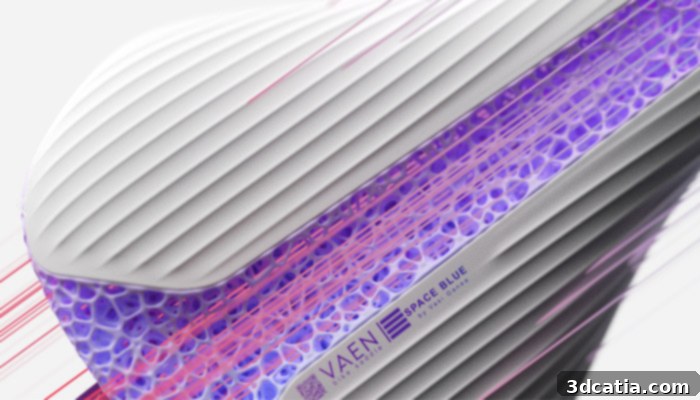
The bike saddle is available in 5 colors (photo credits: Vasi Ganea)
Beyond its technical sophistication and ergonomic superiority, the VAEN 3D printed bike seat also allows for aesthetic customization. Recognizing that cyclists often want their equipment to reflect their personal style, the saddle is available in a vibrant palette of 5 distinct colors: classic black, energetic yellow, sleek glass (perhaps a translucent or clear option), calming blue, and bold orange. This range of options ensures that functionality doesn’t come at the expense of style, allowing riders to personalize their bike setup even further. This marriage of advanced engineering with design aesthetics makes the VAEN saddle a truly desirable upgrade for any cyclist looking to elevate their riding experience.
The VAEN 3D printed bike saddle represents more than just a new product; it signals a significant shift in the entire cycling industry. It demonstrates the immense potential of additive manufacturing to create highly personalized, performance-enhancing, and remarkably comfortable components. As 3D printing technology continues to advance, we can expect to see even greater levels of customization and innovation, making the future of cycling ergonomics incredibly exciting. To discover more detailed information about this revolutionary project and its specifications, you can visit the official VAEN saddle website HERE. We invite you to share your thoughts on this groundbreaking innovation in the comments section below or engage with us on our social media platforms. Join the conversation on our Linkedin, Facebook, and Twitter pages. Don’t forget to sign up for our free weekly Newsletter here to receive the latest 3D printing news directly to your inbox! You can also find all our compelling videos and content on our YouTube channel, offering deeper dives into the world of additive manufacturing.