
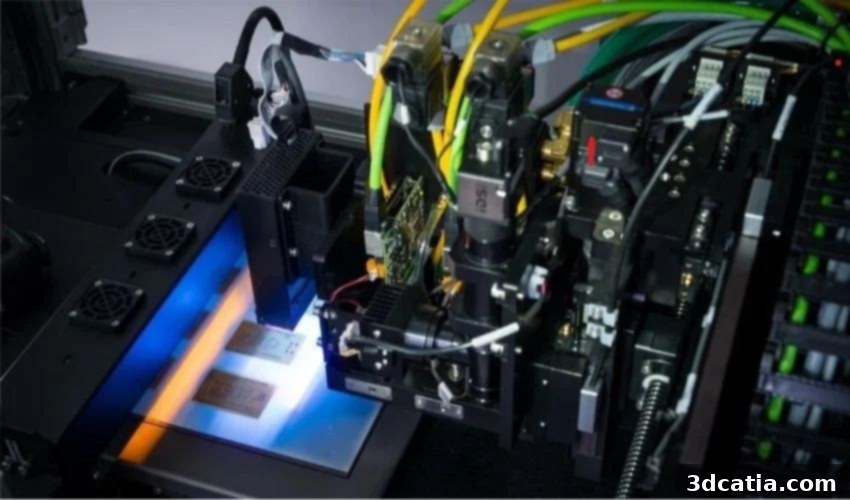
Revolutionizing Additive Manufacturing: LEAM’s DEMEX System Unleashes Unprecedented Strength in 3D Printed Parts
The journey from groundbreaking scientific research to a tangible, market-ready solution is often long and arduous. For LEAM, a dynamic spin-off from the prestigious Technical University of Munich (TUM), this path has culminated in the innovative DEMEX system, a technology poised to redefine the capabilities of additive manufacturing. This pioneering company emerged directly from the university’s research foundation, leveraging a novel approach to material processing in 3D printing. Unlike conventional methods that rely on lasers to melt material, LEAM’s DEMEX system employs a continuous light spectrum to precisely heat the material just before it exits the nozzle. This targeted, pre-nozzle heating technique ensures superior adhesion between printed layers, a critical factor for the structural integrity of 3D printed components. The DEMEX system is ingeniously designed as an add-on module, seamlessly integrating with existing large-format 3D printers, thereby enhancing their performance and expanding their material compatibility. This young yet ambitious enterprise has already garnered significant attention, securing its first customers and validating its transformative potential in the industrial landscape. We recently had the opportunity to engage with the LEAM team to delve deeper into the origins of their company, the intricate details of their technology, the pivotal milestones they’ve achieved, and their ambitious plans for the future of 3D printing.
The Genesis of Innovation: How LEAM’s Founders Embraced 3D Printing
The three visionary founders of LEAM – Patrick Consul, Ting Wang, and Benno Böckl – share a common thread: a profound and long-standing fascination with 3D printing. Their journey into this transformative technology began during their academic pursuits in mechanical engineering and their subsequent roles as collaborating scientists at the Chair of Carbon Composites (LCC) at the Technical University of Munich, where their paths first converged. Each brought a unique perspective and area of expertise that would ultimately contribute to the development of the DEMEX system.
Patrick Consul, for instance, had already encountered the limitations of traditional 3D printing during his Master’s thesis. He was attempting to 3D print intricate PEEK (Polyether Ether Ketone) cores destined for high-performance aerospace structures. At that time, achieving the requisite mechanical strengths for such demanding applications proved impossible with existing 3D printing techniques, highlighting a significant hurdle in the widespread adoption of additive manufacturing for critical parts. Undeterred, Patrick continued to pursue this challenging theme with vigor from 2017 onwards, taking on the role of a scientific collaborator at the esteemed Carbon Composites Chair. Over the subsequent years, he initiated and managed several research projects specifically aimed at overcoming these material and structural limitations in 3D printing, laying much of the conceptual groundwork for what would become LEAM’s core technology.
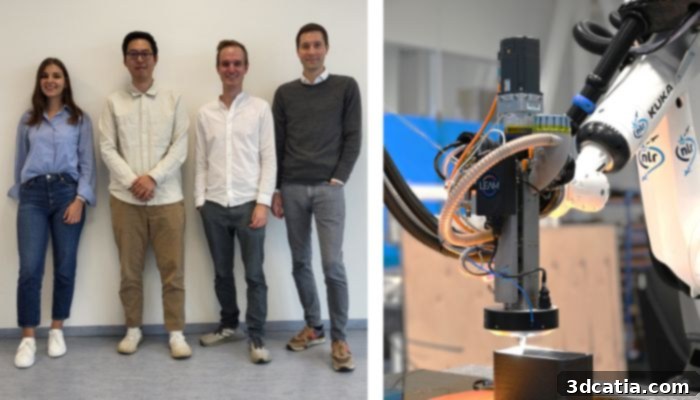
On the left, the LEAM team; on the right, the DEMEX system, a breakthrough in additive manufacturing technology.
Ting Wang’s research significantly complemented Patrick’s efforts. As a dedicated research associate, Ting focused on a crucial aspect: the precise and targeted heating of the substrate material to achieve superior bonding with the newly deposited layer. Her meticulous preparatory work and experimental investigations provided the foundational insights and practical demonstrations that were instrumental in the subsequent design and development of the DEMEX system. Her work directly addressed the persistent challenge of anisotropic material properties in 3D printed parts, where strength in the Z-direction (layer adhesion) often lagged behind strength in the XY-plane.
Benno Böckl also contributed his expertise, having spent several years as a research associate at the same Chair of Carbon Composites. His area of interest revolved around the automated fiber placement process, particularly for the manufacturing of advanced carbon fiber components. This process, while distinct from traditional extrusion-based 3D printing, shares certain fundamental similarities, especially concerning material deposition, localized heating, and controlled layer formation. Benno’s understanding of complex composite manufacturing processes provided valuable cross-disciplinary insights into material handling and structural optimization. Thus, the LEAM team’s collective immersion in cutting-edge scientific research at TUM provided them with an unparalleled understanding of the inherent challenges within 3D printing. This deep scientific foundation was critical, empowering them to conceive and develop innovative solutions that truly unlock new possibilities for 3D printing, enabling the production of parts with previously unattainable levels of mechanical performance and reliability.
From Lab to Market: The Key Milestones in LEAM’s Journey
The formation of LEAM as a commercial entity was a direct result of extensive scientific inquiry and a clear vision to bridge the gap between academic research and industrial application. Patrick Consul’s exhaustive research projects at TUM explored a multitude of approaches aimed at significantly enhancing layer adhesion and, consequently, the overall strength of components produced through extrusion 3D printing. Through this rigorous investigation, a fundamental principle emerged with undeniable clarity: the most promising and effective strategy involved precisely heating and melting the underlying layer at the optimal moment of new material deposition. This insight became the cornerstone of LEAM’s patented technology.
Ting Wang then translated this theoretical understanding into practical experimentation. As part of a dedicated research project, she diligently investigated this approach and successfully developed the very first prototype of what would evolve into the DEMEX system. Initially, this prototype utilized lasers as its energy source, and while it yielded highly promising results in terms of improved layer bonding, a critical commercialization challenge quickly became apparent. The inherent costs associated with laser technology, coupled with the extensive safety equipment and protective measures required for its industrial application, made the proposed product financially unfeasible and unprofitable. This practical limitation spurred the team to rethink their energy source. This pivotal moment led to the innovative idea of replacing lasers with broad-spectrum white LEDs. LEDs presented a vastly superior alternative: they are inherently much safer to operate, significantly more cost-effective than comparable laser systems, and offer flexible control. Preliminary tests with LEDs confirmed their viability and demonstrated their ability to achieve the desired localized heating effects. Armed with this validation, the founders made the strategic decision to establish a company dedicated to commercializing this revolutionary system as a product.
A crucial step in LEAM’s establishment and early growth was the successful acquisition of a grant as part of the prestigious EXIST Transfer of Research program. This vital funding provided the financial runway for the initial 18 months of operation, enabling the team to formalize LEAM as a company, build essential infrastructure, and expand their development efforts. Further validation and support came last year with a pledge from the ESA Business Incubation Centre (BIC) Bavaria, an initiative that actively nurtures promising space-related and high-tech startups. Another monumental achievement was the successful completion of the first proof-of-concept with a paying customer. This not only unequivocally demonstrated the efficacy and reliability of the DEMEX system in a real-world industrial setting but also underscored the immense market potential for such a solution. Following this success, LEAM was able to secure its first sales and subsequently install these pioneering systems at customer sites. Recognizing the increasing demand and complexity of their work, the company took another significant step in the middle of last year by hiring its first full-time employee, a dedicated development engineer, marking LEAM’s evolution into an employer. Most recently, LEAM successfully filed a comprehensive patent application for its core technology, a critical strategic move that secures the company’s intellectual property and is decisive for its long-term future and competitive advantage in the additive manufacturing market.
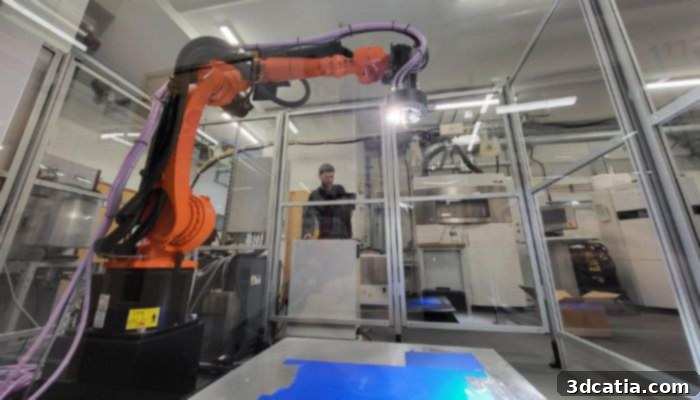
LEAM has registered a patent for its DEMEX system, securing its innovative approach to 3D printing.
The DEMEX System: Unpacking the Technology and Its Game-Changing Advantages
The LEAM DEMEX system represents a paradigm shift in extrusion-based 3D printing. It is not a standalone printer but rather a sophisticated, complementary add-on module specifically engineered to augment the performance of large-format 3D printers. The core of its innovative design lies in its integrated array of high-power LED emitters and precision infrared cameras, strategically positioned around the printer’s extruder nozzle. This synergistic combination allows the DEMEX system to achieve an unprecedented level of control over the printing process.
Utilizing its powerful LED emitters, the DEMEX system meticulously heats the underlying substrate material in a highly targeted and localized manner, precisely in front of where the new filament is being extruded. This pre-heating is not merely a superficial warming; it actively melts the surface of the previous layer, creating a fresh, receptive interface. When the new molten material is deposited onto this prepared surface, it fuses intimately, guaranteeing a perfect, molecular-level weld between the layers. This process effectively eliminates the weak points traditionally associated with layer boundaries in 3D printing. To ensure optimal performance, a sophisticated closed-loop control circuit, powered by the integrated infrared cameras, continuously monitors the temperature of the heated zone. This real-time feedback mechanism allows the DEMEX system to dynamically adjust the LED output, ensuring that the desired target temperature is consistently reached and maintained throughout the entire printing process. This precise thermal management is what fundamentally transforms the mechanical properties of the printed part.
The impact of this technology on material strength is nothing short of revolutionary. Where traditional extrusion 3D printing could only achieve a maximum Z-axis resistance of approximately 60% relative to the material manufacturer’s data sheet (due to weak layer adhesion), the DEMEX system empowers a printed workpiece to reach a full 100% of the specified resistance – and crucially, in all directions! This isotropic strength opens up an entirely new realm of applications for 3D printing, especially for parts subjected to high mechanical stresses. Furthermore, the DEMEX system dramatically expands material compatibility. It now makes it feasible to use materials of much lower quality, such as standard injection-molding grades of polymers, which were previously considered totally unsuitable for 3D printing due to their inability to achieve adequate layer adhesion. This capability significantly broadens the material palette available to additive manufacturing, potentially reducing material costs and enabling the use of proven industrial-grade compounds.
Another critical advantage is the seamless integration and ease of use. The DEMEX system establishes direct communication with the main printer controller. This intelligent link ensures that the DEMEX system always has real-time information about the printer’s movement direction and the specific area requiring localized heating. This intelligent coordination means that designers and engineers do not need to account for the heating process when creating the G-code; the DEMEX system operates autonomously and adaptively, thereby not disrupting the printer’s established operating processes or workflow. This “set it and forget it” functionality streamlines industrial additive manufacturing.
Distinct Advantages Over Conventional 3D Printing Processes
Our technology directly addresses and elegantly solves several common and persistent problems that plague conventional 3D printing methods. One prevalent approach to improving layer adhesion involves utilizing heated print chambers. While seemingly straightforward, this method presents significant disadvantages, particularly for printing tall or complex geometries. The uniform heating of an entire chamber means that the temperature cannot be independently controlled at different heights within the print volume. If the temperature is too high, the entire part can become thermally unstable, leading to warping, sagging, or even complete collapse during the printing process. This fundamental limitation is entirely circumvented by our DEMEX system. Since we only heat a very thin, highly localized layer on the surface, precisely in front of the nozzle, we can safely exceed the bulk melting temperature of the material without compromising the overall structural integrity of the part. This ability to achieve localized superheating is what enables the dramatically higher mechanical resistances.
Another common technique involves the use of infrared emitters, either distributed throughout the printing area or installed locally on the nozzle. However, these infrared (IR) emitters suffer from a crucial drawback: very long reaction times, typically ranging from one to three seconds. This sluggish response makes it incredibly difficult, if not impossible, to achieve the dynamic and precise adjustments necessary for real-time, layer-by-layer temperature control, especially with varying print speeds and geometries. In stark contrast, the power output of our advanced LED-based system can be adjusted with millisecond precision. This instantaneous response allows for unparalleled control over the thermal input, perfectly synchronized with the printer’s movement. Furthermore, the power density achievable with our LED emitters is significantly higher than that of most conventional infrared emitters, allowing for more intense and localized heating when required.
Beyond performance, our LEDs offer a clear and compelling price advantage over laser-based heating systems. Firstly, the LED energy sources themselves are approximately 90% cheaper than a comparable laser system designed for similar heating capabilities. This substantial upfront cost saving is only part of the equation. Secondly, and perhaps even more significantly, the stringent and expensive protective devices typically required for operating high-power lasers are almost entirely eliminated with our LED-based system. For large-format 3D printers, these safety enclosures and interlocks alone can cost more than the entire DEMEX system we offer, making the overall economic proposition of LEAM’s technology incredibly attractive and accessible to a broader range of industrial users.
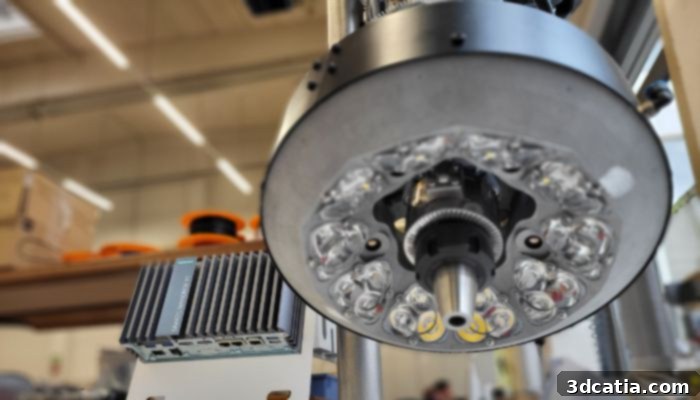
With DEMEX, LEAM utilizes advanced LEDs for heating, offering rapid adaptability and a significant cost advantage over laser systems.
Targeted Impact: Who Benefits Most from the DEMEX System?
The transformative advantages of the DEMEX system are most pronounced and impactful in specific industrial applications and material contexts. Primarily, it is designed for industries and users who work with high-performance plastics or require the production of very large components. Sectors such as aerospace and defense, as well as the oil and gas industries, stand to benefit immensely. In these critical fields, the problems that LEAM’s technology solves – namely, poor layer adhesion and anisotropic mechanical properties – have the most profound and costly consequences. Consider, for example, the production of a large, complex component for an aircraft or an offshore oil platform. If such a part were to fail during the traditional 3D printing process due to delamination or insufficient strength, it would be rendered scrap, incurring costs that could easily run into the thousands or even tens of thousands of dollars, not to mention the loss of valuable production time. With the robust layer bonding ensured by the DEMEX system, printing can be reliably continued even after unexpected interruptions, as the integrity of the connection with the lower layers remains fully assured, drastically reducing material waste and production risk.
Beyond these high-stakes industries, the DEMEX system is also exceptionally well-suited for any sector utilizing engineering plastics or fiber-reinforced polymers where structural integrity is paramount. In principle, anyone who needs to print parts that will be subjected to significant mechanical stresses, and for whom the strengths achievable with existing 3D printing technologies have proven insufficient, will find immense value in the DEMEX system. This includes, but is not limited to, heavy industries such as shipbuilding, where robust, corrosion-resistant components are essential; rail vehicle construction, demanding durable parts capable of withstanding constant vibration and load; and the automotive industry, which continually seeks lighter, stronger, and more efficiently produced components for both internal and external applications. By enabling the production of truly isotropic and high-strength parts, LEAM is unlocking a new era of industrial additive manufacturing.
Pioneering Projects: LEAM’s Journey in Action
The initial installations of our DEMEX systems marked incredibly exciting and validating milestones for LEAM. The very first DEMEX unit was successfully installed at NLR, the esteemed Dutch Aerospace Centre, which serves as the equivalent of Germany’s own German Center for Aeronautics and Aerospace (DLR). This placement at a leading research institution underscored the scientific rigor and industrial relevance of our technology. Shortly thereafter, we had the privilege of commissioning our second system at the University of Exeter in England, further solidifying our presence within academic and research communities dedicated to advanced manufacturing. These early projects not only demonstrated the system’s operational readiness but also provided invaluable feedback from pioneering users.
However, it’s not just these foundational installations that have proven exciting; our current projects continue to push the boundaries of what’s possible. We are consistently surprised and energized by the diverse and often unexpected requests that emerge from sectors we initially hadn’t considered. For example, we are currently engaged in promising discussions with potential customers in the construction sector, where the ability to reliably print large-scale, high-strength polymer components could revolutionize structural applications and material efficiency. Even more uniquely, we’ve had inquiries from individuals interested in applying our technology to fish farming, potentially for creating durable, customizable underwater structures or specialized filtration systems. Such varied interest truly highlights the broad applicability and versatility of the DEMEX system, demonstrating that its potential is virtually limitless across a wide spectrum of industries.
Looking Ahead: LEAM’s Vision for the Future of 3D Printing
Our immediate strategic focus at LEAM is centered on expanding the accessibility and utility of our groundbreaking DEMEX system. The next significant step we are actively pursuing is to adapt our technology to be compatible with smaller 3D printers. Currently, the DEMEX system is primarily designed for and utilized with large-format 3D printers, largely due to certain physical space and integration requirements. However, we have received numerous requests and recognized a significant market demand for our technology on more compact, desktop, and mid-sized industrial filament printers. To meet this demand, our dedicated engineering team is diligently working on reducing the physical size of various components within the DEMEX system. Our ambitious goal is to be ready to equip a broader range of filament printers with the DEMEX system later this year, democratizing access to enhanced strength and material capabilities for a wider user base.
Beyond hardware miniaturization, we are also making significant strides in optimizing our system’s intelligence and connectivity. In the coming weeks, we will be rolling out the crucial switchover to Siemens Industrial Edge. This strategic integration involves implementing advanced new hardware and software components within our DEMEX system, which will unlock an entirely new paradigm of possibilities. Siemens Industrial Edge will introduce enhanced capabilities in terms of system maintenance and upgrades, allowing for proactive diagnostics, remote monitoring, and seamless software updates. This connectivity will significantly boost the overall reliability and uptime of the DEMEX system, offering users greater peace of mind and more efficient operations. Furthermore, it will enable the collection of valuable performance data, facilitating continuous improvement and unlocking new levels of predictive maintenance and operational optimization. This move represents a leap forward in making the DEMEX system not just a powerful tool, but also an intelligent, connected, and highly reliable asset in any advanced manufacturing environment.
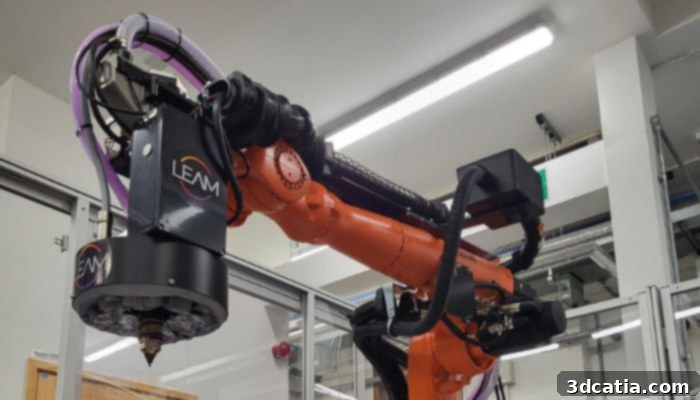
The DEMEX system is currently optimized for large-format 3D printers, with plans for broader compatibility in the future.
What are your thoughts on the innovative LEAM startup and its groundbreaking DEMEX system? We invite you to share your insights in a comment below or engage with us on our LinkedIn, Facebook, and Twitter pages! For the very latest developments and news in the world of 3D printing, don’t forget to sign up for our free weekly Newsletter here, delivered straight to your inbox! You can also explore all our informative videos on our dedicated YouTube channel.
*All Image Credits: LEAM