
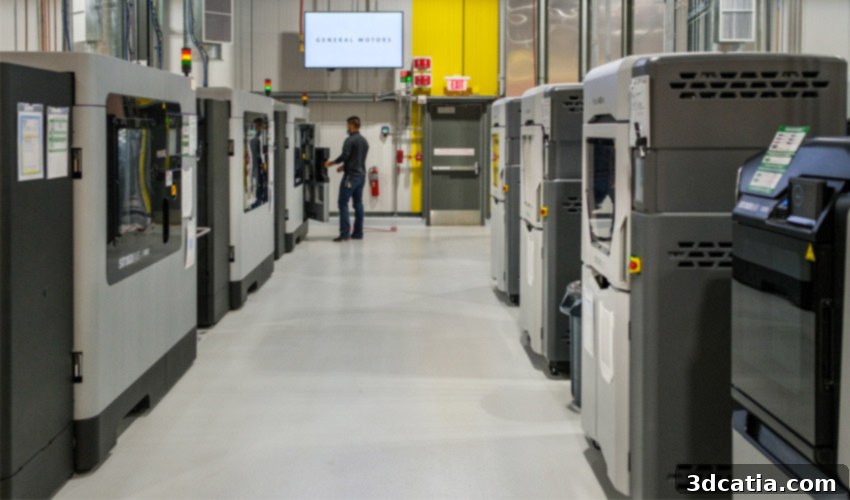
General Motors’ Additive Industrialization Center: Driving Automotive Innovation with 3D Printing
In a significant move that underscores the automotive industry’s accelerating embrace of advanced manufacturing technologies, General Motors (GM) announced the grand opening of its dedicated Additive Industrialization Center (AIC) in December 2020. This initiative places GM alongside other pioneering automakers like BMW and Seat, which have also invested heavily in integrating additive manufacturing into their operations. The AIC, a state-of-the-art 1,400-square-meter (15,000-square-foot) facility, is strategically designed to revolutionize GM’s approach to product development and manufacturing. It empowers the automotive giant to significantly accelerate the creation of prototypes, streamline the production of specialized tools, and most notably, facilitate the manufacturing of high-quality, finished production parts for its vehicles. This monumental step not only highlights GM’s unwavering commitment to innovation but also solidifies its strategy of deeply embedding additive manufacturing (AM) into its daily processes, aiming for unprecedented levels of agility, speed, and efficiency in production. The immediate impact of this strategic shift is already visible, with one of GM’s flagship divisions, Cadillac, proudly unveiling two new vehicles featuring integrated 3D printed components, marking a new era for mass-produced automobiles.
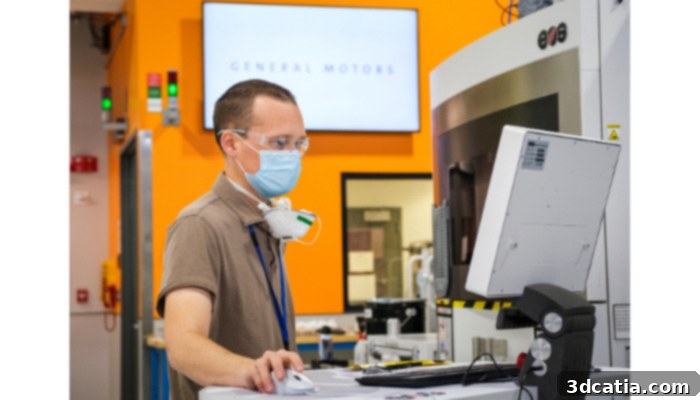
An engineer examines a 3D printer at GM’s Additive Industrialization Center (Photo Credits: Steve Fecht)
Additive manufacturing, commonly known as 3D printing, is far from a novel concept for General Motors. The corporation boasts a rich history spanning over three decades of leveraging AM technologies, primarily for the rapid creation of prototypes. During this extensive period, 3D printing played a crucial role in enabling designers and engineers to quickly visualize, test, and refine new concepts, significantly shortening design cycles. However, the establishment of the new Additive Industrialization Center represents a pivotal evolution in GM’s journey with 3D printing. It is the culmination of years of dedicated experience, strategic investments, and a bold vision to push the boundaries of AM beyond mere prototyping. The AIC transitions 3D printing from a tool for early-stage development to a powerful, integrated manufacturing capability, effectively bringing additive processes into the mainstream production realm. This strategic move is set to unlock new possibilities for design innovation, material science, and overall production efficiency, positioning GM at the forefront of the next industrial revolution in automotive manufacturing.
Audley Brown, GM’s esteemed Director of Additive Design and Materials Engineering, eloquently articulates the profound significance of this venture: “The core component of GM’s transformation is becoming a more agile, innovative company, and 3D printing will play a critical role in that mission. Compared to traditional processes, 3D printing can produce parts in a matter of days versus weeks or months at a significantly lower cost.” This statement encapsulates the profound impact AM is expected to have on GM’s operational framework. The inherent advantages of 3D printing – speed, cost-effectiveness, and design flexibility – are perfectly aligned with GM’s overarching goal of fostering a culture of innovation and responsiveness. By drastically reducing lead times and manufacturing costs associated with tooling and parts production, GM can iterate faster, respond to market demands with greater agility, and ultimately deliver superior products to its customers more quickly. The AIC is not merely a facility; it is a testament to GM’s commitment to leveraging cutting-edge technology to redefine automotive engineering and manufacturing for the 21st century.
Revolutionizing Functional Prototypes at GM
For General Motors, 3D printing has consistently proven its immense value, particularly in the creation of highly functional prototypes. This capability allows engineers to test and validate designs under real-world conditions long before committing to expensive and time-consuming traditional manufacturing processes. One prime example of this transformative impact can be found in the development of the high-performance 2020 Corvette. During its rigorous design and testing phase, several critical brake lines were rapidly 3D printed using advanced plastic materials. These prototypes were then subjected to an exhaustive battery of tests on the track, pushing them to their limits under extreme driving conditions. The ability to quickly produce and test these components proved invaluable. The engineering teams were empowered to modify the part design a remarkable four times in swift succession, all without incurring additional costs that would typically be associated with re-tooling in conventional manufacturing. This iterative design freedom led to an impressive reduction in development time by nine weeks and a significant cut in total costs by an astounding 64%. Such efficiencies demonstrate how additive manufacturing not only accelerates the design cycle but also significantly de-risks the development process, allowing for optimal performance tuning.
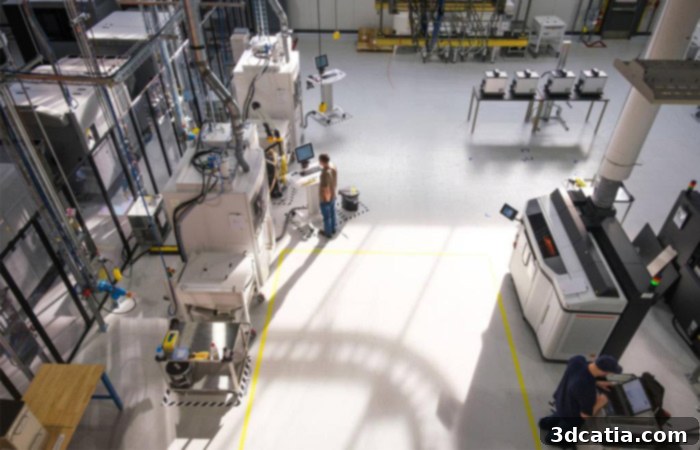
The GM Additive Industrialization Center (Photo Credits: Steve Fechts)
The benefits extend to GM’s next-generation electric vehicles as well. The highly anticipated GMC Hummer EV prototype incorporates no fewer than 17 3D printed parts specifically for its battery system. These specialized components, optimized for lightweighting and complex geometries, are instrumental in reducing development times by an estimated 50% and slashing overall costs by 58%. This application highlights how 3D printing is crucial for developing sophisticated electric vehicle architectures where weight, thermal management, and compact integration are paramount. Audley Brown further elaborates on the broader impact of this technology, stating, “Many recent product developments have benefited in one way or another from 3D printed prototype parts. Not only can these parts save time and money, the team also uses 3D printed applications during product development to overcome unexpected challenges in real time.” This adaptability is a game-changer for engineering teams, allowing them to rapidly create custom fixtures, jigs, and even temporary replacement parts on demand, thereby maintaining project momentum and avoiding costly delays that can arise from unforeseen issues during development.
Manufacturing Finished Parts Through Additive Manufacturing
While prototyping has been a cornerstone of GM’s 3D printing utilization, the new Additive Industrialization Center signals a monumental shift towards a more ambitious goal: the serial production of finished, end-use parts. This represents a significant leap from concept validation to direct application in consumer vehicles. The AIC is equipped with an impressive arsenal of 24 advanced 3D printers, capable of executing a diverse range of additive manufacturing processes. These include established technologies such as Fused Deposition Modeling (FDM), often referred to as molten deposition, for robust plastic parts; Selective Laser Sintering (SLS) and Multi Jet Fusion (MJF) for intricate and high-performance polymer components; and advanced metal printing processes like Laser Powder Bed Fusion (LPBF), which enables the creation of complex metal parts with superior strength-to-weight ratios. This comprehensive suite of technologies provides GM with unparalleled flexibility in material selection and part design, allowing them to optimize components for specific applications.
The fruits of this expanded capability are already making their way into production vehicles. The Cadillac division, renowned for its luxury and performance, is pioneering this integration. The highly anticipated CT4-V Blackwing and CT5-V Blackwing models, slated for availability from summer 2021, will be the first GM vehicles to incorporate 3D printed production parts directly from the factory floor. These groundbreaking components include two specialized HVAC ducts, a meticulously crafted manual shifter knob that enhances tactile feel and driver engagement, and a precision-engineered electrical harness holder. The choice of these particular parts for initial integration is strategic: they benefit from the design freedom offered by AM, allowing for optimized airflow paths, ergonomic improvements, and complex routing solutions that would be challenging or impossible to achieve with traditional manufacturing methods. This integration is not just about technology; it’s about delivering enhanced performance, improved ergonomics, and greater efficiency to the end-user.
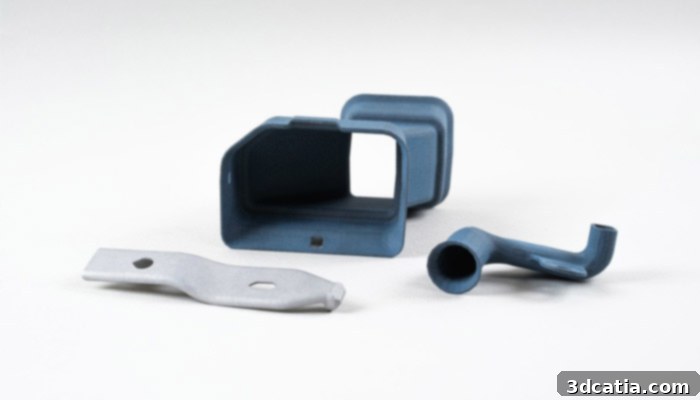
Cadillac V-Series HVAC ducts and electrical harness bracket (Photo Credits: Steve Fecht)
Audley Brown optimistically concludes, “This is just the beginning. Ultimately, we see the potential for 3D-printed parts to be used in a wide variety of production applications — from greater personalization options for new-vehicle buyers, to unique accessories and reproductions of classic car parts.” This vision extends far beyond current applications, hinting at a future where vehicle owners can customize their cars with unique, factory-sanctioned 3D printed accessories, or where rare and obsolete parts for classic cars can be digitally recreated and manufactured on demand. This approach not only enhances customer experience through personalization but also addresses critical challenges in supply chain management and vehicle restoration. The ability to produce parts on-demand, without the need for extensive tooling, promises to transform how spare parts are sourced and how vehicles are maintained throughout their lifecycle. One thing is unequivocally certain: the automotive industry, exemplified by trailblazers like General Motors, has never before placed such a profound reliance on the transformative capabilities of additive manufacturing. This ongoing evolution is set to redefine car design, production, and ownership in unprecedented ways. To delve deeper into General Motors’ comprehensive strategy and witness the future of automotive manufacturing, be sure to watch the insightful video below or explore their official website:
What are your thoughts on General Motors’ pioneering Additive Industrialization Center? Do you believe a future where cars feature numerous 3D printed components will enhance performance, aesthetics, or customization options? We invite you to share your insights and opinions in the comments section below, or engage with us on our social media platforms, including Facebook and Twitter pages! Don’t miss out on the latest advancements and news in the exciting world of 3D printing; sign up for our free weekly Newsletter to have all the updates delivered directly to your inbox!
*Featured image from Steve Fechts