
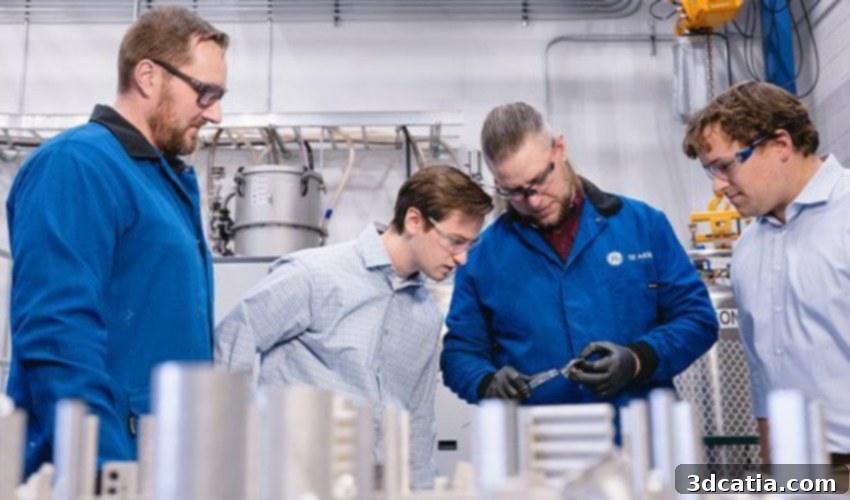
Purdue University Leads Hypersonic Scramjet Innovation with Advanced 3D Printing
As the frontiers of aerospace technology continuously expand, Purdue University stands at the forefront, driving groundbreaking research that is fundamentally reshaping the landscape of hypersonic flight. Leveraging state-of-the-art additive manufacturing techniques, particularly advanced 3D printing technology, researchers at the Purdue Applied Research Institute (PARI) have achieved a significant milestone: the successful production of fully functional prototypes of supersonic combustion ramjet engines, commonly known as scramjets. These innovative and exceptionally powerful engines represent a monumental leap forward, holding the potential to propel the next generation of aircraft and vehicles at blistering hypersonic speeds, effortlessly exceeding Mach 5.
This breakthrough, spearheaded by the Hypersonic Advanced Manufacturing Technology Center (HAMTC) at Purdue, marks a pivotal moment for the entire hypersonics industry. The revolutionary new scramjet design offers an unprecedented approach to prototyping and manufacturing within this highly specialized field, delivering substantial advantages in both cost-effectiveness and development timelines. Traditionally, the creation of such advanced propulsion systems has been an incredibly arduous, expensive, and time-consuming endeavor. Purdue’s methodology, integrating cutting-edge materials and manufacturing processes, radically streamlines this process, enabling faster iterations and more efficient resource allocation, which are critical for accelerating technological readiness.
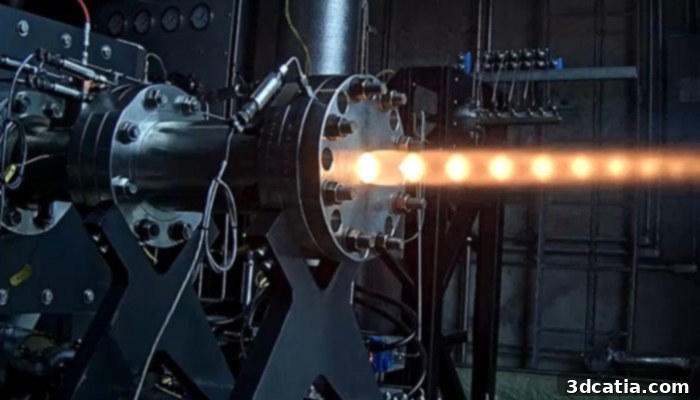
A prototype Scramjet engine undergoing rigorous testing at Purdue’s Maurice J. Zucrow Laboratories, a key facility for hypersonic research.
Understanding the Mechanics of Scramjet Technology
Scramjets are critically important in the aerospace industry due to their unique ability to sustain stable combustion at extremely high flight speeds, typically above Mach 5, allowing aircraft to travel far beyond the speeds achievable by conventional jet engines or even ramjets. The fundamental principle behind a scramjet involves compressing incoming air solely through the vehicle’s forward motion at hypersonic speeds, without the need for complex rotating machinery like compressors. This highly compressed, supersonic airflow is then mixed with fuel and ignited in the combustor. Maintaining this combustion process in a supersonic flow is extraordinarily challenging, a feat vividly described by Nick Strahan, HAMTC senior test engineer, as being akin to “lighting a candle in a hurricane.” The fuel and air have only milliseconds to mix and ignite within the combustor before being expelled, demanding precise engineering and innovative design solutions.
The difficulties associated with scramjet operation are manifold. At hypersonic velocities, the air entering the engine is extremely hot and fast, reducing the time available for fuel injection, mixing, and combustion. Traditional methods struggle to achieve efficient and stable combustion under these extreme conditions. However, through pioneering combustor designs, advanced fuel injection strategies, and sophisticated thermal management techniques, Purdue researchers have adeptly overcome these long-standing obstacles. Their work not only enables sustained combustion at previously unattainable speeds but also ensures the efficiency and reliability necessary for practical applications. This significant achievement is paving the way for unprecedented advancements in aerospace technology, opening new possibilities for high-speed travel and advanced defense capabilities.
The Transformative Role of Additive Manufacturing in Scramjet Development
A cornerstone of this groundbreaking innovation at Purdue is the strategic utilization of advanced 3D printing technology, particularly the GE Concept Laser X Line 2000R. This colossal machine is celebrated as one of the world’s largest metal laser powder bed fusion solutions, boasting an impressive build volume capacity of 160 liters. The sheer scale and precision of this large-scale metal printer are instrumental in revolutionizing the manufacturing process for complex scramjet components. It not only significantly streamlines the overall production timeline but also unlocks the ability to create incredibly intricate and optimized designs that are virtually impossible to achieve with conventional manufacturing methods. These complex internal geometries are crucial for enhancing aerodynamic efficiency, improving fuel-air mixing, and managing the extreme thermal loads experienced during hypersonic flight.
The advantages of using the GE Concept Laser X Line 2000R extend far beyond mere size. Its additive capabilities allow for substantial part consolidation, drastically minimizing the total number of components required in a scramjet engine assembly. This reduction in part count directly translates to several critical benefits: simplified production, decreased assembly time, enhanced structural integrity, and reduced potential points of failure. Furthermore, 3D printing facilitates significant weight reduction through the creation of optimized internal lattice structures and topology-optimized designs, all while rigorously maintaining, or even improving, the full functionality and performance of the engines. This ability to create lightweight yet robust parts is paramount for achieving the high thrust-to-weight ratios essential for hypersonic propulsion systems, enabling greater maneuverability and fuel efficiency.
Michael Sangid, the executive director of HAMTC, underscored the remarkable success and strategic importance of this project. He stated, “The scramjet pilot project is a great example of our vertically integrated capabilities. We can take raw powder and turn it into representative test data from a fielded prototype in a few short months. This leverages the flexibility of additive manufacturing into the component’s design to increase efficiency.” This “vertically integrated” approach means that Purdue’s team controls every aspect of the development process, from initial conceptual design and material selection to advanced additive manufacturing, rigorous post-processing, and comprehensive performance testing. This holistic control significantly accelerates the research and development cycle, allowing for rapid iteration and optimization that would be unfeasible with traditional, more segmented manufacturing pipelines. The ability to quickly move from raw material to a tested, functional prototype in a matter of months is a game-changer for the pace of innovation in hypersonic propulsion.
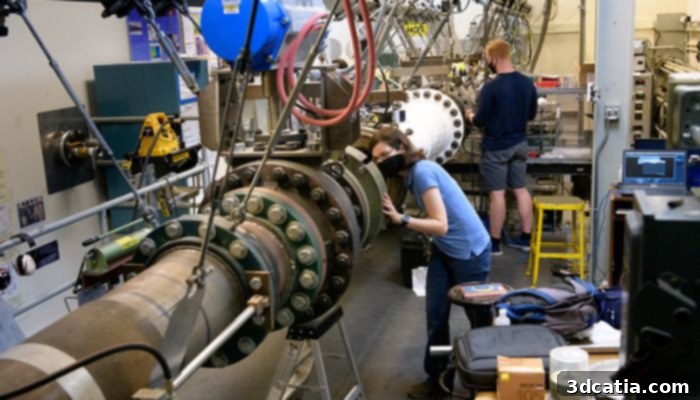
Purdue students actively contributing to cutting-edge research within the university’s state-of-the-art Hypersonics and Applied Research Facility (HARF).
Strategic Implications and Nurturing the Next Generation of Hypersonics Experts
Purdue’s pioneering hypersonic research extends its profound impact far beyond mere technical advancements; it carries significant implications for national security and defense, as well as for the future of aerospace innovation. The enhanced production speed and substantial cost-efficiency achieved through additive manufacturing are not just financial benefits; they directly address the critical and rapidly escalating national need for advanced hypersonic technologies. In an era where global technological leadership is paramount, developing robust and rapidly deployable hypersonic capabilities is essential for maintaining a strategic advantage and bolstering national defense infrastructure. Purdue’s work contributes directly to equipping the nation with these vital tools.
Moreover, a crucial aspect of this project lies in its dedication to workforce development. By deeply involving students in every phase of the project—from initial design and advanced manufacturing to rigorous testing and data analysis—Purdue is actively fostering a new generation of engineers, scientists, and technicians highly proficient in advanced hypersonic skills. These skills are not only highly sought after but are also critical for meeting the burgeoning demands of the growing aerospace and defense industries. The hands-on experience gained in facilities like Purdue’s Hypersonics and Applied Research Facility (HARF) provides invaluable practical knowledge, bridging the gap between academic theory and real-world application. This strategic investment in human capital ensures a sustainable pipeline of expertise, solidifying the United States’ position at the forefront of hypersonic innovation for decades to come. To delve deeper into this transformative project and Purdue’s broader contributions to hypersonic research, you can find more information by clicking here.
Purdue University’s advancements in scramjet development through sophisticated 3D printing mark a defining moment in the quest for faster, more efficient, and more capable aerospace vehicles. This convergence of cutting-edge research, innovative manufacturing, and dedicated talent promises to unlock new realms of possibility for high-speed flight and defense applications, reaffirming Purdue’s role as a leader in global aerospace innovation.
What are your thoughts on Purdue’s innovative use of 3D printing for the rapid prototyping and development of scramjet engines? We invite you to share your perspectives and insights in a comment below, or engage with us on our LinkedIn, Facebook, and Twitter pages! Don’t forget to sign up for our free weekly newsletter here to receive the latest 3D printing news directly in your inbox. You can also explore all our informative videos on our YouTube channel for more content.
*All Photo Credits: Purdue University