
Biomimicry in 3D Printing: Diatom-Inspired Materials Revolutionize Strength and Sustainable Innovation
In recent years, additive manufacturing, commonly known as 3D printing, has profoundly transformed industries by offering unprecedented capabilities in material design and production. This revolutionary technology enables the creation of complex geometries and functional parts with remarkable precision, paving the way for truly extraordinary innovations across diverse sectors. Among the most compelling and rapidly evolving trends within this field is the application of biomimicry. This innovative approach involves drawing inspiration from nature’s millions of years of evolutionary design – mimicking biological structures, processes, and strategies – to develop advanced materials with truly unique and often superior properties. This powerful fusion of nature’s wisdom and cutting-edge manufacturing has recently culminated in the creation of an ultra-strong, 3D printed material that promises to redefine the boundaries of engineering and material science.
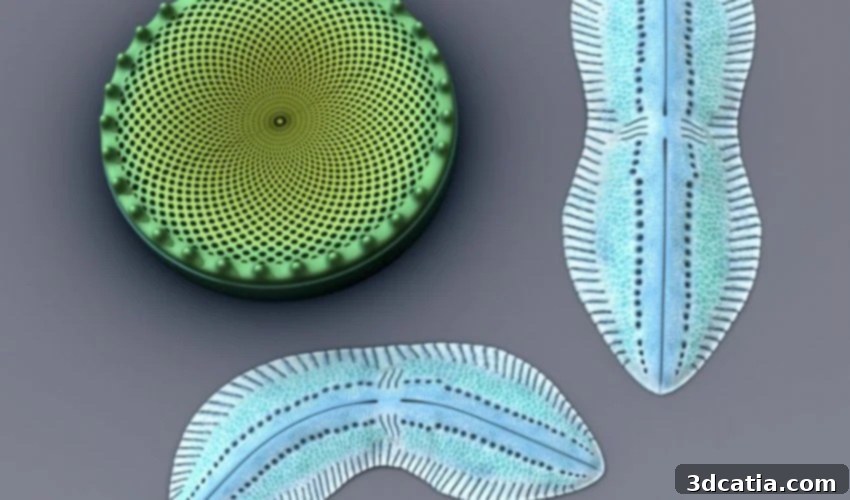
This groundbreaking research project originates from a collaborative effort between the prestigious University of Genoa and the Massachusetts Institute of Technology (MIT) in Boston. Their joint endeavor has successfully harnessed the principles of 3D printing to engineer an ultra-strong material, drawing direct inspiration from diatoms. Diatoms are microscopic marine microalgae, so incredibly small that they are entirely invisible to the naked eye. Despite their diminutive size, these ubiquitous single-celled organisms possess a myriad of remarkable properties that have long fascinated scientists. Ecologically, diatoms play a vital role in Earth’s carbon cycle, being responsible for storing a significant portion—between 20 to 50 percent—of the planet’s annually produced CO2.
Beyond their crucial environmental contributions, diatoms are engineering marvels in their own right. Their external protective shell, known as a frustule, exhibits truly extraordinary mechanical properties. This intricate silica structure is renowned for having the highest strength-to-weight ratio of any known natural material, making it incredibly resilient yet remarkably lightweight. Furthermore, the frustule’s unique architecture provides outstanding energy-absorbing capabilities, a property that has captivated researchers and engineers alike. It is this combination of unparalleled strength, minimal weight, and superior energy absorption that makes diatoms an ideal biological model for biomimetic material development.
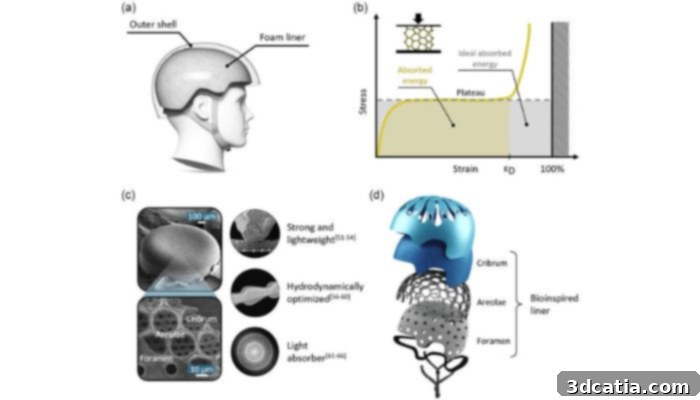
The new material was used to 3D print a protective helmet with remarkable strength.
Reproducing the Structural Properties of Diatoms With 3D Printing
The diatom frustule is a masterpiece of natural engineering, characterized by a highly complex, multi-layered hierarchical architecture. This intricate design features a precise arrangement of micro- and nanopores, which are not merely decorative but serve critical biological and mechanical functions. This sophisticated pore structure is meticulously optimized to enhance structural strength, facilitate efficient fluid dynamics as water interacts with the living organism, and maximize sunlight absorption for photosynthesis. The sheer complexity and functional elegance of this biological design have long presented a formidable challenge for conventional manufacturing techniques, underscoring the necessity of advanced methods like 3D printing.
The structural organization of diatom frustules epitomizes a perfect balance across multiple functionalities. It ensures incredible lightness while maintaining exceptional strength, crucial for buoyancy in aquatic environments. This design also optimizes nutrient acquisition and waste expulsion, vital processes for cellular sustenance. Moreover, the frustule plays a role in efficient energy conversion, enabling the diatom to thrive. Consequently, diatoms stand as an extraordinary natural model for a multifunctional and resilient material, embodying a combination of properties that engineers consistently strive to achieve in synthetic materials.
The complex, multiscale architecture of diatom frustules has captivated the minds of scientists, engineers, and even artists for decades. However, despite intense fascination, the precise design strategies underpinning their remarkable properties remained elusive and had not been uniquely identified or effectively replicated until now. The dedicated research team from the University of Genoa and MIT embarked on this ambitious project with a clear objective: to demonstrate that drawing direct inspiration from these microscopic masterpieces of nature could usher in a new era of innovation in the design of multifunctional materials. Their success lay in leveraging cutting-edge techniques, particularly Design for Additive Manufacturing (DfAM). DfAM is a critical methodology that optimizes designs specifically for the capabilities of 3D printing, enabling the creation of intricate internal structures that would be impossible with traditional manufacturing. By applying DfAM principles, the team was able to meticulously reproduce the complex internal architecture of diatoms within a newly developed 3D printed material.
To achieve their remarkable results, the research team employed a sophisticated and integrated approach. This involved a synergistic combination of advanced 3D printing techniques, rigorous numerical simulations, and detailed computational fluid dynamics (CFD) analysis. Numerical simulations allowed them to predict and optimize the mechanical performance of various structural iterations before physical printing, significantly accelerating the design cycle. CFD analysis, on the other hand, was crucial for understanding how fluid (like air or water) would interact with the material’s intricate pore structures, mirroring the diatom’s natural environment and ensuring optimized fluid flow properties in the biomimetic design. This comprehensive methodology allowed for an unprecedented level of control and insight into the material’s behavior, leading to truly groundbreaking outcomes.
The implications of these research findings are far-reaching and transformative. As explained by the researchers, the results are poised to “provide new ideas for the development of new materials and smart systems capable of performing multiple functions.” This includes paving the way for novel biotechnological approaches aimed at addressing some of humanity’s most pressing challenges. For instance, the diatom-inspired structures could be instrumental in developing more efficient methods to reduce atmospheric CO2, potentially offering powerful tools in the fight against climate change. Furthermore, their unique properties could lead to innovative systems for monitoring the health status of water bodies, capturing light more efficiently for solar energy applications, and developing advanced protective devices that offer superior safety and performance compared to existing solutions. The potential for innovation across various scientific and engineering disciplines is truly immense.
Applications for This Ultra-Strong, 3D Printed Material
The innovative 3D-printed, diatom-inspired material holds immense promise, poised to deliver significant benefits across a multitude of applications in various industries. Its unique combination of strength, lightness, and intricate internal architecture opens doors to advancements previously considered unattainable. The ability to precisely control porosity and structural hierarchy allows for tailored material properties, making it adaptable for diverse functional requirements, from structural components to advanced filtration systems.
One significant area of application is the **automotive industry**. Here, the material’s properties can be leveraged to improve vehicle performance and efficiency. By reducing the overall weight of components while simultaneously increasing their structural strength, the material can contribute to enhanced fuel economy and improved safety through better crash absorption. Furthermore, its ability to influence airflows through optimized geometries could lead to more aerodynamic designs, further boosting efficiency and reducing drag, thus revolutionizing how vehicles are designed and manufactured for a sustainable future.
Another critical application lies in the development of **microporous membranes for CO2 capture**. The material’s high porosity, coupled with its exceptional mechanical strength, makes it an ideal candidate for creating highly efficient and durable membranes. These membranes could significantly enhance gas management systems, offering more effective and economically viable solutions for capturing carbon dioxide from industrial emissions or even directly from the atmosphere. This has profound implications for combating climate change and advancing environmental sustainability efforts globally.
In the biomedical field, this material offers revolutionary potential for **drug delivery systems**. The precise control over porosity, made possible by 3D printing the diatom-inspired structure, allows for the engineering of systems that provide highly controlled and sustained release profiles for therapeutic agents. This precision ensures that drugs are delivered at optimal rates, leading to more effective treatments, reduced side effects, and potentially longer-lasting devices. The ability to customize porosity also enables tailoring drug release kinetics to individual patient needs, ushering in a new era of personalized medicine.
Finally, the unique combination of light weight and flexibility inherent in the diatom-inspired material makes it exceptionally well-suited for advancements in **soft robotics**. By exploiting these properties, engineers can design and fabricate advanced fluid dynamic actuators that are more compliant, safer for human interaction, and capable of more intricate and biomimetic movements. This could lead to a new generation of robots with enhanced dexterity, adaptability to complex environments, and potential applications in fields ranging from delicate industrial manipulation to assistive medical devices and advanced prosthetics.
To concretely demonstrate the material’s superior performance, the research team specifically focused on its incredible energy absorption capabilities. They designed, manufactured, and rigorously tested a novel protective helmet concept, aptly named D-HAT (Diatom-Inspired Helmet for Advanced Protection). This real-world application underscored the material’s potential to revolutionize safety equipment. Extensive tests conducted on the D-HAT prototype unequivocally showed that the 3D printed, diatom-inspired material dramatically outperforms conventional materials currently used in protective gear, such as various types of foams or traditional honeycomb structures. Its ability to dissipate impact energy more effectively signifies a major breakthrough in impact protection technology, offering a new benchmark for safety and resilience in high-performance applications.
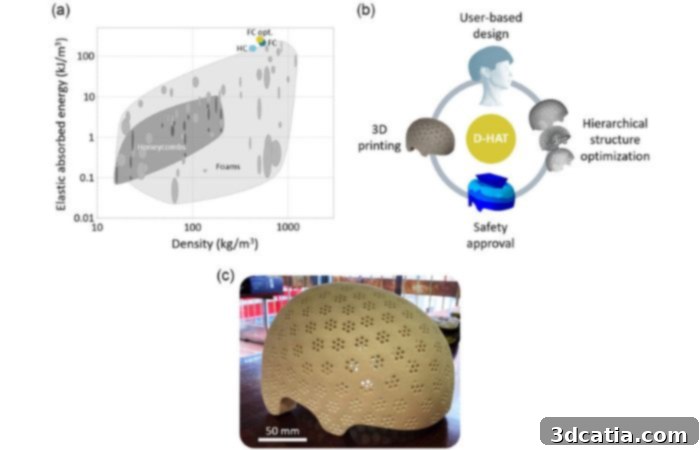
(a) The graph shows the relationship between elastic energy absorption and density for various materials. Biomimetic structures (highlighted in blue and yellow) outperform both honeycomb structures and foams. b) Development of the D-HAT, from user-based design, optimization of the hierarchical structure of the helmet shell, simulations for safety verification, and final 3D printing of the prototype. c) 3D printed D-HAT prototype.
This new breakthrough in the development of advanced materials, driven by the capabilities of 3D printing and the inspiration of nature, profoundly demonstrates the pivotal role of additive manufacturing in fostering entirely new paradigms of thinking, designing, and manufacturing. It highlights a transformative shift from traditional subtractive or formative manufacturing to an era where complex, biomimetic structures can be realized with unprecedented fidelity and functionality. Nature, with its billions of years of evolutionary refinement, consistently proves to be the ultimate master architect for creating highly efficient, incredibly resilient, and inherently sustainable systems. This research powerfully underscores the boundless potential of emulating solutions found in the natural world to drive technological innovation and address complex engineering challenges. The detailed results of this groundbreaking study are available for further exploration and can be accessed HERE.
What are your thoughts on the exciting development of this ultra-strong, 3D printed material and its wide-ranging potential applications? We invite you to share your insights and comments below, or connect with us on our social media channels, including LinkedIn, Facebook, and Twitter! Don’t forget to sign up for our free weekly Newsletter here to receive the latest 3D printing news and updates straight to your inbox. You can also explore all our videos and in-depth content on our YouTube channel for more fascinating insights into the world of additive manufacturing.
*All Photo Credits: Università di Genova