
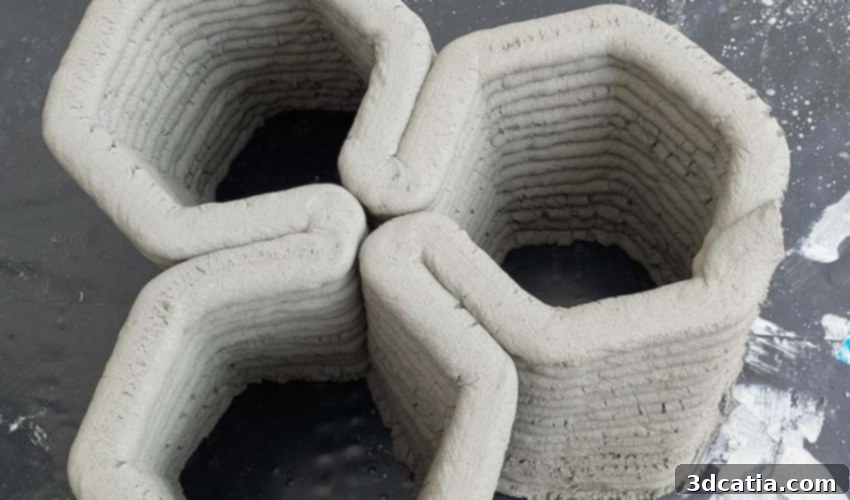
Pioneering Smart Construction: RMIT Researchers Develop Conductive Graphene-Enhanced 3D Printed Concrete
Engineers and material scientists globally are continuously seeking innovative ways to revolutionize the construction industry, addressing challenges such as efficiency, sustainability, and structural longevity. A groundbreaking study conducted by talented engineering students at the Royal Melbourne Institute of Technology (RMIT), a prominent public research university in the Australian state of Victoria, marks a significant leap forward in this quest. These dedicated researchers have successfully developed a novel approach to produce a highly conductive and remarkably stable concrete specifically tailored for 3D printing buildings. Their meticulous investigation centered on understanding how the strategic addition of graphene oxide to concrete mixtures impacts its printability and overall performance in additive manufacturing processes. This pioneering study is among the first of its kind, unequivocally highlighting the immense, untapped potential of concrete 3D printing within the construction sector, promising a future where buildings are not only built faster and more economically but also possess advanced functionalities.
The findings from this pivotal research by the Australian scientists from RMIT have recently gained international recognition, being published in the esteemed journal “Additive Manufacturing Letters.” In their comprehensive publication, the team meticulously detailed their groundbreaking observations, particularly focusing on how the electrical conductivity of concrete used in additive manufacturing can be substantially enhanced by incorporating graphene oxide into the cement matrix. Graphene oxide, a marvel of nanomaterial science, is increasingly recognized for its extraordinary properties and is already widely utilized in a diverse range of high-tech applications, including advanced electronic devices and next-generation battery technologies. Its integration into construction materials represents a paradigm shift, imbuing conventional concrete with capabilities previously unimaginable, opening up new avenues for intelligent infrastructure.
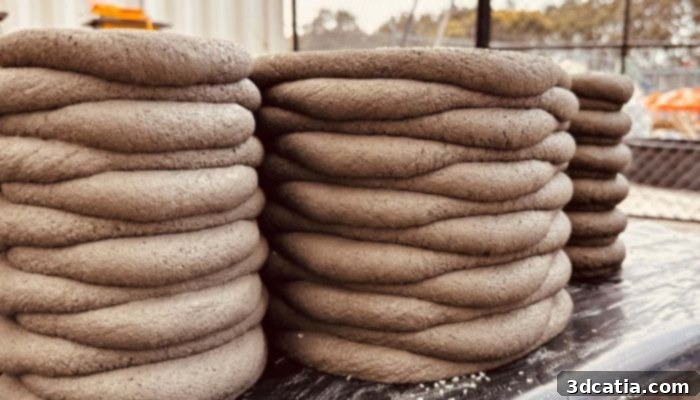
3D-printed concrete with added graphene oxide (photo credits: Jonathan Tran)
According to the visionary research leader and RMIT Associate Professor Jonathan Tran, the remarkable outcomes of their investigations lay a robust foundation for the accelerated development of “smart” buildings. This futuristic vision envisages a scenario where the structural components of a building, such as its walls, could transcend their traditional roles and function as integral parts of a sophisticated sensor network. These intelligent walls would be capable of autonomously detecting and meticulously monitoring minute structural imperfections, such as small cracks or material fatigue, at their earliest possible stages. The inclusion of graphene oxide as a key ingredient within the concrete mix is the enabler for this revolutionary capability. This nanomaterial facilitates the creation of an inherent electrical circuit within concrete structures, a network sensitive enough to register and report a wide array of critical environmental and structural factors, including subtle temperature fluctuations, moisture levels, and even stress distribution. Such real-time data acquisition promises to significantly enhance building safety, optimize maintenance schedules, and extend the overall service life of infrastructure, moving beyond reactive repairs to proactive structural health management.
Further Benefits of Graphene Oxide for Concrete 3D Printing
Associate Professor Tran, a leading figure in the research, firmly believes that 3D printing in the construction sector offers a profoundly advantageous alternative to conventional production methods. Additive manufacturing, or AM, presents considerable benefits when evaluated against crucial metrics such as cost-effectiveness, time efficiency, labor requirements, and environmental sustainability. Tran articulates, “Current concrete structures are predominantly created using formwork, an elaborate process where a custom mold is meticulously constructed before fresh concrete mixture is poured into it. Formwork, while traditional, is inherently labor-intensive, time-consuming, and expensive, frequently generating substantial amounts of waste material. In stark contrast, 3D printed concrete not only delivers significant savings in time, money, and labor but also liberates architects and engineers to conceptualize and construct far more complex and intricate structures. Furthermore, it facilitates the reuse of certain construction waste materials within cement-based composites, aligning perfectly with principles of a circular economy and significantly boosting sustainability efforts in the built environment.”
This compelling array of advantages serves as the fundamental incentive for the RMIT research team to vigorously pursue 3D printing innovations within the construction domain. Beyond the exciting prospect of enhanced electrical conductivity in concrete, Associate Professor Tran highlights several other pivotal benefits conferred by the integration of graphene oxide into the concrete mix for 3D printing applications. One significant improvement lies in the material’s extrudability; thanks to the unique rheological properties imparted by graphene oxide, the concrete can be extruded with greater ease and precision. This optimized flow dramatically improves the bond between individual cement layers during the construction process. Traditional concrete 3D printing often faces challenges related to weaker interlayer bonds, which can compromise the overall structural integrity of the printed object. Graphene oxide acts as a binder and reinforcing agent, mitigating this common problem and ensuring a more cohesive and robust structure. Consequently, this advanced additive can boost the mechanical strength of the 3D-printed concrete by an impressive margin, with studies indicating an increase of up to 10%.
Lead researcher and RMIT PhD student Junli Liu further underscored the critical relationship between the strength of the resultant concrete and the precise amount of graphene oxide incorporated into the cement mix. Liu emphasized the delicate balance required, cautioning that exceeding an optimal concentration of graphene oxide carries the risk of negatively affecting not only the mechanical strength but also the workability and manageability of the mixture during printing. An excessive quantity could lead to a concrete construction with a shortened service life or undesirable material properties. Therefore, meticulous care must be exercised to maintain the equilibrium of the concrete’s composition. The research team is currently engaged in extensive and rigorous testing protocols to pinpoint the exact optimal dosage, ensuring that the enhanced properties of graphene oxide are leveraged without introducing any detrimental effects, thereby maximizing the practical applicability and reliability of this innovative material in real-world construction scenarios.
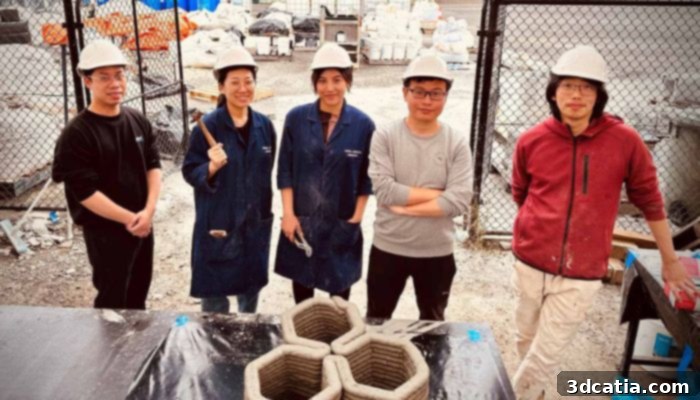
RMIT engineering students Hoang Khieu, Wen Si, Thanh Ha Nguyen, Junli Liu and Shuai Li (photo credits: Jonathan Tran)
Despite the overwhelmingly positive preliminary results and the significant promise demonstrated during initial tests, Associate Professor Tran pragmatically acknowledges that further intensive research is indispensable to thoroughly understand and optimize the long-term properties of concrete mixed with graphene oxide. The immediate objective is to conduct more exhaustive investigations to definitively ascertain whether this newly developed cement mixture genuinely represents a substantial and enduring improvement over conventional concrete in terms of sustained strength, durability, and resistance to environmental factors over its lifecycle. However, the researchers’ subsequent and pivotal project will initially concentrate on delving deeper into the nuances of the electrical conductivity exhibited by graphene oxide within the concrete mixture. This focused exploration is anticipated to unlock entirely new possibilities for concrete 3D printing, not only in terms of enhancing structural integrity and long-term durability but also in significantly improving printability and broadening the scope of its application across various segments of the modern construction industry. Such advancements could pave the way for self-monitoring structures, energy-efficient designs, and construction methodologies that are both robust and adaptable to future demands.
What are your thoughts on this groundbreaking study concerning the integration of graphene oxide into concrete for 3D printing applications within the construction industry? We invite you to share your insights and opinions in a comment below, or engage with us on our LinkedIn, Facebook, and Twitter pages! Don’t forget to sign up for our free weekly Newsletter here, ensuring you receive the latest 3D printing news directly to your inbox. You can also explore all our informative videos and content on our YouTube channel for more in-depth perspectives on additive manufacturing.
*Cover Photo Credits: RMIT University (Jonathan Tran)