
How 3D Printing Propelled the 2025 Ford Mustang GTD to Nürburgring Glory
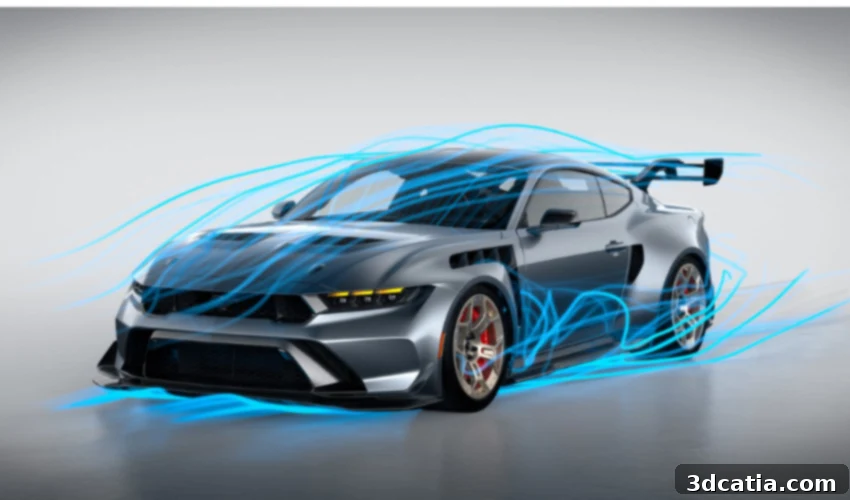
Ford has redefined the boundaries of automotive performance with the spectacular debut of the 2025 Mustang GTD. This track-focused supercar, a true marvel of engineering and design, recently captivated the automotive world by achieving an astonishing 6:52.072 lap time at Germany’s legendary Nürburgring Nordschleife. This incredible feat not only set a new benchmark for the iconic Mustang but also saw it outperform every Ferrari on the circuit, signaling a new era for American muscle on the global stage. The secret behind this monumental leap in aerodynamic performance and track domination lies in a subtle yet revolutionary innovation: tiny, 3D-printed “hood flicks” developed and refined directly during rigorous testing at the very same track.
The 2025 Mustang GTD: A New Breed of American Supercar
The 2025 Ford Mustang GTD is more than just a powerful car; it’s a meticulously engineered machine built for extreme track performance. Under its sculpted hood roars a supercharged 5.2L V8 engine, delivering immense power to propel the car to breathtaking speeds. Complementing this raw power is an advanced carbon fiber bodywork, designed not only for its lightweight properties but also for its exceptional stiffness and aerodynamic efficiency. Every curve and panel of the GTD serves a purpose, optimizing airflow and generating crucial downforce. Its Nürburgring triumph, clocking in at 6 minutes, 52.072 seconds, firmly establishes the GTD as a serious contender in the elite supercar category, proving that American engineering can stand shoulder-to-shoulder with the world’s most exotic machines.
Unveiling the Aerodynamic Secret: 3D-Printed Hood Flicks
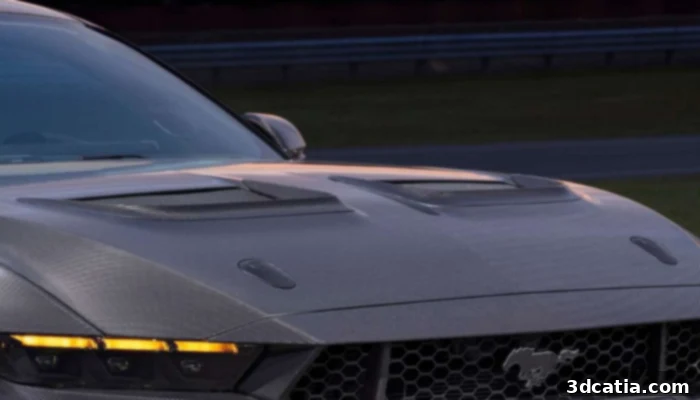
The quest for every fraction of a second on a demanding circuit like the Nürburgring often comes down to minute details, and for the Mustang GTD, those details were the innovative 3D-printed “hood flicks.” These aren’t just decorative elements; they are small, strategically placed raised pieces positioned around the vents on the car’s hood, designed with extreme precision to manipulate airflow. Their development during the crucial final stages of track testing proved indispensable in achieving the GTD’s record-breaking lap time, pushing the boundaries of what was previously thought possible for aerodynamic tuning.
The genius of these hood flicks lies in their subtle yet profound impact on the car’s aerodynamics. By carefully reshaping the airflow over the front end of the vehicle, they significantly increased front-end downforce. Crucially, this enhancement was achieved without introducing any measurable drag, a critical factor for maintaining top speed on long straights. Increased downforce provides superior grip and stability during high-speed cornering, allowing the GTD to maintain higher speeds through turns and inspire greater confidence in the driver. This intricate balance of downforce and drag reduction is a testament to advanced aerodynamic engineering, made possible through rapid iteration and sophisticated design.
Chief Program Engineer Greg Goodall highlighted the transformative role of these parts, stating, “We were able to design and test these parts at the track itself, which saved valuable time and let us optimize performance directly under real-world conditions.” He further explained that these seemingly minor components were instrumental in allowing the GTD to achieve sub-seven-minute lap times—a feat that would have been exceedingly difficult, if not impossible, without the immediate feedback loop provided by on-the-fly 3D printing. The development process for the hood flicks was remarkably agile, with Ford engineers rapidly iterating through eight distinct designs in just a couple of weeks, a pace unheard of with traditional manufacturing methods.
Additive Manufacturing: Revolutionizing Automotive Development
The implementation of 3D printing allowed Ford engineers an unprecedented level of freedom and speed in experimenting with complex aerodynamic tweaks. Traditional manufacturing processes, such as injection molding or CNC machining, involve significant lead times and high tooling costs, making late-stage design changes prohibitively expensive and time-consuming. However, with additive manufacturing, engineers could quickly design a part digitally, print it on-site at the Nürburgring, and immediately test its performance on the track. This direct, real-world validation cycle significantly compresses development timelines and enables a level of optimization that conventional methods simply cannot match.
This strategic advantage meant that Ford could refine the GTD’s aerodynamics far later in the development cycle than ever before. The ability to produce functional prototypes and end-use components directly at the test track provided immediate feedback. Engineers could analyze performance data, make design modifications, print new versions, and re-test, all within a matter of hours or days. This iterative design process is a game-changer, ensuring that the final product is optimized under the exact conditions it’s designed to perform in, translating directly into superior track capabilities and a car that blends raw American power with precision engineering and modern additive manufacturing.
The time saved through this agile development approach is invaluable. Instead of waiting weeks or months for new parts to be manufactured off-site, Ford’s team could implement design changes almost instantaneously. This not only accelerated the GTD’s path to market but also allowed for a more exhaustive exploration of aerodynamic possibilities, leading to a truly optimized vehicle. The flexibility offered by 3D printing drastically reduces the barriers to innovation, enabling engineers to push creative boundaries without the usual constraints of cost and time associated with conventional production methods.
Ford’s Legacy of Innovation with 3D Printing
Ford has long been a pioneer in the adoption of 3D printing technologies, integrating them into various stages of product development and manufacturing. What started primarily as a tool for rapid prototyping and design validation has now expanded significantly to encompass the production of end-use parts, specialized tooling, jigs, and fixtures. This evolution demonstrates Ford’s deep understanding of additive manufacturing’s potential, leveraging it to create custom solutions that are faster, lighter, and more complex than traditional methods allow.
Across its diverse portfolio, Ford harnesses additive manufacturing to create complex metal and polymer parts capable of withstanding extreme conditions. For instance, in the development of the all-electric Explorer, 3D printing was used for functional prototypes, allowing engineers to test fit, form, and function early in the design phase, reducing costly rework. Furthermore, Ford’s collaboration with Red Bull Racing’s Formula 1 team showcases the technology’s application in the most demanding environments, where lightweight, high-performance components with intricate geometries are critical for competitive advantage. Whether it’s enhancing aerodynamics, reducing weight, or creating bespoke tools for assembly lines, 3D printing provides Ford with unparalleled flexibility and innovation.

Beyond Prototypes: Tangible Performance Gains
The 2025 Mustang GTD stands as a powerful testament to how 3D printing has moved well beyond its initial role in mere prototyping to deliver tangible and measurable performance advantages. By enabling rapid iteration of designs, facilitating localized production directly at the point of need, and allowing for incredibly precise aerodynamic tuning, the technology has fundamentally transformed one of Ford’s most iconic muscle cars. It has helped to sculpt the Mustang GTD into a formidable global competitor, capable of challenging established European supercars on the most demanding racetracks worldwide.
This paradigm shift underscores additive manufacturing’s profound impact on modern vehicle design and development. It’s not just about producing parts faster; it’s about enabling entirely new design possibilities and optimization strategies that were once deemed impossible or impractical with conventional methods. The precision and customization offered by 3D printing allow engineers to create highly complex geometries that optimize airflow, reduce weight, and integrate multiple functions into a single component, pushing the boundaries of what a performance vehicle can achieve.
The Future of Automotive Engineering: Horsepower Meets Innovation
This significant milestone, exemplified by the Mustang GTD’s Nürburgring performance, clearly illustrates how additive manufacturing is actively reshaping the landscape of automotive engineering. The benefits extend far beyond simply shortening development cycles; the technology is fostering an environment where innovations that were once considered theoretical can now be brought to life. It empowers engineers with unprecedented design freedom, allowing them to explore radical ideas and optimize vehicles in ways previously unimaginable.
The collaboration between traditional powerhouse engineering and cutting-edge 3D printing is yielding spectacular results, making cars faster, lighter, and more efficient. The 2025 Mustang GTD is more than just Ford’s latest supercar; it is a compelling showcase of what happens when raw horsepower meets the precision, speed, and boundless potential of 3D printing. It represents a thrilling glimpse into the future of high-performance automotive design, where innovative manufacturing techniques are just as crucial as engine displacement and aerodynamic profiles in the pursuit of ultimate speed and efficiency.
How do you feel about Ford’s incorporation of 3D printing in their high-performance vehicles? We’d love to hear your thoughts! Let us know in a comment below or connect with us on our LinkedIn or Facebook pages. Don’t forget to sign up for our free weekly Newsletter to get the latest 3D printing news delivered straight to your inbox. You can also find all our videos on our YouTube channel. If you are interested in more 3D printing news in the automotive and transportation sector, visit our dedicated page HERE.
*All Photo Credits: Ford / Ford Motor Company