
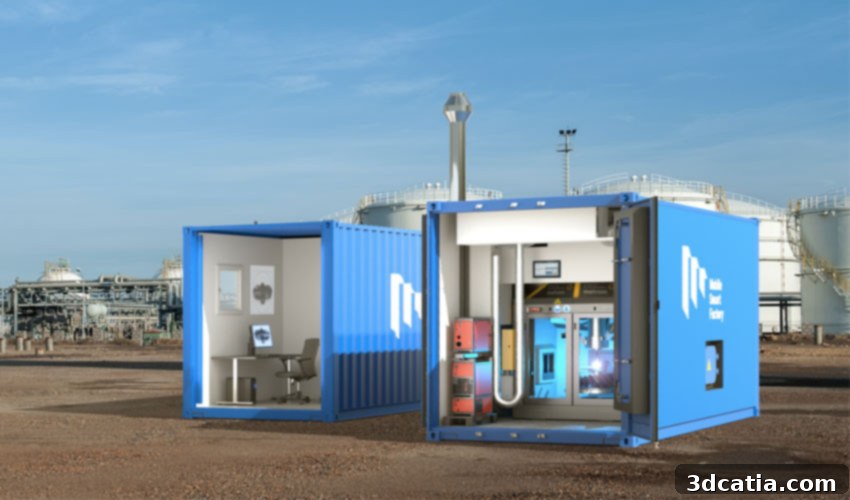
Mobile Smart Factory: Revolutionizing On-Demand 3D Printing and Supply Chain Resilience
In an era defined by global uncertainties and the imperative for greater operational agility, the concept of the Mobile Smart Factory has emerged as a groundbreaking solution. First introduced a few months ago, this innovative project signifies a paradigm shift in how industries approach manufacturing and supply chain management. Developed as a pioneering division of Bionic Production GmbH, the Mobile Smart Factory is essentially an intelligent, self-contained production module designed to integrate advanced additive manufacturing technologies with essential post-processing capabilities. Its core mission is to enable the cost-effective and highly reliable on-site development and production of parts, directly at the point of need.
The global landscape, particularly in the wake of events like COVID-19, has acutely highlighted the vulnerabilities within traditional supply chains. Disruptions have become commonplace, often preventing companies from receiving critical on-demand parts, leading to costly downtime and operational inefficiencies. The Mobile Smart Factory directly addresses these challenges by championing local manufacturing and fostering unprecedented supply chain resilience. This commitment to innovation and problem-solving has earned it widespread recognition, including being featured as a startup of the month. To delve deeper into the transformative capabilities of these modules and the vision behind them, we recently engaged in a conversation with one of the primary architects of this remarkable project.
3DN: Could you please introduce yourself and share your connection to the world of 3D printing?

Johannes Schmidt
My name is Johannes Schmidt, and my professional background lies primarily in project management, strategic development, and business analysis. I am deeply involved with the Mobile Smart Factory, which operates as a dedicated division within Bionic Production GmbH. Bionic Production is distinguished as an innovative full-service provider specializing in industrial additive manufacturing. Our fundamental mission is to significantly enhance performance and generate substantial added value for our clients through the strategic application of bionic 3D printing principles.
Over recent years, we have successfully executed a diverse portfolio of industrial projects for numerous renowned companies across various sectors. These projects span from meticulous part screening and advanced bionic design to the serial production of complex 3D printed metal components. Our expertise allows us to optimize designs for additive manufacturing, leveraging the unique freedoms that 3D printing offers to create lighter, stronger, and more efficient parts. Since 2019, our company has also proudly become an integral part of Hamburger Hafen und Logistik AG (HHLA), a leading logistics enterprise in Europe. This significant integration clearly underscores a vital trend: the logistics and maritime industries are increasingly recognizing and embracing the immense potential and tangible benefits that can be derived from the widespread adoption of industrial 3D printing technologies.
3DN: What inspired the creation of the Mobile Smart Factory? How did this innovative idea come to fruition?
The Mobile Smart Factory represents one of Bionic Production’s flagship innovations. It embodies a fully modular container factory, meticulously equipped with state-of-the-art 3D printing devices capable of producing both metal and polymer parts. The conceptualization of this product was a collaborative effort, developed in close partnership with our affiliated company, the Hamburg port operator. Our joint objective was clear: to directly address and mitigate critical supply chain challenges, particularly those faced by industries operating in remote, often logistically demanding, geographic areas.
We quickly identified that the capability to produce and repair essential parts locally, encapsulated within what we envisioned as a “3D printing factory in a box,” presented an enormous and transformative potential. This model profoundly shifts the paradigm from traditional inventory management. Instead of maintaining extensive physical inventories of every conceivable spare part, which is both costly and space-intensive, companies can now effectively ‘virtually stock’ these parts. This means digital designs are stored in a secure cloud, ready to be printed precisely when and where they are needed – on demand. This approach dramatically reduces the logistical complexities, lead times, and associated expenses typically involved in procuring and supplying spare parts.
Crucially, the Mobile Smart Factory significantly mitigates the risk of production downtime. Such downtimes are often triggered by bottlenecks, delays, or disruptions within the conventional supply chain. By enabling rapid, on-site production in immediate proximity to the customer’s operations, our solution ensures continuity and resilience, transforming how businesses manage their critical spares and repairs in challenging environments.
3DN: Can you elaborate on the specific functions of each module and the distinct benefits offered by this innovative production methodology?
The Mobile Smart Factory is engineered as a comprehensive, plug-and-print solution, specifically designed to provide cost-effective 3D printing and repair services directly where they are needed. This integrated system meticulously covers the entire additive manufacturing process, from initial design to final post-processing, and is housed within two robust, CSC-certified shipping containers, ensuring global transportability and durability.
The first unit, designated as the **control unit**, serves as the hub for all preprocessing activities and polymer production. Within this module, essential tasks such as part digitization are performed with high precision. This involves using advanced CAD software in conjunction with sophisticated handheld scanners, allowing for the precise capture and digital storage of all required part geometries in a secure “virtual cloud.” This digital inventory is a cornerstone of the on-demand production model. The process for polymer part creation begins here, with materials selected from a dedicated, environmentally controlled storage area, ensuring optimal printing conditions.
The second unit is the **production unit**, which primarily focuses on the creation of robust metal parts and the execution of critical repair services. This unit features a highly versatile, multi-optional 6-axis machine. This machine is a true powerhouse, ingeniously combining Wire Arc Additive Manufacturing (WAAM) technology with integrated milling and drilling capabilities. WAAM is a direct energy deposition process that uses an electric arc to melt wire feedstock, building parts layer by layer. The choice of WAAM for metal production within the Mobile Smart Factory is strategic due to its compelling benefits:
- **High Build Rates:** WAAM offers significantly faster material deposition rates compared to many other metal additive manufacturing techniques, making it ideal for large-scale parts and urgent production needs.
- **Large Build Space:** The process can accommodate very large parts, which is crucial for components often required in heavy industries like maritime or mining.
- **Easy Material Handling:** Wire feedstock is generally safer and easier to handle and store than metal powders, reducing operational complexities and safety concerns in remote locations.
- **Simple and Stable Process:** WAAM is known for its robustness and relative simplicity, making it a reliable choice for operations that might have limited expert supervision on-site.
The integration of milling and drilling capabilities within the same 6-axis machine allows for in-situ post-processing. This means that parts can be printed to near-net shape and then precisely machined to final dimensions and surface finish, all within the same module, eliminating the need to transport parts to separate machining facilities. This holistic approach ensures a complete, end-to-end additive manufacturing solution, from digital design to finished, functional part, maximizing efficiency and minimizing logistical overhead.

The Mobile Smart Factory actively promotes local additive manufacturing.
3DN: Which specific sectors are you primarily targeting with the Mobile Smart Factory?
Our innovative solution is specifically engineered for industries that operate in challenging, often remote environments characterized by limited logistical infrastructure and capabilities. These sectors frequently face significant hurdles in obtaining and managing spare parts and critical components. Consider the **mining industry**, where operations are often located far from urban centers and traditional manufacturing hubs. Or the **marine energy sector**, dealing with offshore platforms and installations. The **defense industry** requires rapid deployment and on-site readiness, and the broader **maritime industries**, including shipping and port operations, are constantly seeking ways to enhance vessel uptime and reduce operational costs.
In these industries, there is a consistent requirement for a vast array of individual, often specialized, spare parts. These components are typically costly to manufacture through conventional methods, involve long lead times for delivery, and present significant challenges in terms of inventory management and storage, especially within extremely tight operational schedules. Companies that strategically implement the Mobile Smart Factory and leverage its capabilities to print or repair parts locally can gain profound competitive advantages.
By dramatically reducing logistics efforts and associated costs, while simultaneously improving overall operational efficiency and minimizing downtime, the Mobile Smart Factory delivers tangible benefits. For instance, it can be seamlessly integrated and deployed directly at nearby mine sites or situated strategically on oil and gas platforms. This direct placement ensures that critical parts are produced precisely where and when the need arises, eliminating the lengthy and often uncertain waiting periods for components to arrive from a distant supplier or a centralized storage facility. This localized, on-demand manufacturing capability fosters greater self-sufficiency and resilience. Ultimately, the potential applications and the breadth of value that can be unlocked through the Mobile Smart Factory are immense, promising to redefine operational paradigms across these vital sectors.
3DN: How does the Mobile Smart Factory actively encourage and facilitate local production? And what is your vision for the future trajectory of additive manufacturing?
From my perspective, we are on the cusp of witnessing a powerful and irreversible trend towards reindustrialization and a significant shift towards localized production models. The recent global crises, particularly the COVID-19 pandemic, served as a stark and undeniable revelation of the inherent vulnerabilities within our highly globalized supply chains. China’s established role as a global manufacturing powerhouse, while efficient, means that any disruption within its borders or its outbound logistics inevitably puts global supply chains at severe risk. Consequently, an increasing number of countries and multinational corporations are proactively striving to reduce their dependencies on geographically distant suppliers, opting instead for more robust, regionalized, and localized manufacturing ecosystems.
Simultaneously, the advancements spurred by Industry 4.0 technologies are poised to amplify this trend towards reindustrialization. Industry 4.0, with its emphasis on automation, data exchange, and smart factories, is expected to dramatically boost productivity through unparalleled efficiency gains. This heightened productivity can gradually narrow the historical wage differentials between countries, making local manufacturing economically more viable and attractive even in regions with higher labor costs. Furthermore, the next wave of mass customization is rapidly approaching, a phenomenon that will inevitably accelerate the drive towards local production. Consumers and industries alike are demanding more personalized products, produced closer to the point of consumption, with shorter lead times. In essence, the evolving global economic and technological landscape necessitates new and highly innovative approaches to organizing and executing production operations.
In this transformative context, additive manufacturing is destined to play an absolutely pivotal role. Its ability to produce complex geometries, enable rapid prototyping, and facilitate on-demand production makes it an ideal technology for agile, localized manufacturing. However, it is crucial to recognize that while 3D printing offers immense advantages, it is most likely to function as a powerful complement to traditional manufacturing techniques, rather than an outright substitute. There will always be applications where traditional methods like injection molding or CNC machining remain more cost-effective or suitable for very high-volume production. The future lies in the intelligent integration of additive and subtractive manufacturing, leveraging the strengths of each to create highly efficient and resilient production systems. The Mobile Smart Factory exemplifies this integration, combining additive and subtractive processes within a single, deployable unit, showcasing the powerful synergy of modern manufacturing.
3DN: Do you have any final thoughts or insights you’d like to share with our readers?
We are absolutely convinced that additive manufacturing is not just a technological advancement; it is a disruptive force that will fundamentally transform supply chains and production processes across the globe. The implications are far-reaching, and it is of paramount importance for industries and organizations to be proactively prepared for this ongoing revolution. The time to act is now – to embrace the era of additive manufacturing and strategically leverage its considerable potential. By doing so, companies can not only significantly improve their operational efficiency and resilience but also unlock entirely new areas of business growth and innovation.
For those interested in exploring this cutting-edge solution further and understanding how it can benefit their specific operations, more comprehensive information about the Mobile Smart Factory can be found HERE. We invite you to learn how this modular, on-demand factory can empower your business to navigate the complexities of modern manufacturing with unparalleled agility and efficiency.
What are your thoughts on the Mobile Smart Factory and its potential impact on industrial production? We encourage you to share your insights in a comment below or join the conversation on our Linkedin, Facebook and Twitter pages! Don’t miss out on the latest advancements and news in the 3D printing world; sign up for our free weekly Newsletter here to get updates delivered straight to your inbox! You can also find all our engaging videos and in-depth content on our YouTube channel for visual insights into the future of manufacturing.