
Laser-Assisted Cold Spray (LACS): Revolutionizing Advanced Manufacturing and Sustainable Repair
The pursuit of advanced manufacturing techniques that are both efficient and environmentally responsible has led to significant innovations. Among these, the development of cold spray technology has offered a promising route for depositing materials without melting, crucial for preserving material properties. Building upon this foundation, the Centre for Industrial Photonics (CIP) at the University of Cambridge’s Institute for Manufacturing (IfM) has achieved a remarkable breakthrough: laser-assisted cold spray (LACS). This novel technology is poised to redefine standards in material deposition, offering a substantial improvement over existing cold spray methods. Early demonstrations have already proven LACS’ exceptional effectiveness, particularly in demanding aerospace applications, highlighting its potential to extend the lifespan of critical components and streamline complex repairs.
Traditional cold spray processes, while innovative, often face limitations, especially when working with high-performance materials. Initially, the IfM team utilized nitrogen as a carrier gas to propel powder particles onto a substrate. However, their research revealed that achieving optimal deposition with high-strength materials, such as intricate titanium and aluminum alloys, necessitated the use of helium. Professor Bill O’Neill, the project leader, elaborated on this critical insight: “This is because helium, due to its significantly lower molecular weight, enables higher particle velocities in cold spray. This increased velocity translates directly into enhanced impact energy upon the substrate, which is essential for achieving superior adhesion and forming a strong metallurgical bond without any melting of the materials.” The ability to achieve such bonds without high temperatures is a cornerstone of cold spray, but the reliance on helium introduced its own set of formidable challenges.
Despite its superior performance as a carrier gas, the practical implementation of helium presented significant hurdles. The economic burden was substantial, with helium costing approximately £80 per minute of operation. This high operational cost was compounded by inefficiencies in recycling efforts; even state-of-the-art systems could only recover around 85% of the used helium, leading to considerable waste and ongoing expense. Furthermore, the specialized equipment required for helium recycling imposed severe restrictions on the scale of manufacturing. Parts had to conform to the size limitations of the recovery chamber, severely constraining the dimensions of components that could be processed. Recognizing these limitations, the researchers at IfM understood that a more sustainable and economically viable alternative was indispensable. This critical need led them to explore innovative solutions, specifically turning their attention to the strategic integration of lasers into the cold spray process.
How Laser-Assisted Cold Spray (LACS) Works: A Synergistic Approach
Laser-Assisted Cold Spray (LACS) represents a sophisticated evolution of the traditional cold spray method, integrating the precision and energy of a laser to overcome inherent limitations. The process combines two key actions:
- A cold-spray nozzle precisely directs a supersonic stream of solid-state material powders towards the substrate. Unlike thermal spray techniques, these powders are accelerated to extremely high velocities (often exceeding 500 m/s) but remain below their melting point. Upon impact, the kinetic energy of the particles leads to plastic deformation and metallurgical bonding with the substrate material.
- Concurrently, a focused laser heats the localized deposition site on the substrate just milliseconds before the powder particles impact. This targeted thermal input significantly reduces the substrate’s yield stress, making it softer and more receptive to the incoming particles. The softening effect allows for greater plastic deformation at the interface, resulting in a remarkably stronger and more intimate bond between the applied material and the substrate. Crucially, this laser assistance achieves superior bonding without causing the substrate or the powder material to melt, thereby preserving their inherent microstructures and mechanical properties. This synergistic combination enhances deposition efficiency and creates coatings with superior mechanical integrity compared to conventional cold spray methods.
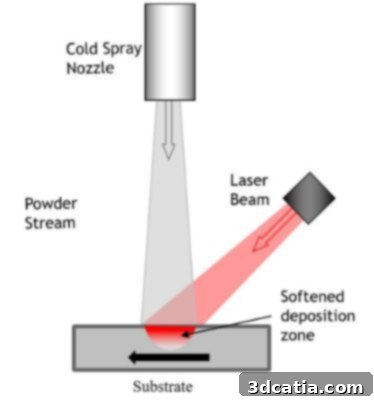
A laser beam precisely softens the deposition zone for the incoming powder stream, enhancing bond strength.
Transformative Advantages Over Other Cold Spray Methods
LACS offers a suite of advantages that address critical limitations of both conventional cold spray and other material deposition techniques, pushing the boundaries of what is possible in manufacturing and repair. It effectively overcomes high-temperature and material compatibility challenges, leading to superior performance and broader applicability. Key benefits include:
- Significant Cost Reduction: By integrating laser heating, LACS largely eliminates the need for expensive helium as a carrier gas. This not only eradicates the high operational costs associated with helium purchases and inefficient recycling systems but also simplifies equipment design and reduces the environmental footprint, making the process more economically viable and sustainable for industrial scale-up.
- Enhanced Adhesion and Deposition Efficiency: The localized laser heating prior to particle impact significantly improves the metallurgical bond between the powder and the substrate. This results in coatings that exhibit superior adhesion and density compared to conventional cold spray. Such robust bonding is particularly critical for high-strength materials like titanium, aluminum alloys, and refractory metals, where integrity and durability are paramount for demanding applications.
- Preservation of Powder Microstructure: Because deposition occurs at a lower overall particle velocity (compared to helium-driven cold spray) and without melting, the intrinsic structure and properties of the deposited powder materials are meticulously maintained. This is a crucial advantage for materials with specialized characteristics, such as nano-structured coatings, amorphous alloys, or rare earth magnets, which can be easily damaged or lose their unique properties under high thermal or kinetic stress.
- Improved Material Compatibility: LACS expands the range of materials that can be successfully deposited. It enables the effective application of harder, more brittle, or traditionally challenging materials that typically exhibit poor adhesion or mechanical degradation in standard cold spray processes. This opens doors for new material combinations and functional coatings.
- Reduced Residual Stresses and Porosity: The precise thermal input from the laser aids in minimizing internal stresses that can accumulate during the deposition process. It also contributes to forming denser coatings with reduced porosity, leading to enhanced mechanical properties, improved corrosion resistance, and prolonged component lifespan.
- Minimal Thermal Impact on Substrate: Unlike traditional thermal spray methods (e.g., plasma spray, HVOF) that expose the substrate to extreme temperatures, LACS ensures that the bulk substrate material experiences minimal thermal loading. This prevents undesirable phase transformations, grain growth, or distortion, making it ideal for heat-sensitive components and precise repairs.
- High-Speed Production Capabilities: LACS boasts impressive deposition rates, with coatings able to be applied at up to 10 kg per hour. This high throughput makes the technology highly attractive for industrial applications requiring rapid processing and efficient production of components or large-area coatings.
- Lower Operating Temperatures and Energy Consumption: The laser assistance allows the entire cold spray process to operate at significantly lower gas temperatures (e.g., 400–700 °C) compared to conventional cold spray (which can reach up to 1200 °C). This reduction in temperature directly translates to substantial power savings and simplifies the overall system design, further lowering operational costs and environmental impact.
- Fine-Tuning of Coating Properties: LACS offers unprecedented control over the final coating characteristics. By enabling the use of customized powder compositions, specific properties such as magnetism, enhanced wear resistance, improved corrosion protection, or solid-state lubrication can be precisely introduced into the deposited layers, tailoring components for highly specialized functions.
- Local Control of Properties and Graded Composition: The ability to precisely control the deposition at a localized level allows for the creation of functionally graded materials. This means that the composition and properties of the material can be varied continuously across a component, reducing stresses at interfaces between dissimilar materials and optimizing performance for specific localized requirements.
LACS for Aerospace: A New Frontier in Performance and Sustainability
The aerospace industry operates under stringent demands for unparalleled precision, exceptional strength-to-weight ratios, and often relatively low-volume, high-value manufacturing. LACS emerges as a highly promising technology for this sector, offering a paradigm shift in both new component fabrication and critical component repair. By enabling the on-demand creation of high-quality coatings and the robust repair of existing parts, LACS holds immense potential for significantly extending the operational lifespans of aircraft. This translates into considerable cost savings for airlines and defense organizations, reduces the need for premature component replacement, and lowers the environmental impact associated with new manufacturing.
LACS offers a truly sustainable, cost-effective, and efficient solution for a sector where traditional repair techniques often fall short. For instance, conventional methods like welding, while common, are frequently unsuitable for high-performance aerospace applications. This is because the intense heat required to fuse new and old materials can induce detrimental changes to the material’s microstructure, creating heat-affected zones that compromise the original strength, fatigue resistance, and overall reliability of the part. In contrast, LACS operates at significantly lower temperatures, preventing such thermal degradation and ensuring that the repaired or coated component maintains its critical performance characteristics, making it an ideal choice for the demanding environment of aerospace.
Diverse and Far-Reaching Applications
The inherent flexibility of LACS, particularly its capability to customize and precisely control material properties during deposition, unlocks a vast spectrum of potential applications across various industries. Professor O’Neill highlighted several compelling examples where this technology can make a transformative impact:
- Producing Lightweight Components: LACS is ideally suited for fabricating lightweight yet high-strength components essential for the next generation of electric vehicles (EVs) and advanced aerospace platforms. Reducing weight directly translates to improved fuel efficiency, extended range, and enhanced performance, driving innovation in both sectors.
- Creating Advanced Hydrogen Storage Systems: As the world transitions to cleaner energy, efficient and safe hydrogen storage becomes paramount. LACS can contribute to developing robust and permeable coatings or structural elements for hydrogen storage tanks, addressing critical challenges in material integrity and gas containment.
- Enhancing Wind Turbine Maintenance and Longevity: Wind turbines operate in harsh environments, often experiencing wear and tear on critical blade and gearbox components. LACS can be employed for on-site repair and protective coating applications, significantly extending the operational life of turbines, reducing downtime, and improving the overall efficiency of renewable energy generation.
- Manufacturing Energy-Efficient Batteries and Fuel Cell Components: The technology can play a crucial role in creating advanced electrodes, protective layers, or interconnects for next-generation batteries and fuel cells. Its ability to deposit challenging materials with precise microstructures can lead to improved performance, greater energy density, and extended cycle life for these vital energy storage and conversion devices.
- Developing Advanced Heat Exchangers and Catalyst Coatings: In industrial settings, LACS can facilitate the creation of high-performance heat exchanger components for improved energy efficiency and specialized catalyst coatings for critical chemical processes, including carbon capture technologies. These applications are directly aligned with global efforts to reduce energy consumption and mitigate climate change.
Professor O’Neill emphasized the broader impact of this innovation, stating, “The potential applications for LACS are limitless, and we are profoundly motivated to deliver a technology that can significantly aid in the transition to net zero. This contribution comes both through a more efficient, low-waste manufacturing technology and by opening new doors for sustainable product development across numerous industries.” This statement underscores the dual benefit of LACS: not only does it offer superior technical performance, but it also aligns with global sustainability goals by promoting resource efficiency and reducing waste.
Future Research: Pushing Towards 3D Printing and Beyond
While LACS has already demonstrated remarkable capabilities in coating and repair, the research team at the University of Cambridge is not resting on its laurels. Their next ambitious goal is to **refine LACS technology** to enable it to **3D print complex shapes**. This evolution would transform LACS from primarily a coating and repair tool into a full-fledged additive manufacturing process, capable of building intricate geometries layer by layer. The researchers are actively investigating several innovative approaches to achieve this groundbreaking capability. These include mounting the part on a sophisticated multi-axis robotic arm, allowing for precise movement in three dimensions relative to the deposition head. Simultaneously, they are working on increasing and refining the control over the direction and focus of the powder stream to produce components with clean, smooth edges and accurate dimensions.
Professor O’Neill acknowledged the current challenge: “Currently, we have relatively limited control over the precise shape of the powder deposition. While this is not an issue for applying uniform coatings, it presents a significant restraint for applications focused on building complete parts or complex structures. Our immediate next goal is to find a robust solution to this limitation, and I am pleased to report that we already have some very promising results from our ongoing experiments.” This continued innovation underscores the dynamic nature of LACS development and its potential to become a cornerstone technology in the additive manufacturing landscape. To delve deeper into the fascinating details of this research, you can click HERE.
What are your thoughts on the revolutionary potential of laser-assisted cold spray for advanced manufacturing and repair? We encourage you to share your insights in a comment below or join the discussion on our LinkedIn or Facebook pages! Don’t forget to sign up for our free weekly Newsletter to receive the latest 3D printing news directly in your inbox. You can also explore all our insightful videos on our YouTube channel. For more news and developments in 3D printing specifically within the aerospace and defense sectors, be sure to check out our dedicated page HERE.
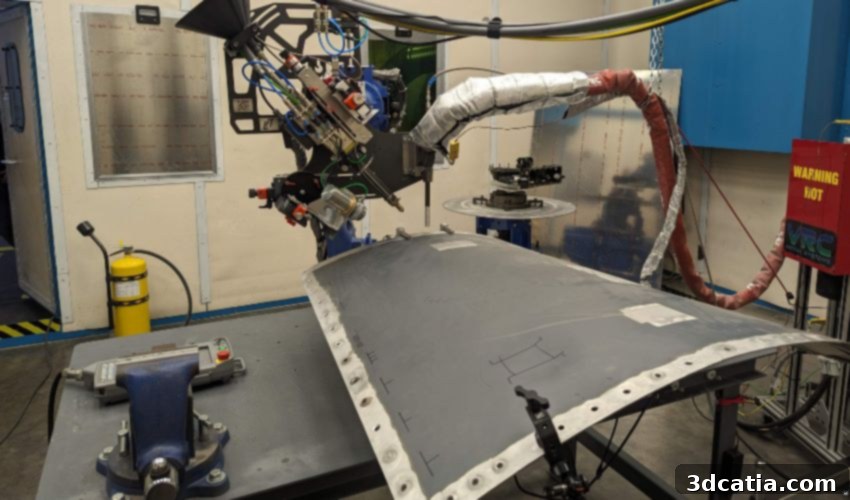
*Cover Photo: An innovative LACS equipment setup skillfully applying a protective coating to repair a critical aircraft wing panel. All Photo Credits: University of Cambridge